

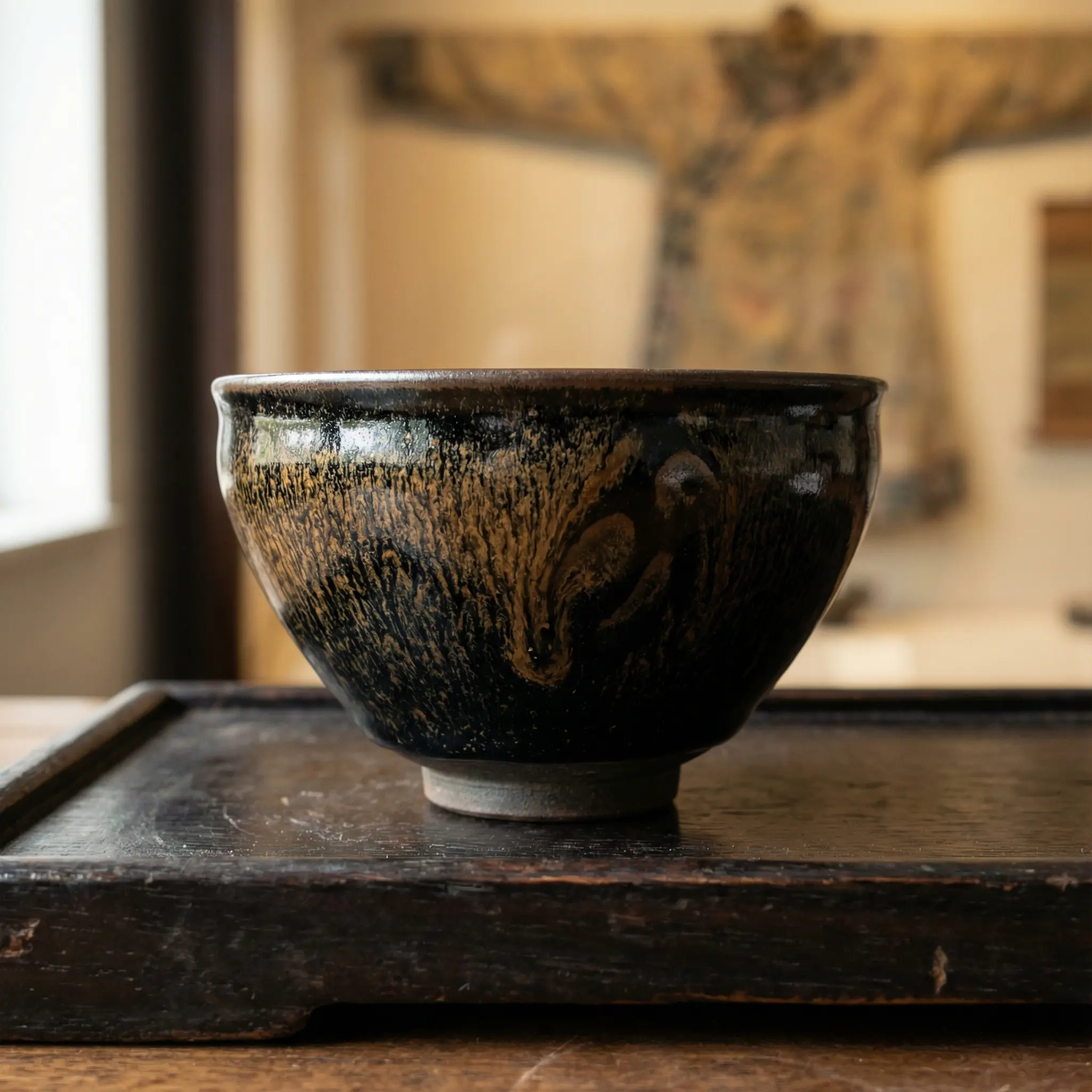
Handmade Jian Zhan tea bowls feel heavier, show natural wall variations, and display unique kiln-transformed patterns—while machine-made pieces are lighter, perfectly uniform, and often lack authentic character. Knowing these differences protects you from overpaying for mass-produced pieces or, worse, drinking from chemically glazed fakes.
At ZenTeaCup, we’ve helped thousands of tea enthusiasts find authentic, artisan-crafted Jian Zhan. This guide shares our expert knowledge so you can confidently identify hand-thrown Jian Zhan from machine-pressed alternatives—whether you’re buying your first piece or expanding a collection.
By the end of this article, you’ll know exactly what to look for, what to avoid, and how to make a purchase decision you won’t regret.
Contents
- What Is the Difference Between Handmade and Machine-Made Jian Zhan?
- How to Identify Handmade Jian Zhan by Touch and Weight
- The Weight Test
- The Wall Thickness Test
- Examining the Base: The Most Reliable Authentication Method
- What Does an Authentic Base Look Like?
- The “Iron Foot” Check
- Glaze Patterns: Natural Kiln Magic vs Artificial Uniformity
- How to Recognize Natural Patterns
- Red Flags: How to Spot Fake or Low-Quality Jian Zhan
- Major Red Flags to Watch For
- The Chemical Glaze Danger
- The Value Question: Is Handmade Worth the Higher Price?
- What You’re Paying For
- The “Yang Zhan” Effect
- Tea Taste Benefits
- Quick Authentication Checklist Before You Buy
- The 5-Point Authentication Test
- Additional Verification Steps
- ❓ Frequently Asked Questions
- Can machine-made Jian Zhan be safe to use?
- Does handmade Jian Zhan really improve tea taste?
- How do I care for my handmade Jian Zhan?
- What’s the difference between Jian Zhan and Tenmoku?
- Where should I buy authentic handmade Jian Zhan?
- Making Your Decision
- 📚 References
What Is the Difference Between Handmade and Machine-Made Jian Zhan?
The fundamental difference lies in the shaping process. Hand-throwing (also called wheel-throwing) is an ancient technique where skilled artisans shape clay on a rotating wheel using their hands. Machine pressing uses molds to stamp out uniform shapes quickly.
This difference affects everything—from the feel in your hands to the patterns on the glaze.
| Characteristic | Handmade (Hand-Thrown) | Machine-Made (Mold-Pressed) |
|---|---|---|
| Technique | Wheel-thrown by artisan | Mold-pressed by machine |
| Origin | Song Dynasty (1,000+ years) | Modern (post-1990s) |
| Clay Density | Superior, tightly compressed | Less dense, looser structure |
| Uniqueness | Every piece is one-of-a-kind | Identical copies possible |
| Production Time | Hours per piece | Minutes per piece |
Hand-throwing requires years of training to master. The artisan must feel the clay’s moisture, judge the wall thickness by touch, and adjust pressure constantly. This skill creates bowls with superior clay density—meaning they hold heat better and are less prone to cracking.
Machine pressing sacrifices this craftsmanship for efficiency. The result? Pieces that look similar but lack the soul and durability of handmade work.
How to Identify Handmade Jian Zhan by Touch and Weight
Hand-thrown Jian Zhan feels noticeably heavier and more substantial than machine-made pieces of the same size. This is the quickest test you can do, and it works every time.
Here’s why: when an artisan throws clay on a wheel, they compress it repeatedly with their hands. This manual compression creates denser clay. Machine pressing doesn’t achieve the same level of density.
The Weight Test
Pick up the bowl. A handmade Jian Zhan should feel:
- Substantial – Like there’s real weight behind it
- Balanced – The weight feels evenly distributed
- Solid – No hollowness or cheap feeling
A machine-made piece typically feels:
- Lighter than expected – Almost surprisingly thin
- Top-heavy or uneven – Weight distribution feels off
- Plasticky – Lacks the heft of real craftsmanship
The Wall Thickness Test
Run your fingers along the inside walls. Handmade bowls have slight natural variations in thickness—not defects, but evidence of human hands at work. Machine-made bowls feel perfectly uniform, almost unnaturally smooth.
Want to feel the difference for yourself? Explore our handmade Jian Zhan collection – each piece is crafted by skilled artisans using traditional wheel-throwing techniques.
Examining the Base: The Most Reliable Authentication Method
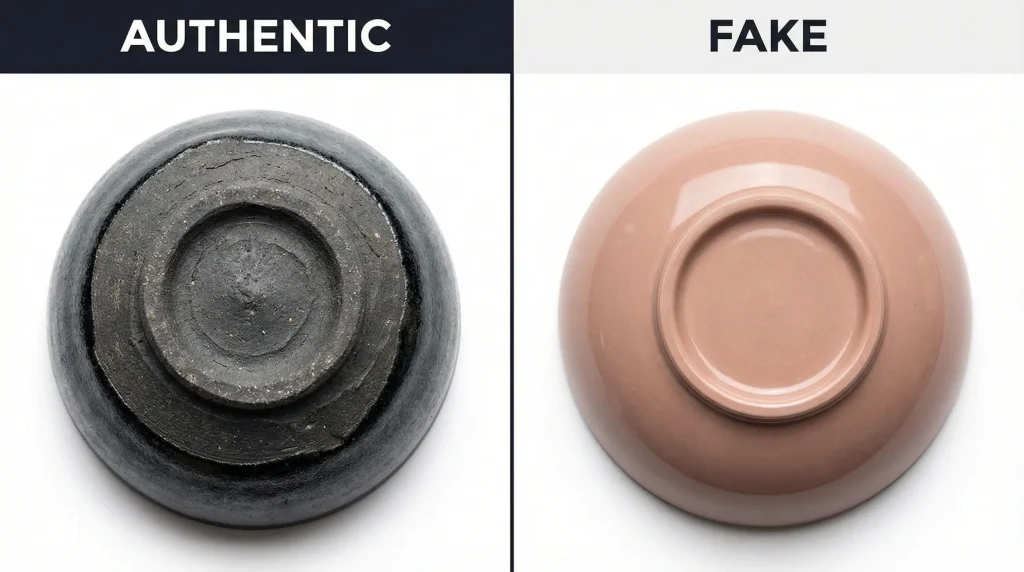
The base of a Jian Zhan is your most reliable authentication point. While glazes can be imitated and weights can be close, the base reveals the truth about the clay and craftsmanship.
Authentic Jian Zhan is made from iron-rich clay sourced from Jianyang, Fujian Province. This clay contains approximately 7% iron oxide on average. When fired at temperatures exceeding 1300°C, this iron transforms the base into a distinctive color.
What Does an Authentic Base Look Like?
| Base Feature | Authentic Handmade | Fake or Machine-Made |
|---|---|---|
| Color | Dark black or gray-black (metallic) | Pale, white, or bright reddish |
| Texture | Rough with visible sand particles | Smooth or artificially roughened |
| Foot Shape | Shallow circle foot with knife marks | Perfect, uniform foot ring |
| Glaze Line | Natural stop with slight irregularity | Perfect, machine-cut edge |
The “Iron Foot” Check
Look for what collectors call the “iron foot”—a dark brown to black coloration at the base where the glaze meets the unglazed clay. This occurs because:
- Iron-rich clay oxidizes during firing
- The high temperature (1300-1350°C) causes iron transformation
- The result is a distinctive metallic appearance
If the base looks pale, white, or bright red, the clay isn’t authentic Jianyang iron clay. The piece may still be usable, but it’s not genuine hand-thrown Jian Zhan.
“Wares with no iron bases are not Jian Zhan. This is the key factor for identifying authentic pieces.”
— Traditional Jianyang Pottery Guild
Glaze Patterns: Natural Kiln Magic vs Artificial Uniformity
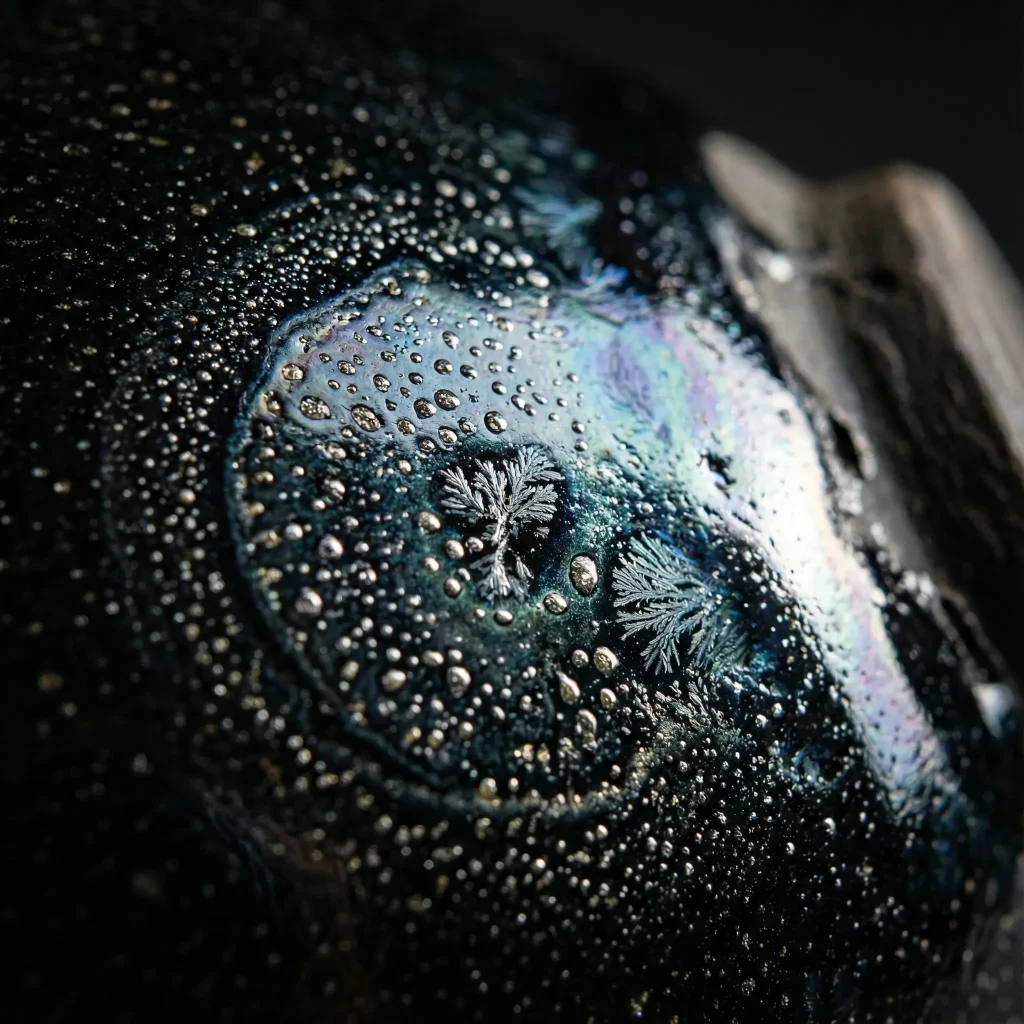
Authentic handmade Jian Zhan displays glaze patterns created by “kiln transformation”—a natural process where iron crystallizes at temperatures above 1300°C into unrepeatable patterns. Machine-made or artificially glazed pieces cannot replicate this depth and complexity.
The most prized glaze patterns include:
- Hare’s Fur (兔毫) – Fine radial streaks resembling rabbit fur
- Oil Spot (油滴) – Metallic droplets scattered across a dark background
- Partridge Feather (鹧鸪斑) – Elliptical spots like bird chest feathers
- Yaobian (曜变) – Rare cosmic patterns with iridescent effects
How to Recognize Natural Patterns
Hold the bowl under a light source and slowly rotate it. Natural kiln-transformed patterns display:
- Depth and layering – Multiple visual layers, not flat printing
- Angle-dependent shimmer – Colors shift as you move the bowl
- Unique distribution – No two pieces look exactly alike
- Natural flow lines – Glaze moves toward the base, sometimes forming “glaze tears”
Artificial or machine-applied patterns show:
- Flat, printed appearance – No visual depth
- Identical repetition – Same pattern on multiple pieces
- Uniform distribution – Too perfect to be natural
- No shimmer or iridescence – Dull under angled light
Each ZenTeaCup Oil Spot Jian Zhan is fired individually, creating one-of-a-kind patterns that evolve with use.
Red Flags: How to Spot Fake or Low-Quality Jian Zhan
Protecting yourself from fake Jian Zhan starts with knowing the warning signs. Some imitations use harmful chemical glazes that can leach into your tea. Others are simply mass-produced pieces sold at handmade prices.
Major Red Flags to Watch For
| Red Flag | What It Indicates | Risk Level |
|---|---|---|
| Non-iron base (pale, white, bright red) | Not authentic Jianyang clay | High – may be fake |
| Extremely low price | Mass-produced or chemical glazed | High – quality concerns |
| Perfect uniform pattern | Printed or sprayed, not kiln-fired | Medium – not authentic craft |
| Lightweight feel | Machine-pressed, low-density clay | Medium – overpriced for quality |
| No maker information | Unknown origin, no accountability | Medium – can’t verify claims |
The Chemical Glaze Danger
Authentic Jian Zhan uses only natural mineral glazes—iron ore mixed with plant ash. Some cheap imitations add chemical compounds to create flashy colors. These chemicals can:
- Leach into hot liquids over time
- Fade or discolor after months of use
- Lack the heat-retention properties of authentic pieces
Bottom line: If the price seems too good to be true, it probably is. A genuine handmade Jian Zhan represents hours of skilled labor, expensive materials, and a low firing success rate. Extremely cheap prices suggest corners were cut—possibly dangerous ones.
The Value Question: Is Handmade Worth the Higher Price?
Handmade Jian Zhan costs more because the production process is brutal. Each piece undergoes 13 traditional steps, requires firing at 1300°C+, and has a very low success rate. Many pieces crack, warp, or develop defects during firing and must be destroyed.
What You’re Paying For
| Factor | Impact on Price |
|---|---|
| Artisan Skill | Years of training required for wheel-throwing |
| Material Quality | Authentic Jianyang iron clay is limited |
| Firing Success Rate | Only a fraction survive the kiln |
| Uniqueness | Each piece is genuinely one-of-a-kind |
| Longevity | Handmade pieces last generations |
The “Yang Zhan” Effect
Here’s something special about handmade Jian Zhan: it gets more beautiful with use. In Chinese tea culture, this is called “yang zhan” (养盏)—nurturing the bowl.
As you drink tea from a handmade bowl, the natural polyphenols and minerals interact with the glaze surface. Over months and years, the glaze develops a richer, more lustrous patina that cannot be replicated by machines. It becomes uniquely yours.
Machine-made pieces don’t develop this patina as beautifully because the clay density and glaze composition are different.
Tea Taste Benefits
The high iron content in authentic Jian Zhan does more than look beautiful—it improves your tea:
- Increased alkalinity – Makes tea smoother and sweeter
- Better heat retention – Keeps tea warm longer due to thick, dense walls
- Enhanced aroma – The iron interacts with tea compounds to enhance fragrance
“Tea brewed in Jian Zhan still tastes fresh even when left for hours, while tea in porcelain becomes bitter and undrinkable.”
— Teavivre Tea Research
Quick Authentication Checklist Before You Buy

Before purchasing any Jian Zhan, run through this five-point checklist. You don’t need special equipment—just your hands, eyes, and these guidelines.
The 5-Point Authentication Test
- Weight Test
Pick it up. Does it feel heavy and substantial for its size?
Pass: Heavy, solid feel | Fail: Light, thin, plasticky - Base Inspection
Look at the bottom. Is the exposed clay dark black or gray-black?
Pass: Dark metallic color | Fail: Pale, white, or bright red - Wall Variation Test
Run fingers along the inside. Are there slight, natural thickness variations?
Pass: Subtle variations | Fail: Perfectly uniform everywhere - Glaze Pattern Check
Hold under light and rotate. Does the pattern shimmer and show depth?
Pass: Multi-layered, angle-dependent | Fail: Flat, printed look - Price Reasonability
Is the price consistent with handmade quality? (Entry-level starts around $30-50)
Pass: Fair market price | Fail: Suspiciously cheap
Additional Verification Steps
- Ask for maker information – Reputable sellers provide artisan details
- Request certificates – Quality pieces often come with authenticity documentation
- Check return policies – Legitimate sellers allow returns for authenticity concerns
Shop with Confidence at ZenTeaCup
Every piece in our collection comes with artisan information, authenticity verification, and a satisfaction guarantee.
❓ Frequently Asked Questions
Can machine-made Jian Zhan be safe to use?
Quality machine-made pieces using authentic clay and natural glazes can be safe. The risk comes from cheap imitations that use chemical glazes. Always verify materials before purchase, and buy from reputable sources that disclose their clay and glaze composition.
Does handmade Jian Zhan really improve tea taste?
Yes—the iron-rich clay releases divalent iron ions that increase water alkalinity. This makes tea smoother, sweeter, and more aromatic. The thick walls also retain heat significantly longer than thin porcelain cups, keeping your tea at optimal drinking temperature.
How do I care for my handmade Jian Zhan?
Caring for Jian Zhan is simple:
- Rinse with warm water after each use—never use detergent
- Allow to air dry completely before storing
- Use regularly to develop the beautiful patina (yang zhan)
- Don’t leave tea sitting for more than 8 hours
For detailed instructions, see our Complete Jian Zhan Care Guide.
What’s the difference between Jian Zhan and Tenmoku?
Jian Zhan refers specifically to pieces made with authentic Jianyang iron-rich clay using traditional methods. Tenmoku (天目) is the Japanese term for the style, often made with different clays and firing techniques. Both can be beautiful, but only pieces using Jianyang materials are true Jian Zhan.
Where should I buy authentic handmade Jian Zhan?
Buy from sellers who provide:
- Maker/artisan information
- Clear photos of the base
- Authenticity certificates
- Return policies for authenticity concerns
Avoid extremely cheap options from unknown sources. Explore ZenTeaCup’s verified collection for authenticated, artisan-crafted pieces with full provenance.
Making Your Decision
Now you know how to distinguish handmade Jian Zhan from machine-made alternatives. The weight test, base inspection, wall variations, and glaze patterns all tell a story—of authentic craftsmanship or mass production.
Choosing handmade isn’t just about avoiding fakes. It’s about connecting with 1,000 years of ceramic tradition, owning a piece that improves with age, and enhancing every tea session with the subtle benefits of iron-rich Jianyang clay.
Whether you’re a first-time buyer or a seasoned collector, these authentication skills will serve you well. Trust your hands, inspect the base, and remember: if the price seems too good to be true, it probably is.
Ready to Find Your Perfect Jian Zhan?
Every ZenTeaCup piece is handcrafted using traditional wheel-throwing techniques, authentic Jianyang clay, and natural mineral glazes.
📚 References
- Jian Ware History and Production: Comprehensive overview of Song Dynasty pottery techniques and the cultural significance of Jian Zhan in tea culture. Wikipedia: Jian Ware
- Tenmoku Glaze Chemistry: Scientific explanation of iron crystallization and phase separation in high-temperature ceramic glazes. Wikipedia: Tenmoku
- Microstructure Research: Academic study on the correlation between glaze patterns and firing conditions in authentic Jian ware. Nature: npj Heritage Science
- Traditional Craft Process: Detailed breakdown of the 13-step production process for authentic Jianzhan teacups. TeaClink: Traditional Craft Process
- Glaze Pattern Classification: Expert guide to the six classic glaze patterns and their characteristics. China Tea Spirit: Six Classic Glaze Patterns


