

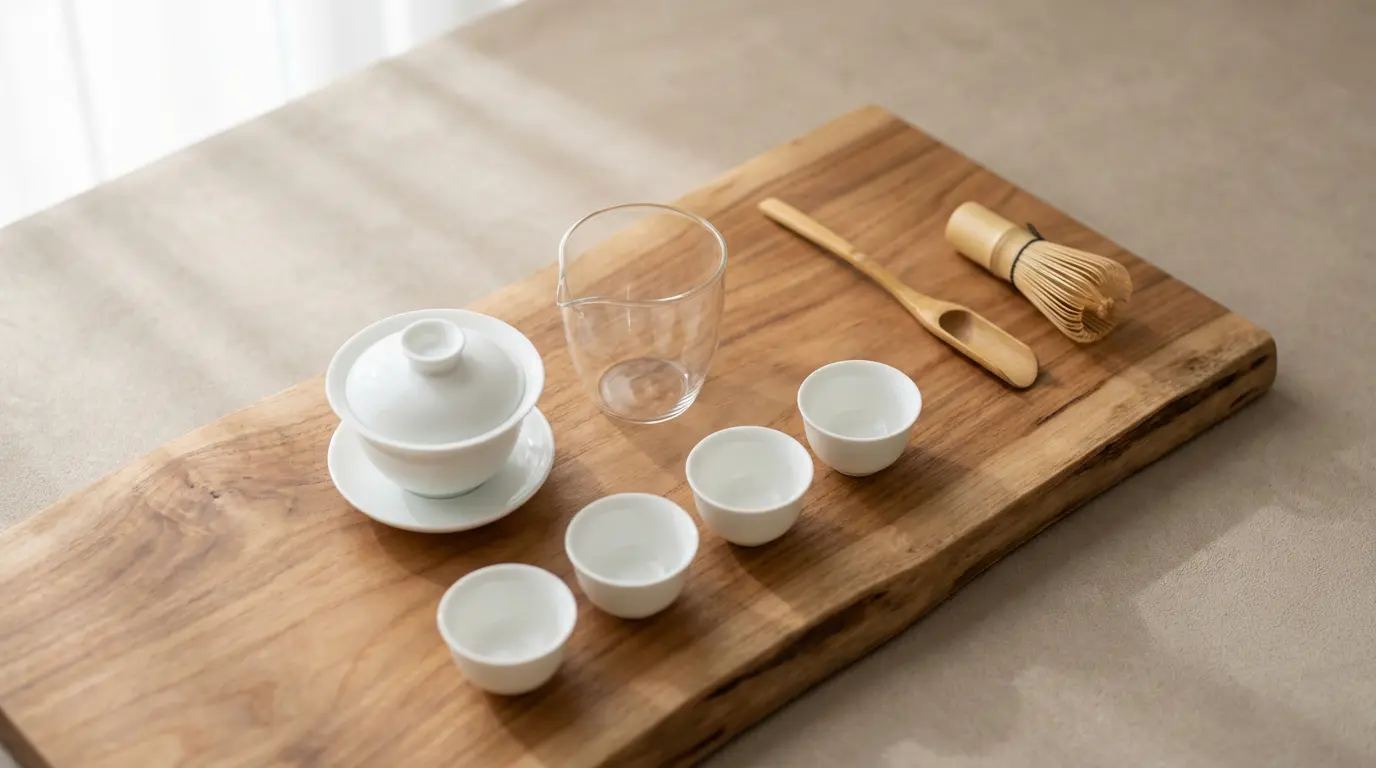
Gongfu Cha is a traditional Chinese brewing method that transforms oolong tea into a journey of flavor evolution. Using 100-150ml vessels with a 1:15 tea-to-water ratio, this technique produces 5-10 concentrated infusions, each revealing different layers of aroma and taste. At ZenTeaCup, we’ve helped thousands of tea lovers master this skill-based approach to unlock the full potential of their oolong tea.
Contents
- What is Gongfu Cha? The Art of Brewing Tea With Skill
- Essential Equipment: What You Need to Start Brewing Gongfu Style
- The Brewing Vessel: Gaiwan or Teapot
- Supporting Tools
- Choosing Your Oolong: Light vs Dark for Gongfu Brewing
- Light Oolongs (10-45% Oxidation)
- Dark Oolongs (50-80% Oxidation)
- Physical Form Matters
- The Perfect Tea-to-Water Ratio: Measuring for Success
- Measuring by Weight (Most Accurate)
- Measuring Visually (Without a Scale)
- Water Temperature Guide: Matching Heat to Oxidation
- Why Temperature Matters
- Water Quality
- Temperature Control Methods
- Step-by-Step Gongfu Cha Brewing Process
- Step 1: Prepare Your Workspace
- Step 2: Preheat Teaware (30-60 Seconds)
- Step 3: Add Tea Leaves
- Step 4: Rinse/Awaken the Leaves (5-10 Seconds)
- Step 5: First Infusion (30-50 Seconds)
- Step 6: Pour Into Pitcher and Serve
- Step 7: Subsequent Infusions (5-10+ Steeps)
- Understanding Flavor Evolution Across Multiple Infusions
- The Science Behind Flavor Progression
- Typical Journey for Light Oolong
- Typical Journey for Dark Oolong
- The Cha Qi Experience
- Common Mistakes and How to Avoid Them
- Mistake #1: Incomplete Pour-Off
- Mistake #2: Wrong Water Temperature
- Mistake #3: Skipping Preheating
- Mistake #4: Using Too Much Tea
- Mistake #5: Identical Timing for All Steeps
- Mistake #6: Poor Water Quality
- Mistake #7: Letting Tea Sit Between Infusions
- ❓ Frequently Asked Questions
- How many times can I steep the same oolong tea leaves?
- Do I really need to rinse oolong tea before brewing?
- Can I use my Yixing teapot for different types of oolong?
- Why is my oolong tea bitter when brewed Gongfu style?
- How long does a typical Gongfu tea session last?
- Can I brew oolong tea Gongfu style without special equipment?
- What’s the difference between Gongfu and Western-style brewing?
- Should I adjust brewing for aged oolong tea?
- ❓ What is the best way to store tea?
- ❓ How much caffeine is in a typical cup of tea?
- ❓ Can I reuse tea leaves for multiple infusions?
- 📚 References
- Start Your Gongfu Journey Today
What is Gongfu Cha? The Art of Brewing Tea With Skill
Gongfu Cha translates to “making tea with skill” and originated in the Chaozhou region of Guangdong Province, China during the 18th century. This brewing method uses small vessels and concentrated leaves to create multiple short infusions. Each steep reveals different flavor compounds as they release at different extraction stages.
The method works because tea leaves contain various compounds. Volatile aromatics release first. Then polyphenols provide body. Finally, amino acids deliver sweetness. By controlling time and temperature precisely, you taste each layer separately.
Think of it like peeling an onion. Western brewing gives you all layers at once in one 3-5 minute steep. Gongfu brewing reveals layers gradually across 8-12 short infusions. You experience the tea’s complete personality, not just a single snapshot.
The beauty of Gongfu Cha lies in its ability to transform tea drinking from consumption into meditation. Each infusion becomes a moment of presence.
Key benefits include less caffeine per cup (compounds extract gradually), full flavor appreciation (nothing gets masked), and a meditative experience that slows down your busy day.
Essential Equipment: What You Need to Start Brewing Gongfu Style
You can start Gongfu brewing with just four items: a small brewing vessel (100-150ml capacity), a fairness pitcher, small tea cups, and a way to catch excess water. The total investment starts at just $30-50.
The Brewing Vessel: Gaiwan or Teapot
Your main choice is between two vessels. A Gaiwan is a lidded bowl made from porcelain or ceramic. It offers neutral flavor presentation and lets you watch leaves unfurl. Price range: $10-30 for quality pieces.
A Yixing teapot is crafted from Zisha purple clay from China’s Yixing region. The porous clay enhances tea over time through flavor absorption. These run $40-200+ depending on craftsmanship.
| Feature | Gaiwan | Yixing Teapot |
|---|---|---|
| Material | Porcelain/Ceramic | Zisha Purple Clay |
| Flavor Impact | Neutral (shows true taste) | Enhances/smooths flavor |
| Versatility | All tea types | One tea type only |
| Maintenance | Easy, soap allowed | Water only, no soap |
| Best For | Beginners, variety | Dedicated enthusiasts |
| Price Range | $10-30 | $40-200+ |
For beginners, we recommend starting with a Gaiwan. It works for all teas, cleans easily, and shows you exactly what each oolong tastes like without modification.
Supporting Tools
The Chahai (fairness pitcher) ensures every cup has identical strength. Some teapots pour slowly. The pitcher equalizes brewing between cups. A 150ml pitcher pairs perfectly with a 100-150ml Gaiwan.
Tea cups should hold 30-50ml. Small size concentrates aroma and encourages sipping rather than gulping. White porcelain cups display tea color accurately and diffuse heat well.
A tea tray or tea boat catches excess water from rinsing and pouring. Simple stainless steel trays cost $15-25. Advanced versions with drain reservoirs run $50-150.
Optional additions that improve precision: a kitchen scale (0.1g accuracy, $15-25), temperature-controlled kettle ($40-80), and a timer (your phone works fine).
Choosing Your Oolong: Light vs Dark for Gongfu Brewing
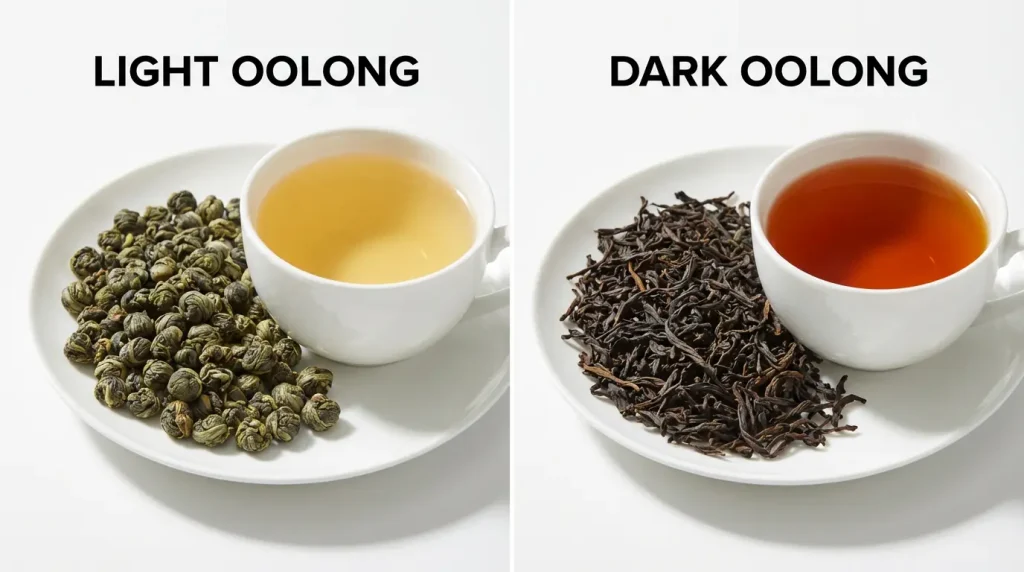
All oolong teas benefit from Gongfu brewing, but understanding oxidation levels helps you adjust parameters. Oolong sits between green tea (0% oxidation) and black tea (100% oxidation), ranging from 10-80% oxidation.
Light Oolongs (10-45% Oxidation)
Light oolongs deliver floral, fruity, and delicate notes. Examples include Taiwanese High Mountain oolong, Tie Guan Yin, Ali Shan, and Baozhong. These teas need 185-195°F water and careful timing to prevent bitterness.
The flavor journey starts with bright florals in early steeps. Mid-session brings creamy, buttery notes. Late infusions finish clean and sweet. Quality light oolongs produce 8-12 infusions.
Dark Oolongs (50-80% Oxidation)
Dark oolongs offer roasted, mineral, and complex fruit flavors. Famous examples are Da Hong Pao (Big Red Robe), traditional roast Dong Ding, and Dan Cong (Phoenix oolong). These handle 200-212°F water and longer steeping without turning bitter.
Expect rich roasted notes upfront. Dried fruit emerges mid-session. Mineral earthiness develops in late steeps. Premium dark oolongs can produce 10-15 infusions.
| Oolong Type | Oxidation | Water Temp | Flavor Profile | Examples |
|---|---|---|---|---|
| Light/Green | 10-45% | 185-195°F (85-90°C) | Floral, fruity, delicate | High Mountain, Tie Guan Yin |
| Medium | 45-65% | 195-205°F (90-95°C) | Balanced, creamy | Medium roast Dong Ding |
| Dark/Roasted | 65-80% | 200-212°F (95-100°C) | Roasted, mineral, fruity | Da Hong Pao, Dan Cong |
Physical Form Matters
Tightly rolled oolongs (ball-shaped) need 40-50 seconds for the first steep to unfurl properly. Strip or long-leaf oolongs open faster, starting with 30-40 seconds. Broken leaves extract quickly and should use 20% less tea to avoid bitterness.
The Perfect Tea-to-Water Ratio: Measuring for Success
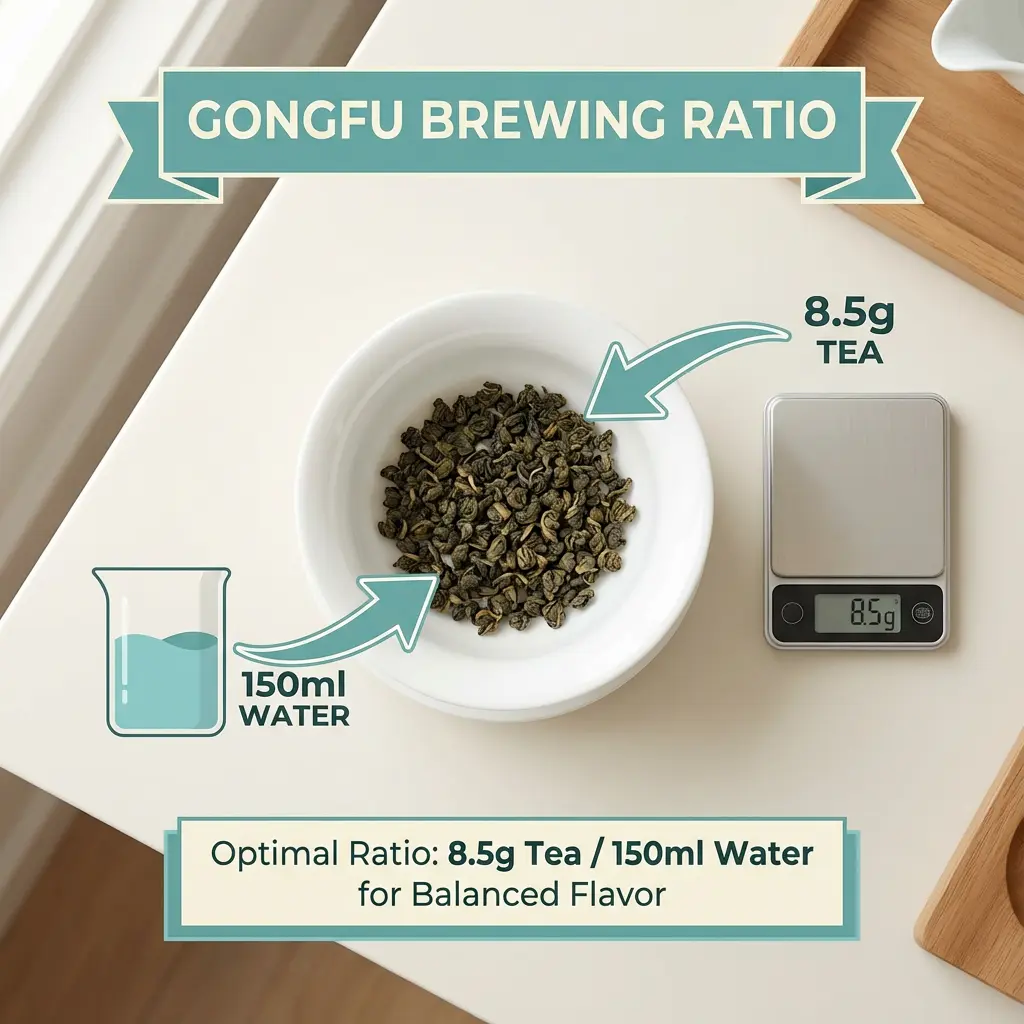
Use a 1:15 tea-to-water ratio for unroasted oolongs. This means 10 grams of tea per 150ml vessel, or 7 grams per 100ml. For roasted oolongs, reduce slightly to 1:20 ratio (8 grams per 150ml) since roasting concentrates flavors.
Measuring by Weight (Most Accurate)
A small kitchen scale with 0.1g precision ensures consistency. For a 150ml Gaiwan:
- Unroasted light oolong: 10g (7-10g range)
- Roasted dark oolong: 8g (6-8g range)
- Medium oolong: 9g (7-9g range)
For a 100ml vessel, use 5-7 grams depending on tea type.
Measuring Visually (Without a Scale)
Rolled oolongs: Cover the bottom of your Gaiwan so you can barely see through to the porcelain underneath. This typically equals 7-10 grams for a 150ml vessel.
Strip/long-leaf oolongs: Fill 1/6 to 1/4 of vessel capacity with dry leaves. They’re less dense than rolled oolongs.
Rule of thumb: 1 gram per 20ml of water. A 150ml Gaiwan needs roughly 7-8 grams. A 100ml teapot needs 5 grams.
Bottom line: More tea creates stronger flavor and more infusions possible. Less tea gives gentler flavor and fewer steeps. Start conservative. Increase in subsequent sessions if too weak.
Water Temperature Guide: Matching Heat to Oxidation
Water temperature controls extraction speed. Too hot destroys delicate aromatics and extracts bitter tannins. Too cold under-extracts, leaving flavor locked in the leaves. Match temperature to your oolong’s oxidation level.
| Oxidation Level | Temperature (°F) | Temperature (°C) | Oolong Examples |
|---|---|---|---|
| Light (10-45%) | 185-195°F | 85-90°C | High Mountain, Tie Guan Yin, Baozhong |
| Medium (45-65%) | 195-205°F | 90-95°C | Moderate Dong Ding, some Dan Cong |
| Dark (65-80%) | 200-212°F | 95-100°C | Da Hong Pao, heavy roast, aged oolongs |
Why Temperature Matters
Different flavor compounds extract at different temperatures. Aromatic terpenes (floral notes) are delicate and destroyed above 195°F. Polyphenols (body and structure) extract well at 185-205°F. Tannins (bitter astringency) release heavily above 200°F in light oolongs.
Research from the Chinese Academy of Agricultural Sciences shows water that’s 5°C too hot can double bitterness in light oolongs. Water 10°C too cool reduces flavor extraction by 40%.
Water Quality
Spring water with moderate mineralization brews the best tea. Minerals enhance mouthfeel and sweetness. Filtered tap water works well if your tap water tastes clean.
Avoid: Hard water (excess minerals muddy flavor), distilled water (too “thin” and flat-tasting), and tap water with strong chlorine smell.
Temperature Control Methods
Electric kettle with temperature control provides perfect precision ($40-80 investment). Set your desired temperature and forget it.
Boil and wait method: Bring water to full boil (212°F), then wait 1-2 minutes to reach approximately 195°F. Add 30 seconds wait time per 5°F drop desired.
Chinese bubble observation: “Crab-eye water” shows small rising bubbles (around 185-190°F). “Fish-eye water” shows large rolling bubbles (around 200-205°F).
Step-by-Step Gongfu Cha Brewing Process
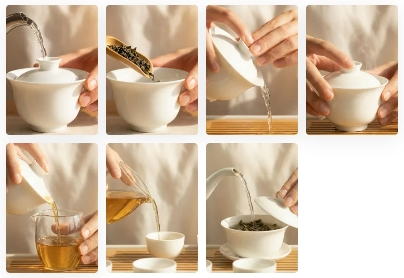
Gongfu brewing follows seven systematic steps: prepare workspace, preheat teaware, add tea, rinse leaves, first infusion, pour and serve, then repeat for 5-10 progressive infusions. Each step takes 30-60 seconds, making total session time 30-45 minutes.
Step 1: Prepare Your Workspace
Arrange all tools within arm’s reach. Place your Gaiwan or teapot on the tea tray. Position the fairness pitcher nearby. Line up tea cups for pouring. Place a waste bowl for discarded water. Boil water to your target temperature.
Create a calm environment. Gongfu Cha is as much meditation as brewing. Turn off distractions. Take three deep breaths. You’re ready to begin.
Step 2: Preheat Teaware (30-60 Seconds)
Preheating stabilizes temperature and prevents heat shock. Pour hot water into your Gaiwan. Swirl gently for 10 seconds. Pour warming water into the pitcher, then into cups. Discard all warming water into waste bowl.
This step raises vessel temperature by 15-20°C. Without preheating, cold porcelain drops water temperature by 10-15°C instantly, under-extracting your first infusion.
Step 3: Add Tea Leaves
Measure 7-10 grams for a 150ml vessel. Place leaves gently in the warmed Gaiwan. Smell the dry leaves. This first aroma appreciation reveals processing quality and storage condition.
Step 4: Rinse/Awaken the Leaves (5-10 Seconds)
The rinse rehydrates compressed leaves and removes any dust. Pour water at brewing temperature until leaves are just covered. Close lid. Gently swirl 2-3 times. Immediately pour off into waste bowl. Don’t drink this rinse.
Lift the lid and smell the warmed wet leaves. This second aroma appreciation shows the tea’s true character. For very clean, modern oolongs, rinsing is optional. But for rolled or compressed teas, it’s essential for proper unfurling.
Step 5: First Infusion (30-50 Seconds)
The first infusion sets the tone for your entire session. Fill vessel completely with water at proper temperature. Close lid immediately to retain heat. Time your steep:
- Rolled oolong: 40-50 seconds (needs time to open)
- Strip/open leaf: 30-40 seconds (opens faster)
- Light oolong: Shorter end of range
- Dark oolong: Longer end of range
Pro tip: Use the “three breaths” technique. Steep as long as you slowly inhale and exhale three times. This equals roughly 30-45 seconds and keeps you present.
Step 6: Pour Into Pitcher and Serve
Pour every drop into the fairness pitcher. Leave no water in vessel. Tilt completely to drain fully. Leaving water causes over-extraction, ruining subsequent infusions.
Pour from pitcher into cups using circular motion for even distribution. Wipe cup bottoms with tea towel before serving. Immediately refill vessel with hot water for next infusion.
Before drinking, smell the aroma from the lid and empty vessel. Observe the liquor color. Taste mindfully, letting tea coat your entire mouth.
Step 7: Subsequent Infusions (5-10+ Steeps)
Standard timing progression:
- 1st steep: 40 seconds
- 2nd steep: 30 seconds
- 3rd steep: 40 seconds
- 4th steep: 50 seconds
- 5th steep: 60 seconds
- 6th steep: 75 seconds
- 7th+ steeps: 90-120 seconds
The pattern: Add 10-15 seconds to each subsequent steep. After the 6th infusion, jump to 1-2 minute steeps. Continue until tea loses character, typically 8-12 infusions for quality oolong.
Alternative flash steep approach: Keep first 5-6 infusions at 10-20 seconds each. This prevents over-extraction and works well for very concentrated tea or beginners still learning timing.
Understanding Flavor Evolution Across Multiple Infusions
Oolong tea reveals different layers with each Gongfu infusion. Early steeps (1-2) showcase bright aromatics and floral notes. Mid-session steeps (3-6) deliver full-bodied complexity and peak sweetness. Late infusions (7+) offer gentle mineral notes and lingering sweetness.
The Science Behind Flavor Progression
Tea leaves contain dozens of flavor compounds that extract at different rates. Volatile aromatics (molecular weight 100-200) release in the first 30 seconds. Polyphenols (catechins and tannins) extract between 30-90 seconds. Amino acids like L-theanine release slowly over multiple infusions.
Research from Nanjing Agricultural University shows oolong’s complexity increases until the 4th-6th steep, then gradually simplifies. This creates a natural story arc in each session.
Typical Journey for Light Oolong
Infusions 1-2 (Awakening): Bright, attention-grabbing florals. Light body. Fresh and clean. Like smelling flowers in a morning garden.
Infusions 3-6 (Peak Experience): Full-bodied and complex. Creamy, buttery mouthfeel develops. Sweetness intensifies. This is what you’re brewing for. Floral notes deepen into orchid or jasmine. Fruity undertones emerge. Body becomes substantial.
Infusions 7+ (Denouement): Subtle, mineral, gentle. Less aromatic but deeply satisfying. Clean sweetness lingers on tongue for minutes after swallowing. Calming, meditative quality. Some describe it as “returning to simplicity.”
Typical Journey for Dark Oolong
Infusions 1-2: Rich roasted notes. Toasted grain, nuts, caramel. Bold and assertive.
Infusions 3-6: Roast mellows. Dried fruit emerges—raisins, dates, plums. Complexity builds. Mineral notes appear. Mouthfeel becomes thick and coating.
Infusions 7+: Earthy, grounding. Sweet minerality like river stones. Woody undertones. Long, warming finish.
The Cha Qi Experience
Cha Qi translates to “tea energy”—physical and mental sensations from quality tea. Manifestations include gentle warming sensation, mental clarity, relaxed alertness, and subtle tingling.
Peak Cha Qi appears around the 4th-6th infusion in high-quality, high-mountain, or aged oolongs. It’s strongest in teas grown above 1,000 meters elevation or aged for 5+ years. At these pieces, our High Mountain Oolong Collection is specifically curated for tea with exceptional Cha Qi.
Stop brewing when flavor becomes bland, astringency increases without balance, or you simply feel complete. Quality oolong typically provides 8-12 flavorful infusions. Exceptional teas can reach 15-20 steeps.
Common Mistakes and How to Avoid Them
The three most critical Gongfu mistakes are incomplete pour-off (leaving water in vessel), wrong temperature for your oolong type, and skipping teaware preheating. Each mistake compounds across multiple infusions, degrading your entire session.
Mistake #1: Incomplete Pour-Off
Problem: Leaving even 5-10ml water in vessel between steeps. Result: Tea continues extracting, becoming over-steeped and bitter. Next infusion tastes harsh.
Fix: Tilt vessel completely vertical. Pour every single drop. Shake gently to release final drops clinging to leaves.
Mistake #2: Wrong Water Temperature
Problem: Using boiling water (212°F) for delicate light oolong. Result: Destroyed aromatics, excessive bitterness, astringency.
Fix: Always match temperature to oxidation level. Light oolongs need 185-195°F. Dark oolongs handle 200-212°F. Invest in a temperature-controlled kettle or use the boil-and-wait method.
Mistake #3: Skipping Preheating
Problem: Cold Gaiwan drops water temperature by 10-15°C instantly. Result: Under-extracted first infusion. Uneven brewing throughout session.
Fix: Always pour hot water through all vessels before adding tea. Takes only 30 extra seconds but dramatically improves consistency.
Mistake #4: Using Too Much Tea
Problem: Eyeballing amounts without learning ratios. Using 15g in a 150ml vessel. Result: Overly strong, bitter from first steep.
Fix: Use 1:15 ratio as baseline. For 150ml vessel, that’s 10g maximum. Use a scale until you develop accurate visual judgment.
Mistake #5: Identical Timing for All Steeps
Problem: Steeping each infusion for exactly 30 seconds. Result: Early steeps over-extracted, later steeps under-extracted and weak.
Fix: Use progressive timing. Add 10-15 seconds each steep. Leaves gradually exhaust and need more time to release remaining compounds.
Mistake #6: Poor Water Quality
Problem: Using hard tap water with high calcium and magnesium. Result: Muddy, unclear flavor. Tea tastes “flat.”
Fix: Use spring water or quality filtered water. Test: if your water tastes good plain, it’ll brew good tea.
Mistake #7: Letting Tea Sit Between Infusions
Problem: Waiting 5-10 minutes between steeps while chatting. Result: Leaves cool and oxidize. Next infusion tastes dull and lifeless.
Fix: Refill immediately after pouring. Maintain session momentum. Gongfu brewing is continuous, not interrupted.
In summary: Master these fundamentals first. Pour completely, match temperature to tea type, preheat vessels, measure accurately, and use progressive timing. These five practices account for 90% of brewing success.
❓ Frequently Asked Questions
How many times can I steep the same oolong tea leaves?
Quality oolong produces 6-10 flavorful infusions using Gongfu method. Exceptional high-mountain or aged oolongs can reach 12-15 steeps. The number depends on leaf quality, intactness, and brewing parameters. Broken leaves exhaust faster, producing only 4-6 infusions.
Do I really need to rinse oolong tea before brewing?
Rinsing serves two purposes: awakening compressed leaves to help them unfurl faster, and removing any processing dust. While optional for very clean modern oolongs, it’s recommended for rolled ball-shaped teas and traditionally processed leaves. The rinse improves first infusion quality by 30-40% according to tea research institutes.
Can I use my Yixing teapot for different types of oolong?
No. Yixing’s porous Zisha clay absorbs tea oils and flavors. Using it for different teas creates muddy, confused taste profiles. Dedicate each Yixing pot to one specific tea—one pot for Tie Guan Yin, another for Da Hong Pao. For trying multiple oolongs, use a neutral Gaiwan instead.
Why is my oolong tea bitter when brewed Gongfu style?
Bitterness comes from three causes: water temperature too hot for light oolong (use 185-195°F, not boiling), steeping too long (start with 30-40 seconds, add time gradually), or incomplete pour-off (leaving water causes over-extraction). Also check if using too much tea—try reducing by 20%.
How long does a typical Gongfu tea session last?
A complete session lasts 30-60 minutes for 8-10 infusions. This includes preheating, rinsing, brewing, and mindful tasting. It’s designed as meditative practice, not rushed consumption. For shorter sessions, do 4-5 concentrated infusions in 15-20 minutes.
Can I brew oolong tea Gongfu style without special equipment?
Yes! Minimum setup: any small mug (100-150ml), a larger cup or pitcher to decant into, and a bowl for waste water. Even without proper Gaiwan, you can brew successfully. However, dedicated tools enhance experience and make brewing easier. Start simple, upgrade gradually as you develop your practice.
What’s the difference between Gongfu and Western-style brewing?
Gongfu uses high ratios (1:15) in small vessels (100-150ml) with short steeps (30-60 seconds) repeated 6-10+ times. Western style uses low ratios (1g per 200-250ml) in large pots with one 3-5 minute steep. Gongfu reveals flavor evolution across multiple infusions. Western provides convenient single brewing. Both are valid—choose based on your time and intention.
Should I adjust brewing for aged oolong tea?
Aged oolongs benefit from slightly longer times—add 10-20 seconds to standard timing. They handle near-boiling water (205-212°F) well. Quality aged oolongs produce 10-15+ infusions. Some benefit from double rinse (two quick 10-second rinses) to awaken deeply stored flavors developed during aging.
❓ What is the best way to store tea?
Store tea in an airtight container away from light, heat, and moisture. A cool, dark cupboard works well. Avoid storing near spices or strong-smelling foods.
❓ How much caffeine is in a typical cup of tea?
It varies by type: green tea has about 20-45 mg per cup, oolong 30-50 mg, black tea 40-70 mg, and herbal tea is typically caffeine-free.
❓ Can I reuse tea leaves for multiple infusions?
Yes, especially with whole-leaf teas. Oolong and pu-erh can be steeped 5-10 times. Green tea typically handles 2-3 infusions.
📚 References
- Scientific Research on Oolong Brewing: Comprehensive study on optimal brewing conditions for Tieguanyin oolong tea, conducted by the Tea Research Institute of Chinese Academy of Agricultural Sciences. Nature – npj Science of Food
- Gongfu Tea Cultural Heritage: Historical documentation and cultural context of Gongfu Cha from its origins in Chaozhou to modern practice. Wikipedia – Gongfu Tea
- Chinese Tea Culture Context: Comprehensive overview of Chinese tea culture including the development and significance of Gongfu brewing methods. Wikipedia – Chinese Tea Culture
- Water Quality Impact on Tea: Research on how different water types affect tea flavor, conducted by Chinese agricultural universities. ScienceDirect – Food Chemistry
- Oolong Tea Multiple Infusions Study: Scientific analysis of chemical composition and sensory quality across multiple brewing cycles of Da Hong Pao oolong. PubMed – Journal of Food Science
Start Your Gongfu Journey Today
Gongfu Cha transforms oolong tea from beverage into experience. By using small vessels, precise ratios, and progressive steeping, you unlock layers of flavor impossible to achieve with Western brewing. Each session becomes a meditation, each infusion a discovery.
Start simple with a basic Gaiwan, spring water, and quality oolong. Master the fundamentals: preheat vessels, measure accurately (1:15 ratio), match temperature to oxidation (185-195°F for light, 200-212°F for dark), and pour completely after each steep. Use progressive timing, adding 10-15 seconds each infusion.
The beauty of this method is its accessibility. You can begin with $30-50 investment and experience the same flavor depth enjoyed by Chinese tea masters for centuries. At these cups, we’ve crafted our Gongfu Starter Set specifically for beginners—including a quality Gaiwan, fairness pitcher, cups, and detailed brewing guide.
Remember: Gongfu Cha literally means “making tea with skill.” Skill develops through practice. Your first sessions may feel awkward. By your tenth session, movements become natural. By your fiftieth session, you’ll intuitively know when each infusion reaches perfection.
The journey begins with a single steep. Start today.
Ready to find your perfect tenmoku tea cup? Explore Zen Tea Cup and discover handcrafted pieces that elevate every sip.


