

Contents
- How to Host a Gongfu Cha Tea Session at Home
- Essential Equipment for Gongfu Cha
- Choosing the Right Tea for Gongfu Cha
- Setting Up Your Tea Space
- The Gongfu Cha Process: Step by Step
- Pouring Technique: The Art of Even Distribution
- Water Temperature Guide by Tea Type
- ❓ Frequently Asked Questions About Gongfu Cha
- ❓ Do I need a Yixing teapot for Gongfu Cha?
- ❓ How much tea should I use per session?
- ❓ Can I mix different teas in one session?
- ❓ What if I make a mistake and over-steep the tea?
- ❓ How do I clean up after the session?
- Gongfu Cha Etiquette: Being a Good Host and Guest
- 📚 References
How to Host a Gongfu Cha Tea Session at Home
Gongfu Cha (功夫茶, “skillful tea”) is the Chinese method of brewing tea with high leaf-to-water ratios, short steep times, and multiple infusions — a practice that extracts the maximum flavor, aroma, and character from each tea leaf. At potalastore, we believe hosting a Gongfu Cha session is one of the most rewarding ways to share tea with friends: it is intimate, interactive, and genuinely fun. You do not need years of training or expensive equipment — just good tea, a few basic tools, and the willingness to slow down and pay attention.
This guide covers everything you need to host your first Gongfu Cha session at home, from equipment to etiquette to troubleshooting.
Essential Equipment for Gongfu Cha
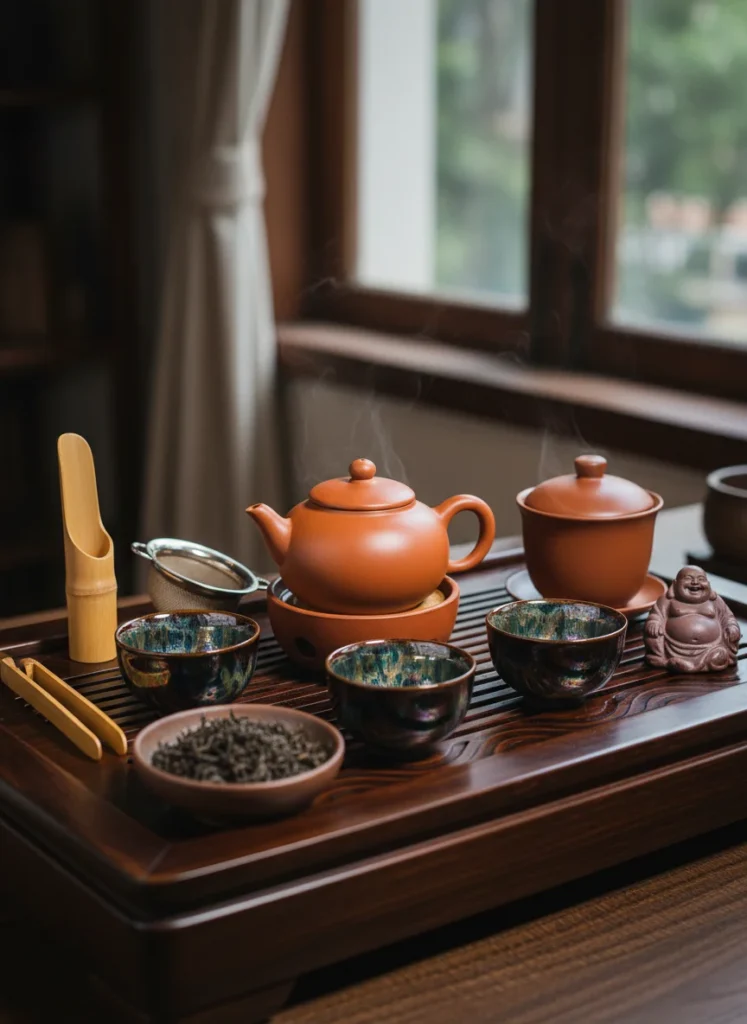
You need less than you think. Here is the minimum viable setup:
| Item | Purpose | Budget Option | Quality Option |
|---|---|---|---|
| Gaiwan or small teapot | Brewing vessel | Porcelain gaiwan ($10) | Yixing teapot ($50+) |
| Tea cups (3–4) | Serving | Porcelain cups ($3 each) | Tenmoku cups ($15+ each) |
| Tea tray (chapan) | Catches spillage | Baking sheet with rack ($5) | Bamboo tea tray ($30) |
| Kettle | Heating water | Any kettle ($10) | Variable temp kettle ($40) |
| Tea | The star | Decent oolong ($10/50g) | High mountain oolong ($30/50g) |
Total budget setup: approximately $40. Total quality setup: approximately $200. The most important investment is the tea itself — a mediocre tea in expensive teaware is still mediocre. Start with a good oolong and upgrade your equipment over time.
Choosing the Right Tea for Gongfu Cha
Not all teas work well for Gongfu Cha. The method requires teas that can endure multiple short infusions without losing character:
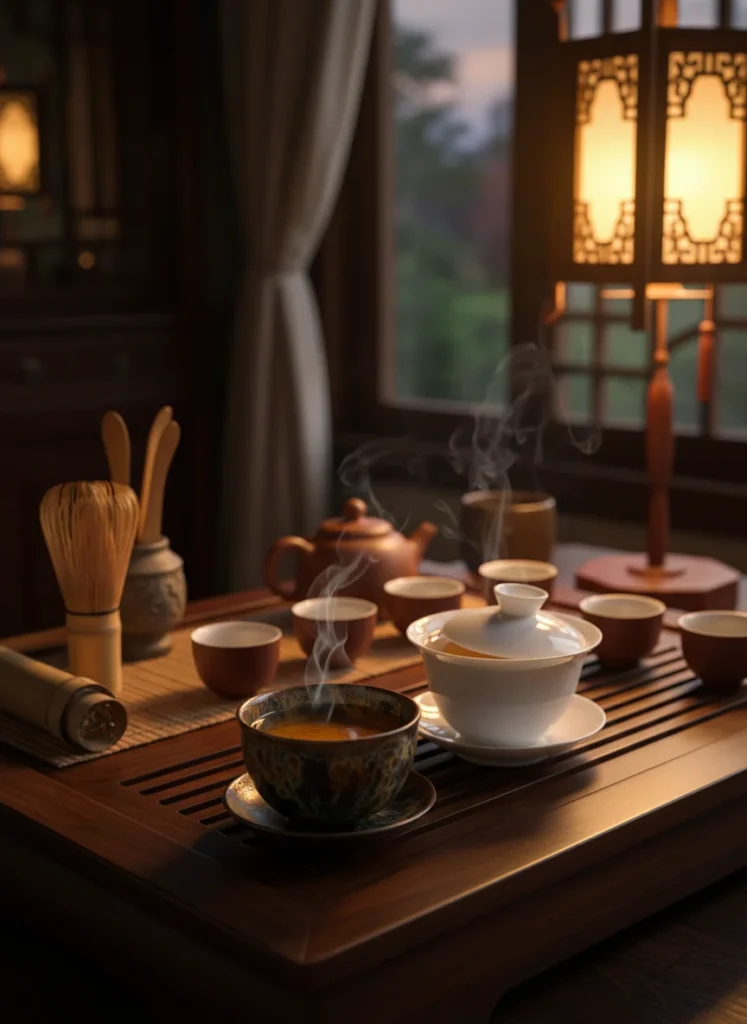
- Best: Oolong tea — The traditional choice. Oolong’s partial oxidation gives it the complexity to reward 8–12 infusions, with each steep revealing different flavor layers. Tieguanyin, Da Hong Pao, and high mountain oolong are all excellent choices.
- Good: Pu’er tea — Both raw (sheng) and ripe (shou) pu’er work well. Raw pu’er can produce 10–15 infusions with evolving character. Ripe pu’er produces 8–10 thick, earthy infusions.
- Good: Black tea — Chinese black teas (Dianhong, Jin Jun Mei) work well for 5–8 infusions. They do not have the staying power of oolong but are accessible and crowd-pleasing.
- Avoid: Green tea and white tea — These delicate teas do not reward multiple short infusions well. They are better brewed Western-style with longer steep times and fewer infusions. If you want to serve green tea Gongfu-style, use a very gentle hand and lower temperature.
For your first session, we recommend a medium-roasted oolong — it is forgiving, complex, and produces consistent results across many infusions.
Setting Up Your Tea Space
Before guests arrive, set up your space for flow and comfort:
- Seating arrangement — Arrange seats so everyone can see the tea being brewed. A circular or semicircular arrangement works best. The host should have easy access to the kettle and tea tray.
- Tea tray in the center — Place the chapan (tea tray) where everyone can see it. The tray catches the water discarded between infusions, and watching the host pour and discard is part of the experience.
- Cups arranged in a row — Line up the serving cups on the tray. In Gongfu Cha, you pour all cups in a single motion (more on this below), so they need to be close together.
- Hot water ready — Have your kettle filled and heated before guests sit down. Running out of hot water mid-session is the most common beginner mistake.
- Snacks nearby — Simple, unsweetened snacks (nuts, dried fruit, plain crackers) that do not compete with the tea’s flavor. Avoid chocolate, strong cheeses, or anything greasy.
The space does not need to be elaborate. Clean, comfortable, and focused on the tea. The same simplicity that makes a good mindfulness space makes a good tea space.
The Gongfu Cha Process: Step by Step
Here is the complete process for a Gongfu Cha session:
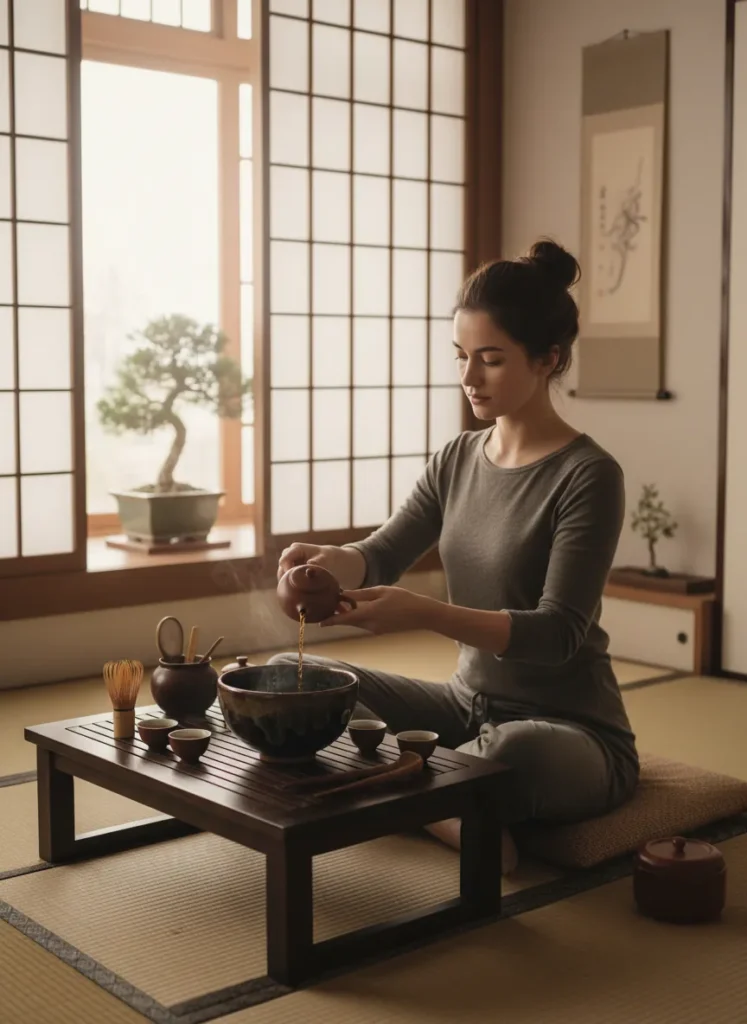
- Warm the vessels — Pour hot water into the gaiwan, then into each cup, then discard. This warms the vessels so the tea does not lose heat on contact with cold ceramic. Warm vessels also help the tea’s aroma develop more fully.
- Add tea leaves — Fill the gaiwan 1/3 to 1/2 full with dry leaves. For oolong, this is approximately 5–8 grams. The high leaf ratio is what makes Gongfu Cha work — it produces concentrated, flavorful infusions from very short steep times.
- Rinse (wash) the tea — Pour hot water over the leaves, immediately pour it out, and discard. This “wakes up” the leaves, removes dust, and begins the hydration process. Some people drink the rinse; most discard it. Smell the lid of the gaiwan after rinsing — it gives you a preview of the tea’s character.
- First infusion (10–15 seconds) — Pour hot water, cover, and wait 10–15 seconds. Then pour into the cups in a continuous back-and-forth motion, filling each cup partially before moving to the next. This ensures even concentration across all cups. Serve immediately.
- Subsequent infusions — Add 5–10 seconds per infusion. The second and third infusions are often the best — the tea has fully hydrated and is producing its most complete flavor profile. By the 6th–8th infusion, the tea is mellowing but still enjoyable.
- Observe and discuss — Between infusions, encourage guests to share what they notice. How is the flavor changing? Which infusion do they prefer? What aromas do they detect? This conversation is the heart of Gongfu Cha — it turns tea drinking into a shared experience.
A typical session with oolong produces 8–12 infusions over 30–45 minutes. Each infusion is small (1–2 oz per person) but intensely flavored.
Pouring Technique: The Art of Even Distribution
The pouring technique is one of the most distinctive aspects of Gongfu Cha:
- Continuous pour — Do not fill one cup completely, then the next. Instead, pour in a continuous stream, moving back and forth between cups, filling each a little at a time. This ensures that all guests receive tea of the same concentration.
- Height — Pour from a height of 2–3 inches above the cups. This aerates the tea and releases aromatics. A low pour produces a flatter cup; a high pour produces a more aromatic one.
- Speed — Pour quickly. The tea continues steeping in the gaiwan while you pour, so the longer you take, the stronger the last cup will be. Speed ensures evenness.
- The last drops — After pouring, tilt the gaiwan and drain every last drop. The final liquid is the sweetest and most concentrated — do not waste it. Pour these drops into whichever cup looks least full.
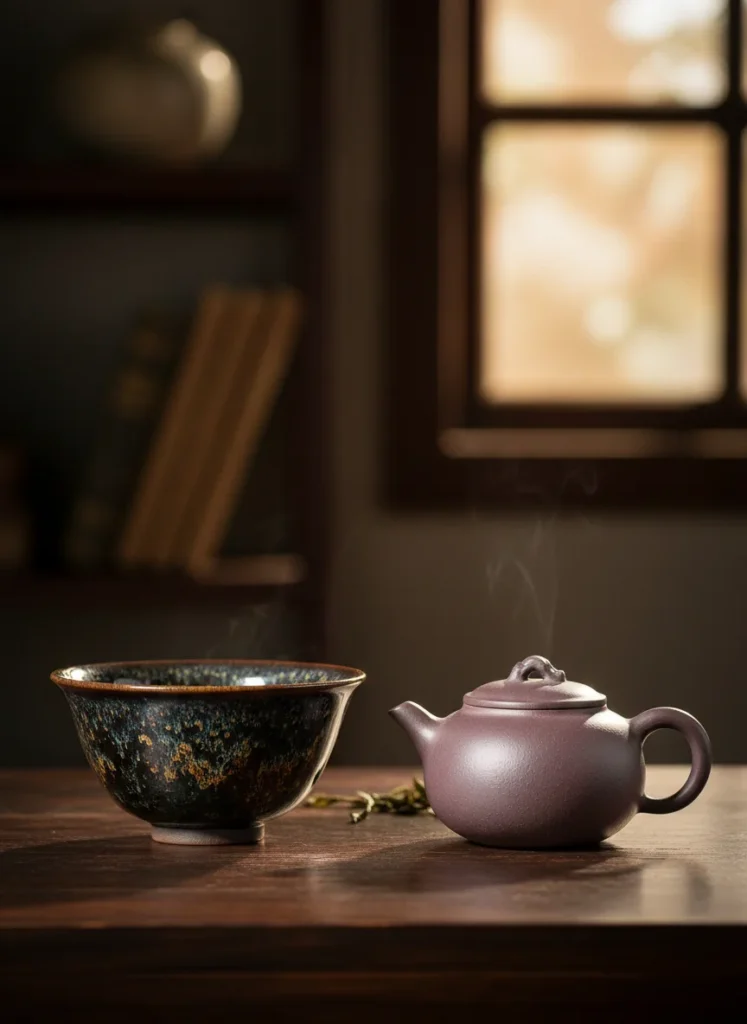
If you are serving in Tenmoku cups, the tea’s color against the dark glaze becomes part of the visual experience — another dimension of appreciation that your guests will enjoy.
Water Temperature Guide by Tea Type
| Tea Type | Temperature | First Steep | Add Per Infusion | Max Infusions |
|---|---|---|---|---|
| Light oolong | 190–195°F (88–90°C) | 15 sec | +5 sec | 8–10 |
| Dark oolong | 200–205°F (93–96°C) | 10 sec | +5 sec | 10–12 |
| Raw pu’er | 200–212°F (93–100°C) | 10 sec | +5 sec | 10–15 |
| Ripe pu’er | 212°F (100°C) | 15 sec | +10 sec | 8–10 |
| Black tea | 195–205°F (90–96°C) | 15 sec | +10 sec | 5–8 |
These are starting points. Adjust based on your taste — if the tea is too strong, reduce steep time or lower temperature. If it is too weak, increase steep time or add more leaves. Gongfu Cha is a conversation between you and the tea, not a rigid formula.
❓ Frequently Asked Questions About Gongfu Cha
❓ Do I need a Yixing teapot for Gongfu Cha?
No. A porcelain gaiwan works perfectly for all tea types and is actually preferred by many tea professionals because it is neutral — it does not absorb flavors. Yixing teapots are wonderful for specific teas (especially oolong and pu’er) but are not necessary to start. See our comparison of Tenmoku vs. Yixing for more details.
❓ How much tea should I use per session?
For a gaiwan (5 oz / 150 ml), use 5–8 grams of oolong, 7–10 grams of pu’er, or 3–5 grams of black tea. The general rule: fill the gaiwan 1/3 to 1/2 full with dry leaves. They will expand dramatically during brewing.
❓ Can I mix different teas in one session?
It is possible but not ideal for your first session. Different teas require different temperatures and steep times, which complicates the process. Start with one tea and master the basics before experimenting with multiple teas in a single session.
❓ What if I make a mistake and over-steep the tea?
Just pour it out and move to the next infusion. Over-steeped tea is bitter but not dangerous — the next infusion will be fine. Do not serve over-steeped tea to guests; it is better to discard one infusion than to serve a bad cup.
❓ How do I clean up after the session?
Rinse all vessels with warm water — no soap. Spread the spent tea leaves on the tea tray and let guests see and smell them; this is part of the experience. Dry the gaiwan and cups with a soft cloth. Store the gaiwan open so it airs out completely.
Gongfu Cha Etiquette: Being a Good Host and Guest
Gongfu Cha has a few simple etiquette rules that enhance the experience for everyone:
- The host pours, the guests receive — In Gongfu Cha, the host handles all brewing and pouring. Guests should not pour their own tea unless the host explicitly offers. This is not about hierarchy — it allows the host to control the brewing and ensure consistent quality across all cups.
- Receive with both hands — When the host offers a cup, receive it with both hands as a sign of respect. This is especially important if the cups are Tenmoku — the weight and beauty of the cup deserve a deliberate, respectful gesture.
- Taste before talking — Take at least one sip before commenting. Let the tea speak first. Rushing to describe the flavor before actually tasting it is considered gauche.
- Thank the host after each infusion — A simple nod or “thank you” after each pouring is sufficient. In formal Chinese settings, guests tap two fingers on the table to thank the host — a tradition dating back to the Qing Dynasty.
- Do not wash your cup — Between infusions, do not rinse your cup. The residual tea oils enhance the next infusion. This is why Gongfu Cha cups develop such beautiful patina over time.
These are not rigid rules — they are courtesies that make the session more pleasant for everyone. The most important rule is: be present, be curious, and enjoy the tea.
📚 References
Liu Zhonghua, Chinese Tea, China Intercontinental Press, 2010.
Heiss & Heiss, The Tea Enthusiast’s Handbook, Ten Speed Press, 2010.
Updated June 2026.
Ready to host your first Gongfu Cha session? Explore our Tenmoku collection at potalastore — cups that make every infusion beautiful.


