

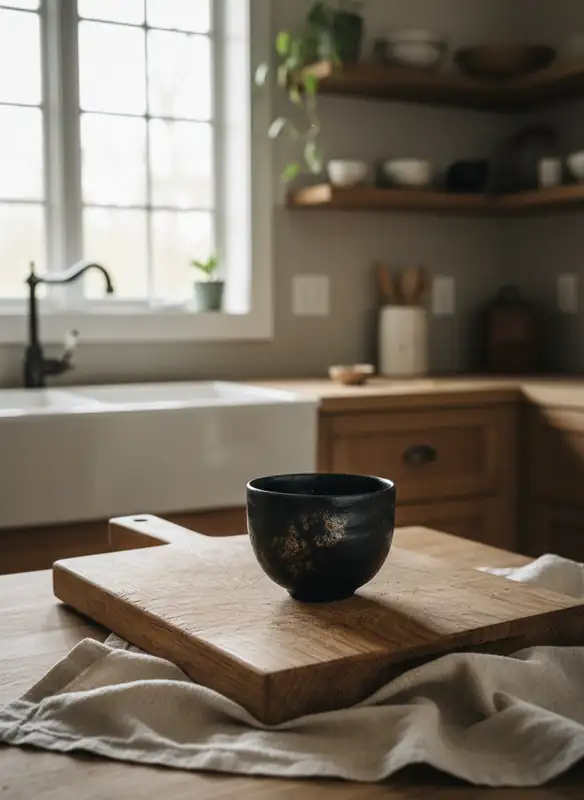
Contents
- Why Wabi-Sabi Belongs in Your Kitchen
- Perfect Matching Sets vs Imperfect Ceramics
- What Your Hand Notices
- What Your Eye Notices Over Time
- Build a Wabi-Sabi Kitchen Without Renovating
- Start With One Useful Anchor Object
- Use the 30-40% Breathing-Room Rule
- Choose Ceramics That Are Safely Imperfect
- Character Worth Keeping
- Damage That Should Stop Food Use
- How Daily Use Changes Your Relationship With Things
- A Seven-Day Wabi-Sabi Kitchen Reset
- Frequently Asked Questions
- ❓ Is wabi-sabi the same as a cluttered or rustic kitchen?
- ❓ Are cracks and glaze flaws safe on handmade ceramics?
- ❓ How can I start a wabi-sabi kitchen for under $50?
- 📚 References
Why Wabi-Sabi Belongs in Your Kitchen
Wabi-Sabi Kitchen: Beauty in Imperfect Ceramics is the idea that your kitchen feels warmer, calmer, and more personal when useful objects show natural variation instead of factory-perfect sameness. A slightly uneven rim, a glaze that changes in the light, or a visible hand-thrown line gives you something a mass-produced matching set cannot: evidence that a person and a process shaped the object.
You do not need a remodel to get that feeling. You can begin with one cup, bowl, or serving dish that you use every day. At Zen Tea Cup, the most convincing examples are often iron-glazed Tenmoku pieces because their color, crystal pattern, and profile vary naturally from firing to firing. The point is not to make your kitchen look old. It is to let useful things feel alive.
| Key Stat | Practical Value |
|---|---|
| Starter budget | $25-$60 for one handmade focal object |
| Typical tea-cup capacity | 3-5 fl oz (90-150 ml) |
| Open shelf breathing room | Leave 30-40% visually empty |
| Dominant palette | Limit the area to 3-5 grounded colors |
| Useful display grouping | Use 1-3 objects, not a crowded collection |
| Daily reset time | About 5 minutes |
Perfect Matching Sets vs Imperfect Ceramics
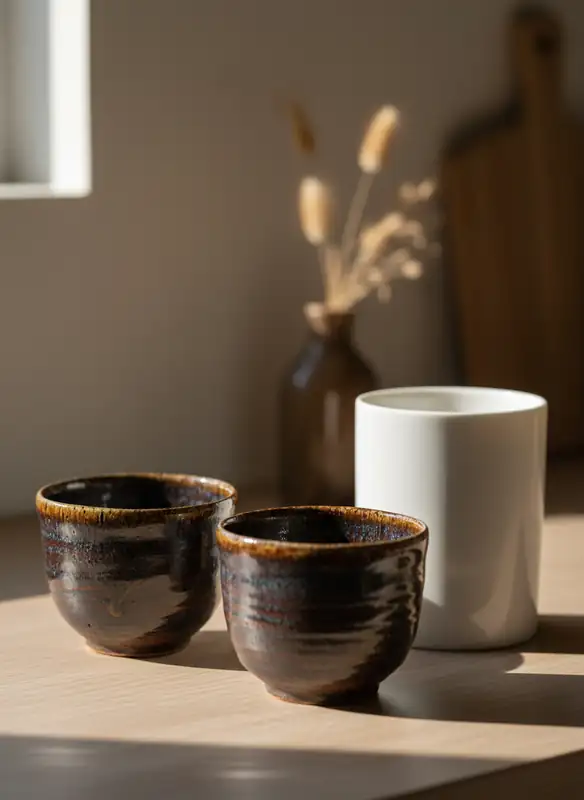
Mass-produced living promises convenience through repetition. Every plate is the same diameter. Every white mug has the same handle angle. Every replacement looks untouched by time. That consistency can be useful, but a kitchen made entirely from identical surfaces often feels more like a catalog than a room where you cook, spill, learn, and gather.
Imperfect ceramics interrupt that visual flatness. The imperfection should come from material and process, not neglect. You may see a rim that rises by 1/8 inch, an oil-spot pattern that clusters more densely on one side, or a foot ring with tiny trimming marks. These differences invite you to look twice (and that second look is the beginning of attachment).
What Your Hand Notices
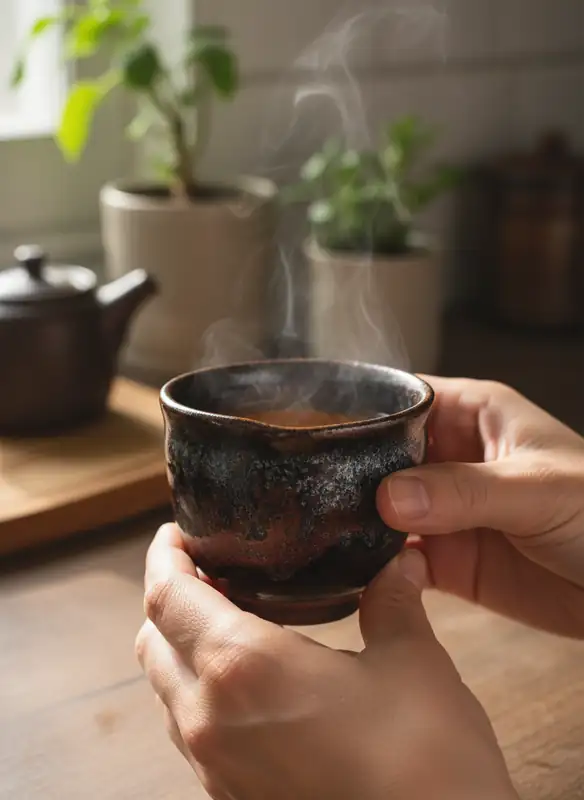
Your hand reads information before you consciously name it. A handmade cup may be 4-6 oz heavier than a thin commercial mug, with a textured foot and a wall that narrows toward the lip. When tea is poured at 185-205°F, that extra mass changes how heat reaches your fingers. You adjust your grip, slow your sip, and pay attention.
This tactile contrast is one reason a handmade cup can become the object you reach for first. The effect is not mystical. Weight, surface friction, temperature, and asymmetry provide more sensory input than a smooth, lightweight cylinder. Our guide to why a handmade cup feels different explores that sensory response in more detail.
What Your Eye Notices Over Time
A factory glaze is designed to look stable from every angle. A reduction-fired Tenmoku glaze can shift from black to bronze, silver, blue, or rust depending on daylight and viewing angle. You do not consume the whole object in one glance. You discover it gradually.
That slow discovery matters in a room filled with appliances that demand immediate attention. A ceramic surface can be visually quiet without being blank. It gives you complexity without adding another screen, label, or notification. The cup looks dark at first – then a band of hare’s-fur crystals appears near the rim.
Build a Wabi-Sabi Kitchen Without Renovating
A wabi-sabi kitchen is not a shopping list. If you replace every plate, repaint every cabinet, and buy a coordinated set of “imperfect-looking” accessories, you have recreated mass production in a different color palette. The better approach is subtraction, selection, and use.
Start With One Useful Anchor Object
Choose one object you will touch at least once a day. A 3-5 fl oz tea cup works well because it is small enough for a rental kitchen, useful enough to avoid becoming decor, and visually strong enough to anchor a shelf. A bowl, wooden tray, or linen towel can work too, but the object should earn its space through use.
Place it where your routine already happens: beside the kettle, near your tea tin, or on the shelf above your favorite chair. Do not create a ceremonial corner you will never use. You are designing for Tuesday morning, not for a photo shoot.
Use the 30-40% Breathing-Room Rule
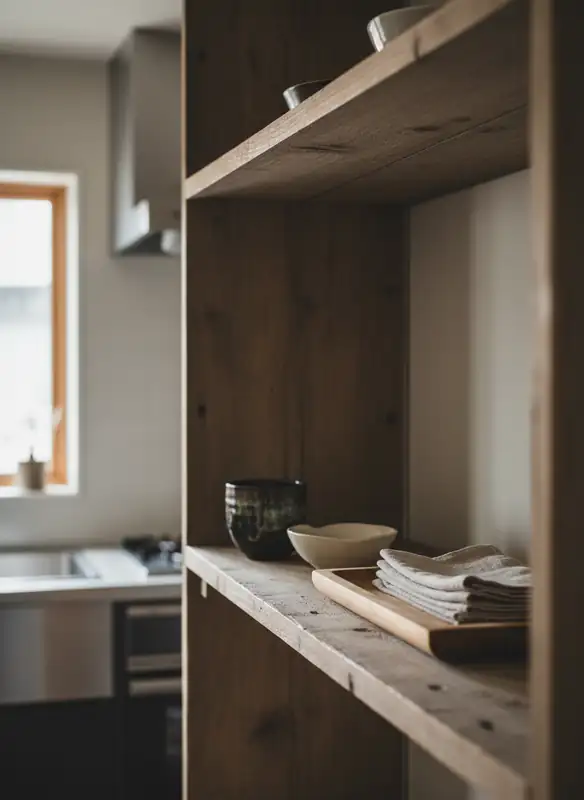
Open space is what lets irregular objects register. On one shelf or one section of counter, remove enough items to leave roughly 30-40% of the surface visually empty. Keep 1-3 useful objects together and vary their heights by about 1-3 inches. That is usually enough to create rhythm without clutter.
Limit the immediate palette to 3-5 colors. Black iron glaze, warm wood, muted green, white linen, and one metal tone are more expressive than ten similar brown objects. Wabi-sabi is often described through earth tones, but the deeper principle is restraint. You need contrast for texture to be visible.
Choose Ceramics That Are Safely Imperfect
Not every flaw is charming, and food safety matters more than aesthetics. The most useful distinction is between process variation and structural damage. Process variation tells you how the piece was formed and fired. Structural damage can trap moisture, weaken the vessel, or expose an unstable surface.
| Feature | Usually Safe Character | Reason to Stop Food Use |
|---|---|---|
| Rim | Slight asymmetry with a smooth glazed edge | Sharp chip or crack crossing the drinking edge |
| Glaze | Natural color variation and stable crystal patterns | Flaking, powdering, or exposed unknown coating |
| Foot | Unglazed iron-rich clay and trimming marks | Deep fracture extending into the wall |
| Surface | Fine stable crazing confirmed as intentional | Open crack that catches a fingernail or leaks |
| Shape | Hand-formed variation that sits securely | Unstable rocking that risks hot-liquid spills |
Character Worth Keeping
Look for a stable base, a comfortable lip, and glaze variation that feels integrated into the surface. Turn the cup under a window or a single warm lamp. You should see depth rather than a printed pattern. On many handmade pieces, the foot ring reveals dark clay and subtle tool marks. Those are useful clues, not defects.
You should also consider proportion. A cup around 3.2-3.8 inches wide and 2.2-2.8 inches tall usually feels intimate without becoming difficult to handle. If the cup holds 90-150 ml, you can use it for gongfu tea, a small coffee, or a slow evening infusion.
Damage That Should Stop Food Use
Retire a ceramic from food use if it has a sharp rim chip, an active crack, visible glaze flaking, or a repair material that is not certified food-safe. A beautiful object can continue as a pencil cup or dry-flower vessel. Wabi-sabi does not require you to ignore risk. Accepting change is different from pretending damage is harmless.
This distinction protects you from a common styling mistake: buying distressed-looking ceramics without asking how the effect was made. If you are uncertain, use a practical handmade-ceramic authentication checklist and ask the seller about clay body, firing temperature, and glaze composition.
How Daily Use Changes Your Relationship With Things
The strongest antidote to mass-produced living is not buying a rarer object. It is building a longer relationship with one. When you use the same handmade cup for 5 minutes each morning, you learn its balance, its warm spots, and the exact point where the glaze catches light. Familiarity creates value that a price tag cannot supply.
Daily use also gives wear a context. A faint tea patina, a softened wooden tray, or a linen towel that becomes more flexible after 20 washes records your routine. These changes are satisfying because you participated in them. The object becomes less interchangeable — and more yours.
There is a limit, of course. You do not need to romanticize every stain or keep everything forever. Wabi-sabi works best when it helps you care for fewer useful things. Clean the cup with warm water, dry it fully, and store it where it can be reached without moving five other objects. If an item creates work but no pleasure or function, let it go.
This is where wabi-sabi overlaps with the comfort of hygge without becoming the same style. Hygge emphasizes warmth and ease; wabi-sabi emphasizes change, incompleteness, and material honesty. You can combine both by using the calm ritual ideas in our hygge tea guide while allowing the objects themselves to remain irregular and unpolished.
A Seven-Day Wabi-Sabi Kitchen Reset
You can test the idea without committing to a makeover. Use this 7-day reset and spend no more than 5-10 minutes a day.
- Day 1: Clear one 24-36 inch section of counter or shelf. Put back only what you use weekly.
- Day 2: Choose one handmade or naturally varied object as the anchor.
- Day 3: Reduce the local palette to 3-5 colors and remove one distracting package or appliance.
- Day 4: Add one natural texture: wood, linen, bamboo, stone, or unfinished clay.
- Day 5: Brew tea and notice grip, weight, temperature, aroma, and sound for 5 minutes.
- Day 6: Inspect every ceramic for sharp chips, active cracks, unstable bases, or flaking glaze.
- Day 7: Photograph the space, then remove one more object. The final subtraction is often what makes the arrangement feel intentional.
At the end of the week, ask a simple question: did the space make your routine easier to begin? If you used the cup, enjoyed the shelf, and spent less time moving clutter, the reset worked. If it only looked good in the photograph, adjust it around your real habits.
Frequently Asked Questions
❓ Is wabi-sabi the same as a cluttered or rustic kitchen?
No. Wabi-sabi values restraint, natural change, and honest materials, while clutter simply makes useful objects harder to reach. You can have a clean modern kitchen with one irregular ceramic cup and still express the principle.
❓ Are cracks and glaze flaws safe on handmade ceramics?
Some surface variation is intentional, but sharp chips, active cracks, leaking walls, and flaking glaze should end food use. When you are unsure, ask for firing and glaze details or use the piece only for dry display.
❓ How can I start a wabi-sabi kitchen for under $50?
Clear one small area, reuse a wooden board or linen cloth you already own, and spend your budget on one food-safe handmade cup. Choose an object you will use daily instead of buying several decorative accessories.
📚 References
- Japanese Aesthetics: Stanford Encyclopedia of Philosophy overview of Japanese aesthetic traditions, including impermanence and restraint. Stanford Encyclopedia of Philosophy
- Japanese Tea Culture: Historical context for tea practice, ceramics, and the development of aesthetic values around tea objects. The Metropolitan Museum of Art
- Jian Ware Tea Bowl: Museum documentation showing the material, glaze, and hand-formed character of historical iron-glazed stoneware. The Metropolitan Museum of Art Collection
- Wabi-Sabi Interior Design: A design overview of wabi-sabi materials, patina, asymmetry, and the role of useful imperfection in contemporary homes. Architectural Digest
Ready to replace showroom sameness with an object that has real character? Explore the Zen Tea Cup collection and choose one imperfect ceramic you will genuinely use every day.


