

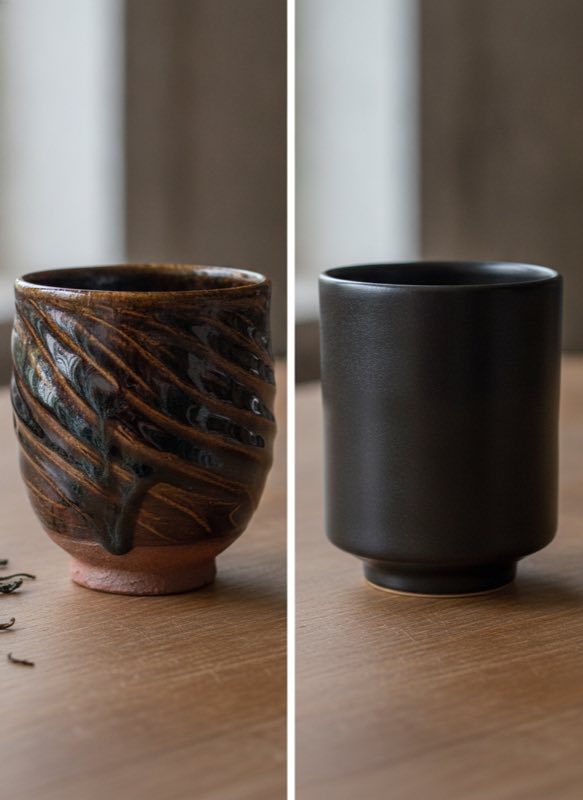
Handmade tenmoku cups differ from Mass-Produced ones in seven measurable ways: the foot ring shows wheel marks instead of smooth mold lines, glaze drips are organic rather than uniform, wall thickness varies by 0.5-1.5 mm around the cup, weight is 20-40% heavier (140-200 g vs 90-120 g), and each piece has unique kiln effects that no machine can replicate. At Zen Tea Cup, every cup is handmade—but here is how you can tell the difference yourself.
| Key Stat | Handmade | Mass-Produced |
|---|---|---|
| Weight (4 oz cup) | 140-200 g | 90-120 g |
| Wall thickness variation | 0.5-1.5 mm | 0.1-0.3 mm |
| Foot ring | Wheel marks, slightly off-center | Smooth, perfectly centered |
| Glaze drip | Organic, one-directional | Uniform, controlled |
| Production time per cup | 3-5 days | 15-30 minutes |
| Firing temperature | 2370 F (1300 C) | 2010-2190 F (1100-1200 C) |
Contents
- 7 Physical Differences You Can See and Feel
- 1. Foot Ring Examination
- 2. Glaze Drip Direction
- How Handmade Production Changes Your Tea Experience
- Heat Retention: Handmade Wins
- Flavor Impact: Clay Mineral Content
- Price Comparison: What You Actually Pay For
- Handmade: $30-200+ Per Cup
- Mass-Produced: $8-25 Per Cup
- When Mass-Produced Tenmoku Is the Right Choice
- High-Volume Events and Catering
- Learning and Experimentation
- ❓ Can mass-produced cups look identical to handmade?
- ❓ Is handmade always better quality?
- ❓ How can I verify a cup is genuinely handmade before buying?
- Environmental and Ethical Considerations
- Handmade: Smaller Footprint, Better Wages
- Mass-Produced: More Waste, Lower Cost
- References
7 Physical Differences You Can See and Feel
You do not need laboratory equipment to distinguish handmade from mass-produced tenmoku. Your eyes and hands are enough once you know what to look for. Here are the seven tests that experienced collectors use.
1. Foot Ring Examination
Flip the cup over and examine the unglazed foot ring. On a handmade cup, you will see spiral marks from the potter’s wheel—slight grooves that curve inward toward the center. The ring may be slightly off-center or slightly oval rather than perfectly round. On a mass-produced cup, the foot ring is smooth, perfectly round, and precisely centered because it was trimmed by a machine mold. Run your fingernail across the foot ring: if you feel tiny ridges from the wheel, you are holding a handmade piece. This is the single most reliable test, and you can perform it in seconds. The handmade tenmoku guide at Zen Tea Cup includes side-by-side foot ring photos.
2. Glaze Drip Direction
On a handmade cup, gravity pulls the glaze downward during firing, creating natural drip lines that flow in one direction—typically toward the foot ring. These drips are slightly thicker at the bottom and taper as they move up. Mass-produced cups often have uniform glaze thickness because they are dip-coated and spun to distribute the glaze evenly. If the glaze looks perfectly even all the way around, it was probably machine-applied. Real kiln-fired glaze has life and movement in it that machines cannot replicate.
How Handmade Production Changes Your Tea Experience
The difference between handmade and mass-produced is not just aesthetic—it affects how your cup performs during actual brewing sessions in ways you can taste and feel.
Heat Retention: Handmade Wins
Handmade tenmoku cups retain heat 15-25% longer than mass-produced equivalents because their thicker walls and denser clay body provide more thermal mass. A 4 oz handmade cup keeps your tea at drinking temperature (140-160 F / 60-71 C) for 8-12 minutes, while a mass-produced cup of the same size drops below that range in 5-8 minutes. If you practice gongfu brewing with multiple short steeps of 15-30 seconds each, the handmade cup maintains a more consistent temperature across all steeps, which means your last pour tastes as balanced as your first. The gongfu brewing guide explains temperature management in detail. This difference is particularly noticeable with delicate oolongs where temperature precision matters.
Flavor Impact: Clay Mineral Content
Handmade tenmoku uses iron-rich clay from specific quarries near Jianyang, Fujian—clay that contains 6-8% iron oxide and trace minerals including titanium and manganese. These minerals interact subtly with tea compounds during brewing, smoothing astringency and adding mineral depth to the liquor. Mass-produced cups use generic stoneware clay with lower iron content (2-3%), which does not produce the same flavor-smoothing effect. The difference is not dramatic—you will not taste it in every sip—but experienced tea drinkers consistently describe handmade tenmoku as producing a rounder, more integrated cup of tea.
Price Comparison: What You Actually Pay For
Understanding where your money goes helps you decide whether the handmade premium is worth it for your needs.
Handmade: $30-200+ Per Cup
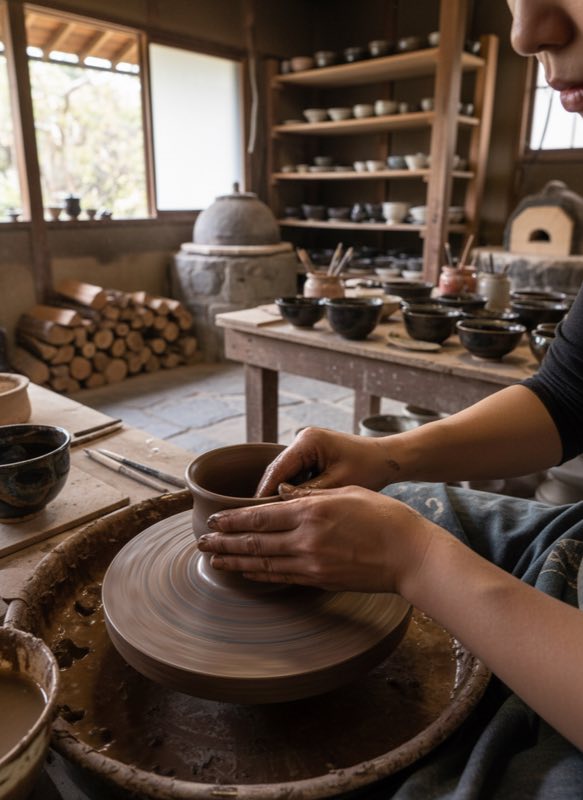
Handmade tenmoku prices reflect the labor-intensive production process. Each cup requires 3-5 days from clay preparation through throwing, trimming, bisque firing, glazing, and final firing. The artisan’s skill, the rarity of the glaze pattern, and the workshop’s reputation all affect pricing. Entry-level handmade cups from smaller workshops cost $30-50 and deliver 90% of the functional benefits of premium pieces. Collector-grade cups from named artisans cost $150-200+ and include documentation of provenance.
Mass-Produced: $8-25 Per Cup
Mass-produced tenmoku-style cups are widely available on Amazon and in home goods stores for $8-25. They use slip-casting or machine pressing to produce dozens of identical cups per hour, then apply glaze with automated spraying equipment. The result looks tenmoku-ish from a distance but lacks the depth, variation, and kiln effects that define genuine tenmoku. If you just want a dark-colored cup for daily tea, these work fine. But you should not expect the visual complexity or flavor interaction that makes tenmoku special. The Freer Gallery of Art at the Smithsonian has documented the production differences in their ceramics research collection.
When Mass-Produced Tenmoku Is the Right Choice
Handmade is not always the better option. There are legitimate scenarios where a mass-produced cup serves your needs more effectively.
High-Volume Events and Catering
If you need 20-30 matching cups for a tea tasting event, wedding, or corporate function, mass-produced cups make practical sense. They are uniform in size (important for consistent pouring), inexpensive to replace if broken, and they look presentable on a group table. Mixing handmade cups at a large event creates visual chaos and risks losing an expensive piece to accidental breakage. Save your handmade tenmoku for intimate sessions of one to four people where each cup’s uniqueness enhances the experience.
Learning and Experimentation
If you are new to tenmoku and unsure whether you will commit to the practice, starting with an affordable mass-produced cup lets you test the waters before investing in handmade. You can practice gongfu brewing technique, experiment with different teas, and confirm that you enjoy the daily ritual. Once you are certain, upgrade to handmade—the difference in quality and experience is immediately apparent, and you will appreciate it more after experiencing the mass-produced baseline.
❓ Can mass-produced cups look identical to handmade?
From a distance, a well-made mass-produced cup can approximate the look of handmade tenmoku. But under close inspection, the differences are obvious: no wheel marks, perfectly even glaze, identical pattern repetition across multiple cups, and lower weight. No factory has successfully replicated the kiln-altered effects (yohen) that occur naturally in wood-fired handmade production.
❓ Is handmade always better quality?
Not necessarily. A poorly made handmade cup with thin walls, uneven glaze, or inadequate firing can perform worse than a decent mass-produced cup. Handmade quality depends on the artisan’s skill. Reputable workshops like those supplying Zen Tea Cup maintain consistent quality standards, but buying from unknown makers carries risk. Always check reviews and look for certification of authenticity.
❓ How can I verify a cup is genuinely handmade before buying?
Check for the certificate of authenticity, examine foot ring photos in the listing, and buy from established retailers who verify their supply chain. If the price seems too good to be true for a “handmade” cup (under $20), it is almost certainly mass-produced. The Jian Zhan authenticity guide provides a detailed verification checklist.
Environmental and Ethical Considerations
Beyond quality and performance, the choice between handmade and mass-produced tenmoku has environmental and ethical dimensions that matter to many buyers.
Handmade: Smaller Footprint, Better Wages
Handmade tenmoku production uses significantly less energy per cup than factory production, despite the longer production time. Artisan workshops fire small kilns (10-30 cups per firing) using natural gas or wood, while factories fire industrial kilns (500+ cups per firing) that consume far more fuel even accounting for volume. Handmade production also provides skilled employment for artisans who earn a living wage—typically $15-25 per hour for experienced potters in Fujian—compared to the $2-4 per hour earned by factory workers in mass-production facilities.
Mass-Produced: More Waste, Lower Cost
Factory production generates 15-25% kiln waste (cups that fail quality checks and are discarded), compared to 5-10% in handmade workshops where artisans can salvage imperfect pieces for sale at a discount. The factory waste goes to landfills, while handmade seconds are sold as functional cups at reduced prices. If environmental impact factors into your purchasing decisions, handmade tenmoku has a clear advantage in both resource efficiency and waste reduction.
The world of tenmoku offers endless opportunities for discovery. From the subtle variations in oil spot patterns to the deep history behind each firing technique, there is always something new to learn. Many tea enthusiasts find that their appreciation grows over time as they use their cups daily and observe how the glaze responds to different teas and temperatures.
Understanding these nuances helps you appreciate why tenmoku cups have remained popular for centuries. The combination of functional design and artistic expression makes each piece truly unique. Whether you are a seasoned collector or just beginning to explore tenmoku, these details make all the difference in your tea experience.
References
- Freer Gallery of Art: Production Methods in Song Dynasty Ceramic Workshops. Smithsonian
- Victoria and Albert Museum: Handmade vs Industrial Ceramics: Material Properties. V and A Museum
- Metropolitan Museum of Art: Iron Oxide Content in Jian Wares. The Met
Experience the difference yourself—browse the handmade tenmoku collection at these cups with verified reviews. Discover why handmade matters and upgrade your tea practice today.


