

Contents
- What Are Partridge Spots in Jian Zhan?
- How Partridge Spot Crystals Form in the Kiln
- Three Types of Partridge Spot Patterns
- Partridge Spots vs. Oil Spots: A Common Confusion
- Why Song Dynasty Tea Masters Prized Partridge Spots Above All
- How to Identify Authentic Partridge Spot Jian Zhan
- Caring for a Partridge Spot Tea Bowl
- Modern Revival and What to Look for When Buying
- ❓ Frequently Asked Questions About Partridge Spots
- ❓ Are partridge spots the same as oil spots?
- ❓ Why are partridge spot Jian Zhan so expensive?
- ❓ Can modern kilns reproduce Song Dynasty partridge spots?
- ❓ How should I care for a partridge spot Jian Zhan bowl?
- 📚 References
What Are Partridge Spots in Jian Zhan?
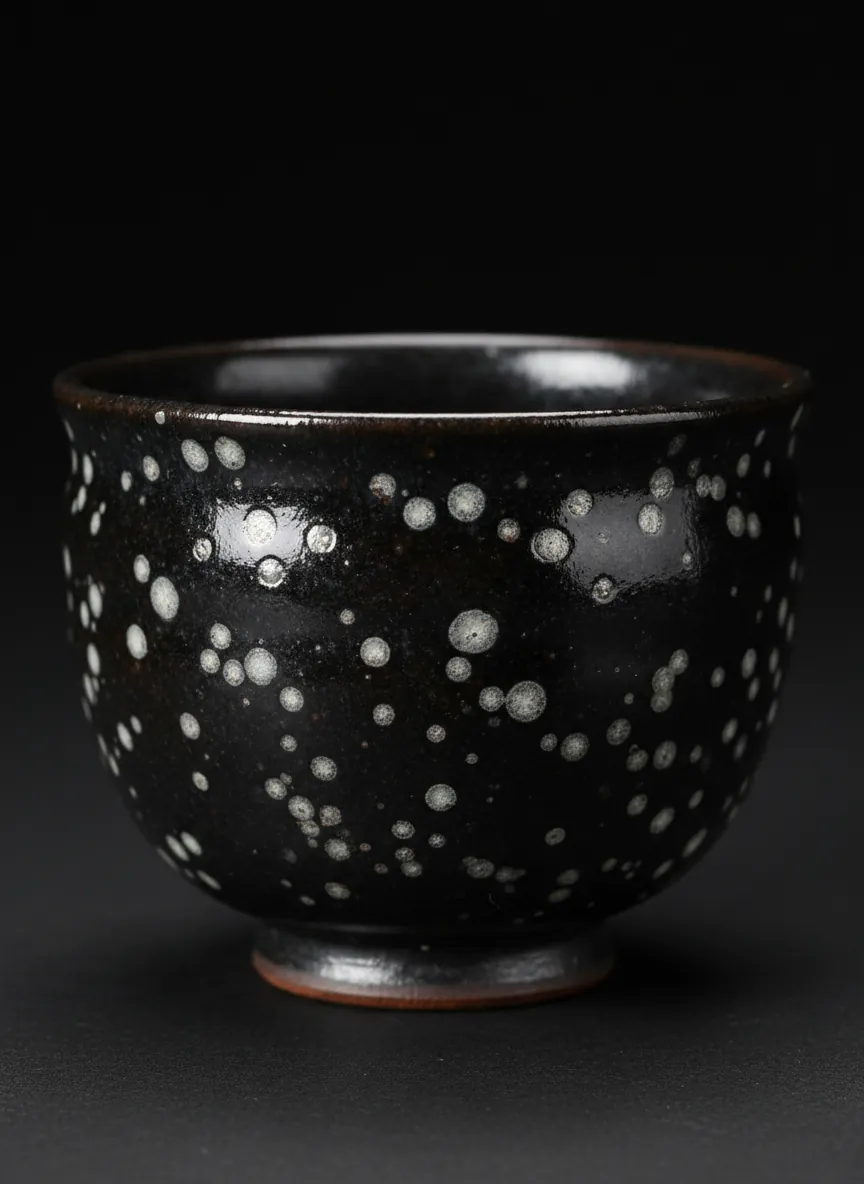
Partridge spots (鹧鸪斑, zhegu ban) are one of the rarest and most revered glaze patterns on Jian Zhan tea bowls — round, silvery-white crystalline dots scattered across a dark iron-rich glaze, resembling the speckled breast feathers of a partridge bird. Unlike the more common hare’s fur streaks or oil spot droplets, partridge spots form only under an exceptionally narrow range of kiln conditions, making each surviving piece a near-miracle of Song Dynasty ceramic art. See the Jian Zhan size guide for more.
At ZenTeaCup, we work directly with kiln masters in Jianyang, Fujian — the birthplace of Jian Zhan — and even among their finest wood-fired output, true partridge spot bowls appear perhaps once every several firings. This extreme rarity is precisely why Emperor Huizong of the Song Dynasty ranked partridge spots above all other glaze patterns in his Daguan Cha Lun (Treatise on Tea, 1107 CE), and why collectors worldwide still prize them above every other Tenmoku pattern.
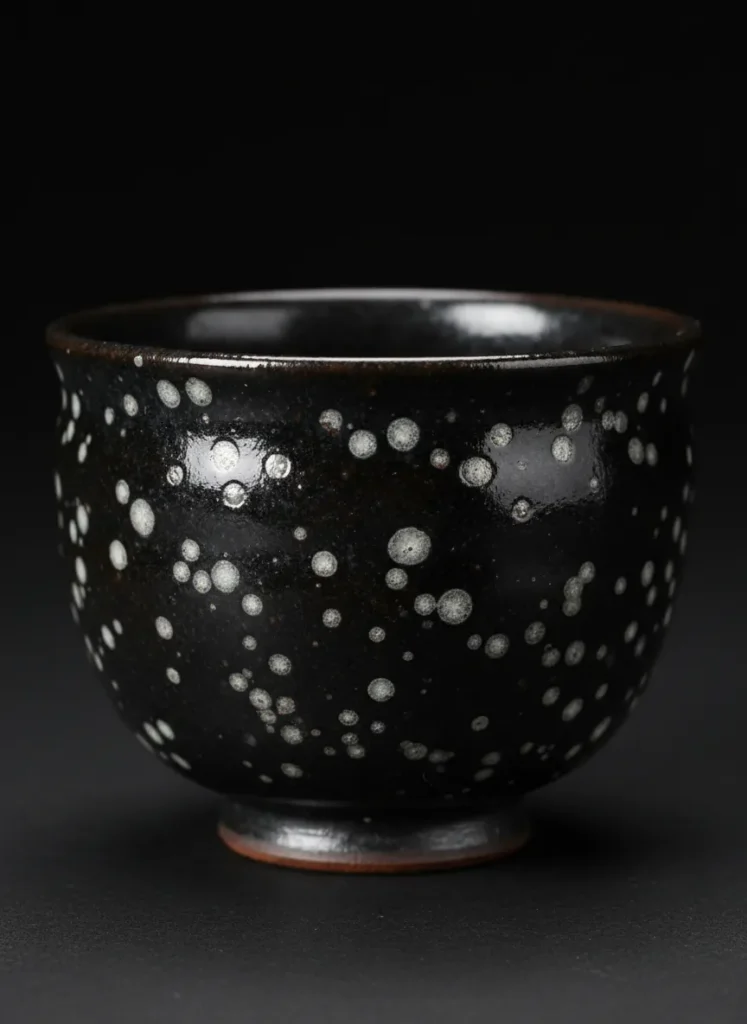
You can display your tenmoku collection as stunning decor when not in use.
How Partridge Spot Crystals Form in the Kiln
The formation of partridge spots is a process of iron oxide crystallization that depends on four tightly coupled variables inside the kiln. Change any one, and the pattern shifts to oil spot, hare’s fur, or no pattern at all.
- Iron-rich glaze application: Jian Zhan glaze contains 15–30% iron oxide (FeO) — far higher than most Chinese ceramics. This iron is the raw material for every Jian Zhan glaze pattern.
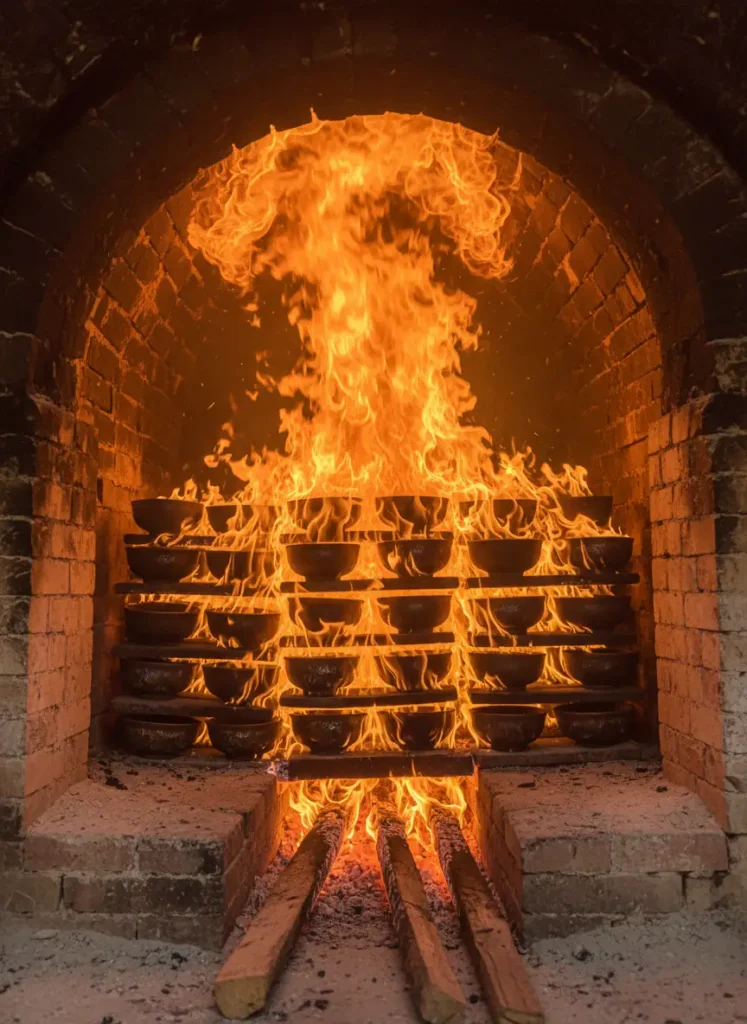
- High-temperature reduction firing: The bowl reaches approximately 1300°C (2372°F) inside a dragon kiln under a reducing atmosphere, where limited oxygen forces the iron to melt into the glaze rather than oxidize on the surface.
- Critical cooling window: As the kiln cools, iron oxide precipitates out of the glaze and crystallizes on the surface. Partridge spots form only when the cooling rate falls within a narrow range of roughly 5–10°C per hour through a specific temperature band — too fast and you get hare’s fur streaks; too slow and the crystals merge into larger oil spot pools.
- Glaze thickness variation: Unlike oil spots (which form from rising bubbles) or hare’s fur (which results from gravity-driven streaking), partridge spots are primarily influenced by subtle variations in glaze thickness across the bowl’s surface. Where the glaze pools slightly thicker, discrete round crystals nucleate and grow independently rather than merging.
In our experience visiting Jianyang kilns, a single 36-hour wood firing might produce hundreds of hare’s fur bowls, dozens of oil spot pieces, and perhaps only one or two with true partridge spots — if any at all. This yield ratio of roughly 1 partridge spot bowl per 200–300 fired pieces helps explain both the price and the reverence.
Three Types of Partridge Spot Patterns
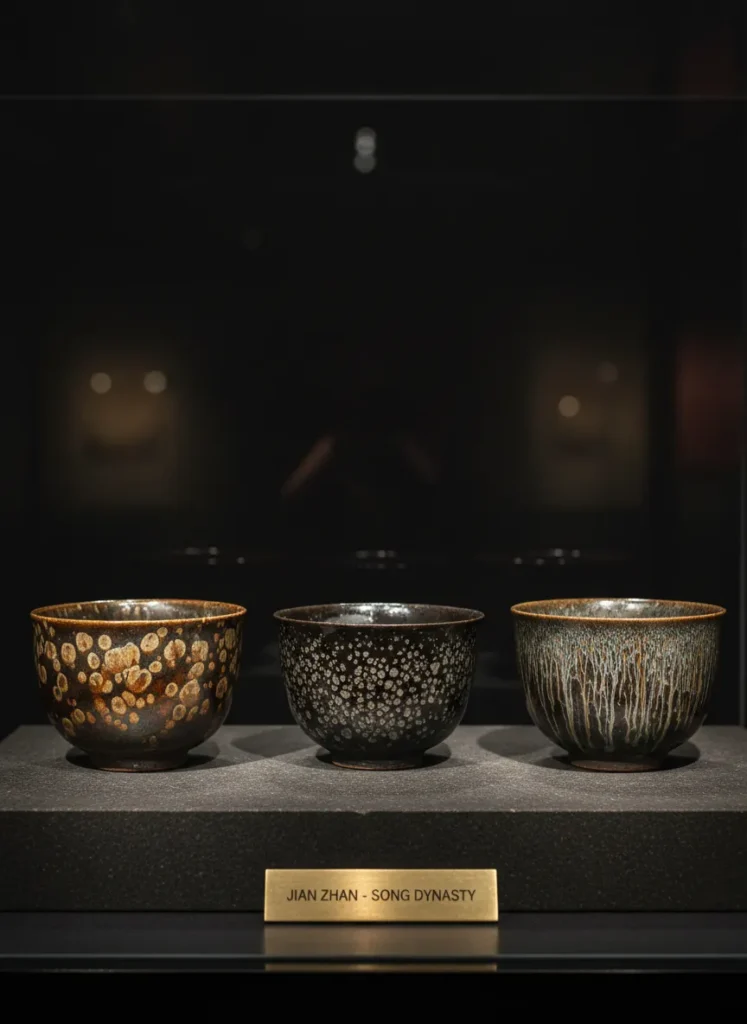
Not all partridge spot bowls look the same. Song Dynasty potters and modern kiln masters recognize three distinct sub-types, each with different visual characteristics and rarity levels.
| Type | Visual Characteristic | Rarity |
|---|---|---|
| Regular Spot (Zheng Ban) | Round or oval silvery-white spots, evenly distributed, resembling pearl-like dots on a partridge’s breast | High |
| Oil-Drop Spot (You Di Ban) | Variable-size spots in silver-gray to yellow-brown tones, resembling boiling oil drops on water | Very High |
| Iridescent Spot (Yao Bian Ban) | Rare spots that emit rainbow-like light shifts when viewed from different angles — the “mysterious light” (神秘光) | Extremely High |
Regular spot partridge bowls feature spots that are remarkably uniform in size and shape — typically 3–5 mm in diameter — scattered across the inner wall of the bowl. The Song Dynasty poet Su Shi captured their beauty in verse: “Thin sticks, grinding ink splatters, golden thread partridge feather spots.” Oil-drop partridge bowls have more variation in spot size and color, while iridescent partridge bowls — the rarest of all — display a thin-film optical effect that shifts between blue, purple, and gold as you rotate the bowl.
Partridge Spots vs. Oil Spots: A Common Confusion
One of the most persistent misunderstandings in the Jian Zhan world is treating partridge spots and oil spots as the same pattern. They are not — and the distinction matters both for collectors and for anyone shopping for authentic Tenmoku teaware.
| Feature | Partridge Spots (鹧鸪斑) | Oil Spots (油滴) |
|---|---|---|
| Spot Shape | Irregular, often with fish-scale or filamentous internal patterns | Mostly circular with a visible colored center |
| Spot Color | Silvery-white, pearl-like, or eggshell white | Silver-gray, yellow-brown, or golden metallic |
| Glaze at Rim | Obvious glaze shedding at the mouth of the cup | Non-shedding rim |
| Glaze at Base | Visible drooping glaze phenomenon | No drooping at bottom |
| Formation | Glaze thickness variation + slow cooling | Rising iron-rich bubbles bursting on surface |
The confusion partly stems from the fact that very few people have seen authentic Song Dynasty partridge spot bowls in person. Most modern imitators use northern “oil-drop” glaze as their model and simply label the result “partridge spot.” The literary record,
When you hold a Jian Zhan, you feel the weight of Song Dynasty tradition.
however, is clear: the Song Dynasty text Qing Yi Lu by Tao Gu explicitly records that “in the kilns of Fujian, cups with patterns of partridge feather spots were made and treasured by tea connoisseurs” — a distinct category from oil-drop ware.
Why Song Dynasty Tea Masters Prized Partridge Spots Above All
In Song Dynasty tea culture, the visual spectacle of the bowl was inseparable from the taste of the tea. The era’s dominant tea practice was dian cha (点茶) — whisking powdered tea into a white froth inside a dark-glazed bowl. The contrast between the pale foam and the dark, shimmering glaze was judged competitively in dou cha (tea battles), where the finest bowls earned social prestige for their owners.
Partridge spot bowls were ideal for dian cha for three reasons:
- Visual contrast: The dark base glaze made the white tea froth pop, while the silvery spots added a secondary layer of visual richness that other bowls lacked.
- Symbolic meaning: The partridge was associated with good fortune and refinement in Chinese literary tradition. Owning a partridge spot bowl signaled both wealth and cultural sophistication.
- Rarity as status: Because partridge spots were so difficult to fire, simply possessing one demonstrated access to the finest kilns and the most discriminating taste.
The monk Huihong expressed this reverence in verse: “To fully appreciate the three flavors of tea, one must sip the dew of spring from the partridge feather cups.” Chen Jian Shu similarly praised: “The partridge feather cups reign supreme among the tea wares, as precious as rabbit hair and as pure as snow.”
 How to Identify Authentic Partridge Spot Jian Zhan
With so many imitations on the market, knowing how to distinguish genuine partridge spot Jian Zhan from fakes is essential. Here are five reliable indicators:
- Spot texture: Run your fingertip gently over the surface. Authentic partridge spots have a slightly raised, crystalline texture — you can feel the subtle bumps. Machine-made imitations typically have flat, printed-on patterns with no tactile difference.
- Spot irregularity: Real partridge spots are never perfectly uniform. Each spot varies slightly in size, shape, and color intensity. If every spot looks identical, it is likely a decal or laser-printed imitation.
- Glaze shedding at the rim: A distinctive feature of true partridge spot glaze is thinning or shedding at the bowl’s mouth — a natural result of the glaze flowing during firing. Oil-drop imitations usually have clean, unbroken rims.
- Iron-rich clay body: Authentic Jian Zhan uses local Jianyang clay with visible iron particles. The unglazed foot ring should feel slightly rough and show a dark, iron-rich color. A white or cream-colored foot ring suggests non-Jianyang clay.
- Weight and thickness: Handmade Jian Zhan bowls have walls typically 3–5 mm thick and weigh 80–150 g for a standard 4 oz (120 ml) cup. If the bowl feels unnaturally light or the walls are paper-thin, it is likely machine-made.
Caring for a Partridge Spot Tea Bowl
Partridge spot Jian Zhan requires the same mindful care as other Tenmoku teaware, but a few details deserve special attention given the rarity and value of these bowls.
- Rinse with hot water only: After each use, rinse the bowl with hot water. Never use soap or detergent — these strip the glaze of the oils that build a natural patina over time.
- Air dry completely: Pat the exterior gently with a soft cloth, then let the bowl air dry fully before storing. Trapped moisture can dull the crystalline shimmer of partridge spots.
- Season gradually: The more you use the bowl, the deeper its luster becomes. Regular seasoning with tea builds a patina that enhances the reflective quality of the iron oxide crystals — many tea lovers notice a visible improvement after 2–4 weeks of daily use.
- Store with care: Keep the bowl in a ventilated space, never sealed in an airtight container. If stacking with other bowls, place a soft cloth between them to protect the raised crystalline spots from scratching.
For more detailed guidance, see our complete Jian Zhan care guide.
Modern Revival and What to Look for When Buying
After centuries of decline following the Song Dynasty, Jian Zhan firing was revived in the 1980s when Chinese ceramicists studied surviving Song Dynasty pieces and began replicating the traditional processes. Today, a small number of kilns in Jianyang produce partridge spot bowls using both wood-fired dragon kilns and electric kilns.
Wood-fired partridge spot bowls remain far more expensive — typically $150–400 USD for a quality piece — because the unpredictable nature of wood firing means a much lower yield. Electric kiln partridge spot bowls, while more affordable at $60–150 USD, tend to produce more uniform spots that lack the organic irregularity and depth that collectors value.
When shopping for a partridge spot Jian Zhan bowl, keep these factors in mind:
- Ask about the firing method: Wood-fired bowls command a premium but offer the authentic, unpredictable beauty that makes Jian Zhan special. Electric-fired bowls are a more accessible entry point.
- Examine the spots closely: Look for natural variation in size, shape, and color. Avoid bowls where the spots look mechanically uniform.
- Check the foot ring: Authentic Jian Zhan should show dark, iron-rich clay at the unglazed foot. This is a quick visual check that eliminates many fakes.
Browse ZenTeaCup’s handcrafted Jian Zhan collection to find partridge spot and other Tenmoku glaze bowls, each selected from certified kilns in Jianyang.
❓ Frequently Asked Questions About Partridge Spots
❓ Are partridge spots the same as oil spots?
No. Partridge spots (鹧鸪斑) are irregularly shaped crystalline patterns with fish-scale or filamentous internal structures, silvery-white coloring, and glaze shedding at the rim. Oil spots (油滴) are mostly circular with visible colored centers, silver-gray to golden tones, and clean rims. The two patterns form through different mechanisms — partridge spots from glaze thickness variation during slow cooling, and oil spots from iron-rich bubbles rising and bursting on the surface.
❓ Why are partridge spot Jian Zhan so expensive?
True partridge spots form only under an extremely narrow range of kiln conditions. In a typical wood firing, roughly 1 in 200–300 bowls develops genuine partridge spots. This low yield, combined with the historical prestige established by Emperor Huizong’s endorsement and centuries of literary praise, drives the price. Authentic Song Dynasty partridge spot bowls are national treasures in Chinese museums.
❓ Can modern kilns reproduce Song Dynasty partridge spots?
Modern Jianyang kilns can produce beautiful partridge spot patterns, but they differ from Song Dynasty originals in subtle ways. Wood-fired replicas come closest to the organic irregularity of ancient pieces, while electric kiln versions tend to produce more uniform spots. No modern firing perfectly replicates the specific atmospheric conditions inside a 12th-century dragon kiln, but the best contemporary examples are highly regarded by collectors.
❓ How should I care for a partridge spot Jian Zhan bowl?
Rinse with hot water after each use — never use soap. Air dry completely before storing. Regular tea use builds a natural patina that enhances the crystalline luster. Store in a ventilated space with a soft cloth between stacked bowls. For step-by-step instructions, see our Jian Zhan care guide.
📚 References
- Jian Ware History and Classification: Overview of Jian kiln ceramics, glaze types, and their cultural significance in Song Dynasty tea culture. Wikipedia — Jian Ware
- Song Dynasty Tea Culture and Dian Cha: The Metropolitan Museum of Art’s resources on Chinese ceramics and the role of tea bowls in Song Dynasty society. The Metropolitan Museum of Art
- Iron Oxide Crystallization in Stoneware Glazes: Scientific analysis of crystalline glaze formation in high-temperature reduction firing. China Tea Spirit — Six Classic Glaze Patterns
Discover your next favorite tea cup — visit the Zen Tea Cup store for curated tenmoku selections.


