

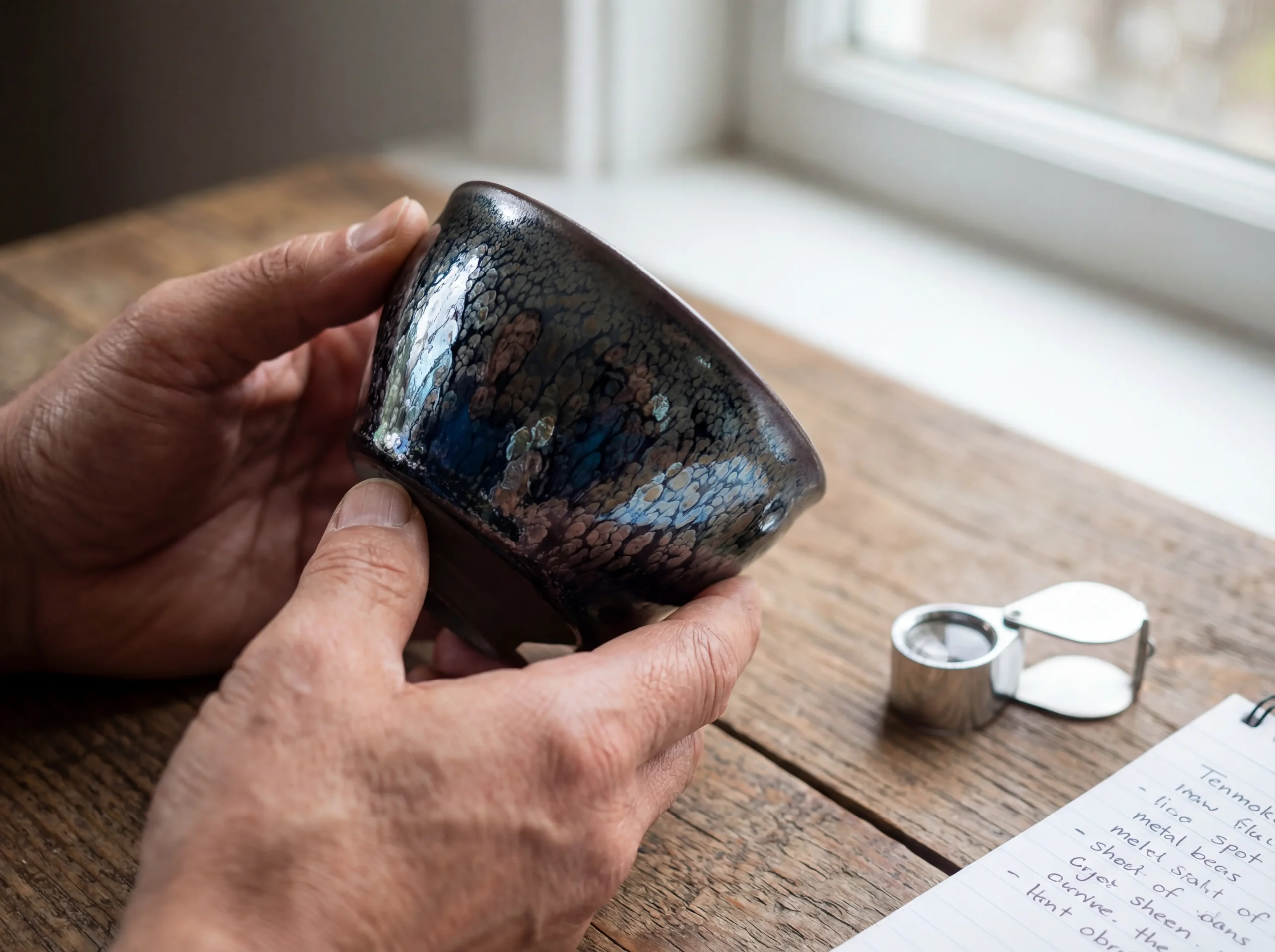
Authentic Tenmoku tea cups originate from iron-rich clay fired at 1300°C (2370°F) to produce distinctive crystallized glaze patterns. These cups—also called Jian Zhan in Chinese—have captivated tea lovers for over 1,000 years. But with mass-produced imitations flooding the market, how do you know you’re getting the real thing?
This guide walks you through everything you need to identify genuine Tenmoku teaware. You’ll learn the telltale signs of authenticity, understand different glaze types and their values, and discover practical tests you can do at home. Whether you’re a tea enthusiast or a collector, this buyer’s guide will help you make confident purchases.
Contents
- What Makes a Tenmoku Tea Cup Authentic?
- Understanding Tenmoku Glaze Patterns and Their Value
- Hare’s Fur (兔毫 / Nogime)
- Oil Spot (油滴 / Yuteki)
- Partridge Feather (鹧鸪斑)
- Yohen (曜変)
- How to Examine Glaze Quality Under Different Lighting
- The 5-Point Physical Inspection Checklist for Authentic Tenmoku Cups
- 1. Foot Ring Examination
- 2. Weight Test
- 3. Acoustic Test
- 4. Magnet Test
- 5. Glaze Flow Lines
- Food Safety: Is Tenmoku Glaze Safe for Drinking?
- Choosing the Right Size and Shape for Your Authentic Tenmoku Cup
- Which Teas Pair Best with Tenmoku Cups?
- Price Ranges: What Should an Authentic Tenmoku Cup Cost?
- How to Spot Fake Tenmoku Cups: Red Flags
- Essential Care for Your Authentic Tenmoku Tea Cup
- Using Your Tenmoku Cup in Tea Ceremony
- Building Your Authentic Tenmoku Collection: Where to Start
- 📚 References
What Makes a Tenmoku Tea Cup Authentic?
An authentic Tenmoku tea cup must meet three essential criteria: proper origin, correct materials, and traditional firing methods.
Jian Zhan (建盏) literally means “Jian teacup”—named after Jianyang, Fujian Province, the only region with the specific iron-rich clay needed for genuine pieces. The clay contains 7-10% iron content, giving the cup its signature weight and dark body color.
The glaze combines natural iron ore with plant ash. When fired above 1300°C, iron crystals form spontaneously, creating patterns impossible to replicate artificially. In 2011, the Chinese government recognized Jianzhan firing techniques as National Intangible Cultural Heritage—a testament to its cultural significance.
“Tea is of light color and looks best in black cups. The cups made at Jianyang are bluish-black, marked like the fur of a hare.”
— Cai Xiang, Song Dynasty scholar (1012-1067), “The Record of Tea”
This ancient praise explains why Tenmoku cups became the preferred teaware during the Song Dynasty (960-1279). Zen Buddhist monks later carried them to Japan, where they earned the name “Tenmoku” after Tianmu Mountain.
Understanding Tenmoku Glaze Patterns and Their Value
Tenmoku glazes fall into four main categories, each commanding different market values based on rarity and complexity. Understanding these patterns is essential when choosing your Jian Zhan.
Hare’s Fur (兔毫 / Nogime)
Hare’s Fur is the most common pattern. It features radial brown or silver streaks resembling rabbit fur. These cups cost $30-150 for quality handmade pieces—the best starting point for new collectors.
Oil Spot (油滴 / Yuteki)
Oil Spot glazes display silvery circular spots scattered across a dark backdrop—like droplets of oil on water. Moderately rare, these pieces typically range from $80-500 depending on spot clarity and distribution.
Partridge Feather (鹧鸪斑)
Partridge Feather patterns resemble the spotted plumage of the partridge bird. This pattern sits between Hare’s Fur and Oil Spot in rarity.
Yohen (曜変)
Yohen—meaning “glittering change”—is the rarest pattern. It displays iridescent colors that shift with viewing angle. Only 3 intact Song Dynasty Yohen pieces exist today, all designated National Treasures of Japan. Modern success rates for this pattern remain below 1%.
| Glaze Pattern | Rarity Level | Price Range (Handmade) | Key Identifier |
|---|---|---|---|
| Hare’s Fur | Common | $30-150 | Radial streaks |
| Oil Spot | Moderately Rare | $80-500 | Silvery circular spots |
| Partridge Feather | Rare | $150-800 | Spotted clusters |
| Yohen | Extremely Rare | $500-50,000+ | Iridescent color shift |
How to Examine Glaze Quality Under Different Lighting
Genuine Tenmoku glazes reveal layered depth when examined at a 45-degree angle under natural light. Authentic patterns show micro-reflective fields with visible crystal structures.
Use a 10x loupe to inspect closely. Look for:
- Natural glaze pooling at the rim and base
- Tiny pinholes (evidence of reduction firing)
- Metallic sheen within the pattern
- Depth and layering—not flat, uniform coloring
Fake glazes appear flat and uniform. Printed or sprayed imitations lack the three-dimensional crystal structures that form naturally during high-temperature firing.
The 5-Point Physical Inspection Checklist for Authentic Tenmoku Cups
Authentic Jian Zhan cups reveal five telltale physical characteristics. You can check most of these without special equipment.
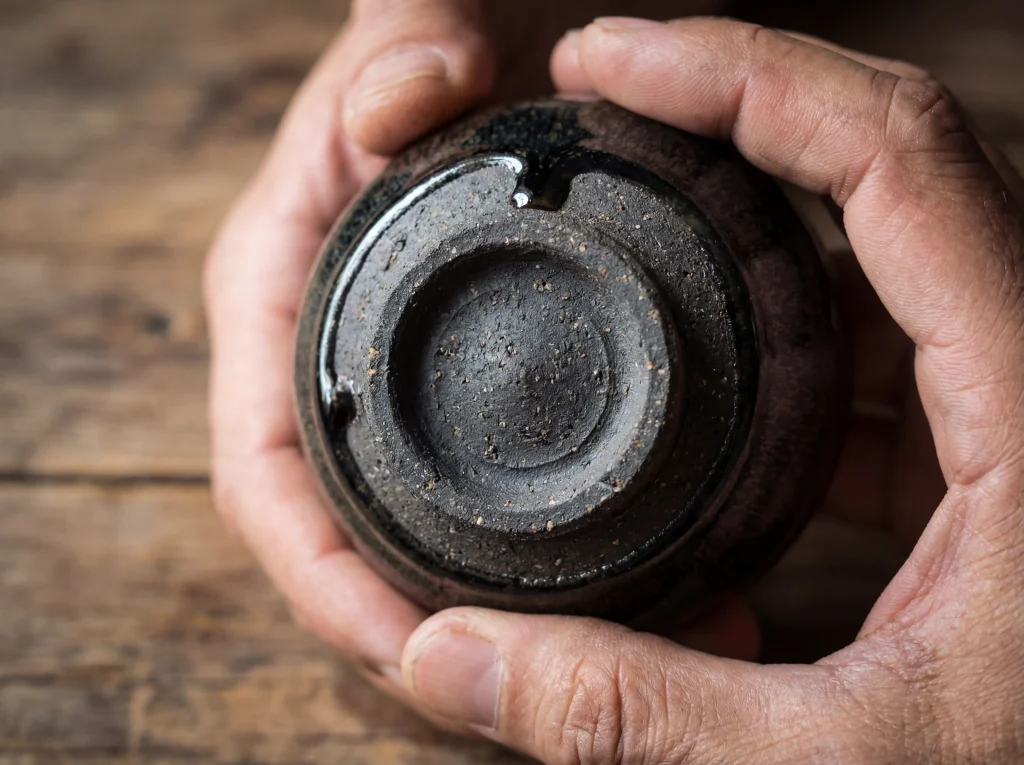
1. Foot Ring Examination
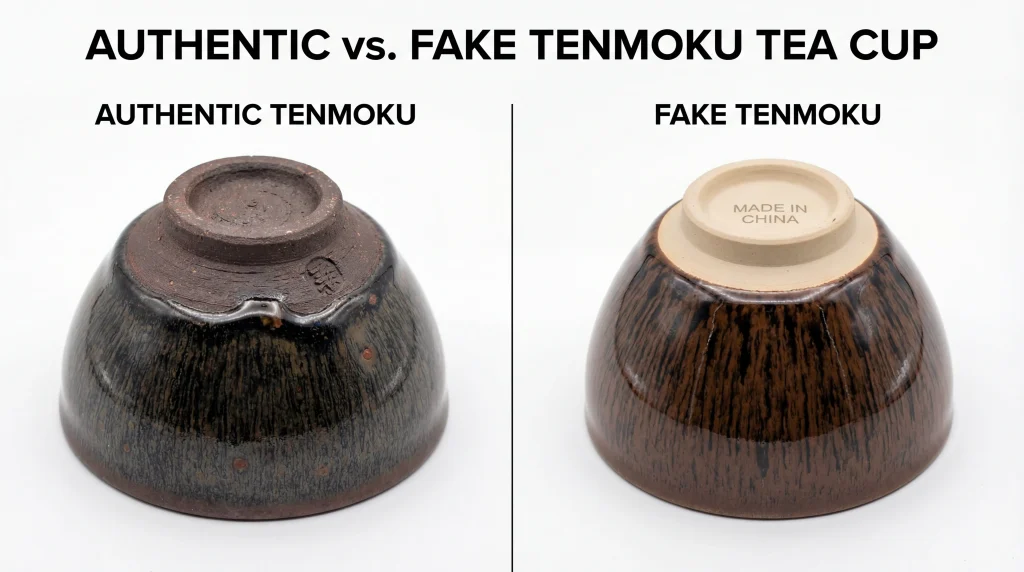
The unglazed foot ring exposes the raw clay body. Genuine Jianyang clay appears dark gray to black due to high iron content. Imitations from other regions show lighter, whitish, or buff-colored clay.
2. Weight Test
Pick up the cup. Authentic pieces feel heavier than standard porcelain of similar size. The dense, iron-rich clay creates substantial weight—a cup measuring 7cm tall × 12cm diameter typically weighs 200-300 grams.
3. Acoustic Test
Tap the cup gently with your fingernail. Genuine Tenmoku produces a crisp, clear metallic ring. A dull thud suggests inferior clay composition or firing issues.
4. Magnet Test
High iron content creates slight magnetic attraction. Hold a small magnet near the unglazed foot—authentic pieces show subtle pull. This test isn’t definitive alone but supports other observations.
5. Glaze Flow Lines
Look for natural drip marks where glaze pooled during firing. Authentic cups show organic flow patterns, often thickening near the base. Uniform, perfect glazing suggests machine application.
Food Safety: Is Tenmoku Glaze Safe for Drinking?
Authentic Tenmoku glazes are completely food safe. The combination of natural iron ore and plant ash, fired above 1300°C, creates an unleachable surface.
You can verify safety with a simple home test:
- Fill your cup with lemon juice or white vinegar
- Leave it overnight (8-12 hours)
- Check for any color change in the glaze
If the glaze changes color, the acid has leached into it—meaning the cup isn’t safe for regular use. Authentic, properly-fired cups show no color change.
Red flags for unsafe cups:
- Visible holes or cracks in the interior glaze
- Unglazed areas inside the cup (where tea touches)
- Bright, unnatural colors (may contain chemical additives)
- Suspiciously low prices with “rainbow” effects
Choosing the Right Size and Shape for Your Authentic Tenmoku Cup
Tenmoku cups come in various sizes designed for different tea styles. Your choice depends on how you prefer to drink tea. Learn more about selecting the right Tenmoku tea bowl for your needs.
| Cup Type | Capacity | Best For | Typical Dimensions |
|---|---|---|---|
| Gongfu Cup | 50-80 ml | Concentrated infusions, multiple steeps | 5-6 cm diameter |
| Daily Tea Cup | 100-150 ml | Everyday drinking | 7-9 cm diameter |
| Matcha Chawan | 250-400 ml | Whisking matcha, tea ceremony | 12-13 cm diameter |
Traditional Song Dynasty bowls measured approximately 12cm diameter × 7cm height. The conical shape with a finger groove below the rim defines the classic Tenmoku silhouette.
Wall thickness matters for heat retention. Thicker walls keep tea warm longer but require more careful handling when hot. Thinner-walled cups (harder to produce, higher breakage rates) offer a more refined drinking experience.
Which Teas Pair Best with Tenmoku Cups?
Dark, full-bodied teas pair best with Tenmoku cups. The iron-rich glaze softens water and enhances natural sweetness in the brew.
Ideal tea pairings:
- Pu-erh: The earthy depth pairs beautifully with dark glaze
- Wuyi Rock Oolong: Roasted notes complement the cup’s mineral character
- Black Tea (Hong Cha): Rich amber liquor contrasts against dark interior
- Matcha: The original pairing—bright green foam against black glaze
The iron content in authentic cups releases trace minerals that increase tea’s alkalinity. Many drinkers report a smoother, sweeter taste compared to porcelain or glass.
Pro tip: If you own an Oil Spot cup, dedicate it to one tea type. The porous surface absorbs tea oils over time, developing a beautiful patina. Mixing different teas can create muddled flavors.
Price Ranges: What Should an Authentic Tenmoku Cup Cost?
Authentic Tenmoku cups range from $5 for mass-produced pieces to $50,000+ for works by Living National Treasures. Understanding price tiers helps you buy wisely.
| Price Tier | Range | What You Get | Best For |
|---|---|---|---|
| Entry Level | $5-30 | Factory-made, authentic materials, simpler patterns | Daily use, beginners |
| Mid-Range | $30-200 | Individual artisans, unique patterns, certificates | Enthusiasts, gifts |
| Premium | $200-2,000 | Named masters, rare glazes, collectible quality | Collectors, investment |
| Museum Grade | $2,000-50,000+ | Living National Treasures, exhibition pieces | Serious collectors |
Key value factors:
- Glaze pattern rarity: Yohen > Oil Spot > Partridge > Hare’s Fur
- Firing method: Wood-fired commands 30-50% premium over electric kiln
- Artisan reputation: Named masters with awards and recognition
- Crafting time: Quality pieces require 72-80+ hours of work
Cups priced above $30 should include a certificate of authenticity with the artist’s name and kiln information.
How to Spot Fake Tenmoku Cups: Red Flags
Counterfeit Tenmoku cups reveal themselves through several telltale signs. Knowing these saves you from costly mistakes.
Warning signs:
- Light-colored foot: Whitish or pale gray clay indicates non-Jianyang origin
- Uniform patterns: Machine-printed glazes lack natural variation
- Too lightweight: Cheap clay lacks iron density
- Chemical colors: Unnaturally bright “rainbow” effects suggest additives
- Perfect symmetry: Handmade pieces show subtle variations
- Suspiciously low prices: Below $5 with “Oil Spot” claims
Pro tip: Request photos showing the foot, rim, interior, and glaze under angled light before buying online. Reputable sellers provide these willingly.
Essential Care for Your Authentic Tenmoku Tea Cup
Tenmoku cups need minimal but consistent care to maintain their beauty and develop prized patina over time. Understanding why Jian Zhan can appear to rust helps you prevent issues.
Daily care:
- Rinse with hot water only after each use
- Air dry inverted on a clean cloth
- Avoid soap or detergent—it damages the glaze surface
Weekly deep clean: Use a soft cloth or toothpaste to gently remove tea stains. Rinse thoroughly afterward.
Rust prevention (for Oil Spot cups): The exposed iron crystals can oxidize if left wet. Dry thoroughly after each use. If rust appears, soak briefly in white vinegar, then clean normally.
Storage: Keep in a dry, ventilated area away from direct sunlight. Temperature fluctuations can stress the glaze.
Important: Never use Tenmoku cups in the microwave. The high iron content can cause sparking and damage.
Using Your Tenmoku Cup in Tea Ceremony
Tenmoku cups hold special significance in Japanese tea ceremony. Mastering how to hold a Tenmoku tea bowl properly enhances your appreciation of this ancient tradition.
In formal ceremonies, Tenmoku bowls are placed on lacquer stands when serving VIPs—a testament to their prestigious status among all chawan styles.
Building Your Authentic Tenmoku Collection: Where to Start
Begin your Tenmoku collection with a $30-80 Hare’s Fur cup for daily use. This common pattern offers authentic experience without major investment. For personalized guidance, read our detailed article on how to choose the right Tenmoku teacup for you.
Beginner strategy:
- Start with Hare’s Fur: Learn care routines and appreciation
- Add an Oil Spot: Experience the patina development process
- Diversify sizes: Get both a Gongfu cup and larger daily cup
- Consider one investment piece: $200+ from a named artisan
Document your purchases with photos and certificates. Quality authentic Tenmoku cups appreciate over time, especially pieces from recognized masters.
The journey of collecting Tenmoku is really a journey into tea culture itself. Each cup connects you to a thousand years of ceramic artistry—from Song Dynasty scholars to modern artisans keeping ancient traditions alive.
Ready to find your first authentic Tenmoku tea cup? Browse our curated Jian Zhan Tenmoku tea cups collection, or explore complete Tenmoku tea sets and matching Jianzhan teapots. Every piece comes with provenance documentation and our satisfaction guarantee.
📚 References
- Song Dynasty Jian Ware History: Comprehensive overview of Jian ware origins, manufacturing techniques, and cultural significance during the Song Dynasty. Britannica – Jian Ware
- Museum Collection Example: Authentic Song Dynasty Jian ware tea bowl in the Metropolitan Museum of Art collection, demonstrating classic Hare’s Fur glaze patterns. The Metropolitan Museum of Art – Jian Ware Bowl
- Scientific Analysis of Tenmoku Glazes: Academic research on the iron oxide crystallization that creates Oil Spot and Hare’s Fur patterns in ancient Jian ware. Nature Scientific Reports – Learning from the Past: Rare ε-Fe2O3 in Ancient Jian (Tenmoku) Wares
- Intangible Cultural Heritage Status: Information about Jianzhan firing techniques being listed as National Intangible Cultural Heritage of China in 2011. Wikipedia – Jian Ware
- Japanese Tenmoku Tea Bowl Traditions: Detailed overview of famous Tenmoku chawan styles and their role in Japanese tea ceremony. Kyoto National Museum – Tenmoku Teabowls


