


Using a tenmoku tea cup correctly transforms your tea experience from casual drinking into mindful ritual. These black-glazed bowls require specific handling techniques that differ from ordinary cups—from how you hold them to how many sips you take.
This guide covers the exact steps for using tenmoku in Japanese tea ceremony: holding, rotating, drinking, whisking, and caring for your bowl. Whether you’re attending a formal ceremony or practicing at home, these techniques will help you honor this 800-year-old tradition.
Contents
- How to Hold a Tenmoku Tea Bowl Properly
- Why and How to Rotate the Tea Bowl Before Drinking
- Step-by-Step: Drinking Tea from a Tenmoku Bowl
- How to Prepare Matcha in a Tenmoku Bowl
- Usucha (Thin Tea) Preparation Steps
- Tips for Whisking in Tenmoku’s Conical Shape
- Using Tenmoku for Different Tea Types
- Formal vs. Casual: Adjusting Your Technique
- Caring for Your Tenmoku After Use
- Quick Reference: Tenmoku Tea Bowl Usage Checklist
- Start Using Your Tenmoku Today
- 📚 References
How to Hold a Tenmoku Tea Bowl Properly
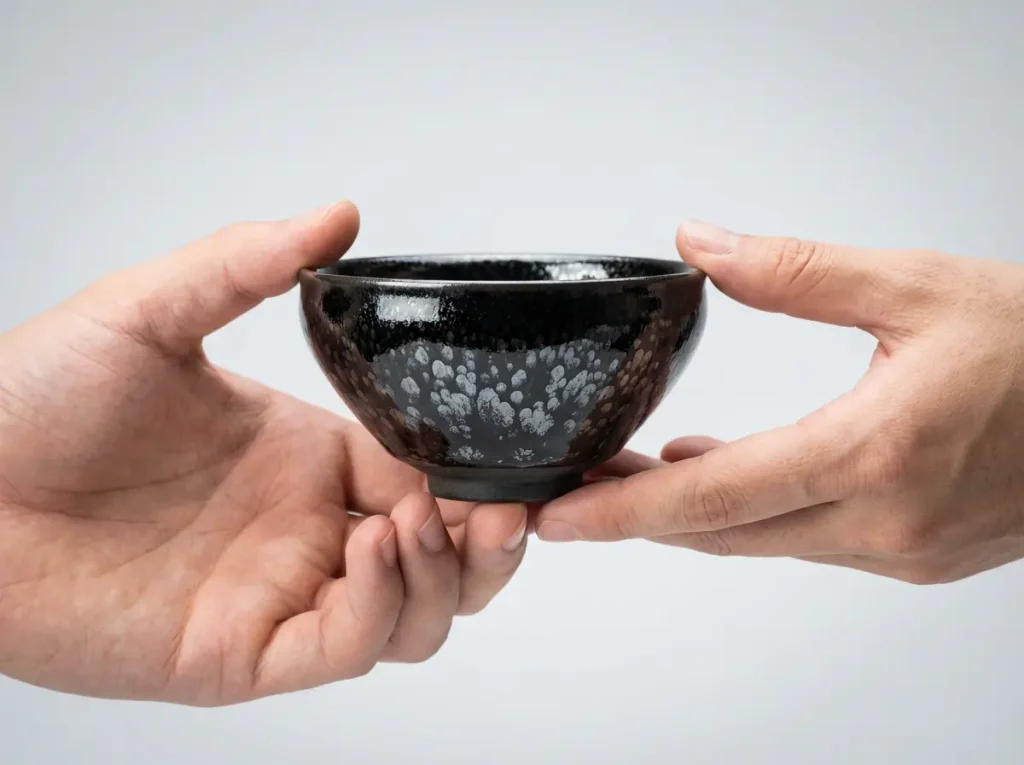
Hold your tenmoku with both hands—pick it up with your right hand, then transfer it to rest in your left palm. Your fingers should cup underneath like a nest, supporting the bowl on the cushions of your fingertips.
This two-handed grip serves three purposes:
- Safety: Tenmoku bowls retain heat well—both hands give you better control
- Respect: Two hands signal that you value the bowl and the tea
- Stability: The conical shape with narrow foot requires secure handling
Follow this sequence every time you receive a tenmoku bowl:
- Reach with your right hand and grasp the side of the bowl
- Transfer to your left palm, fingers cupped underneath
- Place your right hand on the side for support
- Keep the bowl at chest height—never below your waist
Important: In formal ceremonies, tenmoku bowls are often served on a tenmokudai—a lacquered wooden stand. When this happens, lift the bowl off the stand before drinking. Never drink while the bowl remains on the stand.
Why and How to Rotate the Tea Bowl Before Drinking

Rotate the bowl clockwise 2-3 quarter turns (about 90-180°) before your first sip. This moves the bowl’s front—its most beautiful side—away from your lips.
Every tenmoku has a “face” called shoumen (正面). This is typically where the glaze pattern is most striking. By rotating it away, you show humility: you’re saying the honored position isn’t for you.
| When | Direction | Amount | Purpose |
|---|---|---|---|
| Before drinking | Clockwise | 2-3 quarter turns | Move front away from your lips |
| After drinking | Counter-clockwise | 2-3 quarter turns | Return front toward the host |
Use your right hand to rotate the bowl while it rests in your left palm. Make smooth, deliberate turns—not rushed spins.
Step-by-Step: Drinking Tea from a Tenmoku Bowl
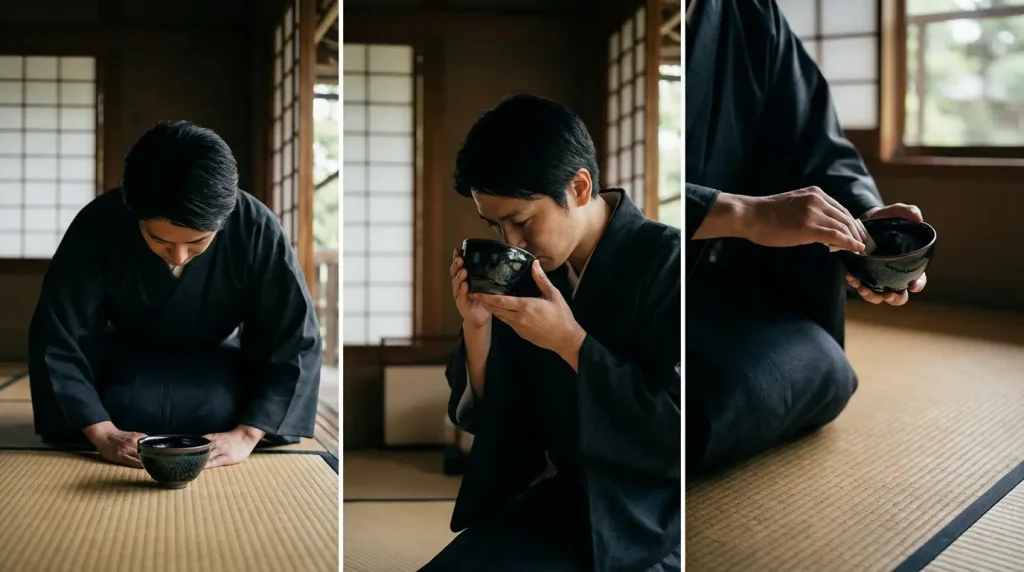
Finish your tea in three and a half sips. The final half-sip should be audible—a small slurp that signals you’ve emptied the bowl completely. This sound isn’t rude; it’s expected.
Here’s the complete drinking sequence used in Japanese tea ceremony:
- Bow when the tea is presented to you
- Place the bowl on the tatami mat in front of your knees
- Pick up the bowl with your right hand, transfer to left palm
- Rotate clockwise 2-3 quarter turns with your right hand
- Drink in approximately 3 sips, pacing yourself
- Finish with a half-sip and audible slurp
- Wipe the rim where your lips touched using thumb and forefinger of your right hand
- Clean your fingers with kaishi paper (small napkin)
- Rotate counter-clockwise to return the front toward the host
- Place the bowl on the mat and bow in thanks
Timing tip: Don’t rush. In formal ceremonies, you might spend 30-60 seconds drinking a single bowl. The pace should feel calm and deliberate.
How to Prepare Matcha in a Tenmoku Bowl
Whisk your matcha using a rapid W or M motion for 20-30 seconds until a layer of fine foam covers the surface. Avoid circular stirring—it won’t create proper froth.
Tenmoku bowls have a conical shape that requires slightly different technique than wider bowls. The narrower base means less room to whisk, so control your movements carefully.
Usucha (Thin Tea) Preparation Steps
| Step | Action | Specifications |
|---|---|---|
| 1 | Preheat the bowl | Fill with hot water, wait 1 minute, discard, wipe dry |
| 2 | Soften the whisk | Soak chasen in warm water for 1 minute |
| 3 | Add matcha | 1-2 scoops (about 1 teaspoon), sifted |
| 4 | Add water | 60-70ml at 70-80°C (158-176°F) |
| 5 | Whisk | W-motion, 20-30 seconds, wrist action only |
Common mistake: Using boiling water. Water above 80°C scorches matcha and creates bitter taste. Let boiled water cool for 2-3 minutes before pouring.
Tips for Whisking in Tenmoku’s Conical Shape
The narrow foot of a tenmoku makes it less stable than flat-bottomed bowls. To compensate:
- Hold the bowl firmly in your left hand while whisking with your right
- Keep the whisk tines slightly lifted from the bottom to avoid scraping
- Use smaller, faster strokes rather than wide sweeping motions
- For formal ceremonies, use a tenmokudate chasen—a long-handled whisk designed for deeper bowls
Using Tenmoku for Different Tea Types
While matcha is the traditional choice, you can use your tenmoku for other teas. The iron-rich glaze actually enhances certain flavors by softening the water and improving heat retention.
| Tea Type | Suitability | Usage Notes |
|---|---|---|
| Matcha | Ideal | Dark glaze contrasts beautifully with green tea and white froth |
| Pu-erh | Excellent | Heat retention keeps dark tea warm; smooths earthy flavors |
| Dark Oolong | Very Good | Iron content rounds out roasted notes |
| Green Tea | Good | Use slightly cooler water (70°C) to prevent bitterness |
Usage tip: Tenmoku keeps tea warm 30-40% longer than thin porcelain cups. If you like to sip slowly, this is your ideal vessel.
Formal vs. Casual: Adjusting Your Technique
In formal tea ceremony (chaji), every gesture follows strict protocol. In casual home use, you can simplify while still respecting the bowl.
| Element | Formal Ceremony | Casual Home Use |
|---|---|---|
| Sip count | Exactly 3.5 sips | Drink at your own pace |
| Final slurp | Required (audible) | Optional |
| Bowl rotation | Required before and after | Recommended but flexible |
| Bowing | Multiple precise bows | Simple acknowledgment |
| Tenmokudai stand | Used for honored guests | Not necessary |
Even at home, using both hands and taking a moment to appreciate the bowl’s beauty honors the spirit of tea ceremony.
Caring for Your Tenmoku After Use
Rinse your tenmoku with warm water only immediately after each use. Wipe gently with a soft cloth and let it air dry completely before storing.
Proper care directly affects how well your tenmoku performs over time:
| Do | Don’t |
|---|---|
| Rinse with warm water after each use | Use dish soap or detergent |
| Wipe with soft cotton cloth | Scrub with abrasive sponges |
| Air dry in ventilated space | Put in dishwasher |
| Store in dry area | Microwave (iron glaze heats unevenly) |
| Handle with dry hands | Seal in plastic while damp |
Note on patina: Over time, tea compounds will create a subtle patina on your tenmoku’s glaze. This is desirable—it shows the bowl has been well-used and loved. Don’t try to scrub it away.
Quick Reference: Tenmoku Tea Bowl Usage Checklist
Use this checklist until the steps become natural:
- ☐ Before receiving: Bow to acknowledge the tea
- ☐ Holding: Right hand picks up → transfer to left palm → right hand supports
- ☐ Pre-drink rotation: Clockwise 2-3 quarter turns
- ☐ Drinking: 3.5 sips, final one audible (formal) or at your pace (casual)
- ☐ After drinking: Wipe rim with fingers, clean fingers with kaishi
- ☐ Post-drink rotation: Counter-clockwise to return front to host
- ☐ Returning: Place on mat, bow in gratitude
- ☐ Cleaning: Warm water rinse, soft cloth wipe, air dry
Start Using Your Tenmoku Today
You don’t need a formal tea room to start using a tenmoku tea cup properly. With just your bowl, a bamboo whisk, and quality matcha, you can practice these techniques every morning.
Begin with the basics: hold with both hands, rotate before drinking, appreciate the bowl’s unique glaze. These simple actions connect you to centuries of tea ceremony tradition—and transform an ordinary cup of tea into a moment of mindfulness.
The more you use your tenmoku following these methods, the more natural they’ll feel. And over time, your bowl will develop its own character—a patina that tells the story of every tea you’ve shared together.
📚 References
- Tea ceremony etiquette and procedure: Official guide from Japan’s largest tea school covering proper temae technique. Urasenke Konnichian – An Introduction to Chado
- Role of ceramics in tea ceremony: Scholarly overview of how tea bowls function within chanoyu practice. The Metropolitan Museum of Art – The Japanese Tea Ceremony
- Historical context of tenmoku bowls: Museum documentation of authenticated Song Dynasty tenmoku in ceremonial use. The Metropolitan Museum of Art – Tea Bowl with Hare’s-Fur Decoration
- Tenmoku production and characteristics: Technical information on glaze composition and firing that affects bowl usage. Wikipedia – Jian Ware


