

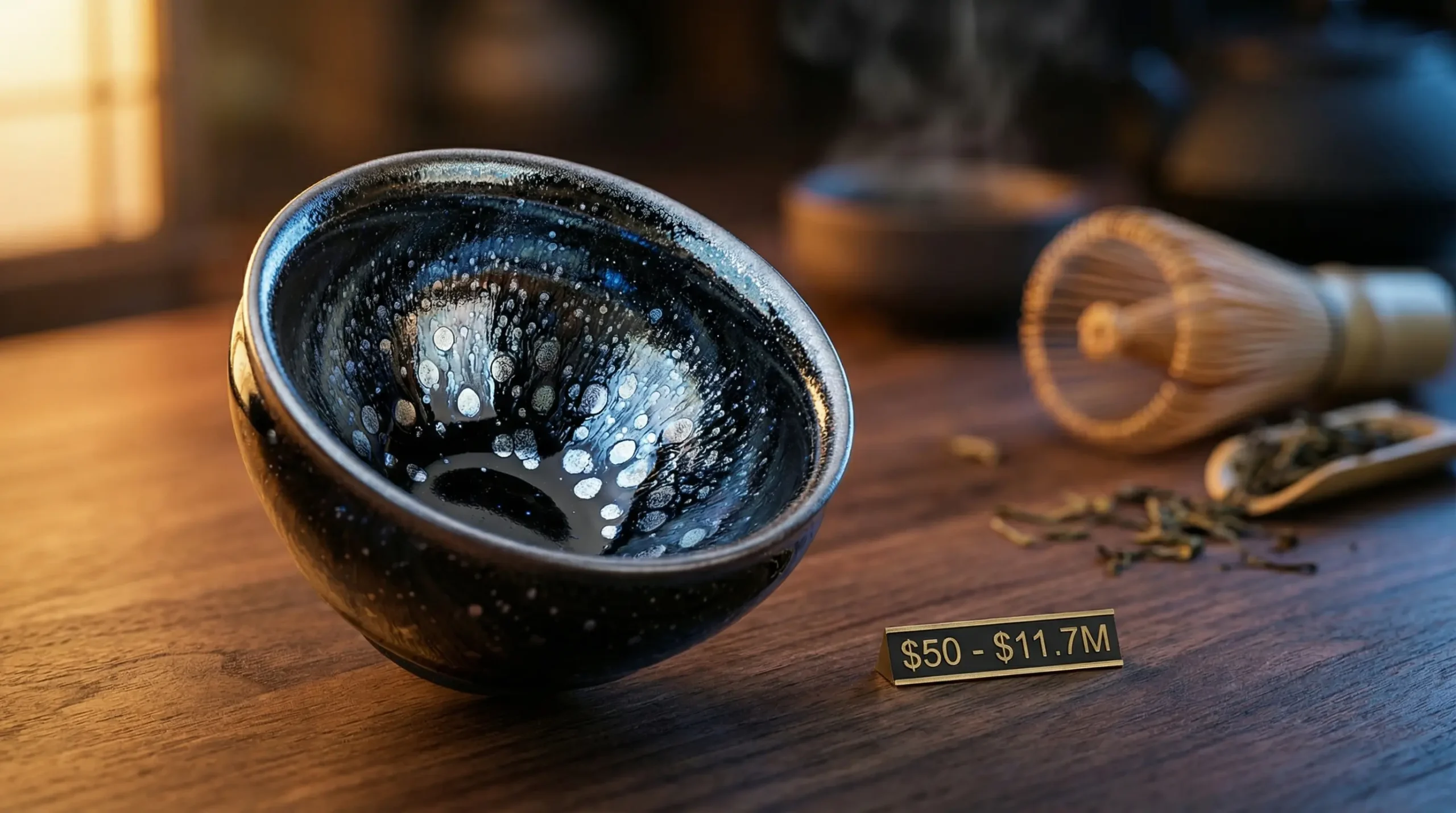
If you’ve been exploring authentic Jian Zhan tea cups, you’ve probably experienced sticker shock. These dark, seemingly simple tea bowls can cost anywhere from $50 to over $5,000—and that’s just for modern pieces. Authentic Song Dynasty examples? They’ve sold at auction for $11.7 million.
At ZenTeaCup, we understand the confusion. How can a tea cup cost as much as a car—or even a house? The answer lies in a fascinating combination of extreme rarity, nearly impossible craftsmanship, and 1,000 years of cultural heritage. Let me walk you through exactly what drives Jian Zhan pricing, so you can make informed decisions about your own collection.
Contents
- The $11.7 Million Record That Changed Everything
- The Brutal Reality of the 5% Success Rate
- The Clay That Exists Nowhere Else
- The Decade-Long Journey to Mastery
- Pattern Rarity Drives Exponential Pricing
- The 700-Year Knowledge Gap
- Hand-Made vs. Machine-Made: Understanding the Price Divide
- Functional Benefits Beyond Beauty
- Cultural Significance and Investment Value
- Breaking Down the $500 Price Tag
- ❓ Frequently Asked Questions
- Is a $1,000 Jian Zhan cup really worth it compared to a $50 one?
- How can I tell if a Jian Zhan is authentic?
- Why are some glaze patterns 10x more expensive than others?
- Do modern Jian Zhan cups appreciate in value?
- Can I use an expensive Jian Zhan cup daily or should it be display-only?
- The Final Word on Jian Zhan Pricing
- ❓ How do I know if my tenmoku cup is authentic?
- ❓ Can I put my tenmoku cup in the dishwasher?
- ❓ What tea tastes best in a tenmoku cup?
- 📚 References
The $11.7 Million Record That Changed Everything
In 2016, Christie’s New York auctioned a single Southern Song Dynasty Jian Zhan tea bowl for $11.7 million USD. The pre-sale estimate? Just $1.5 to $2.5 million. This wasn’t just an auction surprise—it was a cultural awakening.
This particular bowl featured the coveted oil-spot pattern—tiny silver metallic dots scattered across a black glaze like stars in a night sky. But rarity tells only part of the story. Only four complete Yao Bian (iridescent transformation) cups from the Song Dynasty exist today. Three are designated as Japanese National Treasures, locked in museums and never allowed to be filmed.
Here’s what makes Song Dynasty pieces irreplaceable: Production ceased around 1300 CE. The techniques were completely lost for over 700 years. Modern craftsmen, despite decades of research, still cannot perfectly replicate what Song Dynasty potters achieved. Scientists have discovered these ancient cups contain a unique crystalline formation called epsilon phase iron oxide—a structure so complex that even knowing it exists doesn’t tell us how to create it intentionally.
Key Takeaway: Song Dynasty Jian Zhan isn’t just old—it represents a level of craftsmanship that humanity literally forgot how to achieve for seven centuries.
The Brutal Reality of the 5% Success Rate
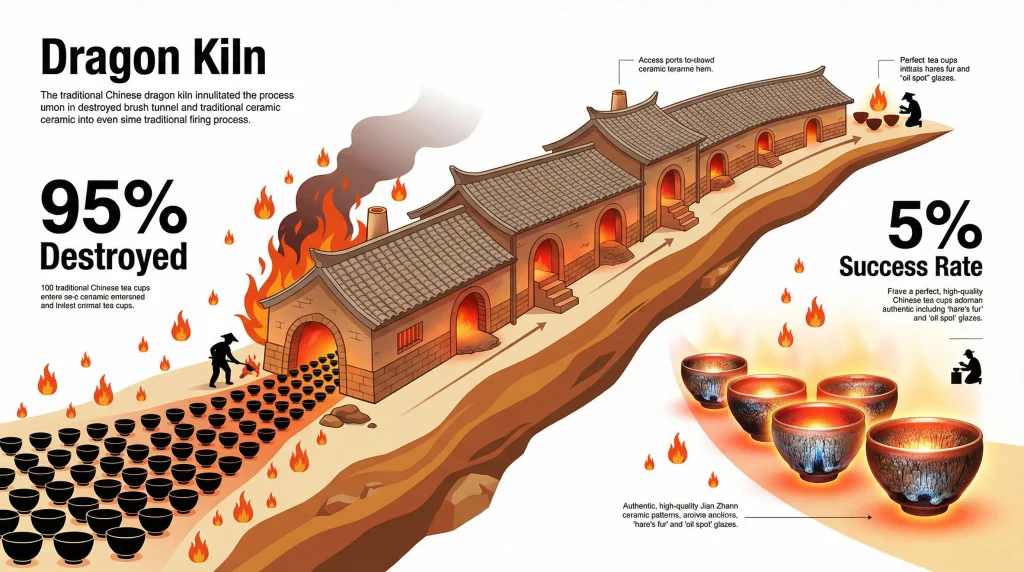
Let’s talk about something potters don’t advertise: Only 5% of fired Jian Zhan cups are sellable. That’s not a typo. For every 100 cups that enter a dragon kiln, 95 are destroyed.
Dragon kilns—those massive wood-fired structures built into hillsides—can hold up to 100,000 pieces in a single firing. The firing process takes over 70 hours of continuous work, burning through cords of pine wood. Temperatures reach 1,300-1,400°C (that’s 2,372-2,552°F).
But here’s the brutal part: nobody knows which pieces will turn out right until they open the kiln. The pattern formation depends on dozens of unpredictable variables:
- Position in the kiln (top vs. bottom, front vs. back)
- Wood moisture content (affects temperature stability)
- Weather conditions (humidity during firing)
- Glaze thickness (a fraction of a millimeter makes the difference)
- Timing of reduction (when oxygen is restricted in the kiln)
Master potters literally smash the imperfect pieces on-site. Visit a kiln location and you’ll find thousands of broken cups that look perfectly functional to the untrained eye. But if the glaze dripped wrong, if the pattern didn’t form clearly, if the rim cracked—it’s destroyed.
In summary, when you buy a hand-fired Jian Zhan for $500, you’re also paying for the 19 cups that were smashed so this one could reach you.
The Clay That Exists Nowhere Else
Jianyang clay contains 7-15% iron oxide. Compare that to standard pottery clay, which contains less than 3%. This single fact explains why every attempt to replicate Jian Zhan outside of Jianyang, Fujian Province has failed.
During the Song Dynasty (960-1279 CE), other kilns across China tried to copy these famous tea cups. They all failed. The reason? You can’t fake geology. The unique iron-rich clay of Jianyang comes from specific mineral deposits that simply don’t exist elsewhere.
| Material Component | Jianyang Source | Standard Clay |
|---|---|---|
| Iron Oxide Content | 7-15% | <3% |
| Clay Aging Time | 1-5 years | 0-6 months |
| Glaze Source | Local plant ash + iron ore | Commercial glaze |
| Geographic Exclusivity | Jianyang only | Worldwide |
But it gets more complex. Authentic Jian Zhan clay must be aged in water for up to 5 years to achieve the perfect density. The glaze? It’s hand-blended from local plant ash and weathered iron ore from the same Shui Ji mineral deposits used in the Song Dynasty.
This geographic exclusivity isn’t marketing hype. It’s mineralogy. And it’s why authentic Jian Zhan commands premium pricing—there’s simply no way to scale production by opening factories elsewhere.
The Decade-Long Journey to Mastery
Creating a sellable Jian Zhan requires mastering 13 production steps. Most craftsmen spend 10-20 years before producing market-worthy pieces consistently.
Consider Master Xiong Zhonggui, who revived authentic Jian Zhan production in the 1990s. He spent decades studying with Japanese Tenmoku masters, excavating original Song Dynasty mineral deposits, and experimenting with firing techniques. His breakthrough? Using the exact same raw materials from the same sites as Song Dynasty kilns.
The 13-step traditional process includes:
- Mineral selection (iron-rich ore identification)
- Crushing (precise particle size)
- Washing and sieving (purity control)
- Clay aging (1-5 years in water)
- Kneading (air removal, density uniformity)
- Wheel throwing (hand-shaping)
- Trimming (foot height adjustment)
- Bisque firing (800°C pre-hardening)
- Glaze blending (secret recipes)
- Glazing (precise application)
- Kiln loading (strategic placement)
- Dragon kiln firing (70+ hours at 1,300-1,400°C)
- Quality inspection (95% rejection rate)
Each step requires skills that take years to develop. Glaze recipes, for instance, take years of experimentation to perfect. One master potter told me he destroyed over 10,000 cups before achieving his first marketable oil-spot pattern.
Bottom line: When you buy from a recognized master, you’re paying for decades of failed experiments and accumulated knowledge that can’t be taught in a classroom.
Pattern Rarity Drives Exponential Pricing

Not all Jian Zhan patterns are created equal. The glaze pattern dramatically affects value, and here’s why: craftsmen cannot control which pattern emerges from the kiln.
Yao Bian (iridescent transformation) represents the pinnacle. These cups display halos of cobalt blue and emerald green around oil spots, creating an effect that seems to glow from within. A 1918 valuation of a Yao Bian piece translates to approximately $15.5 million in today’s currency.
| Pattern Type | Rarity Level | Song Dynasty Value | Modern Price Range |
|---|---|---|---|
| Yao Bian | Extremely rare (4 exist) | Priceless | $10M+ (auction) |
| Oil Spot (silver-blue) | Very rare | 5,000 silk pieces | $2,000-$5,000+ |
| Hare’s Fur | Rare | 3,000 silk pieces | $500-$2,000 |
| Partridge Feather | Uncommon | Lesser value | $300-$1,000 |
| Plain black | Common | Utilitarian | $50-$200 |
Silver-blue oil spots are particularly prized over bronze tones. The color difference comes from microscopic variations in iron crystallization—and it’s entirely luck of the kiln. A master can load 1,000 cups hoping for oil-spot patterns and get only 10-20 successful pieces.
Here’s what you need to know: Pattern rarity explains price jumps that seem irrational. A cup with excellent oil-spot formation might sell for $3,000, while an identical shape with mediocre patterns goes for $300.
The 700-Year Knowledge Gap
In the early Yuan Dynasty (around 1300 CE), Jian Zhan production stopped. Not slowed down—completely ceased. The reason? Tea culture changed.
During the Song Dynasty, tea was prepared by whisking powdered tea leaves into hot water, creating a white froth. Dark Jian Zhan bowls provided perfect contrast to judge the froth quality. But when Ming Dynasty emperors started preferring steeped loose-leaf tea, wide bowls became obsolete. Teapots took over.
The techniques vanished with the craftsmen. For over 700 years, nobody made authentic Jian Zhan. Japan continued producing Tenmoku (their version), but it used different clay and techniques.
Revival timeline:
- 1979: Chinese government initiates research to rediscover techniques
- 1981: First successful reproduction using traditional dragon kiln
- 1990s: Master Xiong revives production with original Shui Ji materials
- 2011: Technique designated as National Intangible Cultural Heritage
Even today, with modern technology and scientific analysis, craftsmen still cannot perfectly replicate the finest Song Dynasty work. This knowledge gap is why modern master works command high prices—they represent the closest we can get to a lost art form.
Hand-Made vs. Machine-Made: Understanding the Price Divide
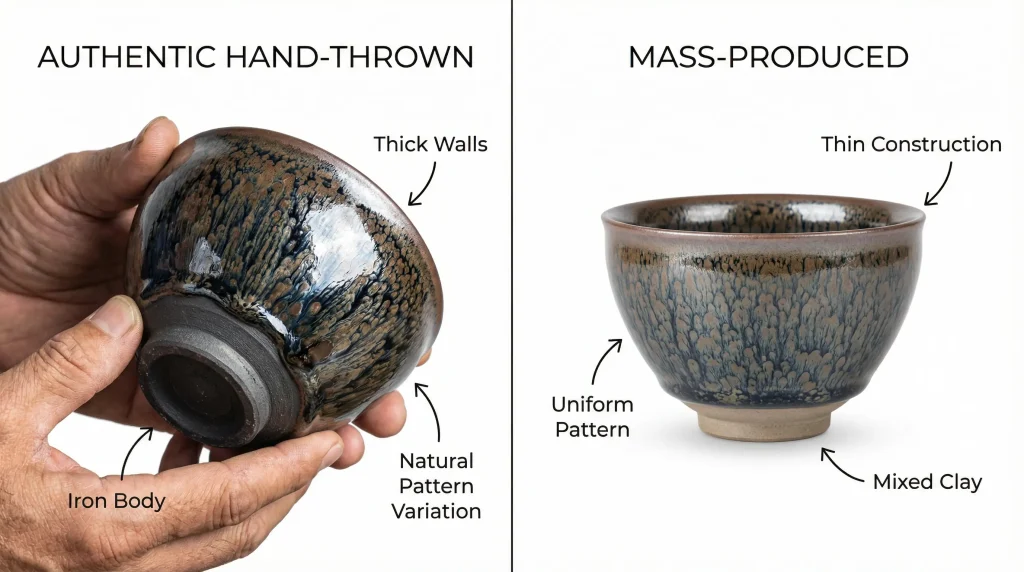
Walk into any tea shop and you’ll see Jian Zhan ranging from $20 to $2,000. What’s the difference?
Mass-produced electric kiln: These use mixed clays (not pure Jianyang), mold pressing (not wheel throwing), and electric kilns with precise temperature control. They’re functional tea cups, but lack the complex crystalline structures that form only in wood-fired dragon kilns.
Hand-thrown wood-fired: Made by skilled craftsmen using authentic materials, shaped on pottery wheels, and fired in unpredictable dragon kilns. Each cup takes days to produce when you include clay aging, shaping, and firing time.
| Feature | Mass-Produced | Master Handmade |
|---|---|---|
| Clay Source | Mixed/imitation | Pure Jianyang |
| Shaping Method | Mold pressing | Potter’s wheel |
| Firing Method | Electric kiln | Wood-fired dragon kiln |
| Success Rate | ~80% | ~5% |
| Production Time | Hours | Days to weeks |
| Price Range | $20-$100 | $500-$5,000+ |
The visual difference is immediate once you know what to look for. Authentic pieces have natural pattern variation, visible iron-rich clay on the unglazed foot (dark gray-black), and substantial weight from thick walls.
To put it simply: Mass-produced cups are for daily tea drinking. Hand-thrown wood-fired pieces are functional art that improves with use.
Functional Benefits Beyond Beauty
Can Jian Zhan actually improve your tea, or is this marketing? The science suggests real benefits exist.
The high iron content (7-15%) subtly increases water alkalinity. Many tea drinkers report tea tastes smoother and rounder with more pronounced aromatics when brewed in Jian Zhan versus regular porcelain.
Try this experiment: Brew the same tea and pour it into both a Jian Zhan cup and a standard porcelain cup. Taste them side by side. Then leave both untouched for half a day. The tea in porcelain will develop bitterness, while Jian Zhan tea often tastes fresher.
Heat retention is another practical advantage. Those thick walls (5-8mm on quality pieces) keep tea hot far longer than thin porcelain. This makes Jian Zhan particularly well-suited for oolongs and pu-erh teas, where maintaining temperature is crucial.
Over time, the cup absorbs tea oils into its crystalline structure. This doesn’t build a visible patina like Yixing teapots, but it subtly alters how crystals refract light. Long-time owners report their cups become more beautiful with years of use.
The key takeaway is: Functional benefits justify daily-use pricing ($200-$500). For purely functional purposes, a mid-range authentic piece provides the full experience.
Cultural Significance and Investment Value
Jian Zhan carries 1,000+ years of tea ceremony heritage. During the Song Dynasty, these were the preferred vessels of Emperor Huizong himself, who wrote extensively about tea culture.
In 2017, Jian Zhan were given as official gifts at the BRICS Summit, representing China’s cultural heritage to world leaders. Three Song Dynasty pieces hold Japanese National Treasure designation—the highest honor for cultural artifacts.
For collectors and investors, the market has shown consistent appreciation:
- Song Dynasty pieces: From $1.5M estimate to $11.7M sale (2016)
- Modern master works: Li Ximei’s “A Thousand Mountains” sold for $4 million (2017)
- Established masters: 50-300% appreciation over 5-10 years
Authentication is critical. Always request certificates from recognized masters and provenance documentation. The market includes many imitations.
At ZenTeaCup, we work directly with authenticated craftsmen from the Jianyang region, ensuring every piece comes with proper documentation and represents genuine traditional craftsmanship.
Breaking Down the $500 Price Tag
Let’s demystify what you’re actually paying for in a mid-range $500 hand-thrown Jian Zhan:
- Raw Materials (10-15%): Authentic Jianyang clay, aged 1-5 years, plus hand-blended glaze from local minerals. ~$50-75
- Master Labor (30-40%): Skilled craftsman’s time through 13 production steps, years of training. ~$150-200
- Failure Rate Absorption (20-25%): Cost of the 19 cups destroyed so this one could exist. ~$100-125
- Kiln Operation (15-20%): Wood costs, 70+ hours of firing, maintenance. ~$75-100
- Distribution & Retail (20-30%): Import, quality control, retail operations. ~$100-150
Notice what’s not on this list: massive profit margins. The pricing reflects genuine costs of maintaining traditional craftsmanship.
Fair Price Expectations by Category:
- Daily use (electric kiln): $50-$150
- Quality handmade: $200-$800
- Master craftsman: $800-$3,000
- Rare patterns/famous artists: $3,000-$10,000+
- Antique/Museum quality: $50,000-millions
If someone offers a “hand-thrown dragon kiln Jian Zhan” for $30, it’s not authentic. The raw materials alone cost more than that.
❓ Frequently Asked Questions
Is a $1,000 Jian Zhan cup really worth it compared to a $50 one?
A $1,000 cup is typically hand-thrown by an established master, wood-fired in a dragon kiln using authentic Jianyang materials, with documented provenance. A $50 cup is usually electric-kiln fired with mixed clays—functional for tea but lacking the complex crystalline structures, authentic materials, and investment potential. The difference is immediately visible in glaze depth and pattern complexity. If you appreciate fine craftsmanship and plan to use it daily for years, the $1,000 piece offers better long-term value.
How can I tell if a Jian Zhan is authentic?
Authentic Jian Zhan has three key markers: (1) Natural pattern variation—no two cups identical, (2) “Iron body” appearance on the unglazed foot (dark gray/black with reddish tones), and (3) Weight—genuine pieces feel noticeably heavy due to thick walls and iron-rich clay. Always request certificates of authenticity from recognized Jianyang masters and avoid uniform patterns suggesting mass production. At ZenTeaCup, we provide full authentication documentation with every piece.
Why are some glaze patterns 10x more expensive than others?
Pattern value follows rarity and difficulty: Yao Bian (iridescent) is most expensive due to near-impossibility of creation; Oil Spot with silver-blue tones commands premium pricing; classic Hare’s Fur is more accessible. In traditional wood-firing, craftsmen cannot control which pattern emerges—the kiln’s “luck” determines outcome, making rarer patterns exponentially more valuable. A master might fire 1,000 cups to get 10-20 excellent oil-spot pieces.
Do modern Jian Zhan cups appreciate in value?
Select modern pieces by recognized masters (those with Intangible Cultural Heritage designations or major awards) have shown 50-300% appreciation over 5-10 years. However, mass-produced pieces rarely appreciate. Investment potential depends on master reputation, wood-firing authentication, pattern rarity, and documented provenance. Treat as art collecting, not guaranteed investment. Pieces under $1,000 are best purchased for personal enjoyment rather than investment.
Can I use an expensive Jian Zhan cup daily or should it be display-only?
Authentic Jian Zhan improves with daily use—tea oils absorbed into the crystalline structure enhance both appearance and tea taste over time. Pieces under $1,000 are ideal for daily use; $1,000-$5,000 for regular special occasions; above $5,000 warrants careful consideration given collectible value. Dragon kiln pieces are remarkably durable despite appearance, fired at temperatures exceeding most modern ceramics. They’re meant to be used, not just displayed.
The Final Word on Jian Zhan Pricing
Expensive? Yes. Overpriced? Not if you understand what you’re getting.
Jian Zhan tea cup pricing reflects a perfect storm of factors: geography-locked materials, nearly lost techniques, brutal failure rates, decades of master training, and irreplaceable cultural heritage. When you hold an authentic piece, you’re holding the culmination of 1,000+ years of ceramic evolution and 70+ hours of wood-fired alchemy.
For casual tea drinkers, a quality mid-range piece ($200-$500) offers the full functional experience. For serious collectors, authenticated master works represent both aesthetic pleasure and potential investment. For everyone else, even a modest authentic piece connects you to one of China’s most refined artistic traditions.
The question isn’t whether Jian Zhan is expensive. It’s whether what you gain—in daily tea enjoyment, aesthetic appreciation, and cultural connection—justifies the cost. For thousands of tea lovers worldwide, the answer is a resounding yes.
Ready to experience authentic Jian Zhan? Visit these cups to explore our curated collection of authenticated pieces, each with full provenance documentation and backed by our commitment to traditional craftsmanship.
❓ How do I know if my tenmoku cup is authentic?
Look for an unglazed foot ring showing dark, iron-rich clay, metallic luster under light that shifts with viewing angle, and subtle asymmetry indicating hand-forming. See the handmade tenmoku identification guide for detailed authentication steps.
❓ Can I put my tenmoku cup in the dishwasher?
No. Always hand-wash with warm water only. Dishwasher detergent and high-pressure water can damage the glaze patina and may cause micro-cracking. The new tenmoku owner guide provides complete care instructions.
❓ What tea tastes best in a tenmoku cup?
Oolong and aged pu-erh are the classic pairings. The iron-rich glaze softens tannins and enhances aroma. Read the oolong-tenmoku pairing guide for the science behind this.
📚 References
- Song Dynasty Jian Ware History and Museum Collections: The Metropolitan Museum of Art houses multiple authenticated Song Dynasty Jian Zhan pieces, providing scholarly documentation on materials, techniques, and cultural significance. Metropolitan Museum of Art – Jian Ware Collection
- Historical Documentation and Scholarly Research: Wikipedia’s comprehensive article on Jian ware compiles academic research, including the 2016 Christie’s auction record, production techniques, and the 700-year knowledge gap. Wikipedia – Jian Ware
- Technical Production Details and Master Craftsmen: Detailed information about modern Jian Zhan revival, master craftsmen techniques, and the relationship with Japanese Tenmoku tradition. One Space – Jian Zhan History and Techniques
- Cultural Context and Tea Ceremony Significance: The Metropolitan Museum of Art blog explores how Jian Zhan tea bowls functioned within Song Dynasty tea culture and their influence on Japanese tea ceremony. The Met – If Tea Bowls Could Talk
Ready to elevate your tea ritual? Explore these cups for handcrafted tenmoku cups shipped across the US.


