

Contents
- Why the Song Dynasty Was the Golden Age of Tea Culture
- Emperor Huizong: The Tea Obsessive Who Changed Everything
- The Daguan Tea Manual: An Emperor’s Obsession Documented
- Diancha: The Whisked Tea Method That Defined an Era
- Step-by-Step: How You Would Whisk Tea in the Song Court
- Why Jian Zhan Became the Emperor’s Chosen Vessel
- The Hare’s Fur and Oil Spot Patterns That Won Imperial Favor
- Tea Competitions: Where Status Was Won and Lost
- ❓ Why Did Song Dynasty Emperors Love Jian Zhan?
- ❓ What Was Diancha in the Song Dynasty?
- ❓ How Did Song Dynasty Tea Culture Influence Japan?
- ❓ What Made Song Dynasty Tea Culture Different from Other Periods?
- The Legacy: From Song Courts to Your Tea Table
- 📚 References
Why the Song Dynasty Was the Golden Age of Tea Culture
The Song Dynasty (960-1279 CE Over 20 emperors ruled during this 318-year period.) did not simply drink tea. They elevated it into an art form, a spiritual practice, and a symbol of refined civilization. No period in Chinese history matched the Song era for the depth, sophistication, and sheer passion surrounding tea. From the imperial court to the scholar’s study, tea was the medium through which aesthetics, philosophy, and social status converged.
At Zen Tea Cup, we celebrate this legacy by offering authentic Jian Zhan tea cups that carry the same spirit of Song Dynasty craftsmanship into your daily ritual.
Emperor Huizong: The Tea Obsessive Who Changed Everything
The Daguan Tea Manual: An Emperor’s Obsession Documented
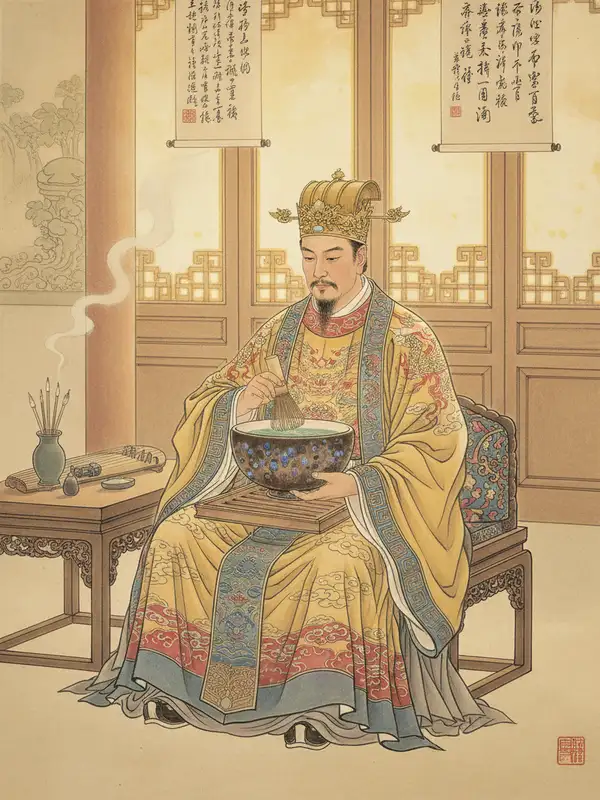
No single person did more to shape Song Dynasty tea culture than Emperor Huizong (1082-1135), the eighth emperor of the Northern Song. Huizong was a terrible ruler whose military failures led to the Jingkang Incident and the fall of the Northern Song, but he was arguably the most artistically gifted emperor in Chinese history. His personal obsession with tea was so intense that he wrote the Daguan Chalun (Treatise on Tea), a 20-chapter imperial manual covering every aspect of tea preparation, from selecting leaves to whisking technique.
According to Huizong’s treatise, the ideal tea foam should be “white as jade, fine as silk, and lasting as clouds.” He personally judged tea competitions at court, where officials would compete to produce the finest whisked tea. The emperor’s endorsement made Jian Zhan the only acceptable vessel for these competitions, because the dark glaze provided the perfect contrast against the white foam. No other cup could display the quality of whisking so clearly.
Historical records from the Xuanhe Beifeng Lu describe how Huizong would spend hours preparing tea for his ministers, treating each bowl as a work of art. His influence was so absolute that the entire Song elite adopted his standards, creating a tea culture that persisted for centuries. The treatise itself is remarkably detailed: Huizong specifies the exact color of tea foam (pure white with no hint of green), the ideal water temperature (just below boiling, around 85 degrees C or 185 degrees F), and even the proper grip for the whisk. Such precision from an emperor tells us that tea was not merely a pastime at the Song court. It was a discipline as serious as calligraphy or poetry.
Diancha: The Whisked Tea Method That Defined an Era
Step-by-Step: How You Would Whisk Tea in the Song Court
The Song Dynasty practiced diancha (点茶), a method of preparing tea that is the direct ancestor of Japanese matcha ceremony. The process was elaborate and required significant skill:
- Roasting: Tea bricks were carefully roasted over a low fire to release aroma without scorching
- Grinding: The roasted tea was ground into an ultra-fine powder using a stone mill, similar to modern matcha production
- Sifting: The powder was sifted multiple times to ensure no coarse particles remained
- Heating: The Jian Zhan bowl was warmed with hot water, then dried
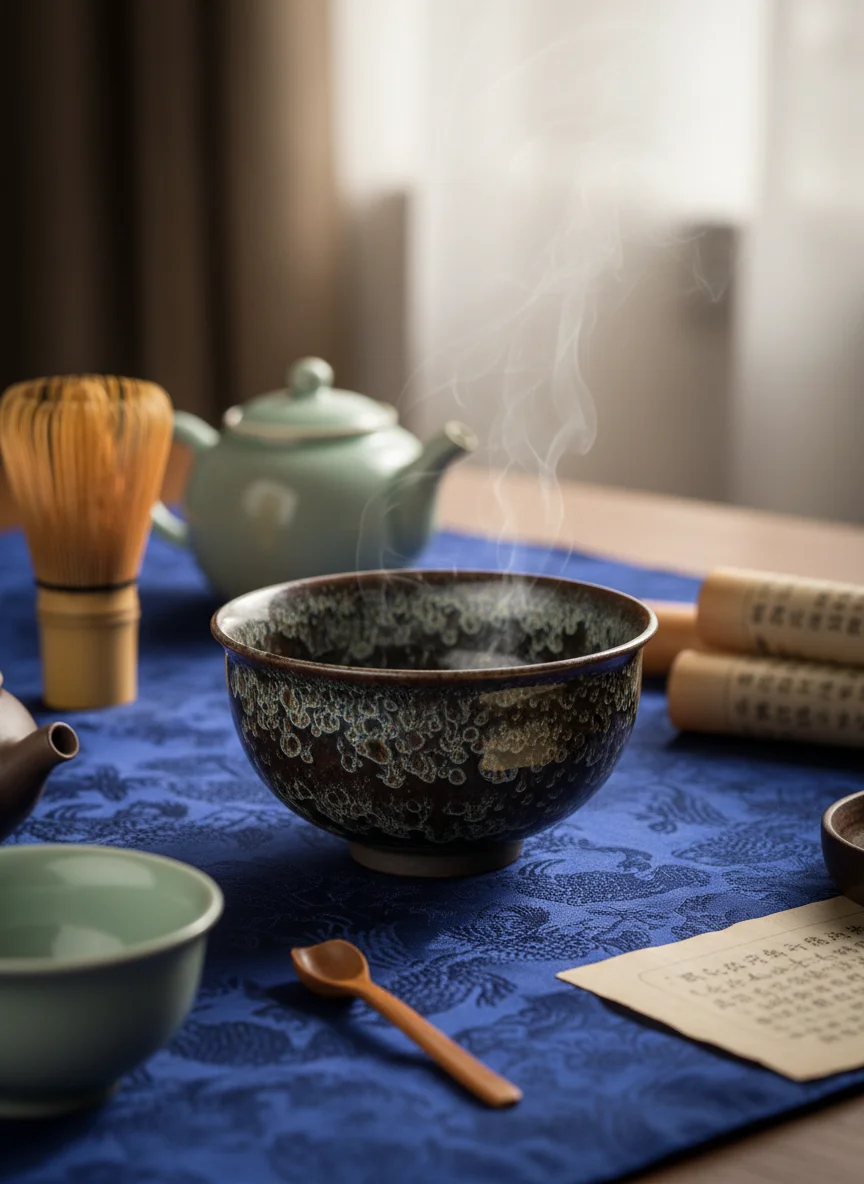
- Whisking: Hot water was added gradually while whisking rapidly with a bamboo chasen until a thick, uniform foam formed
The quality of the foam was the ultimate test. A perfect bowl of diancha had foam that was thick enough to support a grain of rice on its surface without sinking. The Song aesthetic ideal was “bai ru chun you” (white as spring butter), a phrase that appears repeatedly in Song Dynasty tea literature and captures the velvety, luxurious texture that skilled practitioners aspired to achieve. The foam color had to be pure white, and it needed to last for several minutes without breaking. This is precisely why Jian Zhan’s dark iron glaze was essential: the contrast between the white foam and the black bowl made every imperfection visible, and every perfection celebrated.
Why Jian Zhan Became the Emperor’s Chosen Vessel
The Hare’s Fur and Oil Spot Patterns That Won Imperial Favor
Jian Zhan was not the only tea ware available during the Song Dynasty. The imperial court had access to exquisite celadon from Longquan, white porcelain from Ding kiln, and black ware from several other regions. Yet Jian Zhan from Jianyang in Fujian Province became the definitive vessel for diancha, and the reasons go beyond aesthetics.
Thermal properties: The thick iron-rich clay walls of Jian Zhan retained heat exceptionally well, keeping the whisked tea at the optimal temperature for longer. According to research published by the Fujian Provincial Museum, Jian Zhan retains heat 15-20 percent longer than comparable Song Dynasty porcelain. In diancha, temperature control was critical: too cool and the foam would not form properly, too hot and the delicate tea flavors would be destroyed.
Visual contrast: The dark glaze, ranging from deep black to iridescent hare fur and oil spot patterns, provided the perfect backdrop for evaluating the white foam. Emperor Huizong specifically praised the “hare fur” pattern in his treatise, noting that the finest bowls had patterns that seemed to glow from within when filled with tea.
Iron content and taste: The iron-rich clay body of Jian Zhan interacts with tea in subtle ways that enhance flavor. Modern testing has confirmed that the iron oxide in the glaze can soften water and bring out sweeter notes in the tea, a fact that Song Dynasty tea masters discovered through centuries of experience.
Tea Competitions: Where Status Was Won and Lost
Song Dynasty tea culture was not just about quiet contemplation. It was intensely competitive. Doucha (斗茶), or tea battles, were social events where participants competed to produce the finest bowl of whisked tea. These competitions were held at every level of society, from informal gatherings among friends to grand imperial contests presided over by the emperor himself.
| Competition Element | Winning Criteria | Weight |
|---|---|---|
| Foam color | Pure white, no greenish tint | 30% |
| Foam texture | Fine, uniform, no large bubbles | 25% |
| Foam duration | Lasts longest without breaking | 25% |
| Water mark | Latest to appear on bowl wall | 20% |
The “water mark” was the moment when the foam began to recede, leaving a water line on the interior wall of the bowl. In a Jian Zhan, this water mark was clearly visible against the dark glaze. The competitor whose foam lasted the longest, with the latest water mark, won. These competitions were serious business: winning could mean imperial favor, career advancement, and social prestige. Losing could mean public embarrassment. The Song Dynasty poet Su Shi famously wrote about the tension of these competitions, describing how “the hand trembles as the whisk moves, and the heart races as the foam settles.” Literary records from the period suggest that some officials spent small fortunes on the finest tea and equipment, hoping to gain an edge in these high-stakes contests.
The history of Jian Zhan is inseparable from these tea battles. The bowls were literally designed for competition, with every aspect of their form and glaze optimized for the visual evaluation of whisked tea quality.
❓ Why Did Song Dynasty Emperors Love Jian Zhan?
Song emperors, particularly Huizong, loved Jian Zhan because the dark glaze provided the perfect contrast for evaluating whisked tea foam quality. The thick walls kept tea at optimal temperature for whisking, and the iron-rich clay enhanced the tea’s flavor. Jian Zhan was also rare and difficult to produce, making it a status symbol that reflected the emperor’s refined taste and access to the finest craftsmanship in the empire.
❓ What Was Diancha in the Song Dynasty?
Diancha was the Song Dynasty method of preparing whisked tea. Tea was ground into a fine powder, placed in a Jian Zhan bowl, and whisked with hot water Typically, you would use about 2 grams of tea powder and 60 ml of water heated to 85°C (185°F). using a bamboo whisk until a thick white foam formed. The quality of the foam, its color, texture, and duration, was the primary measure of the tea maker’s skill. Diancha is the direct ancestor of the Japanese matcha ceremony.
❓ How Did Song Dynasty Tea Culture Influence Japan?
Japanese Zen monks who traveled to Song Dynasty China encountered diancha and Jian Zhan at Buddhist monasteries. They brought both the whisking technique and the tea bowls back to Japan, where the practice evolved into what we now know as the Japanese tea ceremony (chanoyu). The Japanese term “tenmoku” comes from Mount Tianmu in Zhejiang Province, where monks reportedly first encountered these bowls. Explore our guide to how tenmoku became popular in Japan for the full story.
❓ What Made Song Dynasty Tea Culture Different from Other Periods?
Three things made Song tea culture unique: the diancha whisking method, the competitive tea battles (doucha), and the imperial patronage that elevated tea from a daily beverage to a refined art. Earlier dynasties like the Tang boiled tea with salt and spices, while later dynasties like the Ming shifted to steeped loose-leaf tea. The Song emphasis on whisked tea and visual evaluation of foam quality created a tea culture that has no parallel in any other period of Chinese history.
The Legacy: From Song Courts to Your Tea Table
If you think the story of Jian Zhan ended with the Song Dynasty, you would be mistaken. The technique was lost for centuries after the Ming Dynasty banned compressed tea and promoted loose-leaf brewing, making diancha and its specialized vessels obsolete. But in the 1970s, ceramicists in Jianyang began reconstructing the ancient firing techniques, and today, authentic Jian Zhan is once again being produced using methods that would be recognizable to a Song Dynasty tea master.
Modern ceramicists in Jianyang have spent decades reverse-engineering the ancient firing techniques. The key challenge is reproducing the crystalline glaze patterns, particularly the oil spot and hare fur effects, which require precise control of kiln temperature (around 1300 degrees C or 2372 degrees F) and a reducing atmosphere. Even with modern temperature controls, the success rate for these patterns remains low, which is why high-quality Jian Zhan commands premium prices today.
When you whisk your next bowl of matcha in a Jian Zhan, you are continuing a thousand-year tradition that Song emperors cherished. Browse our authentic Jian Zhan collection and bring a piece of Song Dynasty heritage to your tea table.
📚 References
-
Song Dynasty Tea Culture and Diancha:
Historical overview of whisked tea practices and imperial tea competitions.
Palace Museum, Beijing -
Jian Ware Traditions:
Comprehensive collection of Song Dynasty ceramics and kiln artifacts.
The Metropolitan Museum of Art -
Chinese Tea: A Cultural History:
Academic resource on the evolution of tea preparation methods across Chinese dynasties.
British Museum
When you whisk matcha in a Jian Zhan bowl today, you are participating in a tradition that Emperor Huizong himself would recognize. You will see the same dark glaze, the same iron-rich clay, the same visual contrast between white foam and black bowl. The difference is that you do not need to be an emperor to enjoy it. You simply need the right bowl and the willingness to slow down. Browse our collection of authentic Jian Zhan tea cups and bring a piece of Song Dynasty heritage into your daily tea practice.


