

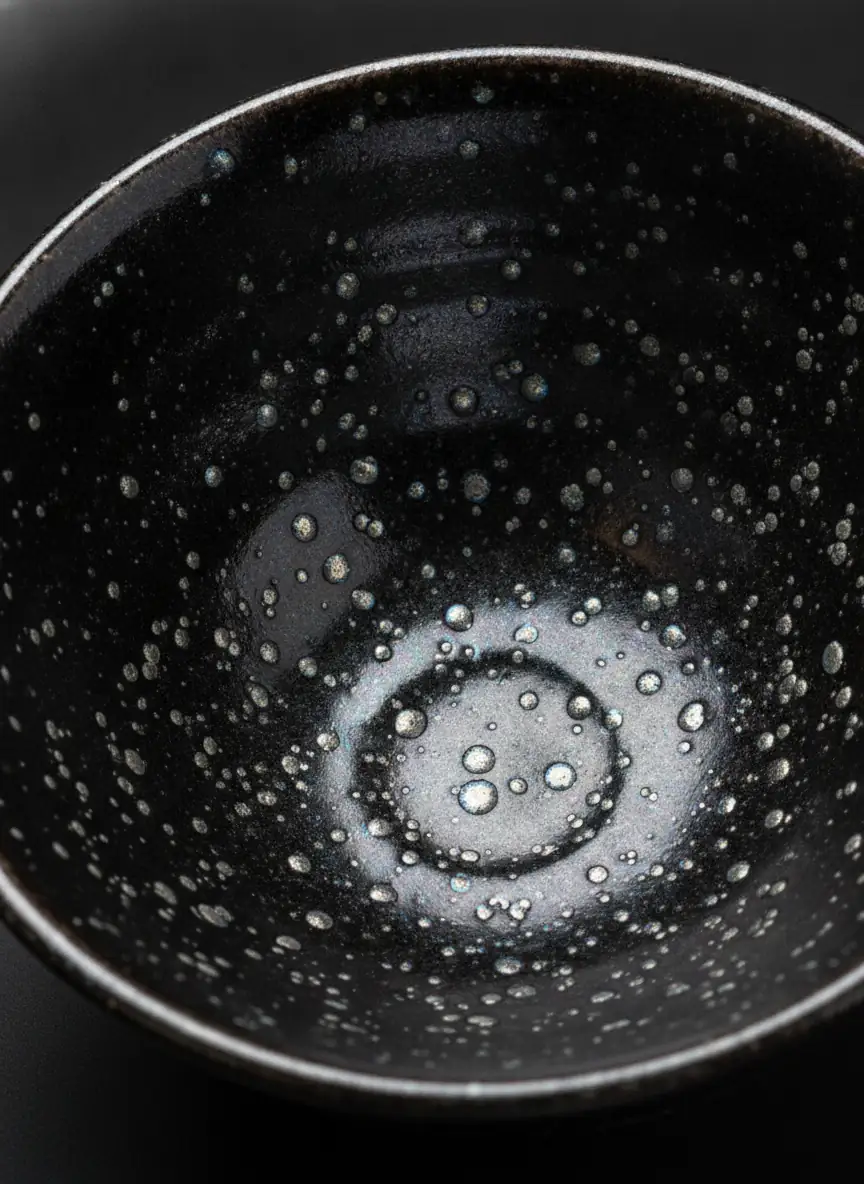
Of all the patterns that grace Song Dynasty Jian Zhan tea bowls, Yuteki Tenmoku stands apart — its silvery oil-spot crystals don’t merely decorate the surface but shimmer with an iridescence that shifts from blue-violet to green as you turn the bowl in your hand. At ZenTeaCup, our years of working with Jianyang kiln artisans have taught us that what makes these bowls truly special isn’t just their beauty, but the extraordinary science and centuries of tradition behind every spot.
In the world of Japanese tea ceremony and Chinese gongfu tea, few vessels carry the weight of history and scientific wonder quite like the Yuteki Tenmoku. These bowls have been treasured by Ashikaga shoguns, documented in feudal storehouse catalogs, and studied by physicists using synchrotron X-ray technology. Here’s a guide to understanding why Yuteki Tenmoku tea bowls have captivated tea practitioners for over 900 years — and how to recognize the real thing.
Contents
- What Does “Yuteki” Mean? The Origin of Oil Spot Tenmoku
- How Oil Spot Patterns Form Inside the Kiln
- The Iridescent Science Behind Yuteki Glaze
- Yuteki vs Yohen vs Hare’s Fur: What Sets Them Apart
- How to Identify Authentic Yuteki Tenmoku Glaze
- ❓ Frequently Asked Questions About Yuteki Tenmoku
- Is Yuteki Tenmoku food safe?
- Can I use a Yuteki Tenmoku bowl for everyday tea?
- Why are some Yuteki bowls so expensive?
- Does the iron glaze really improve tea flavor?
- ❓ How do I know if my tenmoku cup is authentic?
- ❓ Can I put my tenmoku cup in the dishwasher?
- ❓ What tea tastes best in a tenmoku cup?
- 📚 References
What Does “Yuteki” Mean? The Origin of Oil Spot Tenmoku
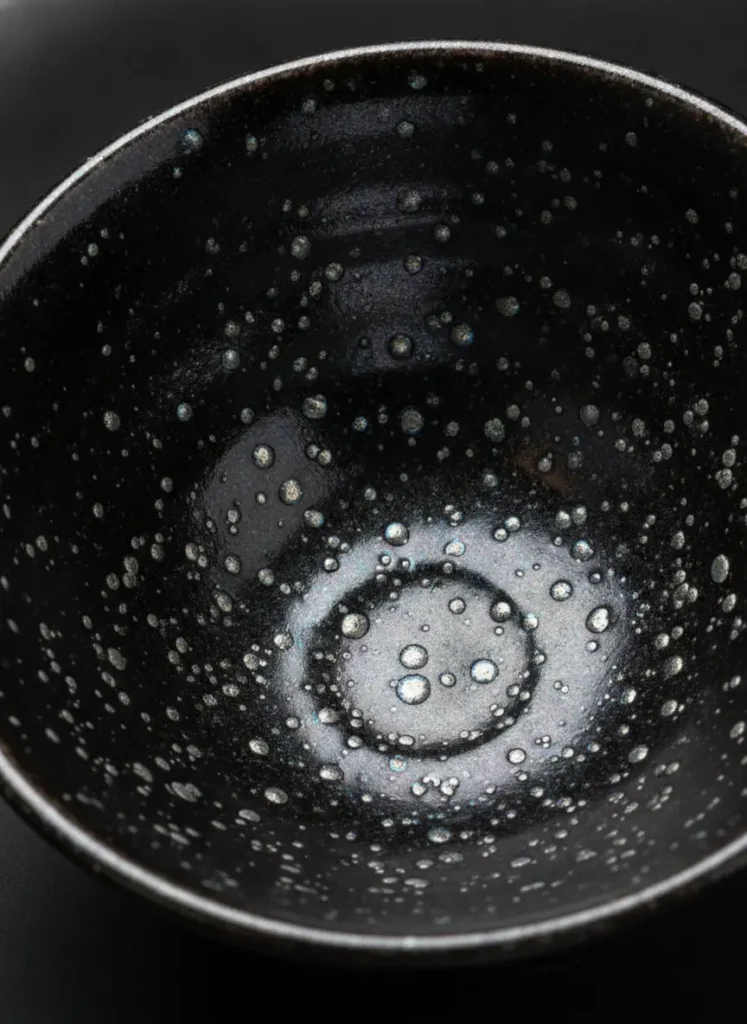
Yuteki (油滴) literally means “oil drop” in Japanese — a name that describes the silvery, circular spots that float across the black glaze of these Song Dynasty tea bowls like drops of oil on water. The term was first widely used during Japan’s Muromachi period (14th–16th century), when tea practitioners simply referred to these bowls as yuteki or yuteki tenmoku, without the broader “tenmoku” classification we use today.
These bowls originated in the Jian kilns (建窑), located in the town of Shuiji in northern Fujian Province, China. During the Song Dynasty (960–1279), Jian kilns produced black-glazed tea bowls prized by imperial tea-tasting competitions. The iron-rich local clay and high-temperature firing produced a thick lustrous glaze that, under the right conditions, developed crystalline metallic spots on its surface. The bowls were specifically designed for the Song Dynasty practice of doucha (斗茶) — competitive tea whisking — where the dark glaze provided a dramatic backdrop for the white tea foam.
In Japan, these Jian ware bowls are collectively called Kensan (建盏), and their cultural status is extraordinary: four of the eight tea bowls designated as national treasures in Japan are Kensan — a testament to how deeply Japanese tea culture has revered these works since Zen monks first brought them back from China in the twelfth century. The Ashikaga shoguns (14th–16th century) used these bowls in the most formal tea ceremony settings (daisu-temae), reserving them for occasions of the highest rank.
The oil-spot pattern was not something the Song Dynasty potters could fully control. Each bowl’s spots vary in size, distribution, and color — a natural result of the firing process that makes every piece one of a kind. This irreproducible quality is part of what has made Yuteki Tenmoku bowls so sought after by collectors and tea practitioners for nearly a millennium.
You can display your tenmoku collection as stunning decor when not in use. The reduction firing phase lasts approximately 30–45 minutes.
How Oil Spot Patterns Form Inside the Kiln
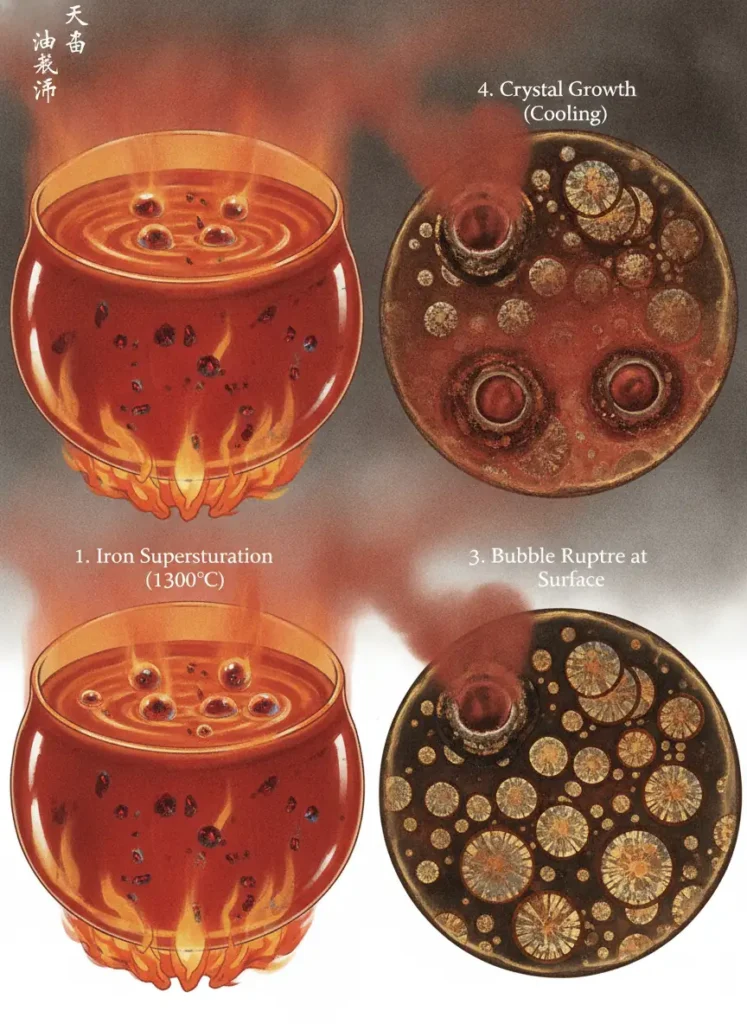
Oil spot patterns form when iron-rich glaze reaches supersaturation during high-temperature firing, causing iron oxide to crystallize on the surface as the bowl cools. The process unfolds in four distinct stages:
- Iron Supersaturation (~1300°C): The glaze, loaded with 15–30% iron oxide, becomes molten. As temperature rises, iron dissolves into the glaze melt until it reaches supersaturation — more iron than the glaze liquid can hold.
- Gas Bubble Formation: Decomposing organic matter and minerals in the clay body release gas bubbles. These bubbles rise through the viscous molten glaze, carrying dissolved iron with them.
- Bubble Rupture at the Surface: When a bubble breaks through the glaze surface, it leaves behind a small circular depression. The iron-rich melt concentrates around the rim of this crater.
- Crystal Growth During Cooling: As the kiln cools, the concentrated iron at each rupture site crystallizes into the silvery or golden spots we recognize as “oil drops.” The size and shape of each crystal depend on cooling speed and local iron concentration.
On our first visit to a Jianyang dragon kiln, we watched a master pull a freshly fired yuteki bowl from the cooling stack. No two bowls from the same firing had identical spot patterns — one was dense with small silver dots, another carried just a few large golden pools. That irreproducible variation is exactly what makes each You might be surprised how much the cup material affects your tea’s taste.
href=”/tea-cups”>Yuteki Tenmoku tea bowl a singular work of natural art.
The Iridescent Science Behind Yuteki Glaze
In 2023, researchers at Japan’s RIKEN institute discovered that the iridescent shimmer of Yuteki Tenmoku comes from a nano-scale wrinkle pattern on the glaze surface, with a periodicity of just 900 nanometers. This finding, published in the journal Kogaku, solved a mystery that had puzzled ceramics experts for decades.
The key to the iridescence lies in the crystal composition. For years, scientists believed the shining silver spots on oil-spot glaze were composed of magnetite (Fe₃O₄). But a landmark 2014 study using synchrotron X-ray techniques revealed that the crystals are actually epsilon iron oxide (ε-Fe₂O₃) — an extremely rare form of iron oxide that is remarkably difficult to produce in a laboratory, yet Song Dynasty potters created it in kilns 900 years ago.
The RIKEN team found that the ε-Fe₂O₃ crystals create a two-dimensional wrinkle pattern on the glaze surface. With a periodicity of 900nm and a depth of about 100nm, this wrinkle structure acts as a 2D diffraction grating — similar to the surface of a CD or holographic sticker. When light hits the surface, the wrinkle pattern diffracts blue-violet wavelengths (around 400nm) approximately 3.5 times more efficiently than red wavelengths (700nm), producing the characteristic blue-violet to bluish-green color shift that moves across the oil spots as you change your viewing angle.
This discovery also explained something tea practitioners had long observed: the iridescence of Yuteki Tenmoku looks most vivid under certain types of lighting. LED surface light sources, which emit strong peaks at 450–460nm (blue), interact with the nano-structure in a way that makes the color shift especially pronounced. This is why museum exhibitions of national treasure Yuteki bowls often use specific lighting configurations to showcase their iridescence — and why your own yuteki bowl may look dramatically different under warm incandescent light versus cool daylight.
The presence of ε-Fe₂O₃ is significant for another reason: this form of iron oxide is extremely difficult to synthesize in a laboratory. It requires very specific thermal conditions to form, and materials scientists have only recently been able to produce it consistently under controlled conditions. That Song Dynasty potters achieved this — without modern instruments, relying solely on generations of empirical knowledge passed down through kiln families — is a remarkable achievement in the history of materials science. Our deeper exploration of how to achieve the perfect oil spot effect in Tenmoku glazes covers the practical firing techniques in greater detail.
Yuteki vs Yohen vs Hare’s Fur: What Sets Them Apart
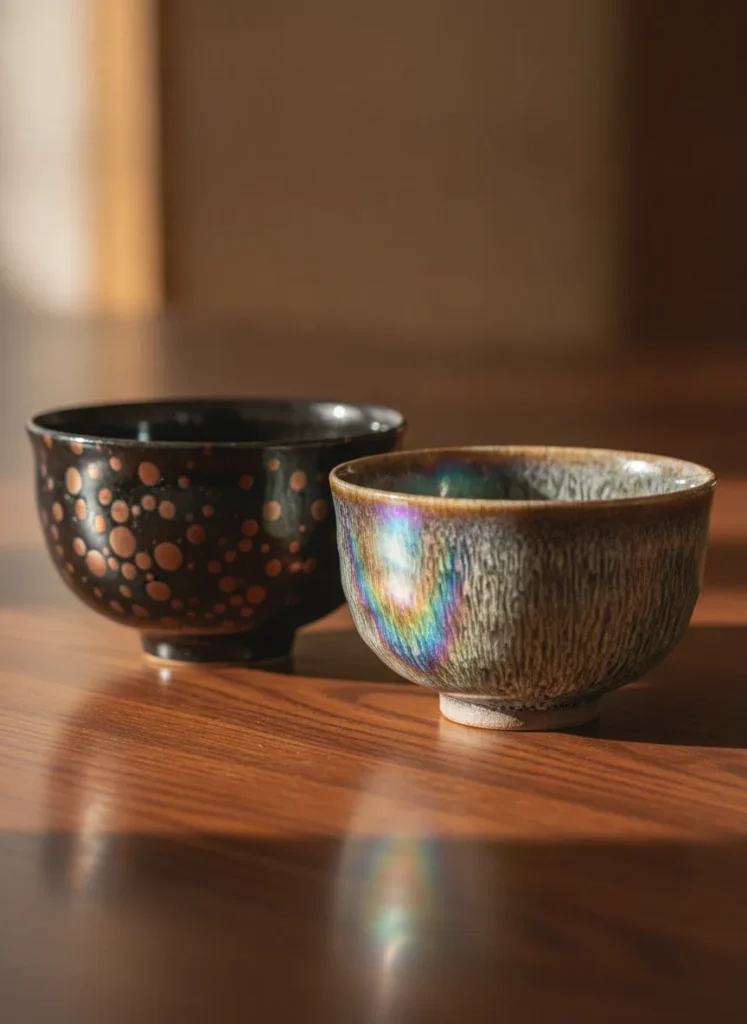
While yuteki, yohen, and hare’s fur are all patterns found on Jian Zhan tea bowls, each forms through a distinct process and creates a completely different visual effect. Understanding these differences helps you appreciate why yuteki occupies a unique position among Tenmoku glazes.
| Feature | Yuteki (Oil Spot) | Yohen (Iridescent Change) | Hare’s Fur (Tuhao) |
|---|---|---|---|
| Pattern | Round metallic spots on black glaze | Color-shifting halos around spots; rainbow effect | Fine parallel streaks running down the bowl |
| Formation | Iron crystal growth at bubble-rupture sites during cooling | Additional nano-layering creates multi-wavelength interference | Iron flows down the bowl surface during firing |
| Appearance | Silvery or golden circular spots; blue-violet iridescence at angles | Spots surrounded by vivid rainbow halos that shift with viewing angle | Thin silver or gold streaks resembling animal fur |
| Rarity | Uncommon — requires controlled oxidation during cooling | Extremely rare — only 3 complete Song Dynasty examples survive | More common — the most frequently seen Jian Zhan pattern |
| Price Range (modern) | $50–$150 USD (contemporary); millions at auction (antique) | Priceless — all 3 survivors are Japanese national treasures | $35–$90 USD (contemporary) |
Yuteki is the most accessible of the premium Tenmoku patterns for collectors. While Yohen is virtually unattainable (the three surviving Song Dynasty examples are all Japanese national treasures), and Hare’s Fur — though beautiful — is more common, Yuteki offers a balance of visual drama and realistic availability. At these pieces, we offer handcrafted Yuteki-style tea cups that faithfully reproduce the oil-spot crystallization using traditional firing methods from Jianyang.
How to Identify Authentic Yuteki Tenmoku Glaze
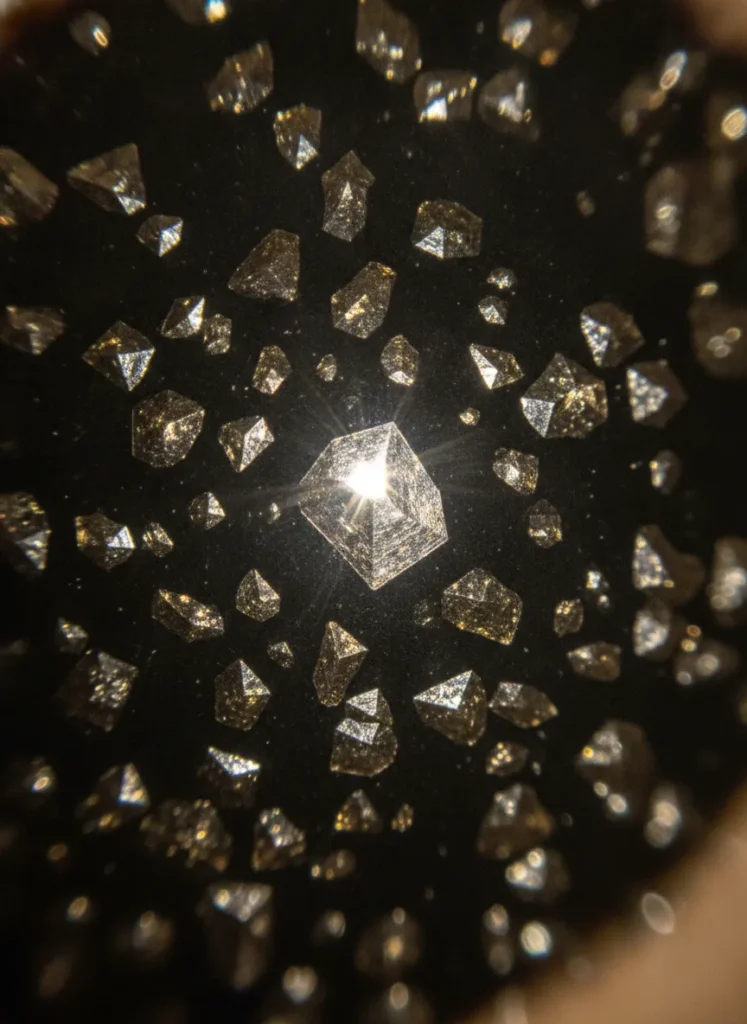
Authentic yuteki glaze features faceted metallic iron crystals that grow during cooling — not painted or printed patterns applied after firing. Here are five reliable ways to distinguish genuine oil-spot crystallization from imitation: Firing temperatures typically reach 1300°C (2372°F) in the kiln.
- The 10× Loupe Test: Under a 10× magnifying loupe, real oil spots reveal tiny faceted metallic islands floating in a glassy matrix. Imitation spots appear flat and printed, with no three-dimensional crystal structure.
- Light Angle Variation: Tilt the bowl under a light source. Authentic iron crystals catch light at different angles, with individual spots brightening and dimming independently. Fake spots remain uniformly reflective.
- Spot Variation: In a genuine yuteki bowl, no two oil spots are identical in size, shape, or spacing. If every spot looks suspiciously uniform, it’s likely machine-printed or decal-applied.
- Surface Texture: Run your fingertip gently across the glaze. Authentic crystallized spots have a subtly raised or textured feel compared to the surrounding glaze. Completely smooth “spots” are a red flag.
- Price Context: Hand-fired authentic Jian Zhan with genuine oil-spot patterns starts around $45–80 USD for contemporary work. If the price seems too good to be true, it probably is — mass-produced imitations with printed patterns often sell for under $15.
The most common telltale sign of a fake, in our experience, is spot uniformity. When iron crystals grow naturally in a kiln, physics dictates that they vary — some cluster densely, others sit isolated; some are 2mm across, others barely visible. If you see a bowl where every “oil spot” is the same size and evenly spaced, you’re looking at a decal, not a crystallization.
For those beginning their journey with Jian Zhan, we recommend starting with a well-crafted Yuteki-style cup from a reputable source. Our guide on what Tenmoku and Jian Zhan are provides additional context for first-time buyers, and our overview of Tenmoku glaze patterns can help you explore the full range of what these remarkable bowls have to offer.
At these cups, every Yuteki-style tea cup in our collection comes with food safety certification and kiln origin documentation — so you can be confident that the oil-spot pattern on your bowl was formed by genuine iron oxide crystallization in a real kiln, not printed in a factory. Browse our tea sets to complete your gongfu tea setup with matching pieces.
❓ Frequently Asked Questions About Yuteki Tenmoku
Is Yuteki Tenmoku food safe?
Yes, authentic Jian Zhan with food-safe certified glaze is safe for daily tea drinking. Modern Jian Zhan from reputable kilns undergoes lead and cadmium testing to meet international food safety standards. Always check that the seller provides food safety certification.
Can I use a Yuteki Tenmoku bowl for everyday tea?
Absolutely. Yuteki Tenmoku bowls are functional tea vessels, not just display pieces. Rinse with hot water after each use, avoid detergent (which strips the developing patina), and let the bowl air dry. With regular use, the glaze develops a deeper luster over time.
Why are some Yuteki bowls so expensive?
Price reflects rarity and firing difficulty. Genuine oil-spot patterns require precise temperature control — too hot and the spots dissolve, too cool and they never form. A single wood-fired kiln load might produce only a few bowls with acceptable yuteki patterns. Antique Song Dynasty examples, like the Kuroda Family Yuteki Tenmoku sold at Christie’s, fetch multi-million dollar prices because they are irreplaceable cultural artifacts.
Does the iron glaze really improve tea flavor?
Many tea practitioners report that tea from Jian Zhan cups tastes smoother and more rounded. However, this effect is based on traditional belief and individual experience, not conclusive scientific evidence. We encourage enjoying Yuteki Tenmoku for its extraordinary beauty and cultural significance — if the tea also tastes better to you, that’s a welcome bonus, but it should not be the primary reason for choosing one.
❓ How do I know if my tenmoku cup is authentic?
Look for an unglazed foot ring showing dark, iron-rich clay, metallic luster under light that shifts with viewing angle, and subtle asymmetry indicating hand-forming. See the handmade tenmoku identification guide for detailed authentication steps.
❓ Can I put my tenmoku cup in the dishwasher?
No. Always hand-wash with warm water only. Dishwasher detergent and high-pressure water can damage the glaze patina and may cause micro-cracking. The new tenmoku owner guide provides complete care instructions.
❓ What tea tastes best in a tenmoku cup?
Oolong and aged pu-erh are the classic pairings. The iron-rich glaze softens tannins and enhances aroma. Read the oolong-tenmoku pairing guide for the science behind this.
📚 References
-
RIKEN Discovers the Secret Behind Yuteki Tenmoku Iridescence (2023):
Research revealing the 900nm nano-structure responsible for the blue-violet color shift in national treasure Yuteki Tenmoku bowls.
Science Japan -
Learning from the Past: Rare ε-Fe₂O₃ in Ancient Black-Glazed Jian Wares (2014):
International study using synchrotron X-ray techniques identifying epsilon iron oxide in Jian tea bowl glazes.
Scientific Reports 4:4941 -
National Treasure Yuteki Tenmoku Tea Bowl:
Detailed catalog entry including provenance and historical significance.
e-Museum (National Institutes for Cultural Heritage, Japan) -
Oil Spot and Hare’s Fur Glazes: Demystifying Classic Ceramic Glazes:
Technical explanation of oxidation firing and oil spot crystallization chemistry.
Ceramic Arts Network
Start your tenmoku journey today — browse Zen Tea Cup for authentic, hand-selected pieces.


