

Contents
- Why Oil Spot Patterns Form: The Crystallography Behind Tenmoku’s Most Prized Surface
- The Bubble-Crystal Mechanism: How Oil Spots Start
- Why Bubble Size Determines Spot Size
- The Crystallography: Why ε-Fe₂O₃ Is So Rare
- Nucleation and Growth: The Physics of Spot Formation
- Nucleation (1,180–1,200°C / 2,156–2,192°F)
- Growth (1,100–1,180°C / 2,012–2,156°F)
- Silver vs Gold Oil Spots: The Manganese Factor
- Why Authentic Oil Spots Cannot Be Replicated by Machines
- ❓ Can oil spots fade or disappear over time?
- ❓ Are oil spots raised or flush with the glaze surface?
- ❓ Why do some cups have oil spots only on the interior?
- 📚 References
Why Oil Spot Patterns Form: The Crystallography Behind Tenmoku’s Most Prized Surface
Oil spot patterns on tenmoku are crystallized iron oxide — specifically, the rare ε-Fe₂O₃ phase that only forms under precise temperature and atmosphere conditions. These are not painted decorations or surface coatings; they are three-dimensional crystal structures that grew atom by atom during the cooling phase of a 1,300°C firing. At Zen Tea Cup, we explain the crystallography in plain language so you understand why no two tenmoku cups ever have identical patterns — and why authentic oil spots cannot be mass-produced.
| Key Stat | Value |
|---|---|
| Primary crystal phase in oil spots | ε-Fe₂O₃ (epsilon iron oxide) |
| Crystal size range (visible spots) | 0.1–3.0 mm diameter |
| Nucleation temperature | 1,150–1,200°C (2,102–2,192°F) |
| Growth time at peak | 20–40 minutes |
| Iron enrichment factor at bubble site | 3–5x bulk glaze concentration |
| Cooling rate for optimal spots | 2–4°C per minute |

The Bubble-Crystal Mechanism: How Oil Spots Start
Your oil spots begin as gas bubbles in the molten glaze. During the reduction firing at 1,300°C (2,370°F), oxygen is stripped from iron oxide (Fe₂O₃ → FeO), releasing O₂ gas. These oxygen bubbles rise through the molten glaze toward the surface, carrying iron-enriched liquid with them. When a bubble reaches the surface and bursts, it leaves a small crater of iron-concentrated glaze that is 3–5 times richer in iron than the surrounding surface.
This iron-enriched crater is the seed of every oil spot. Without the bubble-transport mechanism, the iron would remain uniformly distributed in the glaze and no visible spots would form. The glaze chemistry at 1,300°C ensures that the glaze viscosity is just right — fluid enough for bubbles to rise, but viscous enough to hold the iron-rich crater in place at the surface.
Why Bubble Size Determines Spot Size
Your oil spot diameter is roughly proportional to the diameter of the bubble that created it. Large bubbles (0.5–1.0 mm) create large spots; small bubbles (0.1–0.3 mm) create fine spots. The bubble size distribution depends on the glaze viscosity and the rate of gas generation, which in turn depends on the reduction atmosphere. When you apply strong reduction (high CO concentration) generates more gas faster, producing more bubbles but also driving them out of the glaze before they can grow very large. When you use moderate reduction generates fewer bubbles but allows each one to grow larger before reaching the surface.
This is why tenmoku cups you own may have a mix of large and small spots — each spot represents one bubble that escaped the glaze at a different stage of the firing. The kiln master controls the overall spot distribution by adjusting the fuel-to-air ratio during the reduction phase.
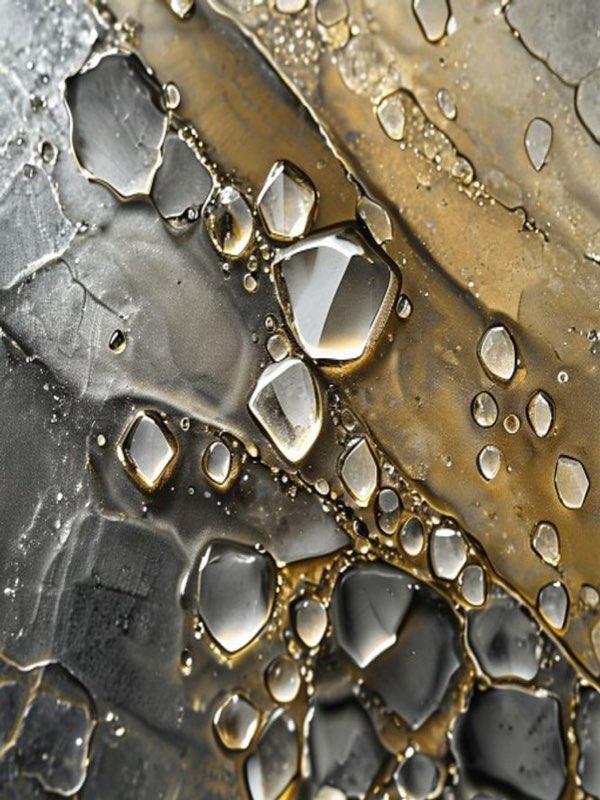
The Crystallography: Why ε-Fe₂O₃ Is So Rare
Iron oxide has several crystalline phases, but the one that creates oil spots — ε-Fe₂O₃ (epsilon iron oxide) — is the rarest and most difficult to produce. Here is how the common phases compare:
- α-Fe₂O₃ (hematite): The most common phase, found in rust and red pigments. Stable at room temperature and forms readily in oxidizing conditions. Creates red-brown surfaces, not tenmoku black.
- γ-Fe₂O₃ (maghemite): A metastable phase found in magnetic recording media. Forms at moderate temperatures with specific particle size constraints. Not typically found in tenmoku glaze.
- Fe₃O₄ (magnetite): A mixed-valence phase (Fe²⁺Fe³⁺₂O₄) that forms under moderately reducing conditions. Common in hare’s fur patterns and some oil spots.
- ε-Fe₂O₃: The rarest phase, first synthesized in a laboratory in 2004. In nature, it has only been found in meteorite impact sites and in tenmoku glaze. It forms only under very specific conditions: temperatures of 1,100–1,200°C, moderate reduction atmosphere, and slow cooling (2–4°C/min).
The reason ε-Fe₂O₃ is so rare is that it is thermodynamically metastable — it wants to transform into α-Fe₂O₃ or Fe₃O₄, which are more stable. The only way to “trap” it in the ε phase is to cool the glaze through the 1,100–1,200°C range at just the right rate: fast enough to prevent transformation to the stable phase, but slow enough to allow the ε crystals to grow to visible size. This window is approximately 20–40 minutes wide, and missing it by even a few minutes means the difference between beautiful oil spots and a plain black surface.
Nucleation and Growth: The Physics of Spot Formation
Crystal formation follows two distinct stages: nucleation (the birth of a new crystal) and growth (the crystal expanding from its seed). Both stages are temperature-dependent:
Nucleation (1,180–1,200°C / 2,156–2,192°F)
At this temperature, the iron-enriched glaze at the bubble crater is still molten but approaching its crystallization point. Random thermal fluctuations cause small clusters of iron and oxygen atoms to arrange into the ε-Fe₂O₃ crystal structure. Most of these clusters dissolve back into the melt before your eyes, but a few reach a critical size (approximately 10 nanometers) where they become stable. These stable clusters are the nuclei — the seeds from which the visible oil spots will grow.
The number of nuclei in your cup determines how many spots form on your cup. More nucleation sites mean more but smaller spots; fewer sites mean fewer but larger spots. The nucleation rate depends primarily on the degree of iron enrichment at the bubble crater — a crater that is 5x enriched in iron will nucleate more crystals than one that is only 3x enriched.
Growth (1,100–1,180°C / 2,012–2,156°F)
Once nucleated, the crystals grow by absorbing iron and oxygen atoms from the surrounding molten glaze. Your crystal growth rate is proportional to the temperature — at 1,180°C, growth is fast (approximately 0.05 mm per minute), and at 1,100°C, growth slows to approximately 0.01 mm per minute. Below 1,050°C, growth effectively stops.
The growth stage is where the cooling rate becomes critical. A slow cooling rate (2–4°C/min) keeps the glaze in the growth temperature window for 20–40 minutes, allowing crystals to reach 0.5–3.0 mm in diameter — visible to the naked eye. A fast cooling rate (8°C/min) rushes through the growth window in under 10 minutes, producing crystals that are too small to see. This is why handmade tenmoku with controlled cooling has visible oil spots while fast-cooled factory pieces often do not.
Silver vs Gold Oil Spots: The Manganese Factor
Oil spots appear in two primary colors: silver and gold. The color difference is caused by trace amounts of manganese (Mn) in the glaze:
- Silver spots: Pure ε-Fe₂O₃ crystals without significant manganese content. These reflect light uniformly across the visible spectrum, appearing silver-white.
- Gold spots: ε-Fe₂O₃ crystals that have incorporated manganese ions (Mn²⁺) into the crystal lattice. Manganese introduces additional electron energy levels that preferentially absorb blue light, shifting the reflected color from silver to gold.
Your cup’s manganese content comes from the wood ash used in the glaze recipe. Different tree species produce ash with different manganese concentrations: pine ash tends to produce silver spots, while oak and chestnut ash favor gold spots. The kiln’s location in Jianyang — surrounded by mixed forests — gives local potters access to a variety of ash types for different visual effects. Our care guide explains how to preserve these colors over years of use.
Why Authentic Oil Spots Cannot Be Replicated by Machines
Modern ceramic factories have tried to sell you to replicate tenmoku oil spots using automated kilns and standardized glaze formulas. The results always fall short because three critical variables cannot be controlled by machines:
- Bubble dynamics are random: The number, size, and timing of oxygen bubbles in the glaze follow a stochastic distribution. No two firings produce the same bubble pattern, and therefore no two cups have the same spot arrangement
- Reduction atmosphere fluctuates: In a wood-fired kiln, the CO concentration varies continuously as fuel is added and consumed. These fluctuations create micro-environments within the kiln that affect crystal nucleation and growth differently in each cup
- Cooling is not uniform: Cups near the kiln wall cool faster than cups near the center. Even within a single cup, the cooling rate varies between the rim (thinner, cools faster) and the base (thicker, cools slower), producing different spot sizes on different parts of the same cup
These uncontrollable variables are not defects for you — they are the source of tenmoku’s uniqueness. Every authentic cup is a record of the specific thermal and atmospheric conditions that existed at its exact position in the kiln during that specific firing. When you hold your tenmoku cup, you are holding a frozen moment of ceramic physics that can never be exactly repeated. This is why authenticity markers focus on pattern irregularity — perfect uniformity is your warning sign of a fake.
❓ Can oil spots fade or disappear over time?
No. The ε-Fe₂O₃ crystals are permanently embedded in the vitrified glaze matrix. They cannot dissolve, fade, or detach under normal use conditions (temperatures below 212°F, pH 3–8). The only mechanism that could destroy them is re-firing the cup above 1,100°C, which would re-melt the glaze.
❓ Are oil spots raised or flush with the glaze surface?
Slightly raised. The crystals grow outward from the glaze surface by 0.01–0.05 mm. You can feel the texture with your own fingernail — a faint bump at each spot. This micro-texture is one of the authentication signs of genuine tenmoku. Factory-printed imitations are perfectly smooth because the “spots” are surface decals, not three-dimensional crystals.
❓ Why do some cups have oil spots only on the interior?
Oil spots form where the iron-enriched bubble craters exist. On the interior, gravity helps bubbles rise to the horizontal surface. On the exterior, the glaze runs vertically during firing, so bubbles escape along the surface and do not create concentrated craters. Some kiln masters intentionally tilt the cups during cooling to create spots on the exterior — a technique that requires precise control of the firing schedule.
📚 References
- ScienceDirect — ε-Fe₂O₃ Crystal Structure and Formation
- NIST — Crystallography Data and Methods
- Metropolitan Museum of Art — Song Dynasty Jian Ware Technical Studies
Want to own a crystallography masterpiece? Every oil spot on your tenmoku cup is a rare ε-Fe₂O₃ crystal that formed at exactly the right temperature, atmosphere, and cooling rate — never to be repeated. Explore the Zen Tea Cup collection and find a cup with patterns born from pure physics.


