

Contents
- What Are Tenmoku Glaze Patterns?
- Hare’s Fur (兔毫 Tuhao): The Classic Tenmoku
- How Hare’s Fur Forms
- What to Look For
- Oil Spot (油滴 Yuteki): The Showstopper
- How Oil Spot Forms
- What to Look For
- Yao Bian (曜变 Yohen): The Rarest Treasure
- How Yao Bian Forms
- What to Look For
- Partridge Spot (鹧鸪斑 Zhegu Ban): The Collector’s Pattern
- How Partridge Spot Forms
- What to Look For
- Glaze Pattern Comparison
- How to Identify Authentic Glaze Patterns vs. Fakes
- Which Glaze Pattern Should You Choose?
- ❓ Frequently Asked Questions
- ❓ How do I know if my tenmoku cup is authentic?
- ❓ Can I use tenmoku cups every day?
- ❓ What tea tastes best in tenmoku?
- 📚 References
What Are Tenmoku Glaze Patterns?
Tenmoku glaze patterns are the crystalline surface effects that form on iron-rich stoneware during reduction firing at 1300°C (2370°F) — each pattern emerges from a precise interaction between iron oxide concentration, glaze thickness, kiln temperature, and oxygen levels. No two cups share the same pattern, because no two cups experience the kiln in exactly the same way.
At ZenTeaCup, we work with Jianyang kiln artisans who spend decades mastering the conditions that produce these patterns. The process is part science, part art, and part surrender to chance — which is exactly what makes each authentic Jian Zhan so compelling.
This guide explains the four principal Tenmoku glaze patterns — hare’s fur, oil spot, yao bian, and partridge spot — how each forms, what to look for, and which pattern suits your needs as a beginner or collector.
If you are new to tenmoku, you can start with an affordable piece under $50.
Hare’s Fur (兔毫 Tuhao): The Classic Tenmoku
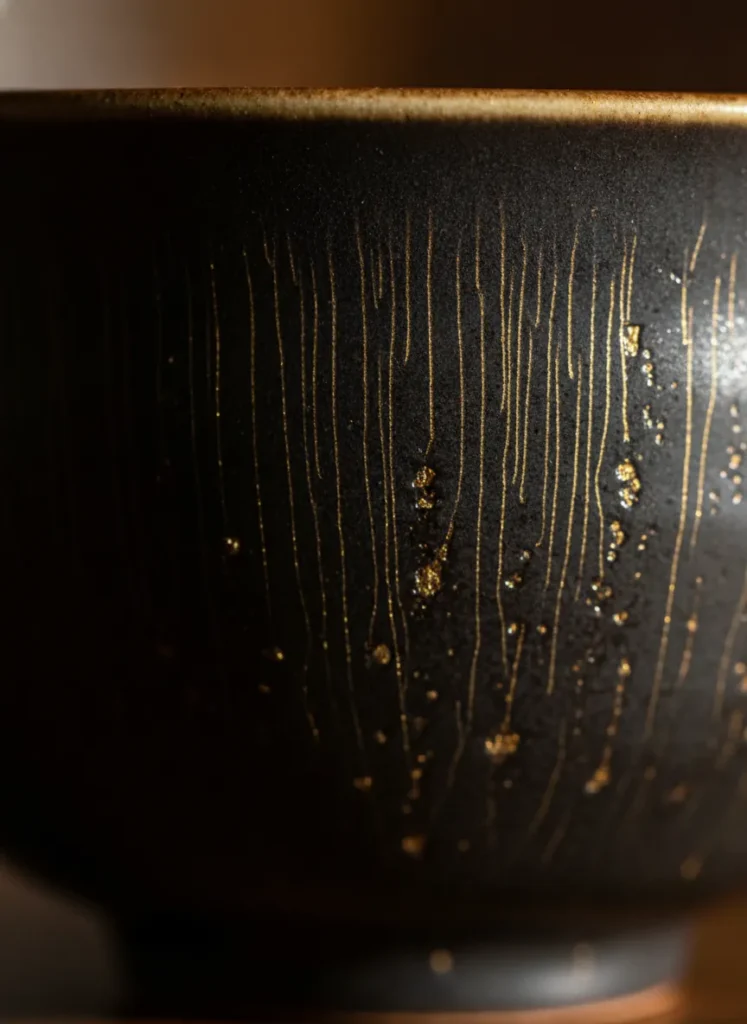
Hare’s fur is the most common and historically celebrated Tenmoku glaze pattern. It appears as fine, parallel streaks radiating from the cup’s rim toward its base — resembling the soft fur of a hare. These streaks are typically silver or golden against a dark black or brown glaze background.
How Hare’s Fur Forms
During firing, iron-rich glaze melts and flows downward under gravity along the cup’s curved surface. As the kiln reaches peak temperature (1280–1300°C / 2370°F), iron oxide crystals precipitate and align into streaks along the flow direction. The streaks’ color depends on the cooling rate: faster cooling produces silver streaks; slower cooling allows iron to oxidize further, creating golden or amber streaks.
What to Look For
- Streak direction: Should flow naturally from rim to base, following gravity
- Streak density: Fine, closely spaced streaks indicate better craftsmanship
- Color variation: Silver is most common; golden or amber streaks are more prized
- Background: Deep black or dark brown base glaze provides the best contrast
Hare’s fur is the best starting point for beginners — it is authentic, widely available, and its understated beauty deepens with use as seasoning develops a natural patina. Browse our hare’s fur tea cup collection to find your first piece.
Oil Spot (油滴 Yuteki): The Showstopper
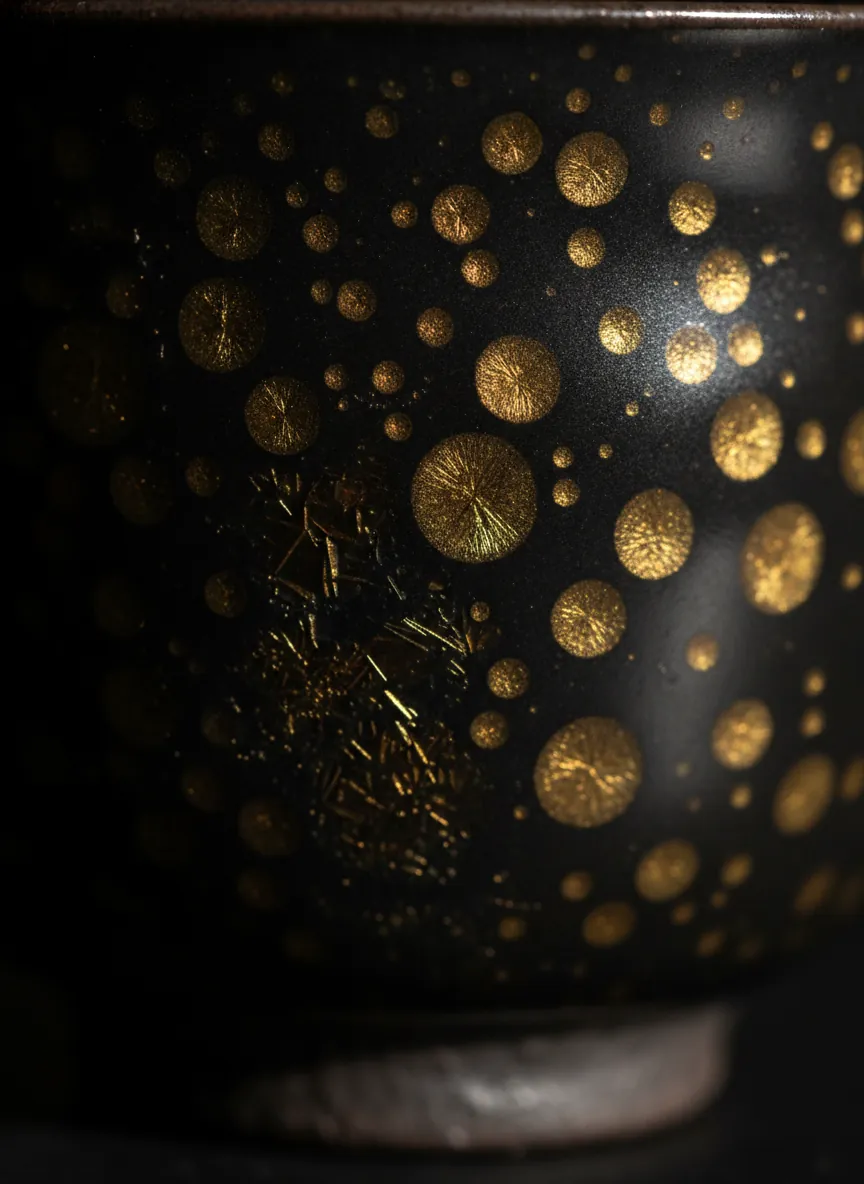
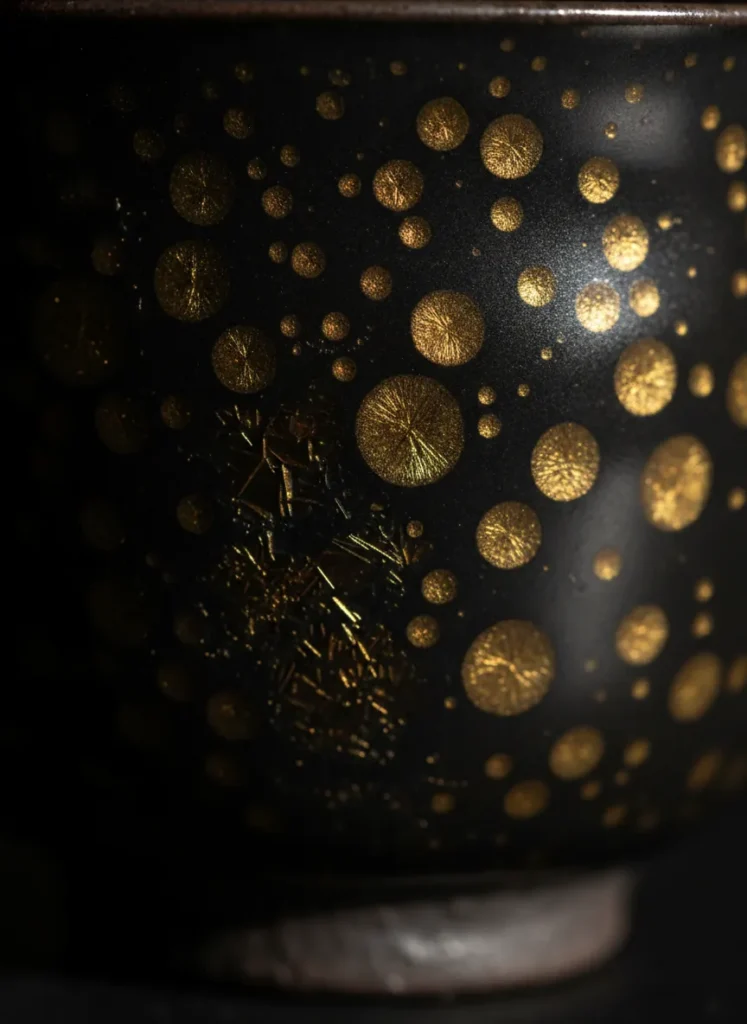
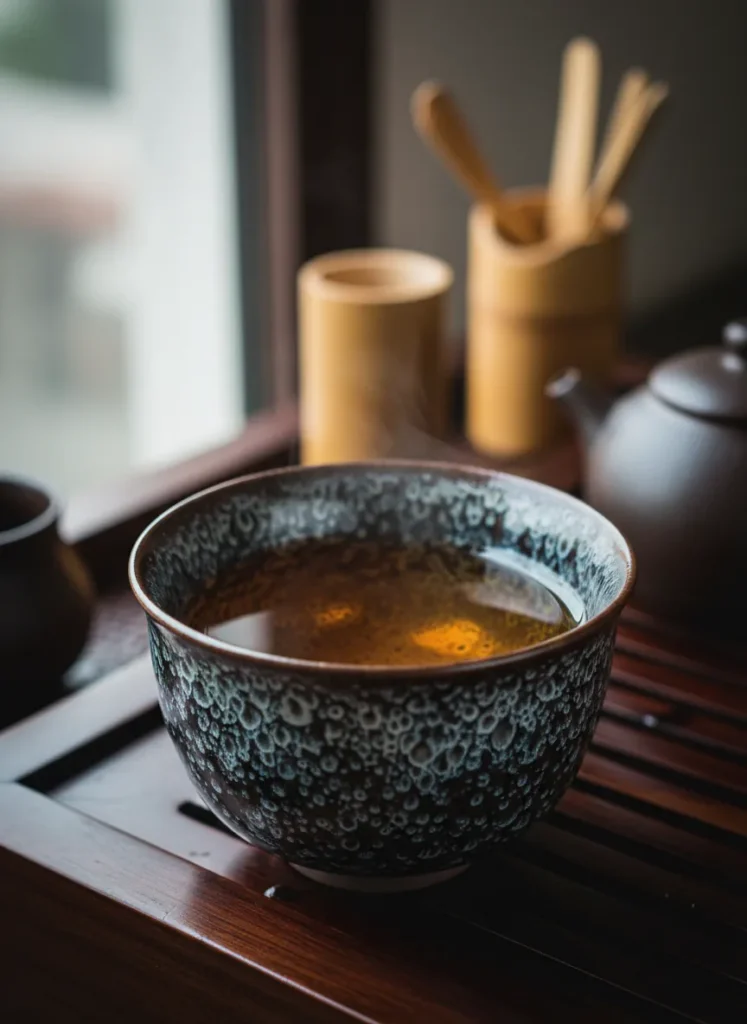
Oil spot glaze produces round, metallic-looking droplets scattered across a dark glaze surface — like oil droplets floating on water. These spots can appear silver, gold, or copper-colored, and they catch light dramatically, making oil spot cups the most visually striking of all Tenmoku patterns.
How Oil Spot Forms
Oil spot requires a slightly thicker glaze application than hare’s fur. During firing, iron oxide bubbles form within the molten glaze and rise to the surface. When these bubbles burst, they leave behind circular depressions filled with crystallized iron oxide — the “oil spots.” The spots’ metallic sheen comes from the crystal structure of the iron oxide, which reflects light differently depending on the viewing angle.
What to Look For
- Spot definition: Well-defined, round spots with clear metallic sheen
- Spot distribution: Evenly scattered rather than clustered in one area
- Color: Silver spots are most common; golden or rainbow-reflective spots are rarer and more valuable
- Size: Medium-sized spots (2–5 mm) are ideal; very large spots may indicate non-authentic techniques
Oil spot is the pattern we recommend most often for first-time buyers who want a cup that makes an
You can pair your tenmoku cup with a variety of teas for different experiences.
immediate visual impression. See our oil spot tea cups for handcrafted options.
Yao Bian (曜变 Yohen): The Rarest Treasure
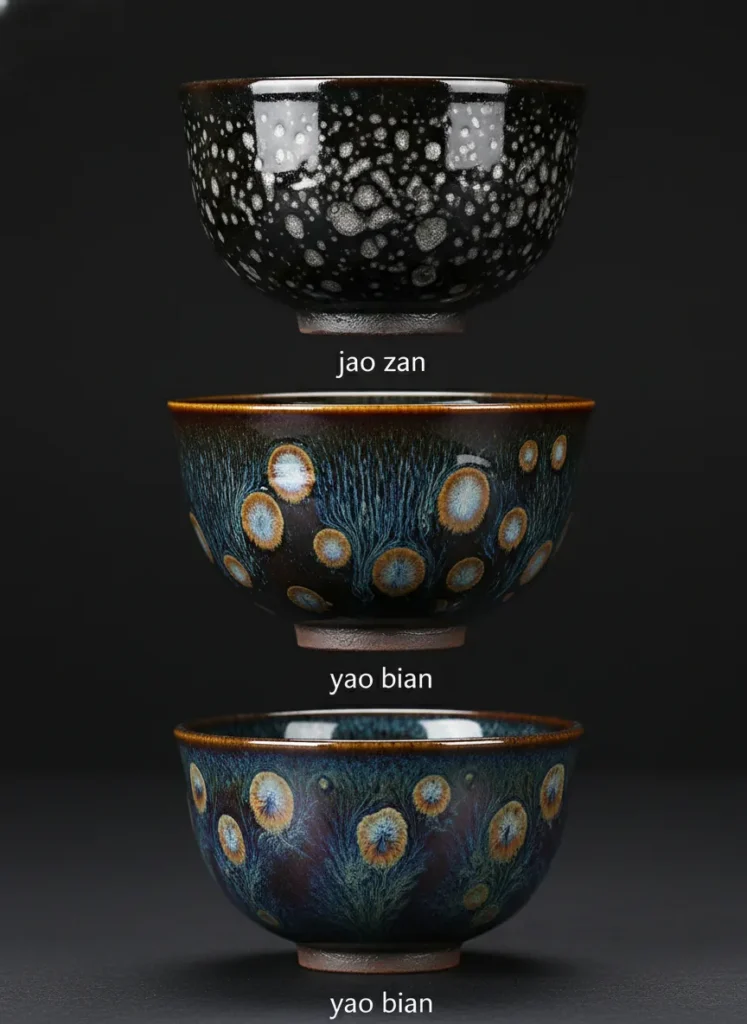
Yao bian — literally “transmutation in the kiln” or “iridescent change” — is the rarest and most valuable of all Tenmoku glaze patterns. It produces iridescent halos that shift color under different lighting conditions, displaying blues, greens, purples, and golds that seem to glow from within the glaze.
Only three complete Jian Zhan bowls with yao bian pattern survive today, all designated as Japanese National Treasures — housed in Tokyo, Kyoto, and Osaka. No modern artisan has successfully replicated their exact effect, though many produce beautiful approximations.
How Yao Bian Forms
Yao bian represents the highest level of kiln transmutation. It occurs when multiple conditions align perfectly: precise iron-rich glaze composition, exact positioning within the kiln’s reduction zone, and a cooling rate that allows specific crystal structures to form. The iridescent effect comes from thin-film interference — similar to oil on water or soap bubbles — where light reflects off multiple microscopic layers within the glaze, creating different colors at different angles.
What to Look For
- Iridescence: True yao bian shows color shifts under different light angles
- Halo formation: Circular or oval halos around spots, not just metallic reflection
- Rarity: Authentic yao bian is extremely rare; most pieces labeled “yao bian” are high-quality oil spot with slight iridescence
- Price: Genuine yao bian pieces start at $500 and can reach tens of thousands
For most you, a well-executed oil spot with slight iridescence provides a tasteof the yao bian experience at a fraction of the cost. Learn more about what makes these patterns authentic in our buyer’s guide to authentic Tenmoku.
Partridge Spot (鹧鸪斑 Zhegu Ban): The Collector’s Pattern
Partridge spot produces larger, more irregular spots than oil spot — resembling the mottled feathers of a partridge bird. These spots are typically less uniform in size and shape, with softer edges and a more matte appearance compared to oil spot’s sharp metallic droplets.
How Partridge Spot Forms
Partridge spot forms under conditions between hare’s fur and oil spot — when the glaze is thick enough for iron oxide to pool but the temperature or reduction atmosphere doesn’t quite reach the level needed for well-defined oil spots. The result is larger, more organic-looking spots with less metallic sheen.
What to Look For
- Spot shape:
You deserve a tea experience that goes beyond the ordinary cup.
Irregular, slightly elongated or merged spots
- Surface texture: Less metallic shine than oil spot; more subtle, matte quality
- Rarity: Less common than hare’s fur or oil spot
- Appeal: Favored by collectors who prefer organic, natural-looking patterns
Glaze Pattern Comparison
| Pattern | Chinese | Appearance | Rarity | Price Range | Best For |
|---|---|---|---|---|---|
| Hare’s Fur | 兔毫 | Fine silver/gold streaks | Common | $50–$120 | Everyday use, beginners |
| Oil Spot | 油滴 | Round metallic droplets | When you season your Jian Zhan properly, you develop a beautiful patina over time.Uncommon | $70–$200 | Visual impact, gifting |
| Partridge Spot | 鹧鸪斑 | Larger irregular spots | Rare | $150–$400 | Collectors |
| Yao Bian | 曜变 | Iridescent color-shifting halos | Extremely rare | $500–$10,000+ | Museum, investment |
How to Identify Authentic Glaze Patterns vs. Fakes
The market is full of cups with printed or sprayed patterns that mimic Tenmoku glaze in photographs but lack the depth, iridescence, and living quality of real crystallized iron oxide. Here are the key tests:
- The Light Test: Rotate the cup under a direct light source. Authentic crystalline patterns show depth and subtle color shifts as the angle changes. Fake patterns look flat and static from every angle.
- The Touch Test: Run your fingertip gently over the pattern. Authentic oil spots and hare’s fur streaks have a very slight texture — the crystalline structures sit slightly above or below the surrounding glaze. Printed patterns are perfectly smooth.
- The Magnification Test: Use a 10x loupe or phone camera zoom. Authentic patterns show irregular, organic crystal structures at the microscopic level. Fake patterns show uniform dots or lines with no natural variation.
- The Price Test: If a cup claims “yao bian” or “oil spot” and costs under $30, it is almost certainly not authentic handmade Jian Zhan.
For a complete authentication guide, see our how to identify authentic Tenmoku tea cups article.
Which Glaze Pattern Should You Choose?
For beginners, the choice comes down to two options:
Hare’s Fur — Choose this if you want the quintessential Jian Zhan aesthetic: understated elegance that rewards close inspection. Hare’s fur cups tend to be more affordable and develop beautiful patina through seasoning over time.
Oil Spot — Choose this if you want immediate visual drama. Oil spot cups make striking display pieces and impressive gifts. Their metallic droplets catch light in a way that photographs beautifully.
For detailed sizing guidance, see our Jian Zhan cup size guide. To understand how these patterns are created, read about the complete 13-step Jian Zhan making process.
❓ Frequently Asked Questions
What is hare’s fur glaze?
Hare’s fur glaze is a Tenmoku pattern featuring fine, parallel silver or golden streaks that radiate from a cup’s rim toward its base. The streaks form when iron oxide crystals align along the direction of glaze flow during high-temperature reduction firing. It is the most common and historically celebrated Jian Zhan pattern.
What color is Tenmoku glaze?
Tenmoku glaze is primarily dark — black, very dark brown, or deep charcoal — with crystalline pattern overlays in silver, gold, or iridescent colors. The base color comes from the high iron oxide content (15–30%) in the glaze, while the patterns emerge from crystallization during firing.
Where did Tenmoku glaze come from?
Tenmoku glaze originated in Jianyang, Fujian, China during the Song Dynasty (960–1279). The name “Tenmoku” comes from Mount Tianmu (天目山) in Zhejiang, where Japanese monks first encountered these bowls. The original Chinese term is Jian Zhan (建盏), referring specifically to bowls from the Jian kiln.
Can the same kiln produce different patterns?
Yes — this is what makes Jian Zhan firing so unpredictable. A single kiln firing can produce hare’s fur, oil spot, and occasionally partridge spot cups simultaneously. The pattern depends on each cup’s glaze thickness, position in the kiln, and the exact reduction atmosphere it experiences. This is why authentic Jian Zhan cannot be mass-produced with consistent patterns.
❓ How do I know if my tenmoku cup is authentic?
Look for an unglazed foot ring showing dark iron-rich clay, metallic luster that shifts with viewing angle, and subtle asymmetry from hand-forming. See the handmade tenmoku identification guide for a detailed checklist.
❓ Can I use tenmoku cups every day?
Yes. Authentic high-fired tenmoku is designed for daily tea drinking and is completely food safe. Daily use actually helps develop the glaze patina that collectors prize. The new tenmoku owner guide covers daily care routines.
❓ What tea tastes best in tenmoku?
Oolong and aged pu-erh are the classic pairings. The iron-rich glaze softens tannins and enhances aroma. Read the oolong-tenmoku pairing guide for the science behind this.
📚 References
- Jian Ware and Song Dynasty Glazes: Documentation of iron-rich crystalline glazes and their classification. The Metropolitan Museum of Art
- Yao Bian (Furnace Transmutation) in Ceramics: Explanation of kiln transmutation effects in Chinese teaware. Encyclopædia Britannica
- Ceramic Foodware Safety Standards: Guidance on lead and cadmium safety for imported stoneware. U.S. FDA


