

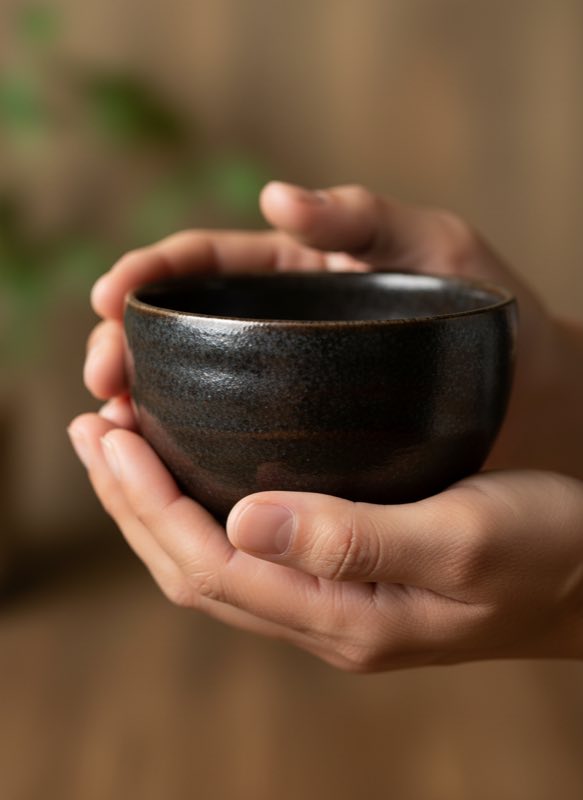
You hold a tenmoku bowl by cradling its base with your middle and ring fingers while your thumb rests lightly on the rim—this is the traditional grip that Zen Tea Cup recommends for both comfort and etiquette. The proper hold protects the glaze from fingerprints, keeps the cup stable, and signals respect for the craft in formal settings.
| Key Stat | Value |
|---|---|
| Standard rim diameter | 8.0 cm (4 oz cup) |
| Grip zone (lower third) | 2.0-3.0 cm from base |
| Comfortable wall temp | 120-160 F (49-71 C) |
| Pouring angle | 45 degrees |
| Finger contact area | 3-4 cm band around foot ring |
| Typical practice time | 5-10 minutes daily |
Contents
- The Traditional Tenmoku Grip: Step by Step
- Single-Hand Hold for Daily Use
- Two-Hand Hold for Formal Occasions
- Why the Lower Third Is the Sweet Spot
- Temperature Zones on the Cup Wall
- Pouring and Drinking Technique
- The 45-Degree Pour
- Tea Etiquette Specific to Tenmoku
- Receiving Tea From a Host
- Serving Tea to Guests
- Daily Care While Using Your Cup
- Warming the Cup Before Use
- Cleaning After Each Session
- ❓ Can I use tenmoku for cold beverages?
- ❓ Does the grip change for different cup sizes?
- ❓ How long does it take to feel natural holding tenmoku?
- References
The Traditional Tenmoku Grip: Step by Step
Learning the correct grip takes about five minutes, but it changes how you experience every cup of tea. The traditional hold dates back to Song Dynasty tea competitions where the way you lifted the cup mattered as much as the tea inside.
Single-Hand Hold for Daily Use
Place your thumb along the outer rim and curl your middle finger underneath the foot ring. Your ring finger supports the middle finger from below, and your index finger can rest gently against the outer wall for balance. The key principle: your grip should feel like you are cradling a small bird—firm enough that the cup will not slip, but gentle enough that you are not squeezing. The cup’s weight (120-150 g for a standard 4 oz handmade piece) should rest primarily on your middle finger, not your thumb. If your thumb feels tired after thirty seconds, you are pressing too hard.
Two-Hand Hold for Formal Occasions
In formal tea settings, you use both hands: your dominant hand grips the cup as described above, while your other hand supports the base from underneath. Your supporting palm cups the foot ring lightly, fingers pointing toward your body. This two-hand hold serves both practical and symbolic purposes—it stabilizes the cup during ceremonial pours and demonstrates respect for the host and the vessel. The Freer Gallery of Art documents this gesture in Song Dynasty tea paintings, where both hands always appear when a guest receives tea.
Why the Lower Third Is the Sweet Spot
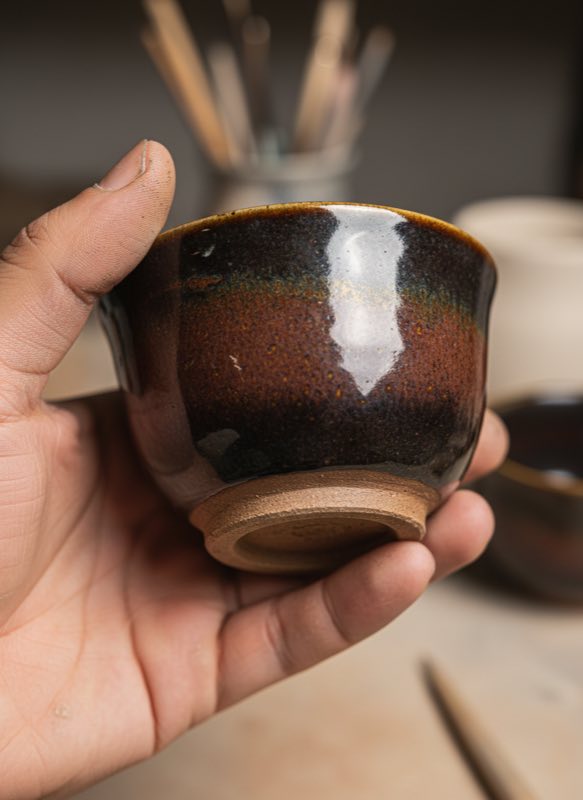
You grip the lower third of the cup for three reasons: temperature control, glaze protection, and stability. The upper two-thirds of a tenmoku cup carry the most visible glaze pattern—oil spots, hare’s fur, or yohen effects—so contact with this area leaves oils and moisture that gradually dull the surface. The lower third is typically unglazed or has a simpler glaze finish that handles finger contact without damage.
Temperature Zones on the Cup Wall
The temperature of your tenmoku cup varies significantly from rim to base. At the rim, where the wall is thinnest (0.2-0.3 cm), the surface reaches 120-140 F within seconds of pouring. The base, with walls of 0.4-0.6 cm, stays cooler at about 100-120 F. By gripping the lower third, you avoid the hottest zone and can hold the cup comfortably even when the tea inside is at its peak temperature of 185 F. If the cup feels too hot to hold at the base, let it cool for 60-90 seconds before picking it up—never use a cloth or sleeve, as these prevent you from sensing the tea’s temperature through your fingers.
Pouring and Drinking Technique
How you pour tea into and drink from your tenmoku affects both the flavor and the cup’s longevity. A few simple adjustments make a noticeable difference.
The 45-Degree Pour
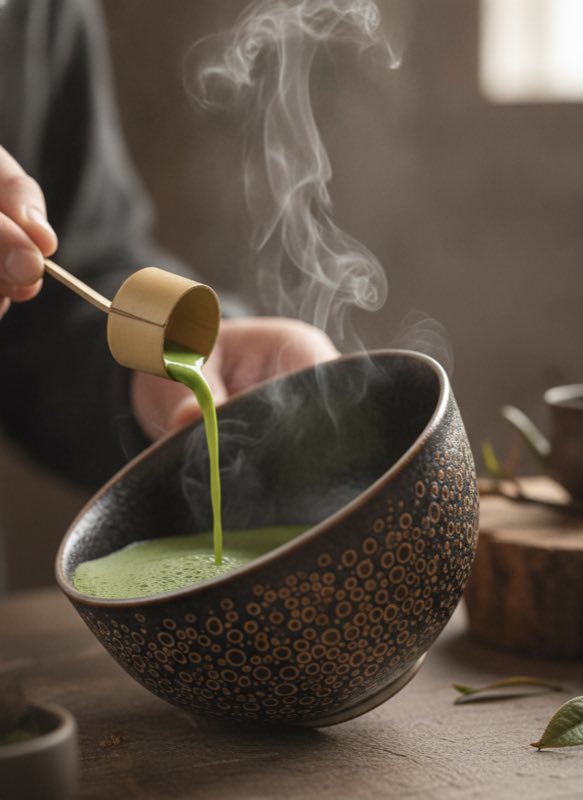
When receiving tea from a pot or gaiwan, tilt your tenmoku at approximately 45 degrees and aim the stream at the inner wall rather than the center. This accomplishes two things: it aerates the tea slightly for better aroma release, and it prevents thermal shock from a direct stream hitting the base. A 45-degree angle also lets you see the tea’s color against the dark glaze, which is part of the sensory appreciation that tenmoku drinkers value. For gongfu sessions with short pours (15-30 seconds), this angled position means you can drink immediately without readjusting your grip.
Tea Etiquette Specific to Tenmoku
Tenmoku carries cultural weight that ordinary teaware does not. Following a few etiquette guidelines shows you understand and respect the tradition behind the vessel.
Receiving Tea From a Host
When someone pours tea into your tenmoku, use the two-hand hold to receive it. Nod slightly in acknowledgment. Take your first sip only after the host has finished pouring for everyone at the table. Before drinking, you may briefly admire the tea’s color against the glaze—this is not pretentious, it is the equivalent of swirling wine before tasting. The Metropolitan Museum of Art notes that Song Dynasty literati treated visual appreciation of tea-in-bowl as seriously as the taste itself.
Serving Tea to Guests
When you pour tea for others using your tenmoku collection, hold the pot or gaiwan in your dominant hand and support the lid with your other hand. Pour each guest’s cup to about 70% full—this leaves room for the aroma to collect in the upper space and shows restraint, which is valued in tea culture. Always pour in order of seniority or guest status, and refill cups before they empty completely. A cup that runs dry signals neglect.
Daily Care While Using Your Cup
Proper holding technique is just one part of caring for tenmoku. How you handle the cup between sessions matters just as much for preserving its glaze and character over years of use. A well-maintained tenmoku actually improves with age—the glaze develops a subtle patina from repeated contact with tea oils, a phenomenon collectors call “nurturing the cup” (yang bei). This process takes months of regular use, but the result is a surface that feels richer and more alive than a brand-new piece.
Proper holding technique is just one part of caring for tenmoku. How you handle the cup between sessions matters just as much for preserving its glaze and character over years of use.
Warming the Cup Before Use
Before your first pour, rinse the tenmoku with hot water (about 175 F) and let it sit for 30 seconds. This warms the clay body evenly and prevents thermal shock when the hotter tea follows. Warming also opens the micro-pores in the iron-rich glaze, which subtly enhances the tea’s body and aftertaste. Discard the rinse water before pouring your actual tea—you will notice the difference in aroma intensity compared to a cold-start cup.
Cleaning After Each Session
Rinse your tenmoku with warm water only—no soap, no scrubbing pad, no dishwasher. The iron-rich glaze is porous enough to absorb detergent residues, which will alter the taste of future teas. If tea stains build up over months, wipe the interior gently with a soft cloth dampened with warm water. Pat the exterior dry with a microfiber cloth to prevent water spots on the glaze. Store the cup upright on a soft surface with adequate ventilation so any residual moisture evaporates completely. Avoid stacking tenmoku cups inside one another—the foot ring of the upper cup can scratch the glaze of the lower one, and the tight fit traps moisture that promotes mold growth on the unglazed base. If you must stack them temporarily, place a soft cloth between each cup and separate them within 24 hours to keep the glaze in good condition.
❓ Can I use tenmoku for cold beverages?
Yes, but avoid rapid temperature changes. If you want to serve iced tea in tenmoku, place the empty cup in the refrigerator for 15 minutes first, then add the cold beverage. Never pour ice-cold liquid into a warm tenmoku—the thermal shock can crack the glaze. The handmade tenmoku guide at Zen Tea Cup covers thermal care in more detail.
❓ Does the grip change for different cup sizes?
The basic principle stays the same—thumb on rim, middle finger under foot ring—but larger cups (6 oz / 180 ml) naturally require more finger spread. For a 6 oz cup, you may shift your grip slightly higher, placing your thumb on the outer wall about 1 cm below the rim, because the wider diameter makes rim-only thumb contact less stable. Smaller cups (3 oz / 90 ml) let you grip more compactly with all four fingers tucked close together.
❓ How long does it take to feel natural holding tenmoku?
Most people adapt within three to five days of daily use. The first day feels deliberate and conscious; by day three, the grip becomes muscle memory. If you practice the two-hand hold for formal settings, allow two weeks of occasional practice before hosting your first tea session. The key is consistency—hold the cup the same way every time, and your hands will learn faster than you expect.
References
- Freer Gallery of Art: Song Dynasty Tea Paintings and Vessel Handling. Smithsonian
- Metropolitan Museum of Art: Visual Culture of Tea in East Asian Ceramics. The Met
- Victoria and Albert Museum: Ceramic Handling and Thermal Properties. V and A Museum
Ready to practice? Browse the tenmoku collection at Zen Tea Cup and find the cup that fits your hand naturally.


