

You can tell if your tenmoku is handmade by checking seven physical signs: an uneven foot ring, natural glaze drip, variable wall thickness, substantial weight (120–180 g), visible kiln marks, lack of mold seams, and the maker’s seal. These are tests you can perform at home in under two minutes—no lab equipment required—drawing from Zen Tea Cup‘s authenticity playbook for US buyers.
| Key Stat | Value |
|---|---|
| Handmade weight range | 120–180 g |
| Mass-produced weight | 80–110 g |
| Foot ring diameter | 3.2–4.0 cm |
| Glaze drip length | 0.5–2.0 cm |
| Wall thickness variation | 0.2–0.5 cm |
| Firing temperature | 2370 °F (1300 °C) |
Contents
- 7 Physical Tests to Verify Handmade Tenmoku
- 1. The Foot Ring Test
- 2. The Glaze Drip Check
- Weight and Thickness: What Your Hands Reveal
- 3. The Wall Thickness Variation
- 4. The Weight Test
- Visual Clues Only Handmade Pieces Show
- 5. The Kiln Mark and Fire Shadow
- 6. No Mold Seam Lines
- The Maker’s Mark and Documentation
- 7. The Maker’s Seal or Signature
- Handmade vs Mass-Produced at a Glance
- How to Verify Authenticity When Buying Online
- Common Myths About Handmade Tenmoku
- ❓ Can machine-made tenmoku look handmade?
- ❓ Is there a quick single test I can rely on?
- ❓ Do all handmade tenmoku cups have a maker seal?
- 📚 References
7 Physical Tests to Verify Handmade Tenmoku
When you hold a tenmoku cup for the first time, your hands can tell you more than your eyes. The seven tests below are arranged from easiest to most subtle—each one takes under 30 seconds, and together they give you a reliable verdict on whether your cup was shaped by human hands or a factory mold.
1. The Foot Ring Test
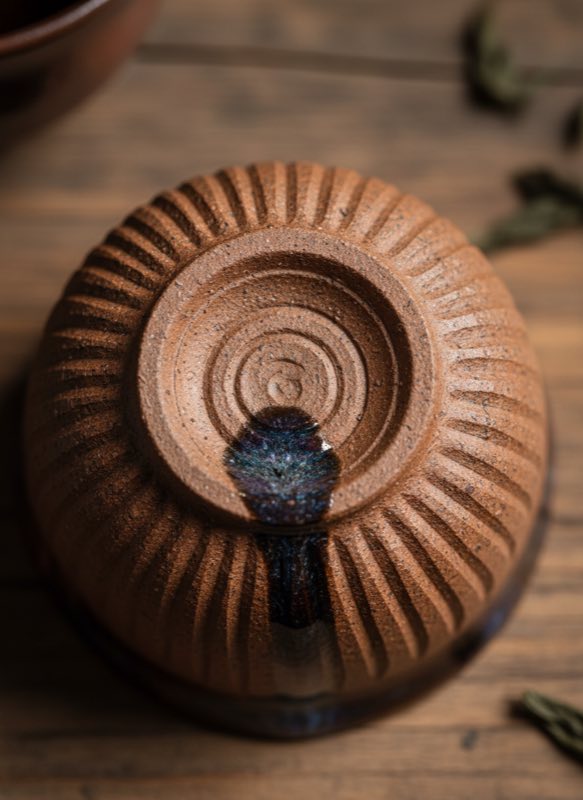
Flip the cup over and examine the unglazed foot ring. On a handmade piece, the foot ring shows subtle spiral marks from the potter’s wheel and slight asymmetry—no two are identical. A mass-produced cup has a perfectly uniform foot ring, often cut by CNC machinery with no trace of the wheel. Measure the diameter: handmade foot rings typically fall between 3.2 cm and 4.0 cm, with a slightly rough texture you can feel when you run your fingernail across it. If the foot ring feels glassy-smooth and perfectly round, that is a machine signal.
2. The Glaze Drip Check
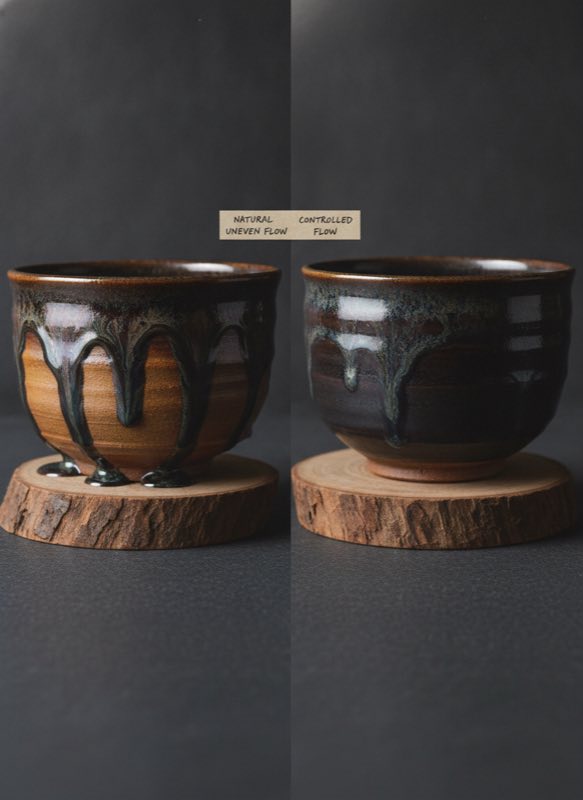
Look at the bottom edge where the glaze meets the bare clay. Handmade tenmoku features a natural, uneven glaze drip measuring 0.5–2.0 cm long—the glaze ran during firing and stopped organically, creating a unique edge on every single cup. Machine-made cups have a razor-sharp, uniform glaze line because the glaze is applied by dipping or spraying in a controlled environment. If every drip looks identical across multiple cups from the same seller, you are looking at mass production. The glaze drip is one of the hardest features for factories to fake convincingly.
Weight and Thickness: What Your Hands Reveal
Pick up the cup and pay close attention to how it feels in your palm. Handmade tenmoku weighs between 120 g and 180 g for a standard 4 oz cup—noticeably heavier than the 80–110 g range of machine-made versions. The extra weight comes from thicker walls and denser clay body. You can feel the difference immediately if you hold one of each side by side.
3. The Wall Thickness Variation
Run your thumb slowly around the interior wall. On a handmade cup, you will feel gentle thickness variations of 0.2–0.5 cm—the potter’s fingers compressed the clay unevenly on the wheel, and that human irregularity remains even after firing. Mass-produced cups feel uniform all the way around, like a factory mold produced them—because one did. This variation is not a flaw; it is the fingerprint of human craft. According to research at the Metropolitan Museum of Art, wall thickness variation is one of the most reliable indicators of wheel-thrown ceramics across all traditions.
4. The Weight Test
If you have a kitchen scale, weigh the cup. A genuine handmade jian zhan in the standard size (approximately 4 oz / 120 ml) should weigh at least 120 g. If it comes in under 110 g, it was likely slip-cast or pressed—both mass-production techniques that use less clay. The iron-rich clay body of authentic Jian Zhan tradition is inherently dense, with an iron content of 7–10%, which contributes to both the weight and the distinctive metallic sheen of the glaze. Mass-produced versions typically use clay with only 2–4% iron content.
Visual Clues Only Handmade Pieces Show
Beyond touch, your eyes can spot details that machines simply cannot replicate. These visual markers are especially useful when you are shopping online and can only rely on photos provided by the seller.
5. The Kiln Mark and Fire Shadow
Look for small discolorations or “fire shadows” on the exterior—areas where another cup shielded the glaze from direct flame inside the kiln. Handmade pieces fired in traditional saggar kilns at 2370 °F (1300 °C) almost always show these marks somewhere on the surface. A cup with zero kiln marks was likely fired in an electric kiln with precise temperature control, which is common for mass-produced pieces. Fire shadows are not defects—they are proof that your cup shared a kiln with other handmade pieces, each one influencing the other’s final appearance.
6. No Mold Seam Lines
Inspect the exterior surface under bright light at eye level. Run your fingertip slowly along any vertical lines you see. Mass-produced slip-cast cups leave a faint seam where the two halves of the mold met—sometimes nearly invisible, but detectable to a trained fingertip. Handmade tenmoku will never have a seam line, because the clay was shaped on a wheel, not poured into a mold. If you feel even a hairline ridge running vertically, that cup was mold-made regardless of what the listing says.
The Maker’s Mark and Documentation
The final confirmation comes from the artisan themselves—but you need to know what to look for and how to verify it against the seller’s claims.
7. The Maker’s Seal or Signature
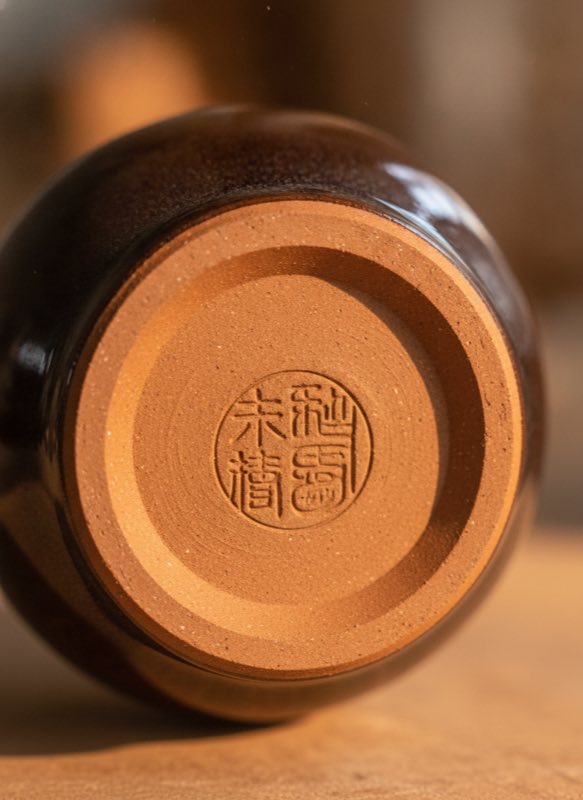
Many handmade tenmoku cups carry a small seal stamped or carved into the foot ring or base. This seal identifies the workshop or artisan, and it is as individual as a signature. Compare it against the seller’s documentation—if they provide a certificate of authenticity with the maker’s name and kiln location, that is a strong signal. Mass-produced cups sometimes add a generic “handmade” stamp, but the seal will look identical across dozens of cups. The Freer Gallery of Art at the Smithsonian maintains records of historically documented jian zhan marks—real artisans stand behind their work with traceable provenance.
Handmade vs Mass-Produced at a Glance
| Feature | Handmade | Mass-Produced |
|---|---|---|
| Foot ring | Uneven, spiral marks, 3.2–4.0 cm | Uniform, CNC-cut, no spiral |
| Glaze drip | Natural, 0.5–2.0 cm, varies per cup | Sharp, uniform line |
| Weight (4 oz cup) | 120–180 g | 80–110 g |
| Wall thickness | 0.2–0.5 cm variation | Uniform throughout |
| Kiln marks | Present—fire shadows, spots | Absent—electric kiln |
| Mold seams | None | Possible hairline ridge |
| Iron content in clay | 7–10% | 2–4% |
| Maker’s seal | Unique, documented | Generic or identical |
How to Verify Authenticity When Buying Online
You cannot hold the cup before purchasing, but you can still spot the signs from product photos and seller communication. Here is your online buyer’s checklist:
- Request foot ring photos — Ask the seller for a close-up of the unglazed base. Look for spiral wheel marks and slight asymmetry. If they refuse or send a blurry image, that is a warning sign.
- Check for kiln variation — If the seller shows three identical cups with identical glaze patterns, they are mass-produced. Genuine tenmoku always varies—no two cups from the same firing look the same.
- Ask about the maker — Legitimate sellers know which workshop produced each cup and can name the artisan or kiln. If they cannot, or give vague answers like “a master craftsman,” proceed with caution.
- Verify the weight — Ask for the exact weight in grams. Under 110 g for a standard cup? Likely machine-made. A reputable seller will provide this without hesitation.
- Look for the certificate — Authentic handmade tenmoku from reputable sources includes documentation of origin. The Victoria and Albert Museum emphasizes that provenance documentation is the gold standard for ceramic authentication.
Common Myths About Handmade Tenmoku
Not everything you hear about identifying handmade cups is accurate. Let us clear up three persistent myths that trip up even experienced collectors:
Myth 1: “If it has oil spots, it must be handmade.” False. Machine-made cups can reproduce oil-spot patterns through controlled glazing and firing. The pattern itself is not the proof—how the pattern varies between cups is what matters. On a handmade piece, no two oil spots will have the same size, shape, or distribution.
Myth 2: “Expensive means handmade.” Not always. Some mass-produced tenmoku is priced comparably to handmade pieces, especially when sold through premium retailers with elegant packaging. Price is a signal, not proof. A $120 cup could be either—only the seven physical tests tell you for certain.
Myth 3: “Machine-made cups are bad quality.” That depends on your standards. Machine-made tenmoku can be perfectly functional for daily tea drinking—they hold liquid, they look attractive, and they cost less. The distinction is about craft authenticity and the unique character that only human hands can give. If you value the story behind the object as much as the object itself, handmade matters.
❓ Can machine-made tenmoku look handmade?
Yes—some high-end mass-produced cups are designed to mimic handmade traits like slight asymmetry and varied glaze drips. However, the seven tests above still reveal the difference: the foot ring will be too uniform, the weight too light, and no maker’s documentation will exist. You cannot fake all seven signs simultaneously.
❓ Is there a quick single test I can rely on?
The weight test is the fastest single indicator. If a standard 4 oz cup weighs under 110 g, it is almost certainly mass-produced. But for confidence, combine at least three tests—weight, foot ring, and glaze drip give you a reliable verdict in under two minutes.
❓ Do all handmade tenmoku cups have a maker seal?
No. Some artisans choose not to stamp their work, especially small-batch studio potters who sell directly. The absence of a seal does not mean the cup is mass-produced—but the presence of a documented, verifiable seal is strong confirmation of authenticity.
📚 References
- Freer Gallery of Art: Jian Zhan Collection and Authentication Research. Smithsonian Institution
- Metropolitan Museum of Art: Chinese Ceramics — Technical Analysis and Provenance. The Met
- Victoria and Albert Museum: Maker’s Marks in East Asian Ceramics. V&A Museum
Ready to verify your cup? Browse our handmade tenmoku collection at Zen Tea Cup—every piece comes with artisan documentation and our authenticity promise.


