

Contents
- What Makes Jianzhan Black Glaze So Special?
- The Science Behind Jianzhan Black Glaze
- Black Glaze vs. Other Chinese Ceramic Glaze Traditions
- The Role of Black Glaze in Song Dynasty Tea Culture
- How Black Glaze Creates Every Jianzhan Pattern
- Why Black Glaze Enhances the Tea Experience
- ❓ Frequently Asked Questions About Jianzhan Black Glaze
- ❓ Is Jianzhan black glaze the same as regular black ceramic glaze?
- ❓ Why does the black glaze look different under different lighting?
- ❓ Can the black glaze pattern fade over time?
- ❓ How should I care for a black-glazed Jian Zhan bowl?
- The Modern Legacy of Jianzhan Black Glaze
- 📚 References
What Makes Jianzhan Black Glaze So Special?
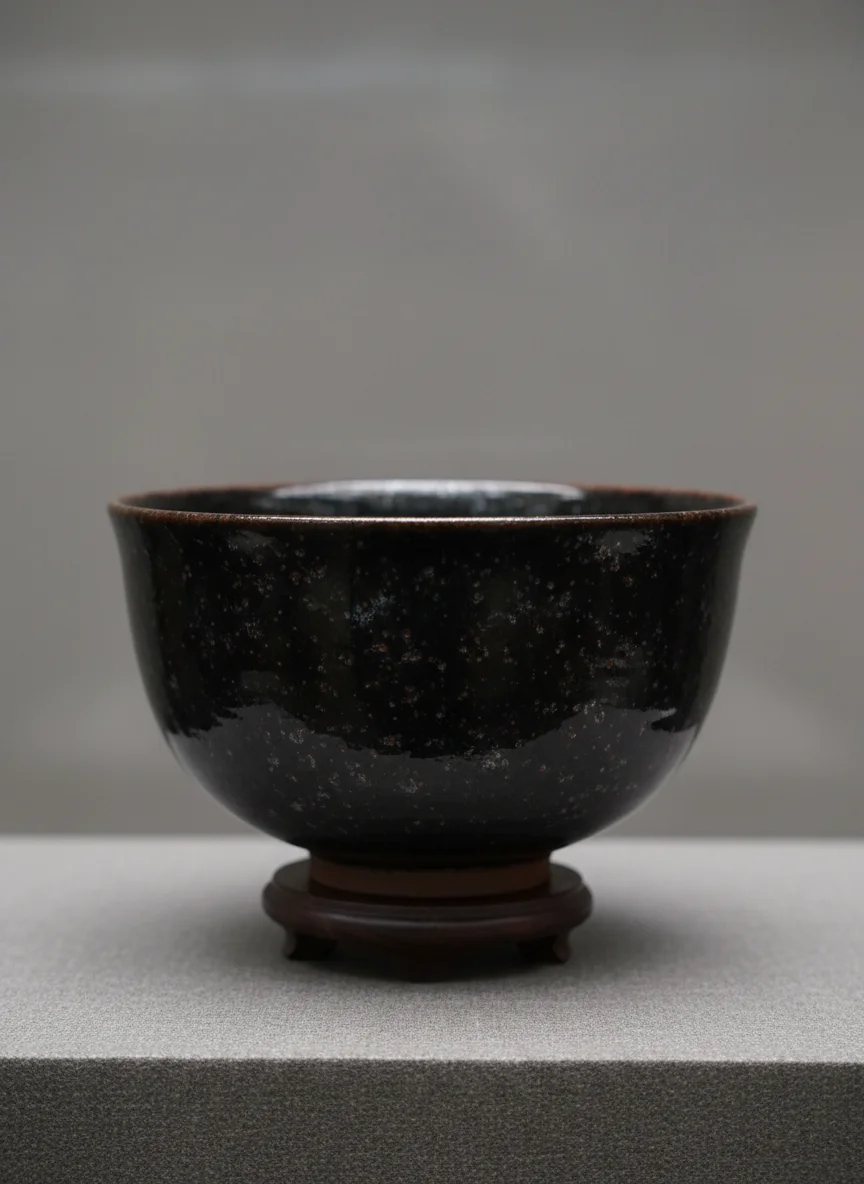
The black glaze of Jian Zhan — the iron-rich stoneware fired in the dragon kilns of Jianyang, Fujian, during the Song Dynasty (960–1279 CE) — is not simply a dark surface. It is a living, dynamic medium where iron oxide crystallizes into oil spots, hare’s fur streaks, partridge spots, and the legendary Yohen halos. In the world of Chinese pottery, at potalastore, we believe understanding the black glaze is the key to appreciating every Jian Zhan pattern, because the glaze itself is the canvas on which fire and chemistry paint their masterpieces. at Zen Tea Cup
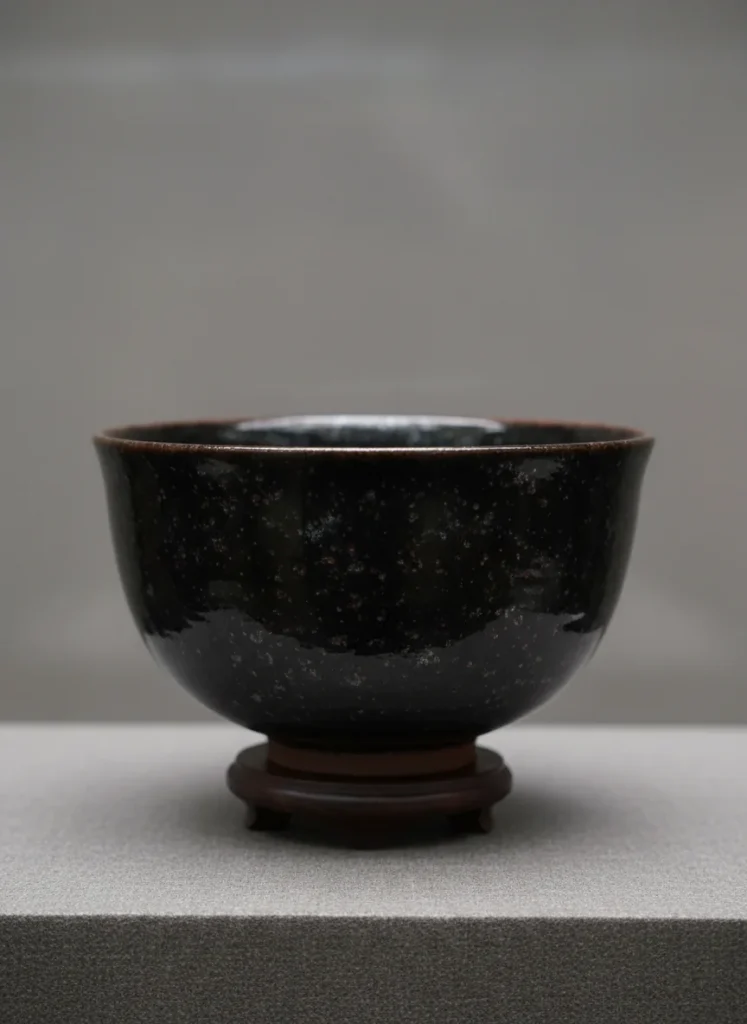
What makes Jian Zhan black glaze unique in the history of ceramics is its extraordinary iron content — 15–30% iron oxide (FeO), far higher than virtually any other ceramic glaze tradition in the world. This iron is not merely a colorant; it is the active ingredient that drives every pattern, every shimmer, and every optical effect that makes Jian Zhan so prized. Without this iron-rich foundation, there would be no oil spots, no hare’s fur, no Yohen — just an ordinary piece of pottery.
The meaning of “black glaze” in the Jian Zhan context is therefore quite different from black glaze in other ceramic traditions. In most traditions, black glaze is simply a colored coating. In Jian Zhan, the black glaze is a reactive medium — a material that transforms under kiln conditions into patterns of astonishing beauty and complexity.
You should consider the cup size that best fits your drinking habits.
The Science Behind Jianzhan Black Glaze
Understanding the chemistry of Jian Zhan black glaze reveals why it produces such extraordinary patterns:
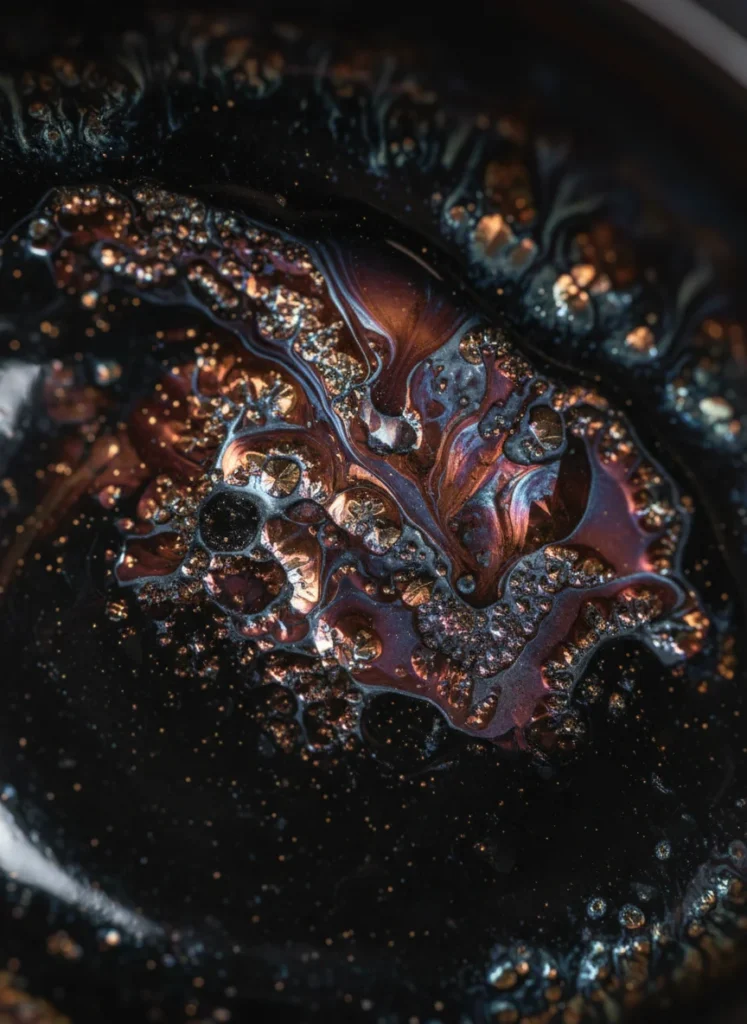
- Iron-rich glaze composition — The glaze formula uses local Jianyang clay mixed with iron-rich minerals. The iron oxide content (15–30%) is the highest of any traditional Chinese ceramic glaze. This iron exists primarily as Fe₂O₃ (ferric oxide) in the raw glaze.
- Reduction firing — In the dragon kiln’s reducing atmosphere (low oxygen), Fe₂O₃ converts to FeO (ferrous oxide). This chemical transformation is critical: FeO is far more reactive and mobile than Fe₃O₄, allowing the iron to flow, pool, and crystallize during the cooling phase.
- Phase separation — As the kiln cools from 1300°C (2372°F), the iron-rich glaze undergoes liquid-liquid phase separation. The iron separates from the base glass and forms distinct pools or streams on the surface.
- Crystallization — These iron-rich pools crystallize as the temperature continues to drop. The specific pattern — oil spots, hare’s fur, or partridge spots — depends on how the iron moved and where it concentrated before crystallizing.
Recent research using non-destructive spectroscopy has identified multiple iron oxide phases in Jian Zhan glazes, including hematite (α-Fe₂O₃), magnetite (Fe₃O₄), and the rare epsilon-Fe₂O₃ that produces the distinctive iridescent effects in the finest pieces. This multi-phase crystallization is what gives Jian Zhan black glaze its depth — you are not looking at a single color but at layers of different iron oxide crystals, each reflecting light differently.
Black Glaze vs. Other Chinese Ceramic Glaze Traditions
Jian Zhan black glaze stands apart from other Chinese ceramic traditions in several key ways:
| Feature | Jian Zhan Black Glaze | Celadon (Qingci) | White Porcelain (Bai Ci) |
|---|---|---|---|
| Iron content | 15–30% FeO | 1–3% FeO | Less than 1% |
| Primary effect | Reactive crystallization | Subtle green color | Translucent white |
| Pattern formation | Kiln-transformed (uncontrollable) | Controlled glaze application | Controlled glaze application |
| Aesthetic philosophy | Beauty through unpredictability | Beauty through refinement | Beauty through purity |
| Surface texture | Variable — jade-like to glassy | Smooth, glossy | Smooth, translucent |
The fundamental difference is philosophical: celadon and white porcelain represent the Chinese ideal of human control over materials, while Jian Zhan black glaze represents the opposite — the beauty that emerges when you surrender control to the kiln. This is why Song Dynasty tea masters prized Jian Zhan above all other bowls: the patterns were not made by human hands but born from the marriage of earth and fire.
The Role of Black Glaze in Song Dynasty Tea Culture
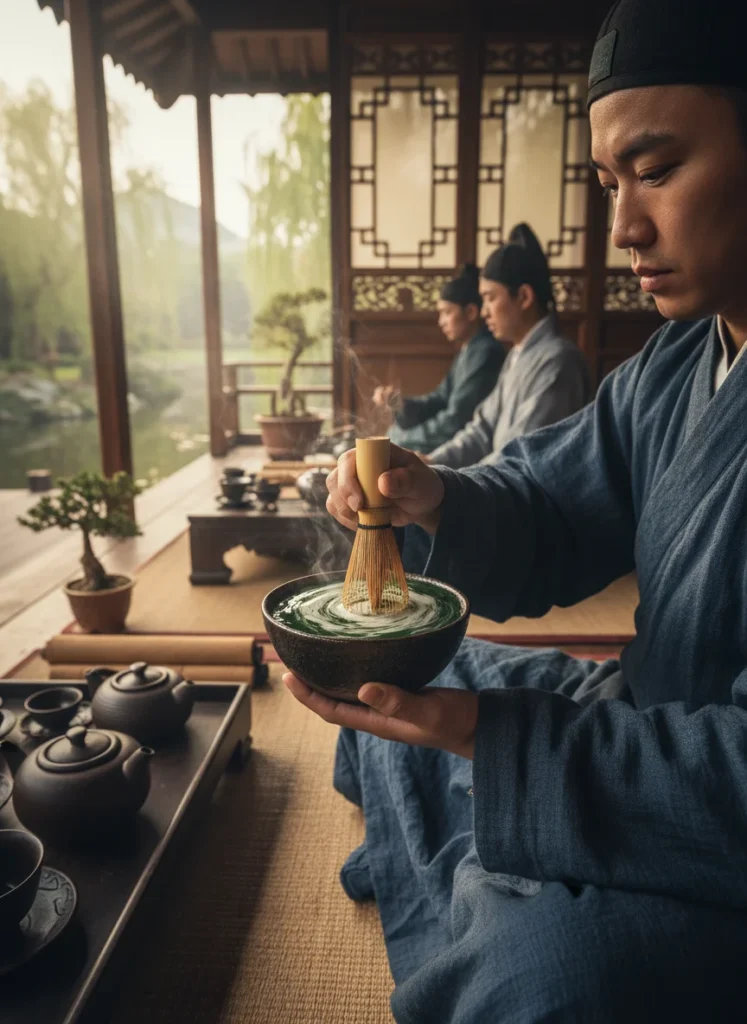
During the Song Dynasty, tea was prepared by whisking powdered tea into a white froth — a method that later evolved into Japanese matcha preparation. The visual contrast between the dark Jian Zhan glaze and the white tea foam was central to the tea competition (斗茶, dou cha) experience.
The Song Dynasty text Cha Lu (茶录) by Cai Xiang specifically explains why black-glazed bowls were preferred: “The white froth of tea appears most vividly against a dark glaze. Light-colored bowls make it difficult to judge the quality of the froth.” This practical consideration — visibility of the tea — was the original reason Jian Zhan became the standard vessel for tea competitions.
But the black glaze offered more than just contrast. The subtle patterns within the glaze — the shimmer of hare’s fur, the glow of oil spots — added a layer of aesthetic pleasure that enhanced the entire tea experience. The history of Jian Zhan is inseparable from this intersection of function and beauty.
How Black Glaze Creates Every Jianzhan Pattern
The black glaze is not just the background for Jian Zhan patterns — it is the source material from which all patterns emerge:
- Hare’s fur (兔毫) — Iron flows downward under gravity during the melting phase, then crystallizes into fine vertical streaks during cooling. The black glaze provides the iron that flows.
- Oil spots (油滴) — Iron pools into round droplets through phase separation, then crystallizes into metallic spots. The black glaze provides the iron that pools.
- Partridge spots (鹧鸪斑) — Iron crystallizes into small, discrete dots during slow cooling. The black glaze provides the iron that crystallizes.
- Yohen (曜变) — The rarest pattern, where iron crystallizes into circular spots surrounded by iridescent halos. The black glaze provides the iron and the optical depth that makes the halos visible.
In every case, the pattern is not applied to the glaze — it emerges from within the glaze. This is why authentic Jian Zhan patterns show depth and interaction with the surrounding glaze surface, while imitations with painted patterns appear flat and superficial. You can explore the full range of Tenmoku glaze patterns to see how the same black glaze foundation produces such diverse results.
Why Black Glaze Enhances the Tea Experience
Beyond its visual beauty, the black glaze of Jian Zhan has practical effects on the tea you drink:
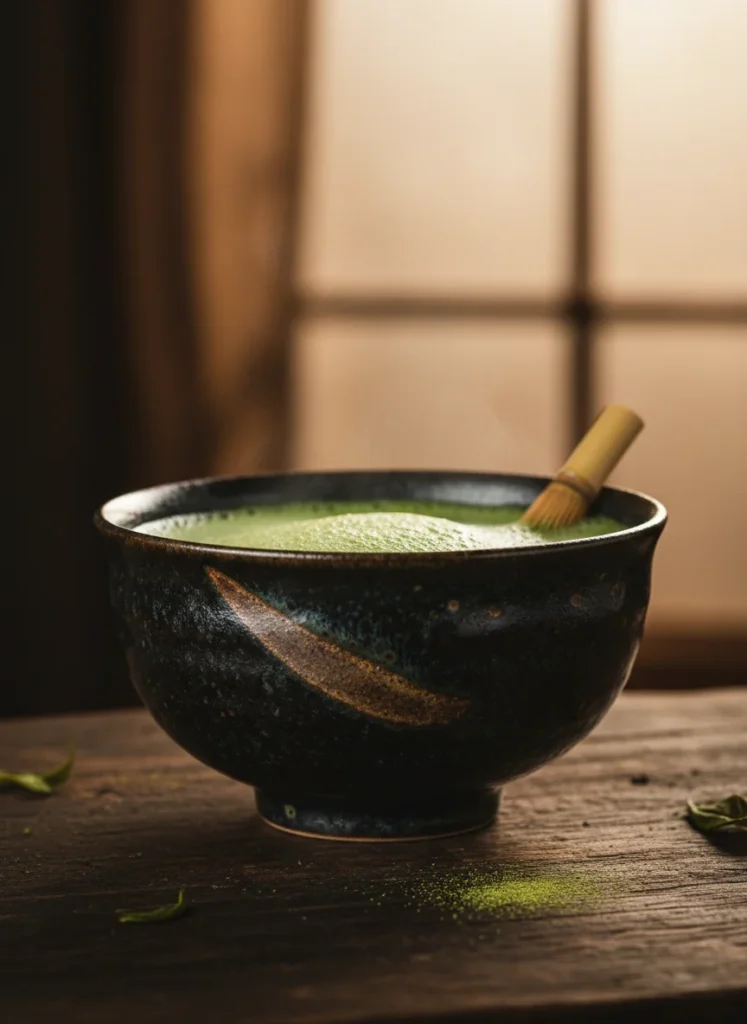
- Visual contrast — The dark surface makes the color and texture of the tea clearly visible, allowing you to judge the quality of your brew.
- Heat retention — The thick, iron-rich glaze and heavy stoneware body retain heat longer than thin porcelain, keeping your tea warm throughout the session.
- Iron interaction — The iron in the glaze subtly interacts with the tea, softening the water and enhancing the flavor. Many tea practitioners report that the iron in Tenmoku cups makes tea taste better by releasing trace minerals into the brew.
- Patina development — With regular use, tea oils build a warm patina on the black glaze through a process called yang hu (养壶). This patina deepens the glaze’s luster and creates a personal connection between the bowl and its owner.
These functional benefits are not secondary to the aesthetic value — they are integral to why Jian Zhan has been the preferred tea bowl for nearly a thousand years.
❓ Frequently Asked Questions About Jianzhan Black Glaze
❓ Is Jianzhan black glaze the same as regular black ceramic glaze?
No. Regular black ceramic glaze uses carbon-based pigments or low-iron minerals to achieve a dark color. Jian Zhan black glaze contains 15–30% iron oxide, which makes it a reactive medium that crystallizes into patterns during firing. The iron is not just a colorant — it is the active ingredient that produces all Jian Zhan patterns.
❓ Why does the black glaze look different under different lighting?
The iron oxide crystals in the glaze reflect light at different angles and wavelengths depending on their crystal structure and thickness. Under direct light, you may see metallic reflections, iridescent halos, or color shifts between silver, gold, and blue-purple. This optical complexity is a direct result of the multi-phase iron oxide crystallization within the glaze.
❓ Can the black glaze pattern fade over time?
No. The patterns are crystallized iron oxide embedded within the glaze — they are as permanent as the glaze itself. With regular tea use, the surface may develop a warm patina (yang hu), but the underlying crystalline patterns remain unchanged. A thousand-year-old Song Dynasty Jian Zhan still shows its original patterns as clearly as the day it was fired.
❓ How should I care for a black-glazed Jian Zhan bowl?
Avoid sudden temperature changes, never use in a microwave or dishwasher, and clean with warm water and a soft cloth. No soap or detergent is needed — the iron-rich glaze is naturally resistant to staining. Regular tea brewing enhances the bowl’s luster through the yang hu process.
The Modern Legacy of Jianzhan Black Glaze
Today, the black glaze tradition of Jian Zhan continues to inspire ceramicists and collectors worldwide. Modern Jianyang kiln masters have revived the Song Dynasty techniques, producing wood-fired black glaze bowls that — while not identical to the originals — capture much of the depth and complexity that made Jian Zhan famous. The revival has been so successful that in 2011, the Chinese government designated Jian Zhan firing techniques as part of the nation’s Intangible Cultural Heritage.
At the same time, scientific research on Jian Zhan black glaze has accelerated. New analytical techniques — including synchrotron X-ray diffraction and electron microscopy — have revealed that the glaze contains multiple phases of iron oxide arranged in complex layered structures. This research has not only deepened our understanding of how Song Dynasty potters achieved their extraordinary results, but has also inspired new approaches to ceramic glaze chemistry that draw on the Jian Zhan tradition.
The global appreciation for Tenmoku continues to grow, and the black glaze remains at the heart of this tradition. Whether you are a collector seeking museum-quality pieces or a tea practitioner looking for the perfect daily bowl, understanding the black glaze is your foundation for appreciating everything that makes Jian Zhan extraordinary.
📚 References
Cai Xiang, Cha Lu (茶录, Record of Tea), Song Dynasty, c. 1049–1053 CE.
H. Duan et al., “Non-destructive identification of iron oxide crystals in 15th-century Jian ware,” Heritage Science, 2024.
Robert D. Mowry, Hare’s Fur, Tortoiseshell, and Partridge Feathers: Chinese Brown- and Black-Glazed Ceramics, 400–1400, Harvard Art Museums, 1996.
Dejoie et al., “A New Nanostructured Iron Oxide in Ancient Chinese Jian Ceramic Glazes,” Scientific Reports, 2014.
Updated June 2026. Ongoing spectroscopic research continues to reveal new details about the multi-phase iron oxide crystallization in Jian Zhan black glazes.
Ready to experience the depth of Jian Zhan black glaze for yourself? Explore our curated collection at potalastore — where Song Dynasty tradition meets your daily tea practice.


