

Tenmoku glaze patterns — oil spot, hare’s fur, and yao bian — form when iron-rich glaze crystallizes at extreme kiln temperatures above 2,300°F (1,260°C), creating visual effects that have fascinated tea drinkers for over a thousand years. Each pattern emerges from a precise combination of iron oxide concentration, firing duration, and cooling rate, making every tenmoku cup a frozen record of its own birth inside the kiln. Explore our handcrafted selection from Zen Tea Cup to see these patterns up close.
| Key Stat | Value |
|---|---|
| Firing Temperature | 2,372°F (1,300°C) |
| Iron Oxide Content | 5–8% of glaze |
| Oil Spot Crystal Size | 0.5–2 mm diameter |
| Hare’s Fur Streak Width | 0.1–0.3 mm |
| Typical Firing Duration | 10–14 hours |
| Glaze Layer Thickness | 1–2 mm (0.04–0.08 in) |
Contents
- What Are Tenmoku Glaze Patterns?
- Oil Spot — The Iron Crystal Constellation
- How Oil Spot Forms at 2,372°F
- Identifying Authentic Oil Spot
- Hare’s Fur — The Streaking Crystal Lines
- The Physics Behind Hare’s Fur Streaks
- Hare’s Fur vs Oil Spot: Key Differences
- Yao Bian — The Kiln-Transformed Miracle
- Why Yao Bian Is the Rarest Pattern
- Temperature and Timing for Yao Bian
- How to Identify Each Pattern When You Shop
- Caring for Your Tenmoku Tea Cup
- ❓ What are the different types of Tenmoku glaze?
- ❓ What color is Tenmoku glaze?
- ❓ Where did Tenmoku glaze come from?
- ❓ Can you tell oil spot from hare’s fur on a single cup?
- 📚 References
What Are Tenmoku Glaze Patterns?
Tenmoku glaze patterns refer to the crystalline surface effects that appear on stoneware fired with iron-saturated glazes — a tradition that began at the Jian kilns in Fujian Province during China’s Song Dynasty (960–1279 CE). The term “tenmoku” itself comes from the Japanese pronunciation of Tianmu Mountain, where Buddhist monks first brought these bowls back from China, as documented by the Metropolitan Museum of Art.
When you look at a tenmoku bowl, what you see is not paint or decoration applied after firing — it is iron oxide (Fe₂O₃) that crystallized as the glaze cooled. The three most celebrated patterns — oil spot, hare’s fur, and yao bian — each form under different thermal conditions, and understanding them helps you appreciate what you are holding and identify authentic pieces when you shop.
Oil Spot — The Iron Crystal Constellation
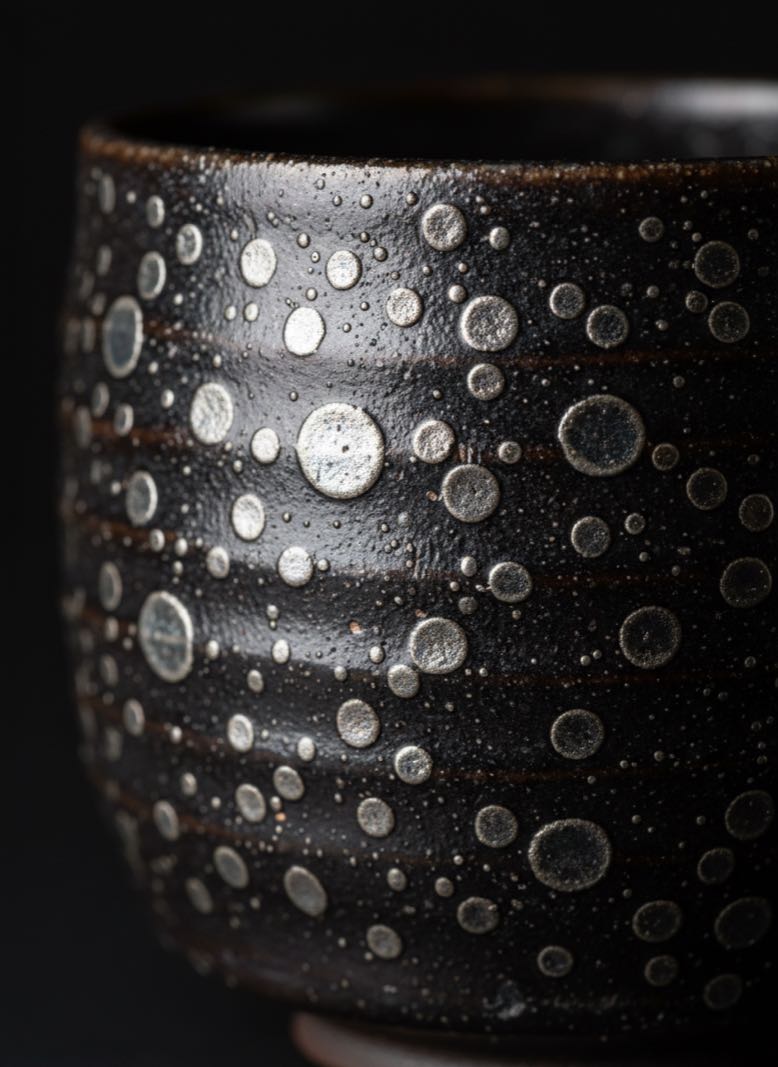
Oil spot (you-dian) is arguably the most visually dramatic tenmoku pattern. Round, metallic-sheened spots scatter across the dark glaze surface like stars in a night sky, each spot marking where an iron crystal cluster grew large enough to reflect light. When you tilt an oil spot cup under a lamp, those spots shimmer with a silvery or golden iridescence that painted ceramics can never replicate.
How Oil Spot Forms at 2,372°F
Oil spot forms when iron-rich glaze reaches peak temperature — around 2,372°F (1,300°C) — and then cools relatively slowly through a specific crystallization window. At this temperature, iron oxide dissolves completely into the glaze melt. As the kiln cools at roughly 100°F per hour (56°C/hour), iron atoms migrate to the glaze surface and begin clustering into crystal nuclei. If the cooling rate allows enough time for these clusters to grow without being disturbed, they expand into the round spots you recognize as oil spot.
The iron oxide content must be between 5–8% of the total glaze weight for oil spot to develop reliably. Below 5%, the glaze lacks enough iron to form visible crystals; above 8%, the surface tends to flood with metallic sheen rather than distinct spots. The glaze thickness also matters: a layer of 1–2 mm (0.04–0.08 in) provides enough iron at the surface for crystal growth without running off the bowl during firing.
Identifying Authentic Oil Spot
When you evaluate an oil spot tenmoku cup, look for these markers: each spot should have a slightly raised profile you can feel with your fingertip; the spot center should show a brighter metallic sheen than the edges; and under strong light, genuine oil spot displays a color shift from silver to gold depending on the viewing angle. Machine-replicated oil spot often appears flat and uniform — genuine oil spot crystals vary in size from 0.5 mm to 2 mm across a single cup, creating an organic irregularity that mass production cannot match.
Hare’s Fur — The Streaking Crystal Lines
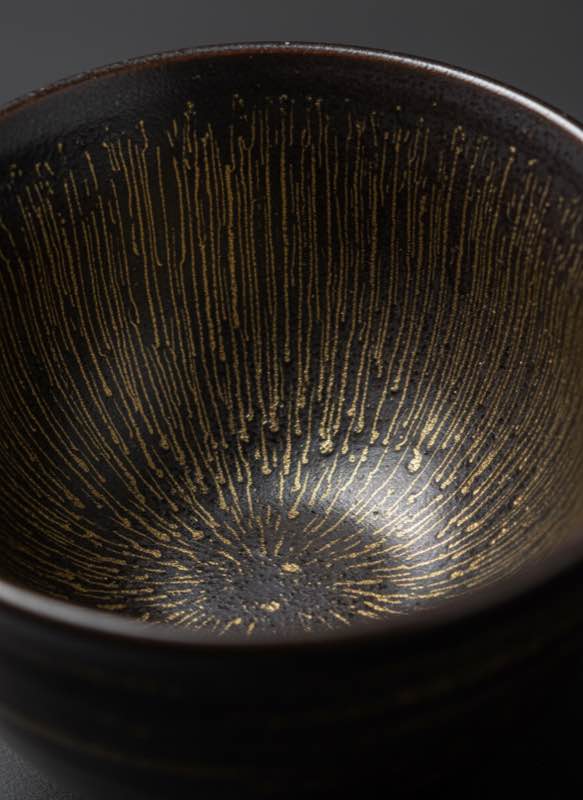
Hare’s fur (tu-hao) presents as fine, parallel lines streaming down the bowl’s interior — lines so delicate they resemble the silky fur of a hare’s back. Unlike oil spot’s round constellation, hare’s fur creates a directional flow that draws your eye downward toward the bowl’s center, which is precisely where your tea pool gathers during a gongfu session.
The Physics Behind Hare’s Fur Streaks
Hare’s fur forms when the glaze is slightly more fluid at peak temperature than oil spot conditions require. As the glaze melts and begins flowing downward along the bowl wall — pulled by gravity — iron crystals align into streaks rather than clusters. The streaks are essentially oil spot crystals that stretched into lines because the glaze was moving while the crystals were forming. The width of each streak measures roughly 0.1–0.3 mm, far finer than oil spot diameters, and the streaks typically run 1–3 cm (0.4–1.2 in) in length before thinning to nothing.
The key variable that separates hare’s fur from oil spot in the kiln is the cooling rate: faster cooling through the crystallization zone favors hare’s fur because the glaze does not have time to let iron clusters grow into round spots. China Tea Spirit notes that many Jian zhan pieces exhibit both patterns — oil spot near the rim where the glaze is thickest, transitioning to hare’s fur lower on the wall where the glaze is thinner and cools faster.
Hare’s Fur vs Oil Spot: Key Differences
| Feature | Oil Spot | Hare’s Fur |
|---|---|---|
| Visual Form | Round spots, 0.5–2 mm | Parallel streaks, 0.1–0.3 mm wide |
| Direction | Random scatter | Vertical, flowing downward |
| Iron Crystal Shape | Clusters (hematite plates) | Stretched strands |
| Cooling Rate | Slower (80–100°F/hour) | Faster (120–150°F/hour) |
| Glaze Viscosity | Higher (less fluid) | Lower (more fluid) |
| Surface Texture | Slightly raised bumps | Smooth, nearly flat |
Yao Bian — The Kiln-Transformed Miracle
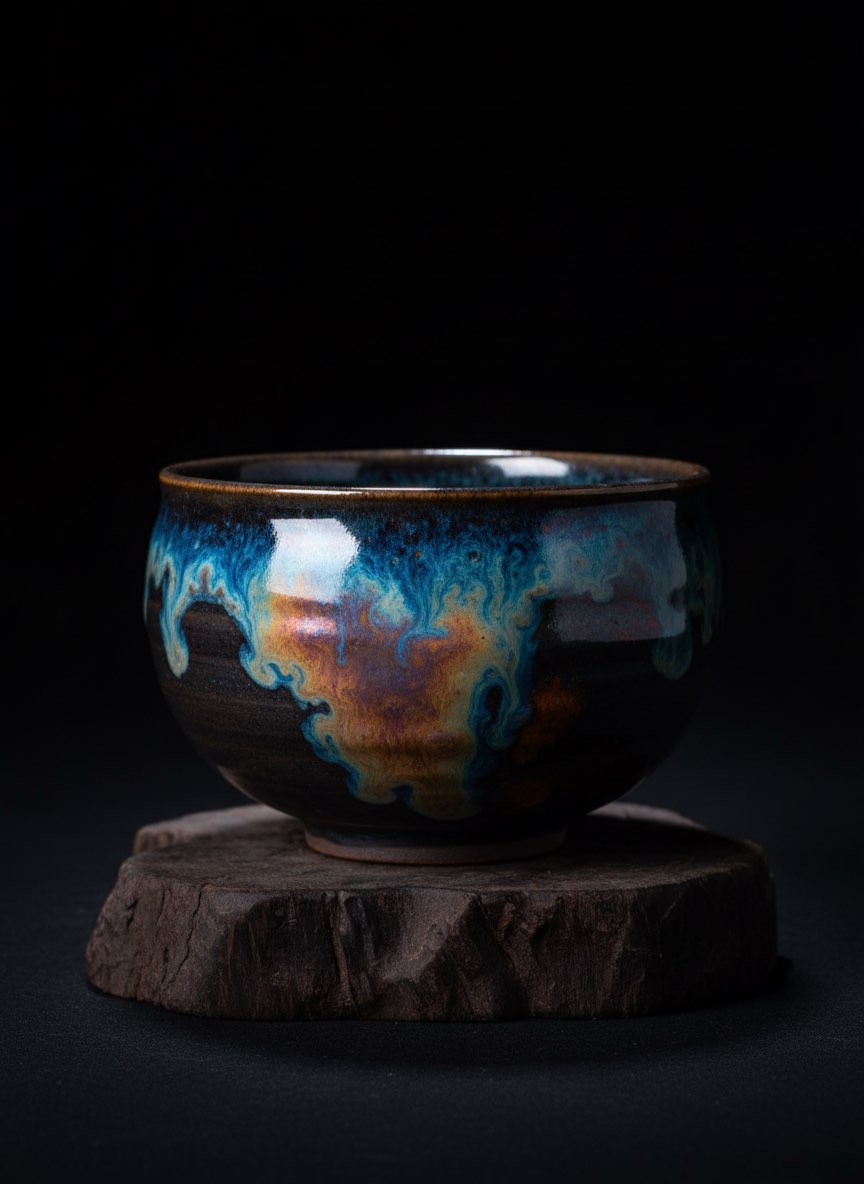
Yao bian (窑变), sometimes written as yohen in Japanese, translates literally to “kiln transformation” — and the name is earned. Unlike oil spot and hare’s fur, which can be intentionally produced by controlling temperature and glaze composition, yao bian is the result of unpredictable kiln conditions that cause the glaze to transform in ways even the potter cannot fully predict. When yao bian happens, the bowl’s surface may display patches of blue, silver, gold, or iridescent color that shift as you rotate the cup, an effect caused by thin-film interference in the iron crystal layer.
Why Yao Bian Is the Rarest Pattern
Yao bian requires a convergence of factors that rarely align: the glaze iron content must be at the upper edge (around 7–8%), the peak temperature must hold within a narrow 50°F (28°C) band near 2,372°F, and the cooling profile must pass through a specific crystallization range at an exact rate — roughly 90–120°F per hour (50–67°C/hour). Even then, only a fraction of the bowls in the kiln show yao bian. Historical records from the Song Dynasty suggest that out of thousands of Jian zhan fired, perhaps a handful emerged as yao bian, making them treasures presented to the emperor.
When you hold a genuine yao bian tenmoku cup, you will notice that the color shifts depending on the light angle — a phenomenon called iridescence. This happens because the iron crystal layer is thin enough (under 0.01 mm) to create interference patterns between reflected light wavelengths, similar to what you see on a soap bubble or oil slick. Learn more about the history behind these bowls and how Song Dynasty potters first achieved them.
Temperature and Timing for Yao Bian
Modern potters who pursue yao bian use a controlled reduction atmosphere during the final 2–3 hours of a 12–14 hour firing cycle. The reduction phase — where oxygen supply is limited — converts Fe₂O₃ (red iron oxide) into FeO (ferrous oxide), which has different crystallization behavior. The kiln temperature must then drop through the 1,800–2,000°F (982–1,093°C) range at no faster than 120°F per hour (67°C/hour). Rushing the cooling by even 30°F/hour can collapse the delicate crystal film, turning a potential yao bian piece into an ordinary black-glaze bowl.
According to glaze chemistry research at Digitalfire, the iron oxide reduction reaction is exquisitely sensitive to partial pressure of oxygen in the kiln atmosphere — a difference of just 0.5% oxygen concentration can shift the outcome from yao bian to a metallic-sheen surface that lacks the prized iridescence.
How to Identify Each Pattern When You Shop
Knowing the science helps, but you also need practical visual checks when you are evaluating a tenmoku cup — whether online or in person. Here is a quick identification guide:
Oil Spot: Look for distinct, round spots scattered across the glaze. Run your finger over the surface — genuine oil spot crystals feel slightly raised. Under direct light, each spot should show a metallic flash that changes from silver to gold as you rotate the cup.
Hare’s Fur: Look for fine vertical lines running down the bowl’s interior. The lines should be parallel and evenly spaced, not random squiggles. The finest hare’s fur streaks are barely visible to the naked eye but shimmer under raking light.
Yao Bian: Look for color that shifts when you tilt the cup — blues, silvers, or golds that appear and disappear depending on the viewing angle. A static multicolored surface is likely a chemical glaze effect, not genuine yao bian crystallization.
When you shop for tenmoku, always ask about the firing method. Wood-fired pieces are more likely to produce natural yao bian, while gas and electric kilns can reliably produce oil spot and hare’s fur but rarely generate true yao bian because the atmosphere control is too uniform for the unpredictable transformation yao bian requires.
Caring for Your Tenmoku Tea Cup
Tenmoku glaze is chemically stable and does not contain lead or toxic materials — the iron oxide crystals are fully fused into the glaze surface during firing at 2,372°F. However, the metallic sheen on oil spot and yao bian surfaces can be dulled by abrasive scrubbing or harsh detergents. Wash your tenmoku cup by hand with warm water and a soft cloth. Avoid dishwashers, which use high-pressure jets that can gradually erode the crystal sheen over years of repeated cycles.
One delightful aspect of using a tenmoku cup daily is that tea oils gradually build up a patina on the glaze surface, enhancing the metallic iridescence rather than diminishing it. Many tea enthusiasts report that their oil spot cups become more brilliant after months of regular use — a process sometimes called “nurturing the glaze.” Discover why tea also tastes better in tenmoku as the iron content subtly affects your brew.
❓ What are the different types of Tenmoku glaze?
The three classic tenmoku glaze patterns are oil spot (round metallic crystal spots), hare’s fur (fine vertical crystal streaks), and yao bian (iridescent kiln-transformed surfaces that shift color). Each forms from the same iron-rich glaze under different kiln temperature and cooling conditions.
❓ What color is Tenmoku glaze?
Base tenmoku glaze ranges from deep brown to black, but the crystalline patterns create visual effects on top of that dark surface. Oil spot appears silver or gold, hare’s fur shows as fine lighter lines against the dark ground, and yao bian displays shifting blues, silvers, and golds depending on the light angle.
❓ Where did Tenmoku glaze come from?
Tenmoku glaze originated at the Jian kilns in Fujian Province, China, during the Song Dynasty (960–1279 CE). Japanese monks studying at Tianmu Mountain brought these bowls back to Japan, where the style name “tenmoku” — the Japanese reading of Tianmu — became the universal term for this iron-crystal glaze tradition.
❓ Can you tell oil spot from hare’s fur on a single cup?
Yes — many authentic Jian zhan pieces show both patterns on the same bowl. Oil spot typically appears near the rim where glaze pools thicker, while hare’s fur streaks form lower on the wall where glaze is thinner and flows faster. The transition zone between the two patterns is one of the clearest signs of a traditionally fired piece.
📚 References
- Song Dynasty Jian Ware: The Metropolitan Museum of Art’s collection of Jian tea bowls with tenmoku glaze. The Metropolitan Museum of Art
- Six Classic Glaze Patterns: Detailed breakdown of Jian zhan glaze types including oil spot, hare’s fur, and yao bian. China Tea Spirit
- Tenmoku Glaze Chemistry: Technical analysis of iron oxide crystallization in tenmoku glazes. Digitalfire Ceramic Materials
Whether you are drawn to the star-like sparkle of oil spot, the silky flow of Hare’s fur, or the impossible shimmer of Yao Bian, tenmoku Glaze Patterns Explained through science only deepen your appreciation for these ancient ceramics. When you understand how oil spot, Hare’s fur, and Yao Bian each form under specific kiln conditions in Tenmoku ware, every cup becomes a story of fire and iron — and that knowledge makes each sip more meaningful. Explore our full collection of handcrafted tenmoku tea cups — each one a unique record of fire, iron, and time — at Zen Tea Cup.
Ready to find your perfect tenmoku cup? Explore the Zen Tea Cup collection for handcrafted, artisan-crafted teaware shipped across the US.


