

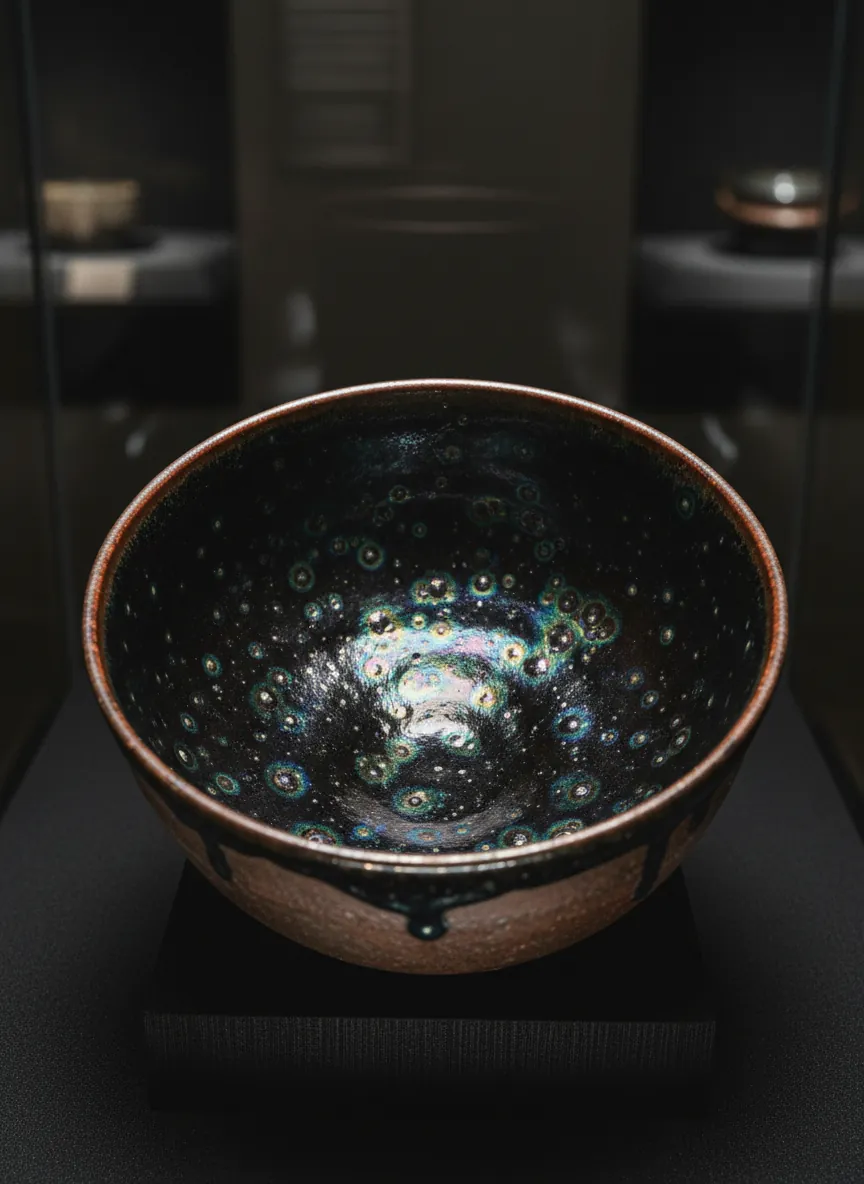
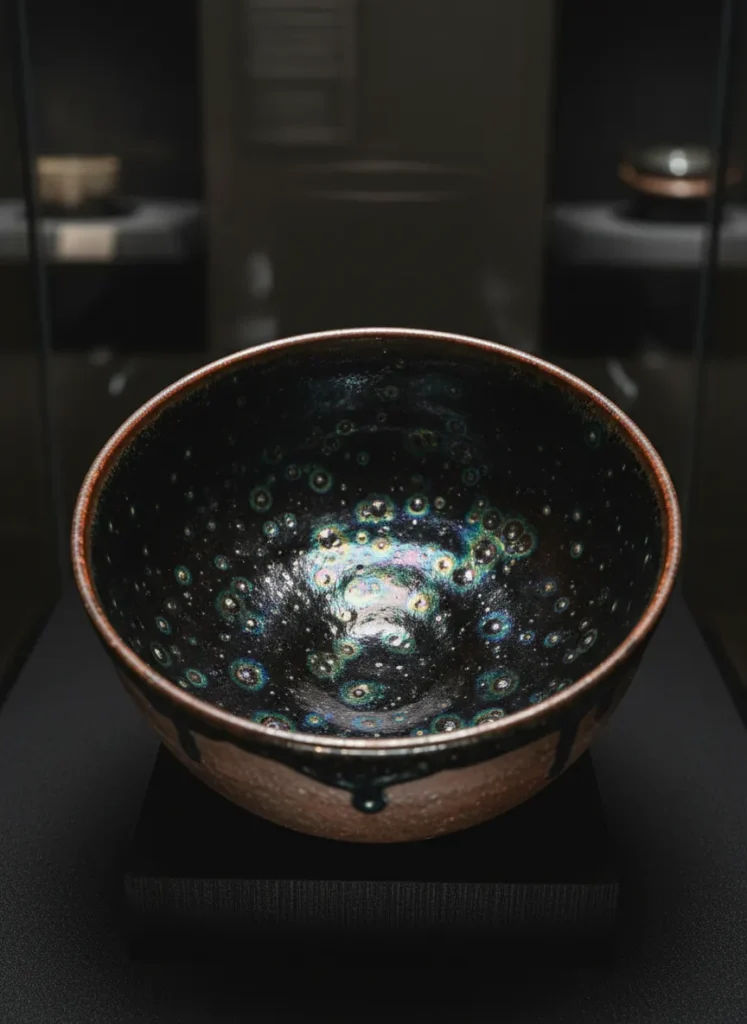
Yao Bian (曜变) — often romanized as Yohen — is the rarest and most mysterious glaze effect in Jianzhan Tenmoku pottery, where nanoscale crystal structures inside the glaze produce iridescent halos that shift between blue, green, purple, and gold as you change the viewing angle. According to Victoria and Albert Museum, ceramic conservation provides additional context on traditional firing techniques. According to ScienceDirect ceramic research, ceramic science studies provides additional context on traditional firing techniques. According to Metropolitan Museum of Art, Chinese ceramics research provides additional context on traditional firing techniques. Unlike hare’s fur streaks or oil spot droplets, yao bian cannot be intentionally created; it emerges only when kiln temperature, glaze thickness, iron concentration, and cooling rate align in a precise, unrepeatable combination that potters call “the kiln’s gift.”
At ZenTeaCup, we work directly with Jianyang kiln artisans who have spent decades studying the conditions that might — just might — produce yao bian effects. After years of observation, they’ll tell you the same thing: yao bian remains the one pattern that still humbles every master. This article explains what yao bian means, how it forms, why only three complete Song Dynasty examples survive, and what modern potters are doing to chase this elusive treasure.
Contents
- What Does “Yao Bian” Mean in Jianzhan Tianmu?
- How Yao Bian Forms: The Science Behind the Iridescence
- The Three Surviving Yohen Tenmoku National Treasures
- Yao Bian vs. Oil Spot: How to Tell the Difference
- Modern Attempts to Recreate Yao Bian
- Japanese Masters and the Yohen Pursuit
- Chinese Revival in Jianyang
- Why Yao Bian Matters to Tea Drinkers and Collectors
- ❓ Frequently Asked Questions
- Can modern potters create true yao bian?
- How can I tell if a bowl labeled “yao bian” is authentic?
- Why are there only three yao bian bowls in existence?
- Is yao bian the same as “kiln change” (窑变)?
- ❓ How do I know if my tenmoku cup is authentic?
- ❓ Can I put my tenmoku cup in the dishwasher?
- ❓ What tea tastes best in a tenmoku cup?
- 📚 References
What Does “Yao Bian” Mean in Jianzhan Tianmu?
Yao Bian (曜变) literally translates to “transmutation in the kiln” or “iridescent change” — the character 曜 means “radiant” or “glorious light,” and 变 means “transformation” or “mutation.” In Japanese, the same characters are read as Yohen, and the full term 曜变天目 (Yohen Tenmoku) refers specifically to Jian Zhan tea bowls that display this extraordinary iridescent glaze effect.
The name captures the essence of the phenomenon: the glaze undergoes a transmutation during firing that no potter can predict or control. The result is a surface that seems to contain living light — clusters of star-like spots surrounded by luminous halos that change color depending on how light strikes them. Under direct light, you might see deep blue and emerald green; shift the angle slightly, and purple and gold emerge from the same spot.
This is fundamentally different from other Tenmoku glaze patterns. Hare’s fur (兔毫) forms through gravity-driven iron flow, and oil spot (油滴) forms through iron bubble eruptions — both are reproducible effects that skilled potters can achieve with reasonable consistency. Yao bian, by contrast, appears to require a confluence of conditions so specific that even the most experienced kiln masters consider it a matter of chance rather than skill.
How Yao Bian Forms: The Science Behind the Iridescence
Yao bian’s iridescence comes from nanoscale glass-crystal layers that form within the glaze during a narrow window of the cooling phase. Here’s what happens inside the kiln:
- Iron saturation: The glaze contains 15–30% iron oxide (FeO), far higher than ordinary ceramic glazes. At peak firing temperature (1280–1300°C / 2336–2370°F), this iron dissolves completely into the molten glaze.
- Bubble formation: As the glaze melts, iron-rich gas bubbles form and rise toward the surface — similar to the oil spot process, but in yao bian, the bubbles are smaller and more densely packed.
- Crystal precipitation: During the critical cooling phase, if the temperature drops through a specific range (approximately 1100–900°C / 2012–1652°F) at just the right rate, iron oxide precipitates out of solution and forms extremely thin crystalline films around the bubble sites.
- Thin-film interference: These crystalline films are thin enough (measured in nanometers) to create thin-film interference — the same optical phenomenon that produces colors on soap bubbles or oil slicks. Light waves reflecting off the top and bottom surfaces of these films interfere with each other, amplifying some wavelengths and canceling others, which produces the characteristic color shifts.
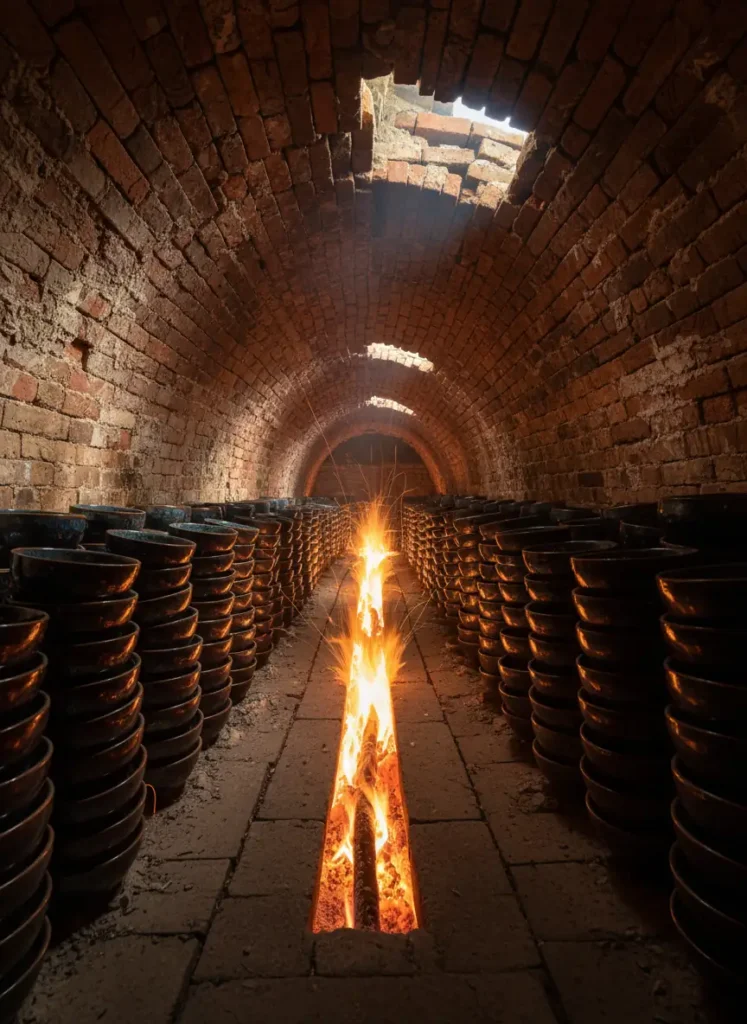
The reason yao bian is so rare is that step 3 requires a cooling rate that is nearly impossible to control in a traditional wood-fired dragon kiln. The kiln must cool slowly enough for crystals to grow, but not so slowly that the crystals become too thick (which would produce ordinary oil spots instead of iridescent halos). This narrow window — estimated at a cooling rate of roughly 1–2°C per minute through the critical range — is almost never achieved deliberately.
In our conversations with Jianyang potters, one master put it this way: “We can set up every condition perfectly — the clay, the glaze recipe, the stacking position, the firing curve — and still, yao bian either appears or it doesn’t. We’ve fired thousands of bowls and seen it happen perhaps once or twice, never in the same kiln twice.”
The Three Surviving Yohen Tenmoku National Treasures
Only three complete Song Dynasty Jian Zhan tea bowls with confirmed yao bian pattern are known to exist today, and all three are designated National Treasures of Japan — the highest cultural property classification in the Japanese system. Each bowl has a documented history stretching back centuries, and none have left Japan in modern times.
| Bowl Name | Current Location | Key Visual Feature | Approximate Size |
|---|---|---|---|
| Yohen Tenmoku (Seikadō) | Seikadō Bunko Art Museum, Tokyo | Large star spots with deep blue-purple halos | Diameter: 12.0 cm (4.7 in) |
| Yohen Tenmoku (Ryōan-in) | Ryōan-in sub-temple of Daitoku-ji, Kyoto | Smaller spots with green-gold iridescence | Diameter: 11.8 cm (4.6 in) |
| Yohen Tenmoku (Fujita) | Fujita Art Museum, Osaka | Dense cluster of spots with multi-color halos | Diameter: 12.3 cm (4.8 in) |
These bowls traveled from Jianyang, Fujian Province, to Japan during the Song Dynasty (960–1279 CE), likely carried by Japanese Zen monks who studied at Chinese monasteries on Tianmu Mountain — the very mountain that gave Tenmoku its name. In Japan, they became the most prized possessions of shōguns and tea masters, passed down through generations as symbols of ultimate refinement.
The fact that only three survive tells you something about yao bian’s rarity. Song Dynasty Jian kilns produced millions of tea bowls over roughly three centuries. Out of all those firings, only a handful displayed true yao bian — and of those, only three complete bowls survived wars, earthquakes, and the centuries. Even fragments of yao bian bowls are extraordinarily rare; archaeological excavations at the Jian kiln site in Shuiji, Jianyang, have uncovered tens of thousands of shards, but yao bian fragments can be counted on one hand.
Yao Bian vs. Oil Spot: How to Tell the Difference
Because yao bian and oil spot (Yuteki) both involve iron-rich spots on a dark glaze, they are frequently confused — especially in online listings where sellers may label any reflective spot pattern as “yao bian.” Here’s how to distinguish them:
| Feature | Yao Bian (Yohen) | Oil Spot (Yuteki) |
|---|---|---|
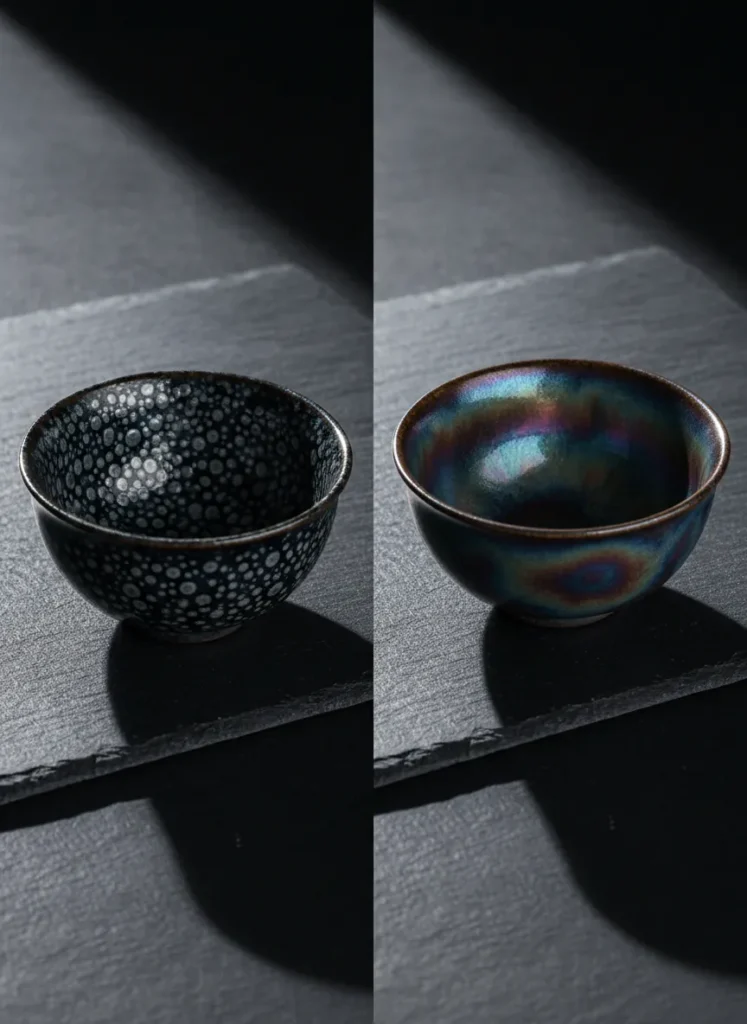
| Spot appearance | Spots surrounded by luminous, color-shifting halos | Discrete metallic droplets with fixed color |
| Color behavior | Iridescent — shifts between blue, green, purple, gold with viewing angle | Static — silver, gold, or copper sheen that doesn’t change color |
| Light response | Appears to glow from within; halos intensify under direct light | Reflects light from surface; spots shine but don’t shift color |
| Crystal structure | Nanoscale thin-film layers creating interference | Surface-level iron oxide crystallization |
| Rarity | Extremely rare — only 3 complete Song examples known | Uncommon but achievable by skilled potters |
| Price range (authentic) | Museum-level; not available on commercial market | $80–$300+ USD for quality examples |
The single most reliable test: rotate the bowl under a light source. If the spots change color — blue shifting to green, or purple shifting to gold — you’re looking at yao bian or a yao bian–like effect. If the spots simply reflect light without changing color, it’s oil spot. This distinction matters not just for identification, but for understanding what you’re paying for. A genuine yao bian bowl from the Song Dynasty is literally priceless; a modern oil spot bowl, however beautiful, is a different category of object entirely.
For those interested in oil spot patterns, our handcrafted Tenmoku tea cup collection includes several oil spot pieces that display stunning metallic sheen — just don’t expect the color-shifting iridescence of true yao bian.
Modern Attempts to Recreate Yao Bian
Recreating yao bian has been one of the great challenges in ceramics for over 700 years. Since the Song Dynasty kilns went dark, no potter has reliably produced a bowl that matches the iridescent quality of the three National Treasures — but several have come close enough to advance our understanding of the process.
Japanese Masters and the Yohen Pursuit
In Japan, a small circle of potters has dedicated their careers to yohen tenmoku. Kamada Kōji (鎌田幸二), based in Kyoto, is perhaps the most renowned — his yohen-style bowls display genuine iridescent halos, though they tend to be smaller and less vivid than the Song originals. Hayashi Kyōsuke (林恭助) and Nagae Sōkichi (長江惣吉) have also produced yohen-adjacent works that are highly valued by collectors.
These Japanese potters typically work with electric kilns that allow precise temperature control — a significant advantage over wood firing, but one that still hasn’t cracked the yao bian code. The consensus among them is that the Song potters likely didn’t understand yao bian either; they simply fired enormous quantities in massive dragon kilns, and yao bian emerged as a statistical anomaly.
Chinese Revival in Jianyang
Since the 1990s, a revival of Jian Zhan production in Jianyang has brought new attention to yao bian. Potters like Xiong Zhonggui in Shuiji village — located at the original Jian kiln site — have resumed production using locally sourced iron-rich clay and traditional firing methods. Some modern Jianyang potters have produced bowls with yao bian–like iridescence, though the effect is typically less dramatic than the Song originals.
What we’ve observed in our visits to Jianyang kilns is that modern potters who achieve yao bian–like effects tend to share a few common practices: using very thick glaze applications (1.5–2 mm / 0.06–0.08 in), placing bowls in specific zones of the kiln where cooling is slowest, and sometimes adding mineral additives to the glaze that promote thin-film crystal formation. Even with these techniques, the success rate remains extremely low — perhaps one yao bian–like piece per several hundred firings.
One thing we’ve learned from watching these attempts: the difference between “almost yao bian” and “true yao bian” is not a matter of degree but of kind. A bowl with slightly thicker crystal layers produces attractive oil spots; a bowl with slightly thinner layers produces genuine iridescence. The boundary between these two outcomes might be a matter of minutes in the cooling schedule, or a few degrees in the peak temperature. This razor-thin margin is what makes yao bian the “impossible” pattern.
Why Yao Bian Matters to Tea Drinkers and Collectors
For tea practitioners, yao bian represents something beyond visual beauty — it embodies the Japanese aesthetic concept of Wabi-sabi, the appreciation of beauty in imperfection and impermanence. A yao bian bowl is beautiful precisely because its beauty was not created by human intention; it emerged from forces beyond control, making each surviving example a unique collaboration between the potter’s skill and the kiln’s chaos.
For collectors, yao bian sits at the absolute pinnacle of the Tenmoku hierarchy. The three National Treasure bowls are valued in the tens of millions of dollars, and even modern yohen-style pieces by masters like Kamada Kōji command prices of $5,000–$15,000 USD or more. But the real value of yao bian isn’t monetary — it’s the understanding that you’re looking at something that cannot be manufactured, only encountered.
For everyday tea drinkers, yao bian’s significance is more philosophical. It reminds us that the most extraordinary things in craft — and perhaps in life — emerge from conditions we can set up but never fully control. The same iron-rich clay and the same reduction firing that produces a simple hare’s fur cup can, under the right circumstances, create something transcendent. Every time you brew tea in a Jian Zhan cup, you’re participating in a tradition that has always held this possibility at its heart.
If you’re new to Jian Zhan and want to experience the beauty of Tenmoku glaze in your daily tea practice, start with our beginner’s guide to Tenmoku tea cups — and explore our handcrafted collection for hare’s fur and oil spot cups that bring authentic Jianyang craftsmanship to your table.
❓ Frequently Asked Questions
Can modern potters create true yao bian?
Modern potters have produced bowls with yao bian–like iridescence, but none have consistently replicated the full color-shifting effect seen in the three Song Dynasty National Treasures. The consensus is that yao bian requires a combination of conditions that current technology cannot reliably reproduce. Some Japanese masters like Kamada Kōji have come the closest, producing genuine iridescent halos, but even their best works are considered “yohen-style” rather than equivalent to the Song originals.
How can I tell if a bowl labeled “yao bian” is authentic?
Rotate the bowl under a direct light source. True yao bian displays color-shifting iridescent halos — the spots will change from blue to green to purple to gold as you change the viewing angle. If the spots simply reflect light without changing color, it’s oil spot, not yao bian. Be especially cautious of online listings; many sellers use “yao bian” loosely to describe any reflective spot pattern. A genuine Song Dynasty yao bian bowl would be a museum piece, not a commercial product.
Why are there only three yao bian bowls in existence?
Yao bian requires an extremely precise combination of glaze composition, firing temperature, and cooling rate that occurs as a statistical anomaly in wood-fired kilns. Even during the Song Dynasty’s peak production — when millions of bowls were fired over three centuries — only a tiny fraction displayed true yao bian. Of those, most were lost to war, earthquake, and the passage of time. The three surviving bowls were preserved in Japan, where they were treasured by shōguns and tea masters for centuries.
Is yao bian the same as “kiln change” (窑变)?
They are related but not identical. “Kiln change” (窑变 yáo biàn in Chinese) is a broad term for any unexpected glaze effect that occurs during firing — including color variations, crackle patterns, and surface textures. “Yao Bian” (曜变) as used in Tenmoku specifically refers to the iridescent, color-shifting halos that appear around iron-rich spots. All 曜变 is a type of 窑变, but not all 窑变 is 曜变. The distinction matters because many bowls are described as having “kiln change” effects when they actually display ordinary oil spots or color variations, not the specific iridescent phenomenon of yao bian.
❓ How do I know if my tenmoku cup is authentic?
Look for an unglazed foot ring showing dark, iron-rich clay, metallic luster under light that shifts with viewing angle, and subtle asymmetry indicating hand-forming. See the handmade tenmoku identification guide for detailed authentication steps.
❓ Can I put my tenmoku cup in the dishwasher?
No. Always hand-wash with warm water only. Dishwasher detergent and high-pressure water can damage the glaze patina and may cause micro-cracking. The new tenmoku owner guide provides complete care instructions.
❓ What tea tastes best in a tenmoku cup?
Oolong and aged pu-erh are the classic pairings. The iron-rich glaze softens tannins and enhances aroma. Read the oolong-tenmoku pairing guide for the science behind this.
📚 References
- Tenmoku Glaze History and Classification: Overview of Tenmoku glaze types including Youhen (Yohen), Yuteki, and other variants. Wikipedia: Tenmoku
- Jian Ware and Song Dynasty Ceramics: Comprehensive resource on Chinese ceramics and historical glazing techniques from the Victoria and Albert Museum collection. Victoria and Albert Museum (V&A)
- Oil Spot and Hare’s Fur Glazes: Demystifying Classic Ceramic Glazes: Technical analysis of iron crystal formation in Tenmoku glazes. Ceramics Monthly, John Britt, April 2011.
- Chinese Glazes: Nigel Wood’s authoritative reference on Jian temmoku glaze chemistry and firing conditions, pages 145–158. A&C Black, 1999.
Ready to elevate your tea ritual? Explore Zen Tea Cup for handcrafted tenmoku cups shipped across the US.


