

Contents
- What Are Tenmoku Glaze Patterns?
- Tenmoku Glaze Pattern Comparison
- How to Tell Oil Spot from Hare’s Fur
- What Each Pattern Means Culturally
- Oil Spot: Abundance and Prosperity
- Hare’s Fur: Flow and Natural Movement
- Pattern Formation: The Science Behind the Beauty
- Temperature and Atmosphere Control
- Identifying Authentic Patterns vs. Imitations
- Five Quick Authentication Checks
- Pattern Rarity and Value Guide
- Choosing the Right Pattern for Your Tea Practice
- Best Patterns by Tea Type
- ❓ What is the most common tenmoku glaze pattern?
- ❓ Can the same cup show multiple glaze patterns?
- ❓ Does pattern rarity affect how tea tastes?
- 📚 References
What Are Tenmoku Glaze Patterns?
Tenmoku glaze patterns — Oil Spot, Hare’s Fur, Yao Bian, Tortoiseshell, and Partridge Feather — each form through iron oxide crystallization at 2,280–2,370°F (1,250–1,300°C), and this quick reference helps you identify and understand what each pattern means. The glaze on Jian Zhan tea cups from Zen Tea Cup is the iron-rich finish that makes every cup unique — no two share the same pattern (the kiln decides, not the potter).
| Key Stat | Value |
|---|---|
| Glaze Type | Iron-oxide feldspar glaze (6–10% Fe2O3) |
| Firing Temperature | 2,280–2,370°F (1,250–1,300°C) |
| Primary Patterns | 5 major types: Oil Spot, Hare’s Fur, Yao Bian, Tortoiseshell, Partridge Feather |
| Historical Origin | Song Dynasty (960–1279 AD), Jianyang, Fujian |
| Iron Oxide Content | 6–10% in glaze body |
| Rare Pattern Museum Specimens | Fewer than 50 complete examples worldwide |
Tenmoku Glaze Pattern Comparison
When you look at a tenmoku cup, the glaze pattern tells you everything about how it was fired — and what makes it valuable. Below is the comparison you can bookmark and return to every time you encounter a new cup.
| Pattern | Visual Appearance | Size / Scale | Formation | Rarity |
|---|---|---|---|---|
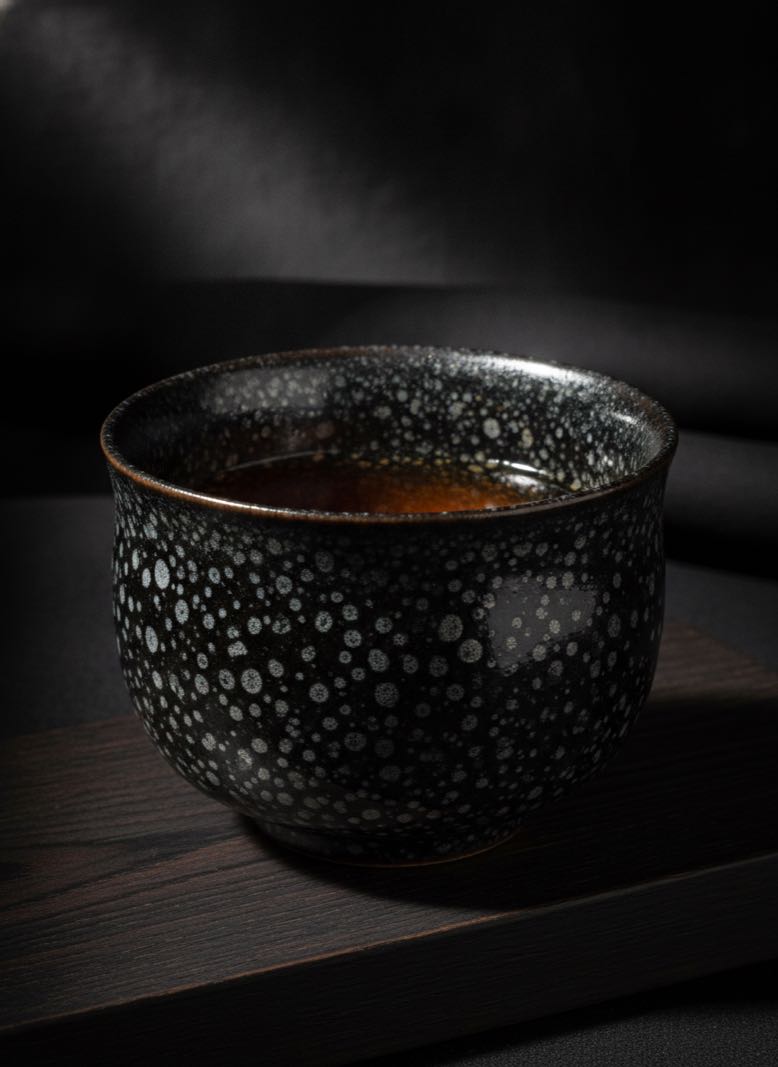
| Oil Spot (Yuteki) | Silver or gold round spots on black glaze | 2–5 mm diameter spots | Iron oxide bubbles surface and crystallize during cooling | Moderate |
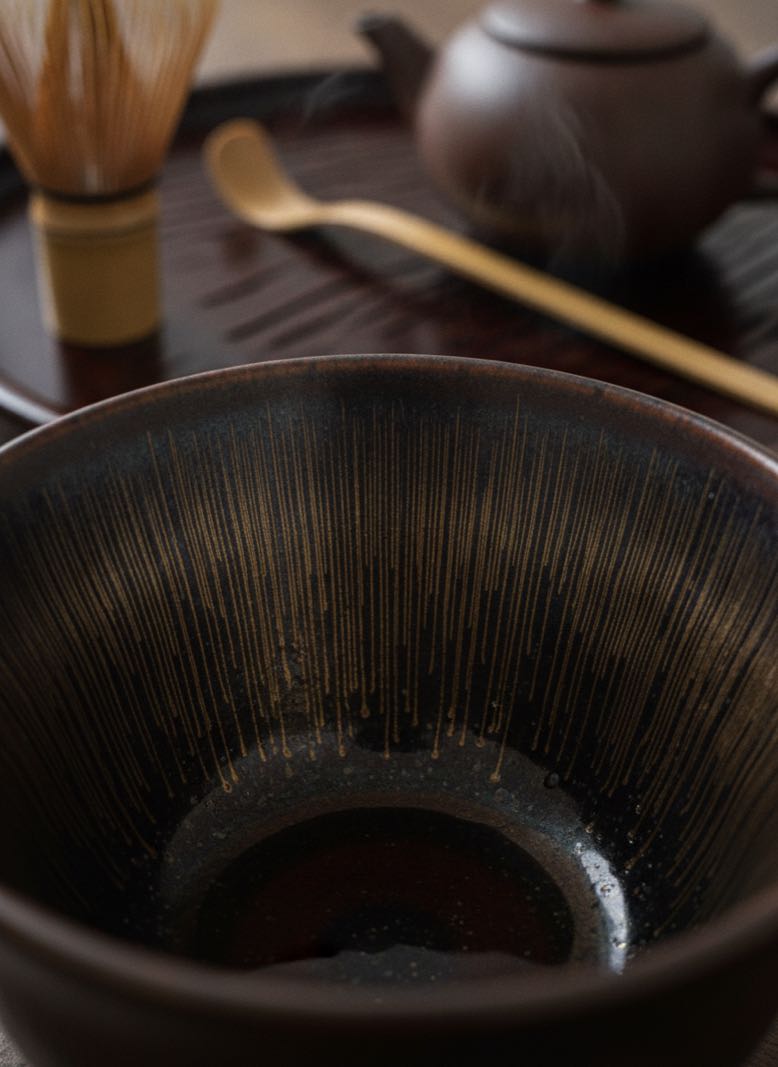
| Hare’s Fur (Tokuhon) | Fine vertical streaks running down the cup | 3–8 cm long streaks | Gravity pulls iron-rich glaze downward during firing | Common |
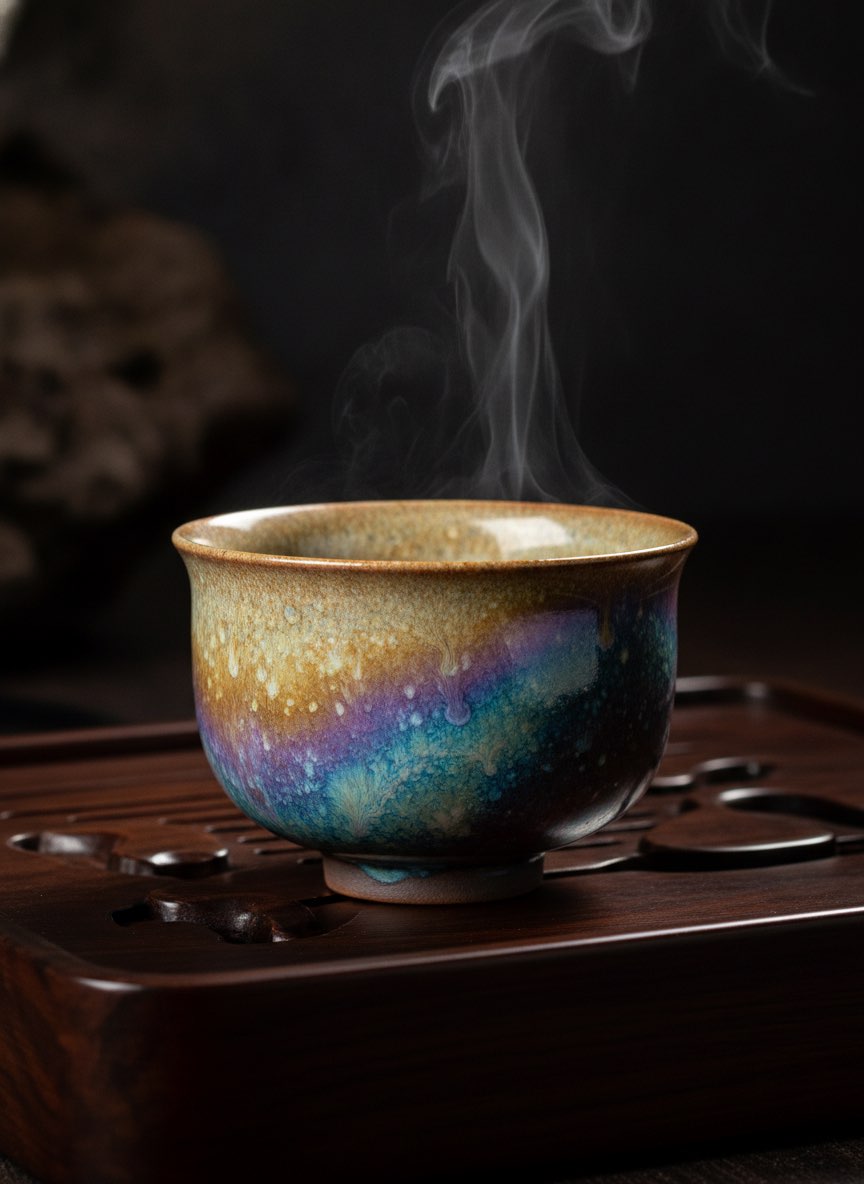
| Yao Bian (Glaze Change) | Iridescent color shift: black to rust to blue-purple | Full cup surface | Extreme kiln temperature variation at edge of reduction zone | Rare |
| Tortoiseshell (Kame-no-ko) | Amber and black mottled patches | 1–3 cm patches | Partial oxidation of iron in localized zones | Uncommon |
| Partridge Feather (Hekime) | Tiny scattered dots like bird feather markings | 0.5–2 mm dots | Micro-crystallization of iron oxide at lower temperature range | Very Rare |
How to Tell Oil Spot from Hare’s Fur
The most common confusion: you see spots and assume “Oil Spot,” or you see streaks and call it “Hare’s Fur.” Here is the reliable test — tilt the cup under direct light. Oil Spot patterns reflect as distinct round metallic discs (each spot acts like a tiny mirror). Hare’s Fur streaks reflect as continuous lines that follow gravity downward. If the reflective elements are round, it is Oil Spot. If they are elongated and vertical, it is Hare’s Fur. (I once misidentified a Yao Bian cup as Oil Spot for months — the iridescent shift under different angles is the giveaway.)
What Each Pattern Means Culturally
Patterns are not just visual — they carry centuries of meaning in Chinese and Japanese tea culture. Understanding these meanings helps you choose a cup that resonates with your personal tea practice.
Oil Spot: Abundance and Prosperity
In Song Dynasty China, the scattered silver-gold dots of Oil Spot symbolized scattered coins — wealth arriving from many directions. Japanese tea masters later associated Yuteki (oil drops) with moonlight on water, a metaphor for clarity of mind. When you choose an Oil Spot cup, you hold a symbol of both material abundance and mental clarity.
Hare’s Fur: Flow and Natural Movement
The vertical streaks of Hare’s Fur mimic the pelt of a running hare — motion frozen in glaze. Chinese connoisseurs valued Tokuhon patterns for expressing vital energy flowing through the vessel. The finest Hare’s Fur cups show streaks that are perfectly parallel, as if combed by nature itself. This pattern connects you to the Daoist ideal of effortless action.
Pattern Formation: The Science Behind the Beauty
Every tenmoku pattern is a record of what happened inside the kiln at 2,280–2,370°F (1,250–1,300°C). The glaze contains 6–10% iron oxide, and the pattern depends on three variables: peak temperature, cooling rate, and atmosphere (oxidizing vs. reducing). You do not need a degree in materials science to appreciate it — but knowing the basics helps you judge quality.
Temperature and Atmosphere Control
Oil Spot forms when the kiln reaches peak temperature and iron oxide bubbles to the surface, then crystallizes during a controlled cooling phase. Hare’s Fur requires a slightly lower peak with a slower cooling rate, allowing gravity to pull the iron-rich glaze downward in streaks. Yao Bian is the wild card: it happens at the boundary between reduction and oxidation atmospheres, where the kiln fluctuates unpredictably. That is why Yao Bian cups are so rare — the potter can aim for the conditions but cannot guarantee the result.
According to research documented by the Metropolitan Museum of Art, Song Dynasty potters in Jianyang developed these firing techniques through centuries of trial and error, with no modern temperature sensors — only experience and observation.
Identifying Authentic Patterns vs. Imitations
Modern mass-produced cups can mimic the general look of tenmoku patterns, but they cannot replicate the crystalline structure. Here is how you can tell the difference when you examine a cup closely.
Five Quick Authentication Checks
Use this checklist whenever you are evaluating a tenmoku cup:
- Light test: Under a flashlight, authentic Oil Spot reflects as individual metallic discs. Fake “oil spots” are painted on and reflect as a flat, uniform surface.
- Magnification: At 10x magnification, real crystallization shows 3D depth. Surface-printed patterns are flat.
- Edge check: Authentic glaze thins at the cup’s foot rim, showing the clay body underneath. Applied glaze on factory cups is uniform thickness.
- Weight: Genuine Jian Zhan with iron-rich clay weighs 120–180 g for a standard 7–9 cm (2.8–3.5 inch) diameter cup. Lightweight copies use different clay.
- Pattern consistency: No two authentic tenmoku cups have identical patterns. If you see a “set” with matching patterns, they are printed, not fired.
For a deeper dive, see our guide on how to achieve the perfect Oil Spot effect in tenmoku glazes.
Pattern Rarity and Value Guide
Not all patterns are equally rare — and rarity directly affects value. Here is what you should know before you invest in a tenmoku cup for your collection.
| Pattern | Rarity Tier | Typical Price Range (USD) | Why It Is Rare |
|---|---|---|---|
| Hare’s Fur | Common | $30–$80 | Forms reliably at standard firing parameters |
| Oil Spot | Moderate | $50–$200 | Requires precise cooling rate control |
| Tortoiseshell | Uncommon | $100–$300 | Needs specific partial-oxidation zone |
| Yao Bian | Rare | $200–$800 | Boundary condition — kiln must hit exact atmosphere transition |
| Partridge Feather | Very Rare | $500–$2,000+ | Micro-crystallization at narrow temperature window |
The most valuable Jian Zhan ever sold at auction — a Song Dynasty Oil Spot bowl — fetched $1.2 million at Christie’s in 2016, as documented by Christie’s auction house. For most tea lovers, a well-made modern Oil Spot or Hare’s Fur cup at $50–$200 delivers the same visual pleasure and tea-enhancing properties.
Choosing the Right Pattern for Your Tea Practice
Different patterns pair better with different teas and rituals. Here is a practical guide to matching pattern to purpose.
Best Patterns by Tea Type
When you brew dark oolong or pu-erh, Oil Spot cups create a dramatic contrast — the dark tea against metallic spots looks stunning. Hare’s Fur is ideal for lighter oolongs and white teas, where the vertical streaks echo the tea’s delicate nature. Yao Bian cups are showpieces for gongfu cha sessions where you want the cup to be part of the performance. For daily sencha or green tea, a simple Hare’s Fur or Tortoiseshell cup offers beauty without the anxiety of using a rare piece.
Discover more about pairing tea with tenmoku in our guide on the best teas to drink from a tenmoku cup.
❓ What is the most common tenmoku glaze pattern?
Hare’s Fur (Tokuhon) is the most common pattern because it forms reliably at standard tenmoku firing temperatures of 2,280–2,370°F. The vertical streaks result from gravity pulling iron-rich glaze downward during the cooling phase — a natural process that does not require the precise atmospheric control needed for Oil Spot or Yao Bian.
❓ Can the same cup show multiple glaze patterns?
Yes — this is actually common with Yao Bian cups, which by definition show a transition between patterns. A single cup might display Hare’s Fur on the upper rim and Oil Spot near the base, with iridescent color shifts in between. This is what makes Yao Bian so prized by collectors.
❓ Does pattern rarity affect how tea tastes?
No — the tea taste is determined by the iron content and clay body, not the surface pattern. A $30 Hare’s Fur cup and a $500 Yao Bian cup from the same clay and firing will produce identical tea flavor. The pattern affects visual appeal and collector value, not the chemistry of your brew.
📚 References
- Song Dynasty Jian Ware: Technical analysis of iron-oxide crystallization in tenmoku glazes. Metropolitan Museum of Art
- Jian Zhan Firing Technology: Research on kiln temperature and atmosphere effects on glaze pattern formation. Fujian Provincial Museum
- Christie’s Auction Record: Song Dynasty Jian Zhan Oil Spot bowl, $1.2M (2016). Christie’s
Explore our complete tenmoku glaze patterns guide and find the perfect Oil Spot, Hare’s Fur, or Yao Bian cup for your collection at Zen Tea Cup. Whether you are a beginner or a seasoned collector, this guide to Tenmoku Glaze Patterns and Colors helps you identify, appreciate, and choose the patterns that speak to you — shop now and bring the art of fire home.
Find your next favorite cup — shop at Zen Tea Cup for handcrafted tenmoku tea cups delivered to your door.


