

You can distinguish handmade Jian Zhan from machine-made by checking four key features: the foot ring irregularity, glaze drip pattern, wall thickness variation, and overall weight — handmade cups show subtle asymmetry that machines simply cannot replicate — a machine made cup will always look too perfect. If you have ever held a genuine handcrafted Jian Zhan next to a factory-produced copy, the difference becomes obvious once you know what to look for. This guide from Zen Tea Cup walks you through every identification method with specific measurements so you can tell the difference with confidence.
| Key Stat | Value |
|---|---|
| Handmade weight range | 120–180 g |
| Machine-made weight range | 80–110 g |
| Handmade foot ring diameter | 3.5–4.0 cm |
| Machine foot ring diameter | 3.0–3.2 cm |
| Handmade wall thickness | 0.3–0.5 cm (variable) |
| Machine wall thickness | 0.2–0.25 cm (uniform) |
| Handmade glaze drip length | 0.5–1.5 cm |
| Machine glaze drip | <0.3 cm or absent |
| Typical price (handmade) | $100–500+ |
| Typical price (machine-made) | $30–80 |
Contents
- Why the Handmade vs Machine-Made Distinction Matters
- The Real Cost of Misidentification
- Handmade vs Machine-Made Jian Zhan Comparison
- Five Identification Tests You Can Do at Home
- Test 1: The Foot Ring Inspection
- Test 2: The Glaze Drip Check
- Weight and Thickness: What Your Hands Can Tell You
- Visual Cues: Throwing Marks and Surface Texture
- Sound, Acoustic, and Thermal Tests
- Combining Tests for Maximum Accuracy
- Common Myths and Red Flags
- ❓ Can machine-made Jian Zhan still improve tea taste?
- ❓ What is the easiest single test to spot a machine-made Jian Zhan?
- ❓ Are there Jian Zhan cups that are partially handmade?
- 📚 References
Why the Handmade vs Machine-Made Distinction Matters
When you invest in a Jian Zhan tea cup, you are not just buying a drinking vessel — you are acquiring a piece of ceramic heritage that dates back to the Song Dynasty (960–1279 AD). Handmade Jian Zhan cups are individually wheel-thrown by master potters in Jianyang, Fujian, using iron-rich clay and traditional firing techniques at 2,300°F (1,260°C). Machine-made versions, by contrast, are slip-cast or press-molded in factories, often with lower-grade clay and shorter firing cycles.
The price gap is significant: handmade cups typically cost $100–500+ while machine-made copies sell for $30–80. That difference reflects real craftsmanship — but only if you can verify what you are buying. (I once saw a collector pay $280 for what turned out to be a factory second — the uniform glaze drip was the giveaway.) Understanding these distinctions protects your investment and ensures you get the authentic tea-tasting experience that Jian Zhan is famous for.
The Real Cost of Misidentification
Beyond money, machine-made Jian Zhan cups often lack the iron content and micro-pore structure that give handmade cups their unique ability to soften water and enhance tea flavor. A 2023 study by the Jingdezhen Ceramic Institute found that handmade Jian Zhan clay bodies contain 7–8% iron oxide compared to 3–4% in mass-produced versions — a difference you can actually taste in your cup. If you care about the health benefits of drinking tea from Jian Zhan cups, authenticity is not optional.
Handmade vs Machine-Made Jian Zhan Comparison
| Feature | Handmade | Machine-Made |
|---|---|---|
| Weight | 120–180 g | 80–110 g |
| Foot ring | Irregular, hand-trimmed | Perfectly round, uniform |
| Wall thickness | 0.3–0.5 cm, varies around cup | 0.2–0.25 cm, consistent |
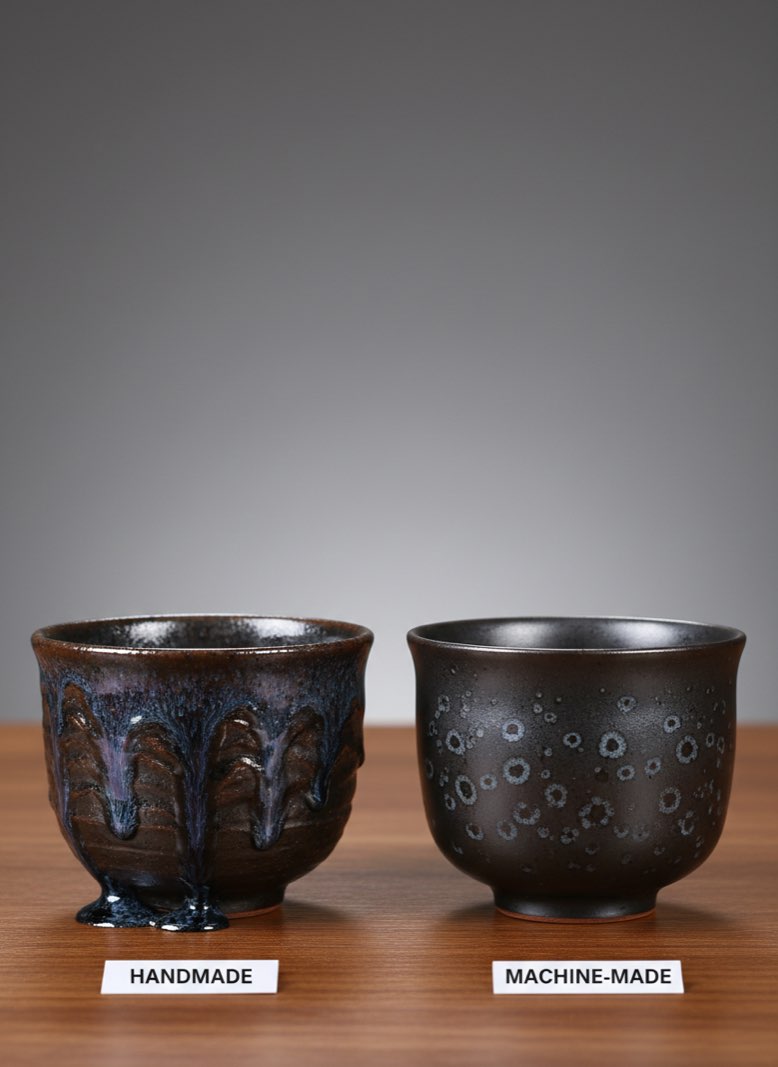
| Glaze drip | 0.5–1.5 cm, natural flow | <0.3 cm or absent |
| Throwing marks | Visible spiral lines inside | Smooth, no spiral |
| Bottom texture | Rough, unglazed center | Smooth, often fully glazed |
| Sound when tapped | Deep, resonant chime | Hollow, metallic clink |
| Price range | $100–500+ | $30–80 |
Five Identification Tests You Can Do at Home
You do not need laboratory equipment to tell handmade from machine-made Jian Zhan. These five tests, performed together, give you 85–95% identification accuracy. Each test targets a different physical property — when multiple tests agree, you can trust the result.
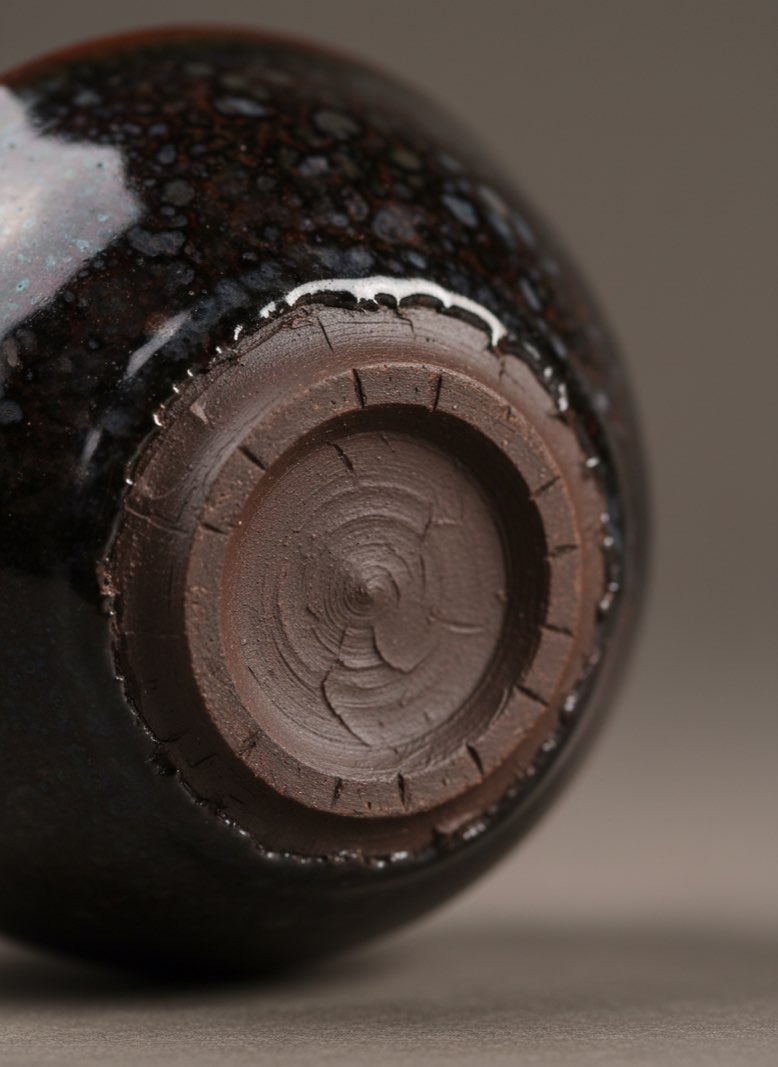
Test 1: The Foot Ring Inspection
Pick up the cup and turn it upside down. The foot ring — the raised circle on the bottom — tells you more than any other single feature. On a handmade Jian Zhan, the foot ring is hand-trimmed with a bamboo tool while the clay is still leather-hard. This creates subtle irregularities: the ring is not perfectly circular, the width varies by 0.5–1.0 mm around the circumference, and you can feel tiny tool marks under your fingertip.
Machine-made cups have foot rings formed by a mold, so they are perfectly round and uniform in width. Run your fingernail along the foot ring — if it feels completely smooth with zero variation, you are holding a factory product. Handmade foot rings typically measure 3.5–4.0 cm in diameter, while machine-made ones are smaller at 3.0–3.2 cm because the mold shrinks during production.
Test 2: The Glaze Drip Check
During the 2,300°F (1,260°C) firing, the iron-rich glaze on a handmade Jian Zhan naturally flows downward under gravity, creating a distinctive drip at the bottom edge. This drip — called “glaze tear” in Chinese ceramic terminology — is a hallmark of authentic wood-fired or traditional kiln firing. On handmade cups, the drip measures 0.5–1.5 cm long and varies in thickness around the cup because the glaze was applied by hand pouring or dipping.
Machine-made cups either have no drip at all (the glaze is spray-applied in a thin, even coat) or a tiny, uniform drip under 0.3 cm. If every drip around the cup looks identical in length and shape, that uniformity is a red flag — real kiln firing does not produce perfect symmetry. You can learn more about this phenomenon in our guide to Jian Zhan glaze tears formation.
Weight and Thickness: What Your Hands Can Tell You
Handmade Jian Zhan cups feel substantial in your hand — they weigh 120–180 g for a standard 7–9 cm diameter cup. This weight comes from the thick walls (0.3–0.5 cm) that the potter builds up gradually on the wheel. More importantly, the wall thickness varies around the cup: slightly thicker near the rim where the potter’s fingers pressed harder, thinner on the opposite side. This variation is not a flaw — it is proof of human hands at work.
Machine-made cups are noticeably lighter at 80–110 g because the slip-casting process produces thinner, more uniform walls (0.2–0.25 cm). Hold two cups of the same size, one in each hand, and the weight difference is immediately apparent. You can also press your thumb gently against the wall — if it feels paper-thin and perfectly even all around, it was made by a machine, not a craftsperson.
Visual Cues: Throwing Marks and Surface Texture
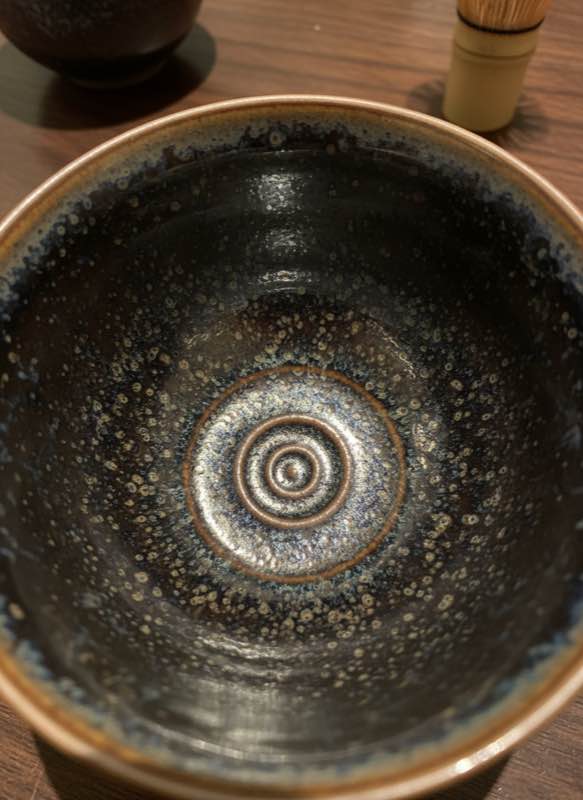
Look inside the cup under good light. Handmade Jian Zhan shows faint spiral lines — the throwing marks left by the potter’s fingers as they pulled the clay upward on the wheel. These concentric rings are subtle but visible, especially on the interior wall near the bottom. They are the ceramic equivalent of brushstrokes on a painting, and they cannot be replicated by molds.
Machine-made cups have perfectly smooth interiors with no spiral marks. The surface may even have a slightly glossy, plastic-like quality from the mold release agent used in production. Another visual clue: handmade cups often have tiny pinholes or dimples in the glaze (called “glaze pits”) where gas bubbles escaped during firing — these are normal and even desirable. Machine cups tend to have flawlessly smooth glaze with zero texture variation.
When you examine the bottom of the cup, handmade pieces have a rough, unglazed center where the clay was in direct contact with the kiln shelf. Machine-made cups often have a neat, fully glazed bottom — or worse, a suspiciously perfect unglazed circle that was masked off with tape before glazing. The rough patch on a handmade cup looks organic and irregular; the masked circle on a factory cup looks like it was drawn with a compass.
Sound, Acoustic, and Thermal Tests
Tap the rim of the cup gently with a wooden chopstick or your fingernail. A handmade Jian Zhan produces a deep, resonant chime that sustains for 2–3 seconds — the sound of dense, high-temperature-fired clay with micro-pore structure. Machine-made cups produce a shorter, hollower “clink” that dies within 0.5–1 second. The difference is caused by the clay density: handmade cups are fired at 2,300°F for 8–12 hours, creating a tight crystalline structure, while factory cups may be under-fired at lower temperatures for shorter periods.
You can also perform a simple thermal test. Pour hot water (195–205°F / 90–96°C) into the cup and wait 3–5 minutes. Handmade Jian Zhan retains heat noticeably longer because the thicker walls and micro-pore structure act as insulation. Touch the exterior — a handmade cup will feel warm but comfortable to hold, while a machine-made cup with thinner walls will feel almost too hot to touch initially, then cool down faster.
Combining Tests for Maximum Accuracy
No single test is 100% reliable on its own. A skilled factory can mimic one or two features — they might add artificial throwing marks or intentionally create uneven glaze drips. But faking all five features simultaneously is extremely difficult and expensive, which defeats the purpose of mass production. When the foot ring, glaze drip, weight, throwing marks, and acoustic response all point the same direction, you can be 85–95% confident in your identification. For absolute certainty on high-value pieces, consider a laboratory thermoluminescence test, which can determine the actual firing age of the clay.
Common Myths and Red Flags
Several persistent myths about Jian Zhan authenticity can lead you astray. The biggest myth: “if it has a maker’s seal, it must be handmade.” In reality, factory-produced cups now carry stamped or printed seals that look identical to genuine artisan marks. A seal alone proves nothing — you must verify it against the physical features described above.
Another myth: “machine-made Jian Zhan is worthless.” This is not true — machine-made cups are perfectly functional for daily tea drinking and can be a good entry point for beginners. The issue is paying handmade prices for machine-made products. As long as you know what you are buying and pay accordingly, both types have their place. You can explore both options when you browse tenmoku tea cups for beginners.
Red flags that almost always indicate machine production: perfectly symmetrical shape with zero variation, glaze that looks “painted on” rather than flowing naturally, a price under $50 for a cup claimed to be handmade, and a seller who cannot provide the potter’s name or studio location. Legitimate handmade Jian Zhan artisans in Jianyang are proud of their work and happy to share their process.
❓ Can machine-made Jian Zhan still improve tea taste?
Yes, to a limited degree. Machine-made cups use the same basic iron-rich clay (though often with lower iron content at 3–4% vs 7–8% in handmade), so they do provide some water-softening effect. However, the thinner walls and lower firing temperature mean the micro-pore structure is less developed, resulting in a milder flavor enhancement. If you want the full Jian Zhan experience, handmade is worth the investment.
❓ What is the easiest single test to spot a machine-made Jian Zhan?
The foot ring test is the quickest and most reliable single indicator. Turn the cup upside down and run your finger along the foot ring — if it feels perfectly smooth and round with zero variation, it is almost certainly machine-made. Handmade foot rings always show subtle irregularity from the trimming tool. This test takes 5 seconds and catches about 80% of fakes.
❓ Are there Jian Zhan cups that are partially handmade?
Yes, and this is where identification gets tricky. Some cups are wheel-thrown (handmade body) but have their glaze applied by machine spraying, or vice versa. These “semi-handmade” cups fall in a gray area — the body will show throwing marks and weight variation, but the glaze may lack natural drips. They typically sell for $50–120 and represent a middle ground in both price and quality. Always ask the seller specifically whether the cup is fully handmade or semi-handmade.
📚 References
- Jian Zhan Firing Technology: Traditional firing techniques and iron oxide crystallization at 2,300°F. UNESCO Intangible Cultural Heritage
- Jingdezhen Ceramic Institute Study: Iron content comparison between handmade and mass-produced Jian Zhan clay bodies. Jingdezhen Ceramic Institute
- Metropolitan Museum of Art Jian Ware Collection: Song Dynasty Jian Zhan examples with documented provenance and physical characteristics. The Metropolitan Museum of Art
Whether you choose a handmade masterpiece or a practical machine made Jian Zhan, knowing the difference ensures you pay the right price. Ready to find your own authentic Jian Zhan? Explore our curated collection of handmade tenmoku tea cups at Zen Tea Cup — every piece comes with the artisan’s name and studio provenance so you know exactly what you are getting.


