

Contents
- What Is Taiwanese High Mountain Oolong?
- The Four Major High Mountain Tea Regions
- How High Mountain Oolong Is Made
- Tasting Notes: What to Expect from Each Region
- Brewing Guide: Getting the Most from Your High Mountain Oolong
- How to Identify Authentic High Mountain Oolong
- ❓ Frequently Asked Questions About High Mountain Oolong
- ❓ Is high mountain oolong the same as Tieguanyin?
- ❓ Can I age high mountain oolong like Pu’er?
- ❓ Why is high mountain oolong so expensive?
- ❓ What is the difference between spring and winter harvest?
- Storing High Mountain Oolong Properly
- Pairing High Mountain Oolong with Food
- 📚 References
What Is Taiwanese High Mountain Oolong?
Taiwanese High Mountain Oolong (高山乌龙, gaoshan wulong) is tea grown at elevations above 1,000 meters (3,300 feet) in Taiwan’s central mountain range, where cool temperatures, persistent fog, and mineral-rich soil produce some of the most sought-after oolong teas in the world. At potalastore, we consider high mountain oolong one of the finest expressions of tea craftsmanship — a tea that captures the essence of its altitude in every sip. from Zen Tea Cup
| Key Stat | Value |
|---|---|
| Growing Elevation | 3,300–8,800 ft |
| Oxidation Range | 15–70 % |
| Water Temp | 185–205 °F |
| Steep Time | 30–90 seconds |
| Price Range | $15–$80 per 100 g |
What makes high mountain oolong unique is the growing condition: at high elevations, the cooler temperatures slow the tea plant’s growth, concentrating amino acids and aromatic compounds in the leaves while reducing the harsh catechins that cause bitterness. The result is a tea with extraordinary sweetness, floral aroma, and a creamy texture that lower-elevation oolongs cannot match.
When you brew high mountain oolong, you are tasting the fog that blankets these mountains is not just atmospheric — it acts as a natural shade cloth, diffusing sunlight and encouraging the tea plants to produce more chlorophyll and L-theanine. This is the same principle that makes shade-grown Japanese matcha so sweet, but applied to oolong tea with very different results.
The Four Major High Mountain Tea Regions
Taiwan’s high mountain tea regions each have distinct terroirs that produce characteristically different teas:
| Region | Elevation | Character | Key Notes |
|---|---|---|---|
| Alishan (阿里山) | 1,000–1,400m | Sweet, floral, accessible | Orchid, lilac, honey |
| Shan Lin Xi (杉林溪) | 1,200–1,800m | Complex, foresty, elegant | Pine, bamboo, wildflower |
| Li Shan (梨山) | 1,800–2,500m | Refined, buttery, premium | Pear, cream, mineral |
| Da Yu Ling (大禹岭) | 2,200–2,700m | Rarest, most expensive | Alpine floral, stone fruit |
As a general rule, if you choose higher elevation, you produces sweeter, more complex, and more expensive tea. Da Yu Ling, at up to 2,700 meters, is the highest tea garden in Taiwan — and the most expensive, with prices often exceeding $300 per 150 grams for spring harvest.
How High Mountain Oolong Is Made
The production of high mountain oolong is meticulous and labor-intensive:
- Harvesting — Hand-picked in spring (March–May) and winter (October–December). The best teas are made from the top two leaves and a bud. Because the mountains are steep and the gardens remote, all harvesting is done by hand — no machines can reach these elevations.
- Withering — Fresh leaves are spread out and allowed to wilt in the sun, then moved indoors for continued withering. This step reduces moisture and begins the oxidation process.
- Bruising (摇青) — The leaves are gently shaken or tumbled to break the cell walls at the leaf edges, allowing oxidation to begin at the margins while the center remains green. This is the key step that creates oolong’s characteristic partial oxidation.
- Kill-green (杀青) — When the desired oxidation level is reached (typically 15–30% for high mountain oolong), the leaves are pan-fired to halt oxidation and set the flavor profile.
- Rolling — The leaves are rolled into tight balls, which helps preserve the aromatic oils and creates the distinctive spherical shape of Taiwanese oolong. Each ball unfurls during brewing, releasing layers of flavor.
- Roasting — Light roasting at low temperature removes excess moisture and develops subtle caramel notes. High mountain oolong is typically lightly roasted to preserve the delicate floral character.
When you consider the entire process, from harvest to finished tea, you can see why, can take 24–48 hours of continuous work. This is why quality high mountain oolong commands premium prices — the labor and expertise required are extraordinary.
Tasting Notes: What to Expect from Each Region
Alishan — The most approachable high mountain oolong. Bright, floral sweetness with notes of orchid and honey. The liquor is pale gold with a smooth, creamy mouthfeel. An excellent entry point for those new to high mountain tea.
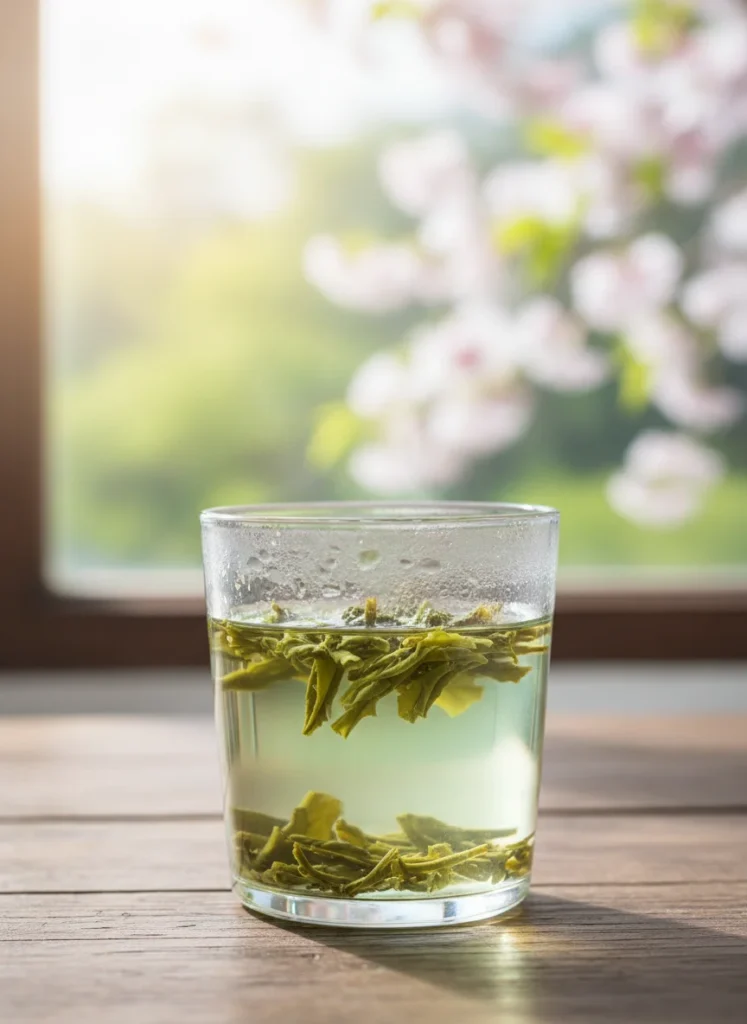
Shan Lin Xi — More complex than Alishan, with a distinctive foresty character — think pine needles and bamboo grove after rain. The floral notes are present but more restrained, with a longer, sweeter finish. This is a tea for those who appreciate subtlety.
Li Shan — The sweet spot of the high mountain range. Exceptionally creamy and buttery, with notes of ripe pear and a mineral undertone that speaks to the rocky soil of the梨山 region. The mouthfeel is thick and coating — almost like drinking silk. Many consider Li Shan the best value in high mountain oolong because its quality approaches Da Yu Ling at a lower price.
Da Yu Ling — The pinnacle. Alpine floral notes that are almost impossible to describe — they exist nowhere else in the tea world. Stone fruit sweetness, extraordinary length, and a texture so refined it feels weightless. At $200–$400+ per 150 grams, it is a luxury, but one that justifies its price for serious tea collectors.
Brewing Guide: Getting the Most from Your High Mountain Oolong
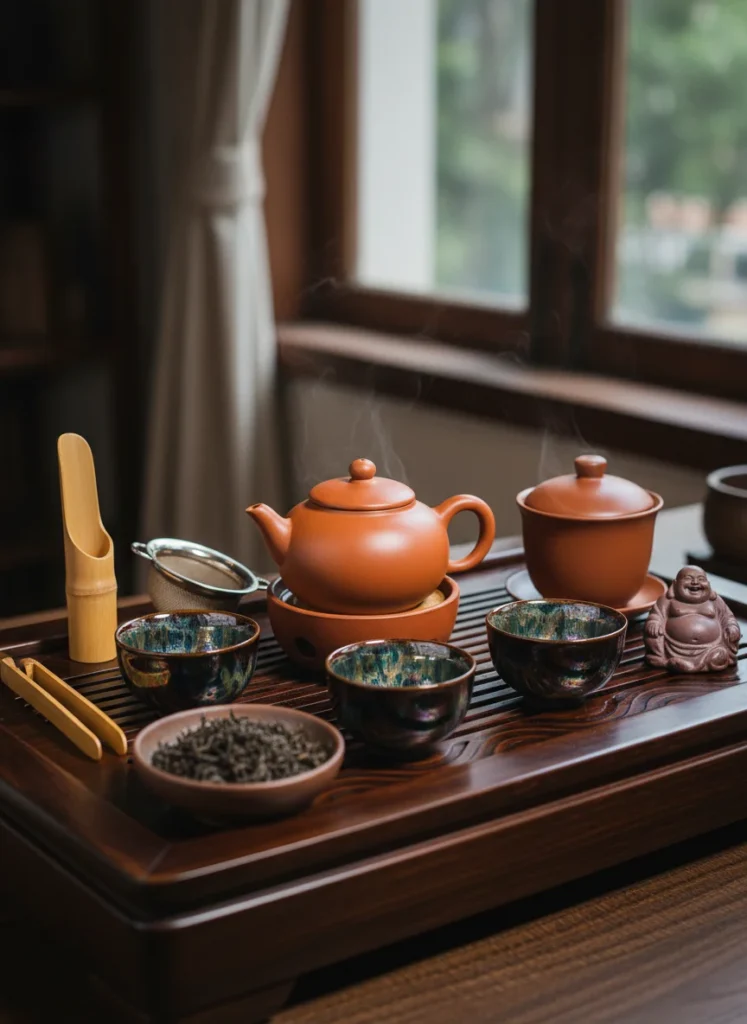
High mountain oolong rewards careful brewing. Use the Gongfu Cha method for the best results:
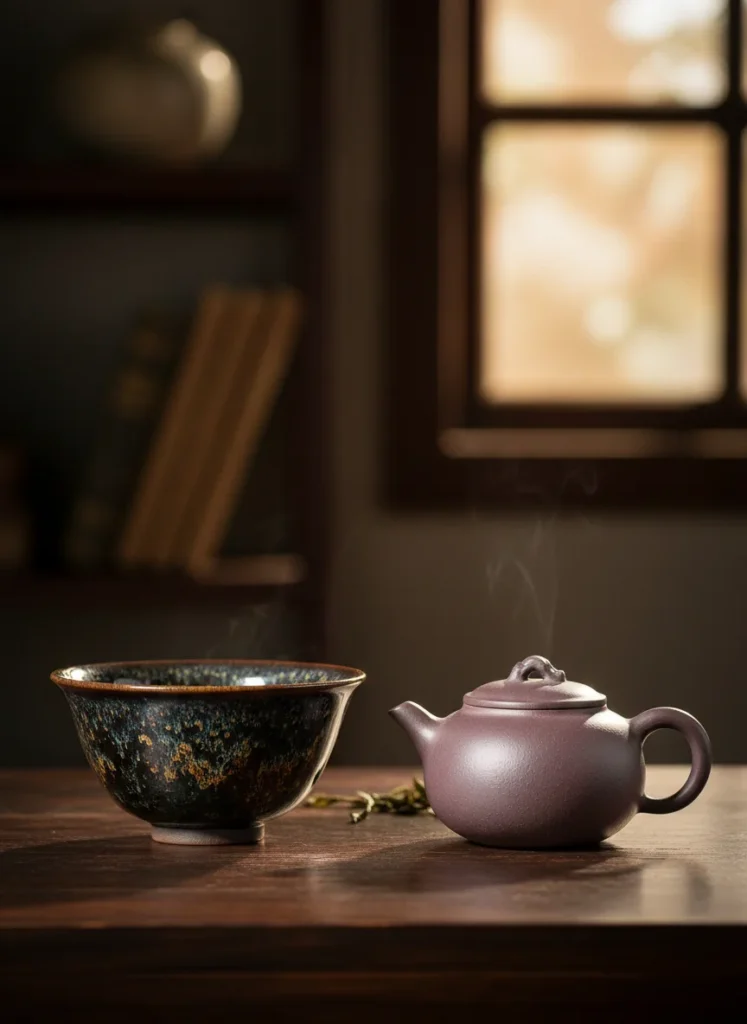
- Vessel — Porcelain gaiwan or Yixing teapot (5–8 oz / 150–200 ml)
- Leaf ratio — 5–8 grams per 150 ml
- Water temperature — 195–205°F (90–96°C)
- First infusion — 30 seconds (rinse first: pour and discard immediately)
- Subsequent infusions — Add 10–15 seconds per infusion
- Expected infusions — 6–10 from quality high mountain oolong
Pour the brewed tea into a Tenmoku cup and you will find the iron-rich glaze enhances the mineral notes that make high mountain oolong so distinctive. The dark glaze also shows the tea’s pale gold liquor beautifully.
How to Identify Authentic High Mountain Oolong
Because high mountain oolong commands premium prices, counterfeiting is a real problem. Here is how to identify genuine high mountain tea:
- Leaf appearance — Genuine high mountain oolong has small, tightly rolled balls with visible buds. The leaves are small because high-altitude plants grow slowly. Large, loosely rolled leaves are not high mountain.
- Unfurling — When brewed, genuine high mountain leaves unfurl into complete, intact leaves with stems. Broken or torn leaves suggest lower-quality sourcing.
- Fragrance — Authentic high mountain oolong has a complex, layered aroma that fills the room when the lid is lifted from the gaiwan. Flat, one-dimensional fragrance suggests low elevation or blended tea.
- Price — Genuine Alishan starts around $30 per 150 grams. Genuine Li Shan starts around $80. Genuine Da Yu Ling starts around $200. If someone is offering “Da Yu Ling” for $20, it is not Da Yu Ling.
The most reliable way for you to ensure authenticity is to buy from reputable tea merchants who provide origin documentation and have direct relationships with Taiwanese tea farmers.
❓ Frequently Asked Questions About High Mountain Oolong
❓ Is high mountain oolong the same as Tieguanyin?
No. Tieguanyin is a specific cultivar from Anxi, Fujian (mainland China), known for its heavy roast and bold flavor. High mountain oolong refers to any oolong grown above 1,000 meters in Taiwan, typically made from the Qingxin cultivar and lightly oxidized. They are fundamentally different teas with different flavor profiles.
❓ Can I age high mountain oolong like Pu’er?
Lightly oxidized high mountain oolong does not age well — it is best consumed within 1–2 years of harvest. Heavily roasted high mountain oolong can be aged, but the aging potential is much less than Pu’er. If you want to age tea, choose a traditional roasted oolong or Pu’er instead.
❓ Why is high mountain oolong so expensive?
The price reflects genuine scarcity and labor. High mountain gardens are remote and steep — all work is done by hand. The cool, slow-growing conditions produce smaller yields. And demand from Taiwan, Japan, and China far exceeds supply. The price is a function of real production costs, not just marketing.
❓ What is the difference between spring and winter harvest?
Spring harvest (March–May) produces teas with more aromatic complexity and floral notes. Winter harvest (October–December) produces teas with deeper sweetness and rounder body. Both are excellent — the choice is a matter of personal preference.
Storing High Mountain Oolong Properly
If you have invested in quality high mountain oolong, proper storage is essential to preserve its delicate aromatics. Here is what you need to know:
- Keep it sealed — Once you open a bag of high mountain oolong, transfer it to an airtight container. Oxygen is the enemy of fresh tea — it degrades the aromatic oils that give high mountain oolong its distinctive fragrance.
- Store cool and dark — Avoid heat, light, and moisture. A kitchen cabinet away from the stove is fine. Do not refrigerate lightly oxidized oolong — the moisture in the refrigerator can damage the leaves.
- Consume within 12 months — Lightly oxidized high mountain oolong is best within 6–12 months of harvest. The spring harvest (March–May) is at its peak through the following winter. After that, the aromatics begin to fade noticeably.
- Heavily roasted oolong lasts longer — If you prefer traditional roasted oolong, it can be stored for 2–3 years and may even improve with age. The roasting process stabilizes the tea and creates aging potential.
Treat your high mountain oolong with the same care you would give a fine wine, and it will reward you with exceptional flavor every time you brew.
Pairing High Mountain Oolong with Food
High mountain oolong is remarkably versatile with food. Its natural sweetness and floral character make it an excellent pairing partner:
- Light seafood — Steamed fish, scallops, and shrimp pair beautifully with Alishan’s floral sweetness. The tea cleanses the palate between bites without overpowering delicate seafood flavors.
- Soft cheeses — Brie, camembert, and fresh goat cheese complement the creamy texture of Li Shan oolong. The tea’s mineral notes cut through the richness of the cheese.
- Fruit desserts — Peach, pear, and lychee desserts echo the stone fruit notes found in high mountain oolong. Try pairing Da Yu Ling with a light pear tart for a remarkable experience.
- Dim sum — The classic Hong Kong pairing. High mountain oolong’s sweetness balances the savory richness of dumplings and buns. Serve it in Tenmoku cups for the full experience.
The key principle for you: pair high mountain oolong with foods that are delicate enough to let the tea shine. Heavy, spicy, or strongly flavored dishes will overwhelm its subtlety.
📚 References
- High Mountain Oolong: Taiwanese tea cultivation and terroir research. www.tea.co.uk
- Chinese Tea Heritage: Traditional processing methods for oolong. www.metmuseum.org
- Fujian Tea Origins: Historical tea production in Fujian Province. www.fujian.gov.cn
Want to taste authentic high mountain oolong? Explore our tenmoku tea cups and elevate your brewing experience today.
Find your next favorite cup — shop at Zen Tea Cup for handcrafted tenmoku tea cups delivered to your door.


