

Contents
- What Is “Golden Oil” in Jianzhan?
- How Golden Oil Spots Form — The Science
- Golden Oil Spot vs. Silver Oil Spot — Key Differences
- The Rarity and Value of Golden Oil Jian Zhan
- Golden Oil in Song Dynasty Tea Culture
- How to Identify Authentic Golden Oil Jian Zhan
- ❓ Frequently Asked Questions About Golden Oil Jian Zhan
- ❓ Is golden oil spot the same as gold-painted Jian Zhan?
- ❓ Why are golden oil spots rarer than silver oil spots?
- ❓ Can modern kilns reliably produce golden oil spots?
- ❓ How should I care for a golden oil Jian Zhan bowl?
- Golden Oil Spot Tenmoku in Japanese Collections
- 📚 References
What Is “Golden Oil” in Jianzhan?
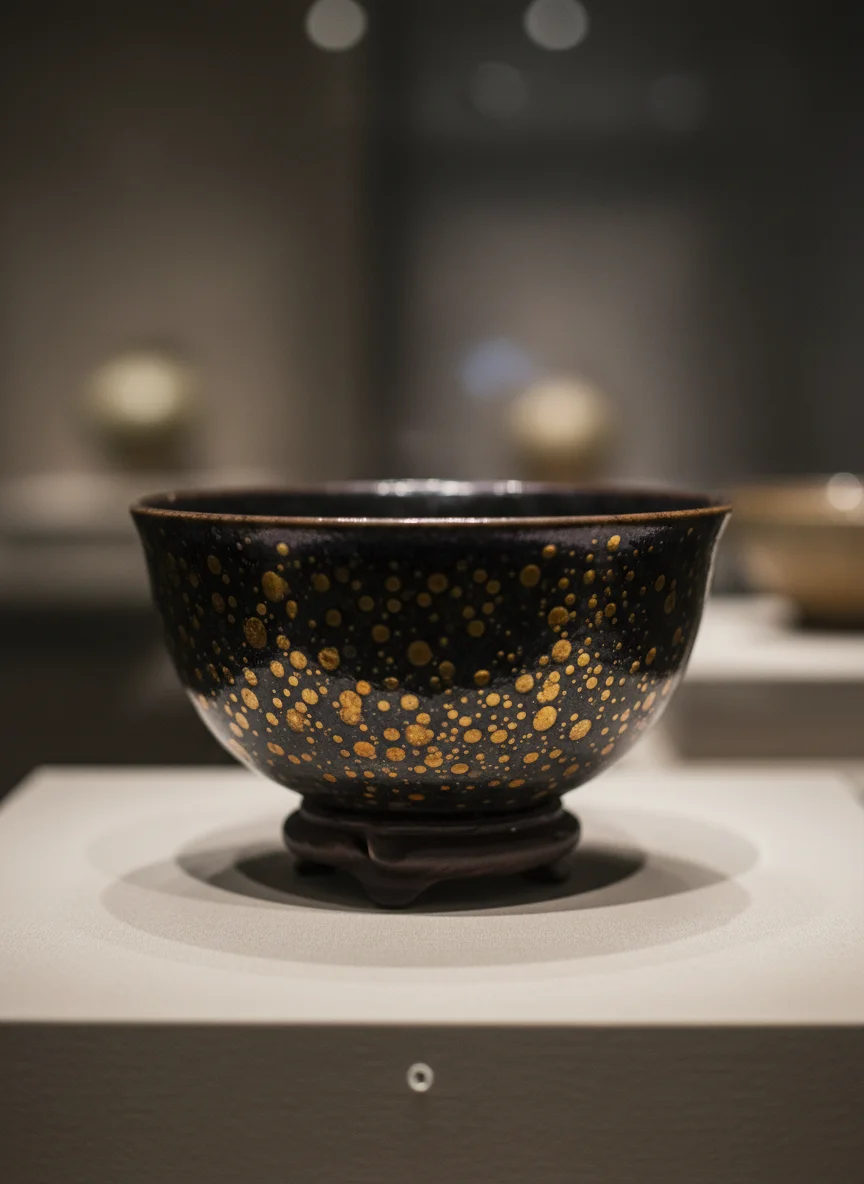
“Golden oil” (金油滴, jin you di in Chinese) refers to one of the rarest and most visually spectacular subtypes of oil spot patterns on Jian Zhan — the iron-rich stoneware fired in the dragon kilns of Jianyang, Fujian, during the Song Dynasty (960–1279 CE). Unlike the more common silver oil spot, golden oil spots display a warm, amber-to-gold metallic luster that seems to glow from within the glaze, as if liquid gold were suspended on the surface of the bowl. At potalastore, we consider the golden oil pattern one of the pinnacles of Jian Zhan artistry — a natural phenomenon that no artisan can guarantee, only hope for. at Zen Tea Cup
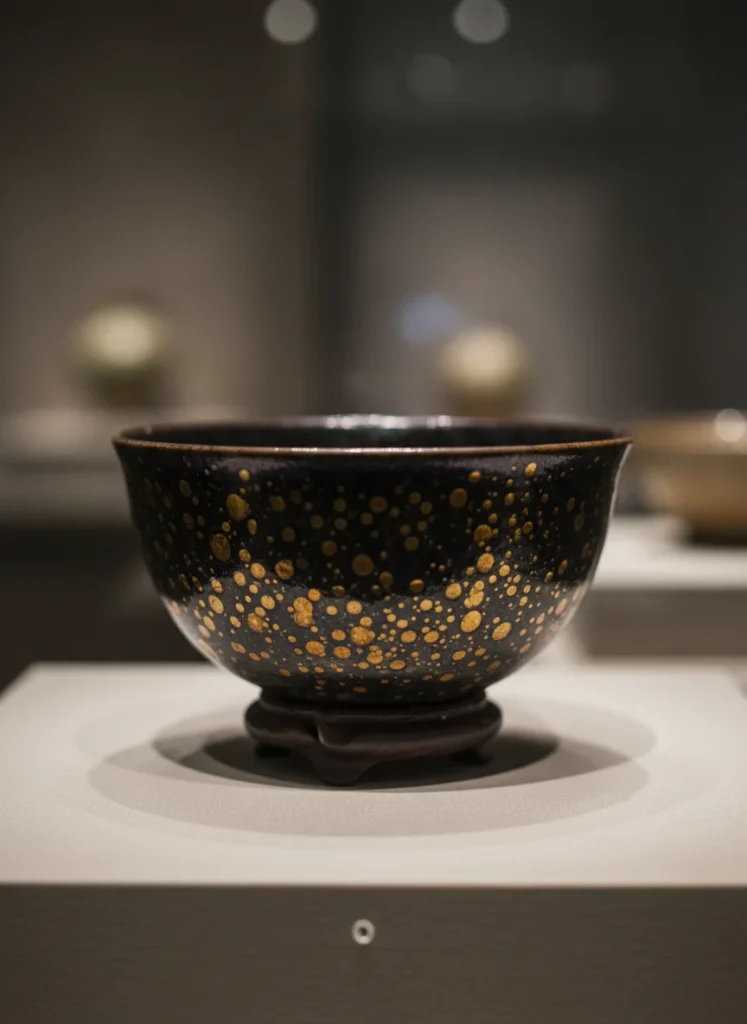
The meaning of “golden oil” goes beyond mere color: it represents the narrowest window of kiln conditions where iron oxide crystallizes into a thin layer that produces warm-toned light interference. The result is a surface that shifts between gold, amber, and sometimes reddish-copper depending on the viewing angle — a living, breathing quality that photographs can never fully capture.
In the hierarchy of Jian Zhan patterns, golden oil spots rank above silver oil spots in rarity and value. While silver oil spots are relatively well-documented, the golden variant requires a more precise combination of glaze thickness, cooling rate, and atmospheric conditions — making it far less common in both antique and modern pieces.
When you season your Jian Zhan properly, you develop a beautiful patina over time.
How Golden Oil Spots Form — The Science
The formation of golden oil spots follows the same basic process as silver oil spots, but with a critical difference in the crystallized layer that produces the warm color:
- Iron-rich glaze application — The glaze contains 15–30% iron oxide (FeO), the same as all Jian Zhan. No additional pigments or gold are added — the golden color comes entirely from the iron.
- High-temperature firing — The bowl fires to approximately 1300°C (2372°F) in a reduction atmosphere. At this temperature, the iron melts into the glaze uniformly.
- Phase separation during cooling — As the kiln cools, liquid-liquid phase separation causes the iron to pool into distinct droplets on the glaze surface.
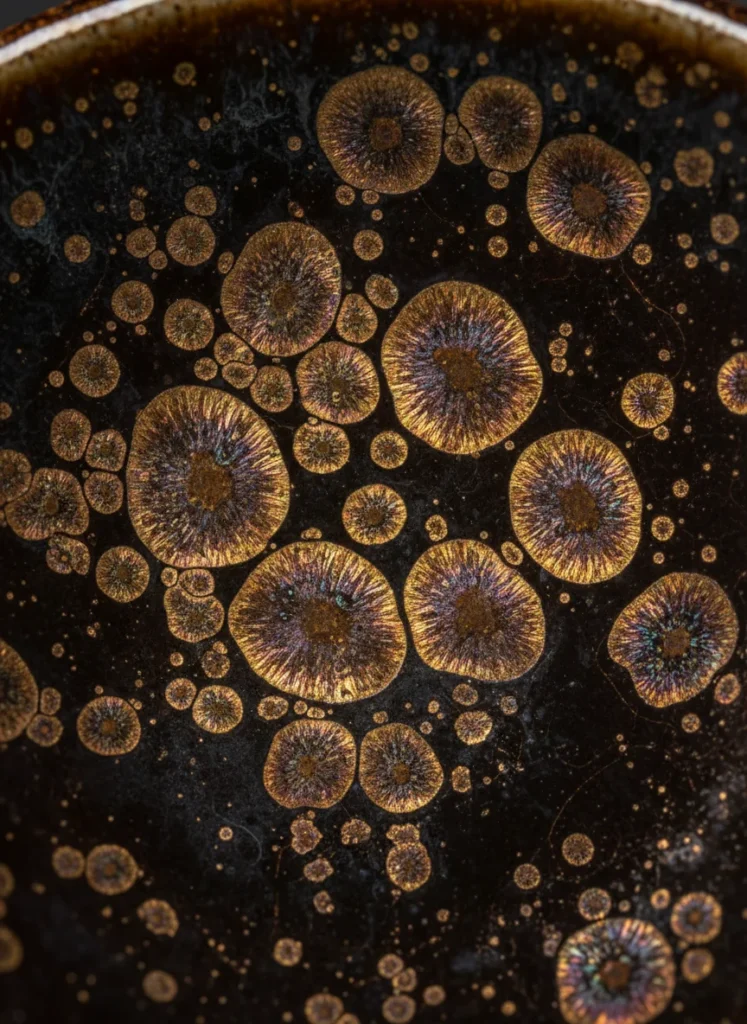
- Thin-layer crystallization — The critical difference: for golden oil spots, the crystallized iron oxide layer is thinner than for silver spots. This thin layer allows light to penetrate and reflect off both the crystal surface and the underlying dark glaze, producing warm-toned interference — the same optical principle that creates the golden sheen on soap bubbles.
Some golden oil spots also contain traces of epsilon-Fe₂O₃ — a rare iron oxide polymorph with a distinctive reddish-gold luster. This epsilon phase is extremely difficult to produce deliberately and is one of the reasons golden oil spots remain so rare. Research published in the Journal of Chinese Ceramics has confirmed that epsilon-Fe₂O₃ appears only under very specific cooling rates and atmospheric conditions.
Golden Oil Spot vs. Silver Oil Spot — Key Differences
Understanding the distinction between these two oil spot variants helps you appreciate why golden oil spots command higher prices:
| Feature | Golden Oil Spot | Silver Oil Spot |
|---|---|---|
| Color | Warm gold, amber, copper-red | Cool silver, white, blue-white |
| Crystal layer | Thinner, allows warm interference | Thicker, reflects cool white light |
| Rare iron oxide | May contain epsilon-Fe₂O₃ | Primarily hematite (Fe₂O₃) |
| Rarity | Considerably rarer | More common |
| Value | Higher | Lower (relative) |
| Light response | Shifts between gold/amber/copper | Shifts between silver/blue-white |
The key insight is that both types come from the same glaze with the same iron content. The difference is not in the ingredients but in the kiln — specifically in how the cooling phase determines the thickness and crystal structure of the iron oxide layer.
The Rarity and Value of Golden Oil Jian Zhan
Golden oil spot Jian Zhan bowls are among the most sought-after pieces in the ceramics world, and their value reflects their extreme rarity:
- Kiln yield — In a typical wood firing of several hundred bowls, a kiln master might produce a few dozen silver oil spot pieces but only one or two — if any — with genuine golden oil spots. The probability is that low because the cooling conditions that produce the golden variant are a narrow subset of those that produce silver.
- Historical value — Song Dynasty records from the Xuanhe Fengshi Gaoli Tujing (宣和奉使高麗圖經) describe golden-spotted Jian Zhan as tributes to the imperial court, indicating that even 900 years ago, the golden variant was recognized as exceptional.
- Modern market — Authentic modern golden oil spot pieces from Jianyang kiln masters typically command prices several times higher than equivalent silver oil spot pieces. When Song Dynasty golden oil spot pieces appear at auction, they regularly achieve multi-million dollar prices.
The full range of Tenmoku glaze patterns shows a clear value hierarchy: hare’s fur at the base, silver oil spot above it, golden oil spot above that, and Yohen at the summit.
Golden Oil in Song Dynasty Tea Culture
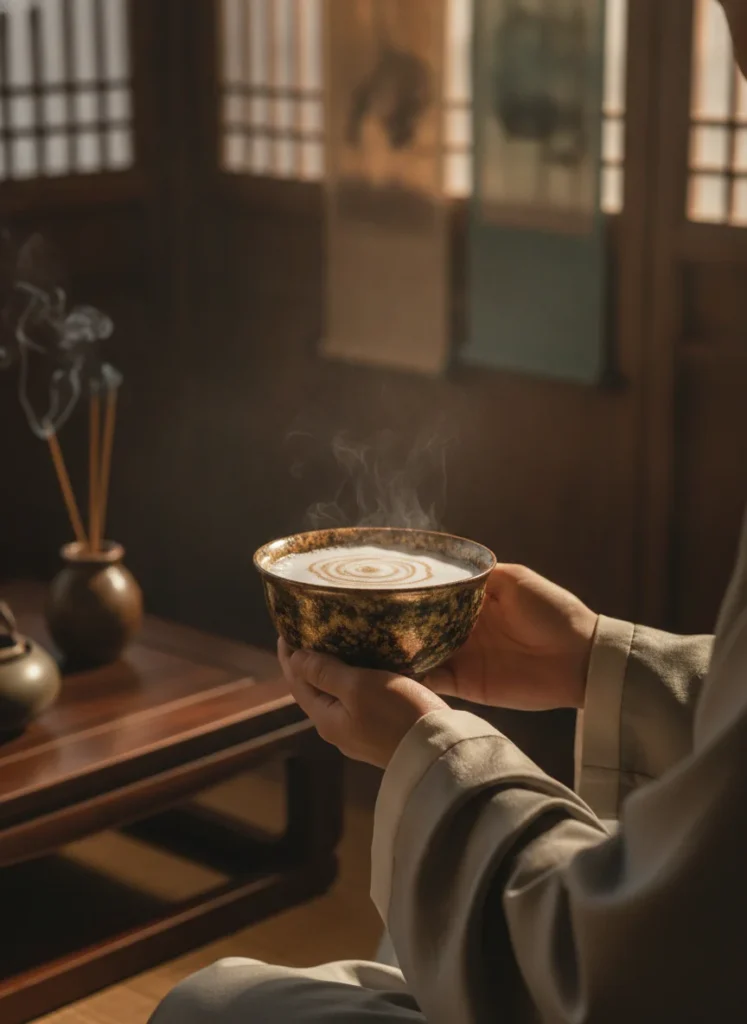
During the Song Dynasty, tea was whisked into a white froth for competitive tastings called dou cha (斗茶). The visual contrast between the dark Jian Zhan glaze and the white tea foam was central to the experience — but a golden oil spot bowl added another dimension entirely. The warm golden spots seemed to glow beneath the white froth, creating a visual effect that Song Dynasty poets described as “golden stars floating in dark water.”
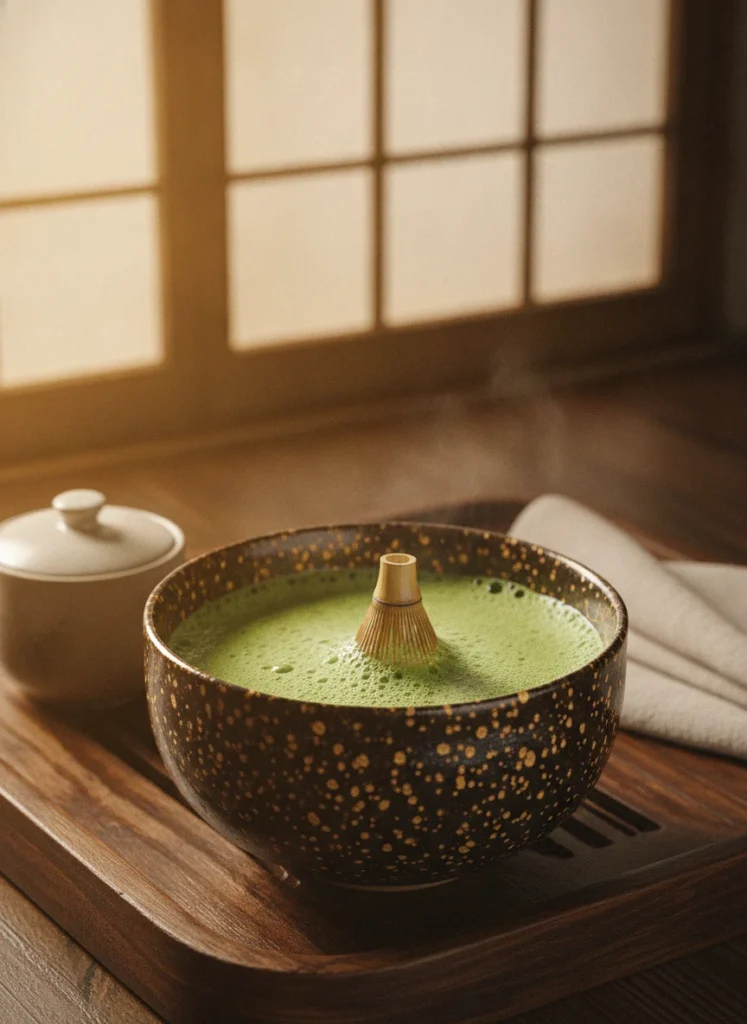
The Song emperor Huizong, who was himself a tea connoisseur and artist, specifically prized spotted Jian Zhan for imperial tea ceremonies. While his writings in Daguan Cha Lun (大观茶论) do not distinguish between gold and silver variants, later Japanese records from the Muromachi period (1336–1573) explicitly note that golden-spotted bowls were valued more highly than silver-spotted ones.
The history of Jian Zhan is deeply intertwined with tea culture, and golden oil spots represent perhaps the most dramatic example of how kiln chemistry served aesthetic and cultural purposes.
How to Identify Authentic Golden Oil Jian Zhan
Because golden oil spots are valuable, imitations exist. Here are the markers you should check:
- Color shift under light — Authentic golden oil spots shift between gold, amber, and sometimes copper-red as you change the viewing angle. This iridescence comes from thin-film interference and cannot be replicated by glaze painting.
- Depth within the glaze — Real golden oil spots emerge from within the glaze, not on top of it. When you tilt the bowl, the spots show depth and seem to float below the surface.
- Natural variation — Authentic spots vary in size, intensity, and spacing. Perfectly uniform golden dots are likely applied, not kiln-formed.
- No metallic gold paint — Some modern imitations use actual gold paint or gold leaf on the surface. Real golden oil spots are crystallized iron oxide — they look like metal but are actually ceramic crystals.
- Iron-rich body — The bowl’s clay body should be dark, heavy, and slightly magnetic due to high iron content.
If you are considering purchasing a golden oil Jian Zhan, buy from reputable kiln masters. Prices for authentic modern pieces start at several hundred dollars, while antique examples — when available — are museum-quality pieces.
❓ Frequently Asked Questions About Golden Oil Jian Zhan
❓ Is golden oil spot the same as gold-painted Jian Zhan?
No. Golden oil spots are natural crystallizations of iron oxide that form during the kiln’s cooling phase. No gold metal is added. The golden color comes from thin-film interference within the crystallized layer — a completely different mechanism from applying gold paint or gold leaf to the surface.
❓ Why are golden oil spots rarer than silver oil spots?
Golden oil spots require a thinner crystallized iron oxide layer, which forms under a narrower range of cooling conditions. The same firing that produces dozens of silver oil spot bowls might yield only one or two golden ones — or none at all. The probability window is simply much smaller.
❓ Can modern kilns reliably produce golden oil spots?
Modern Jianyang kiln masters have improved their ability to produce golden oil spots, but the process is still not fully controllable. Even the most experienced masters consider golden oil spots a gift from the kiln rather than a guaranteed outcome. Electric kilns can produce golden-colored spots, but the depth and iridescence of wood-fired pieces remain unmatched.
❓ How should I care for a golden oil Jian Zhan bowl?
Avoid sudden temperature changes, never use in a microwave or dishwasher, and clean with warm water and a soft cloth. The golden oil pattern is crystallized within the glaze and will not fade or tarnish. Regular tea brewing enhances the bowl’s luster through yang hu (养壶), where tea oils build a warm patina on the surface. The clay body has an iron content of 7–10% by weight.
Golden Oil Spot Tenmoku in Japanese Collections
Several of the most celebrated golden oil spot Jian Zhan bowls reside in Japanese museum collections, where they have been preserved as Important Cultural Properties for centuries. The Japanese appreciation for golden-spotted Tenmoku began during the Muromachi period (1336–1573), when shoguns and wealthy merchants competed to acquire the finest Chinese tea bowls.
The most famous example is the Seikado Bunko Yuteki Tenmoku, which displays a dense field of golden-amber spots across a lustrous black glaze. This bowl has been documented in Japanese collection records since the 15th century and is considered one of the finest surviving examples of the golden oil spot pattern. When you view it in person, the spots appear to shift between gold and copper-red depending on the angle — a quality that no photograph can capture.
The connection between Tenmoku and Japanese tea culture is particularly strong for golden oil spot pieces, which were reserved for the most formal tea gatherings. Even today, a golden oil spot bowl is considered the most prestigious vessel for serving matcha to honored guests in the Japanese tea ceremony.
📚 References
Chen Xianqiu, “Crystallization Mechanisms in Jian Ware Glazes,” Journal of Chinese Ceramics, Vol. 42, 2014.
Xu Jing, Xuanhe Fengshi Gaoli Tujing (宣和奉使高麗圖經), Song Dynasty, 1124 CE.
Robert D. Mowry, Hare’s Fur, Tortoiseshell, and Partridge Feathers: Chinese Brown- and Black-Glazed Ceramics, 400–1400, Harvard Art Museums, 1996.
Dejoie et al., “A New Nanostructured Iron Oxide in Ancient Chinese Jian Ceramic Glazes,” Scientific Reports, 2014.
Updated June 2026. Ongoing research on epsilon-Fe₂O₃ in Jian Zhan glazes continues to reveal new details about the conditions that produce golden oil spots.
Captivated by the glow of golden oil spots? Explore our Jian Zhan collection at potalastore — where centuries of kiln tradition meet your tea practice. The cooling rate after firing is about 100°C per hour.
Elevate your tea experience? Browse the Zen Tea Cup for authentic tenmoku cups and curated collections.


