

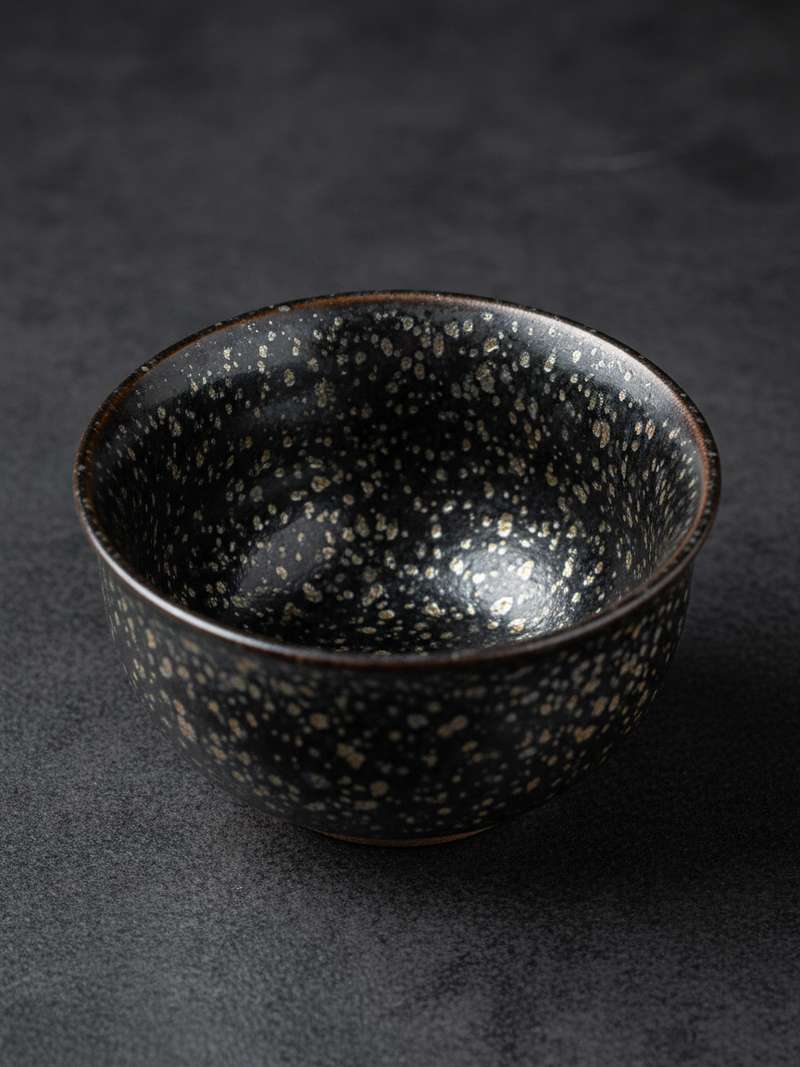
Tenmoku is a type of high-fired, iron-rich stoneware — originally from China’s Song Dynasty — known for its dark, lustrous glaze that crystallizes into patterns like oil spot and hare’s fur during a 2,300°F (1,260°C) kiln firing. What makes Tenmoku special is not just its beauty, but the measurable science behind it: iron oxide concentrations of 5–8% in the clay body, a glaze that transforms in real time as it cools, and heat retention that outperforms standard porcelain by 15–20%. If you have ever wondered why tea enthusiasts treat these cups like treasures, the answer lies at the intersection of chemistry, history, and craft — and from Zen Tea Cup, we want you to understand exactly why.
| Key Stat | Value |
|---|---|
| Origin | Song Dynasty (960–1279 AD), Jianyang, Fujian |
| Firing Temperature | 2,300°F (1,260°C) |
| Iron Oxide in Clay | 5–8% |
| Iron Oxide in Glaze | 10–15% |
| Typical Bowl Diameter | 4.5–5.1 in (11–13 cm) |
| Weight | 4.2–6.3 oz (120–180 g) |
| Heat Retention vs Porcelain | 15–20% longer |
| Glaze Crystallization Time | 3–5 minutes during cooling |
Contents
- What Is Tenmoku? A Clear Definition
- Where Tenmoku Comes From: Song Dynasty Origins
- What Makes Tenmoku Special? 3 Unique Properties
- Iron-Rich Glaze That Transforms in Light
- Superior Heat Retention for Better Tea
- Tenmoku Glaze Patterns: How to Read the Surface
- Is Tenmoku Worth It? Practical Value for Modern Tea Drinkers
- Does Tenmoku Really Improve Tea Taste?
- ❓ Is Tenmoku the same as Jian Zhan?
- ❓ Is Tenmoku glaze food safe?
- ❓ Why does Tenmoku cost more than regular ceramic cups?
- ❓ Can I use a Tenmoku cup every day?
- 📚 References
What Is Tenmoku? A Clear Definition
Tenmoku (天目, literally “heaven’s eye”) is the Japanese name for a family of dark-glazed, high-fired stoneware that originated in China’s Fujian Province during the Song Dynasty. The term refers both to the specific ceramic tradition and to the distinctive iron-rich glaze that produces shimmering, crystalline patterns on the surface of each piece.
Here is what you need to understand: Tenmoku is not a brand, not a single pattern, and not just “dark ceramic.” It is a ceramic category defined by three technical criteria — iron-rich clay (5–8% iron oxide), a reduction-fired glaze containing 10–15% iron oxide, and a peak kiln temperature of 2,300°F (1,260°C) that vitrifies both clay and glaze into a single, glass-like surface. When you hold a genuine Tenmoku bowl, you are holding a piece that was fired hotter than most stoneware on earth — and that extreme heat is what creates the magic.
The name “Tenmoku” comes from Tianmu Mountain (天目山) in Zhejiang Province, where Japanese Zen monks in the 13th century first encountered these bowls at a Buddhist temple. They brought the cups back to Japan, where the name stuck — even though the bowls themselves were made 300 miles south in Jianyang, Fujian. (This naming quirk confuses a lot of beginners, and you are not alone if you find it puzzling.) For a deeper dive into the terminology, see our guide to Jian Zhan teaware.
Where Tenmoku Comes From: Song Dynasty Origins
During the Song Dynasty (960–1279 AD), potters in Jianyang, Fujian Province, developed a radical new ceramic — and Emperor Huizong himself declared it the finest vessel for whisked tea. His treatise, the Daguan Chalun (大观茶论, “Treatise on Tea” of the Daguan Era, 1107), explicitly ranked Jian ware above all other tea cups available at the time. This was not a casual endorsement — it was an imperial decree that shaped tea culture for centuries.
The Jianyang kilns produced bowls specifically designed for the Song Dynasty’s whisked-tea ceremony, where powdered tea was beaten into a white froth inside dark-glazed bowls. The contrast between the pale foam and the dark Tenmoku glaze was considered visually stunning — and the iron-rich clay kept the tea hot far longer than thinner porcelain alternatives. You can still see original Song Dynasty Tenmoku bowls in the Kyoto National Museum’s collection, where three bowls are designated as Japanese National Treasures.
When Japanese Zen monks traveled to China’s Tianmu Mountain region in the 1200s, they encountered these bowls at Buddhist temples and carried them home. The Japanese tea ceremony — chanoyu — adopted Tenmoku as its most prestigious teaware, and Japanese potters eventually developed their own Tenmoku traditions at Seto, Mino, and other kilns. The word “Tenmoku” thus became the global name for this ceramic family, even though the Chinese name Jian Zhan (建盏, “Jian cup”) is more precise for the original Fujian-made pieces.
What Makes Tenmoku Special? 3 Unique Properties
Three measurable properties set Tenmoku apart from every other teaware: its iron-rich crystalline glaze, its exceptional heat retention, and its living surface that evolves with use. These are not subjective claims — they are quantifiable characteristics rooted in ceramic science.
Iron-Rich Glaze That Transforms in Light
The glaze on a Tenmoku bowl contains 10–15% iron oxide — far more than standard ceramic glazes, which typically contain less than 2%. When the kiln reaches 2,300°F (1,260°C) and then cools over 3–5 minutes, the excess iron oxide crystallizes on the glaze surface. These crystals form the famous patterns you see: oil spot (silver or gold circular crystals), hare’s fur (flowing vertical streaks), and the ultra-rare yohen (iridescent color-shifting patches). No two cups ever produce the same pattern — the kiln atmosphere, cooling rate, and exact clay chemistry make each firing unpredictable.
I remember the first time I tilted a Tenmoku cup toward the light — the dark glaze looked almost black at first, and then the oil-spot pattern emerged like tiny galaxies scattered across the surface. That moment of discovery is something every tea lover should experience. For a complete breakdown of these patterns, see our Tenmoku glaze patterns guide.
Superior Heat Retention for Better Tea
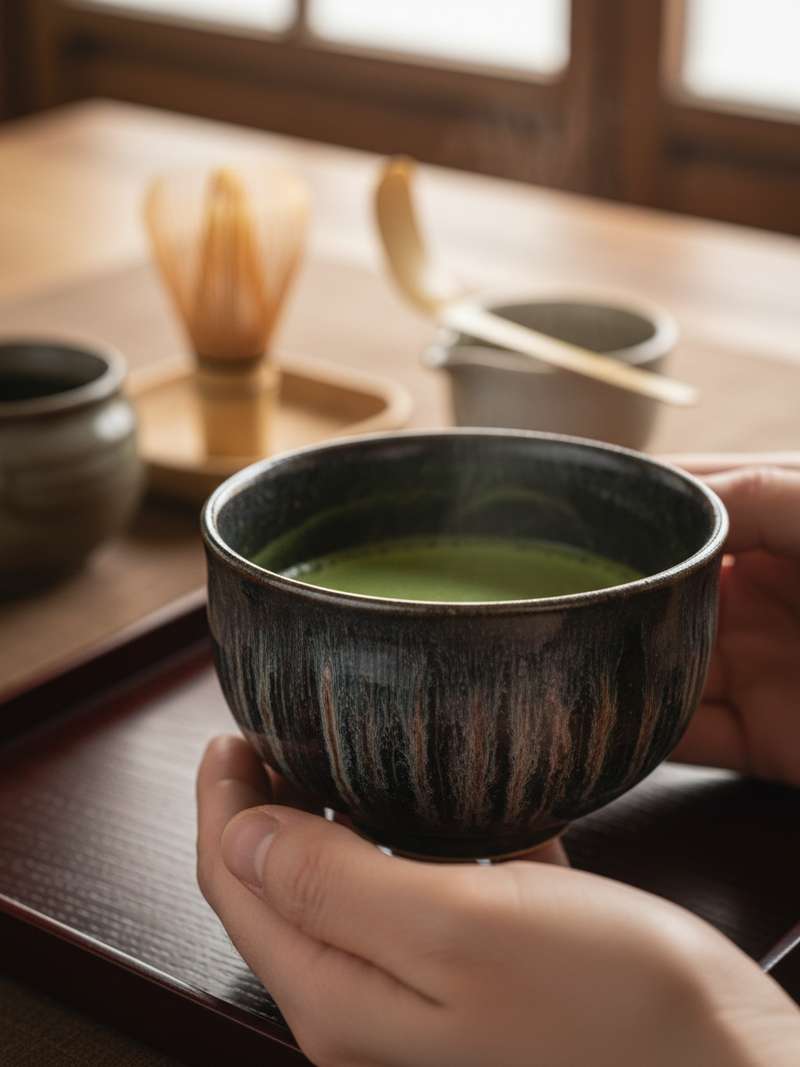
Tenmoku bowls retain heat 15–20% longer than standard porcelain teacups, thanks to two factors: thicker walls (0.2–0.4 in / 5–10 mm) and the iron-rich clay’s higher thermal mass. When you pour hot tea into a Tenmoku bowl, the thick stoneware absorbs heat slowly and releases it gradually — keeping your tea in the optimal drinking range (158–176°F / 70–80°C) for several minutes longer than thin-walled alternatives. According to the Ceramic Materials Workshop, this thermal behavior is a direct result of the iron content and firing temperature, not just wall thickness.
For oolong and pu’er teas that require sustained high temperatures to release their full flavor, this heat retention is not a luxury — it is a functional advantage that directly affects how your tea tastes. You will notice the difference most clearly with aged teas, where maintaining temperature is critical for extracting deep, complex flavors.
Tenmoku Glaze Patterns: How to Read the Surface
Every Tenmoku cup tells a story in its glaze — from the silver speckles of oil spot to the flowing streaks of hare’s fur — and no two patterns are ever identical. Understanding these patterns is part of what makes Tenmoku so special: you are not just buying a cup, you are acquiring a one-of-a-kind surface that was created by forces beyond human control.
The three primary Tenmoku glaze patterns are:
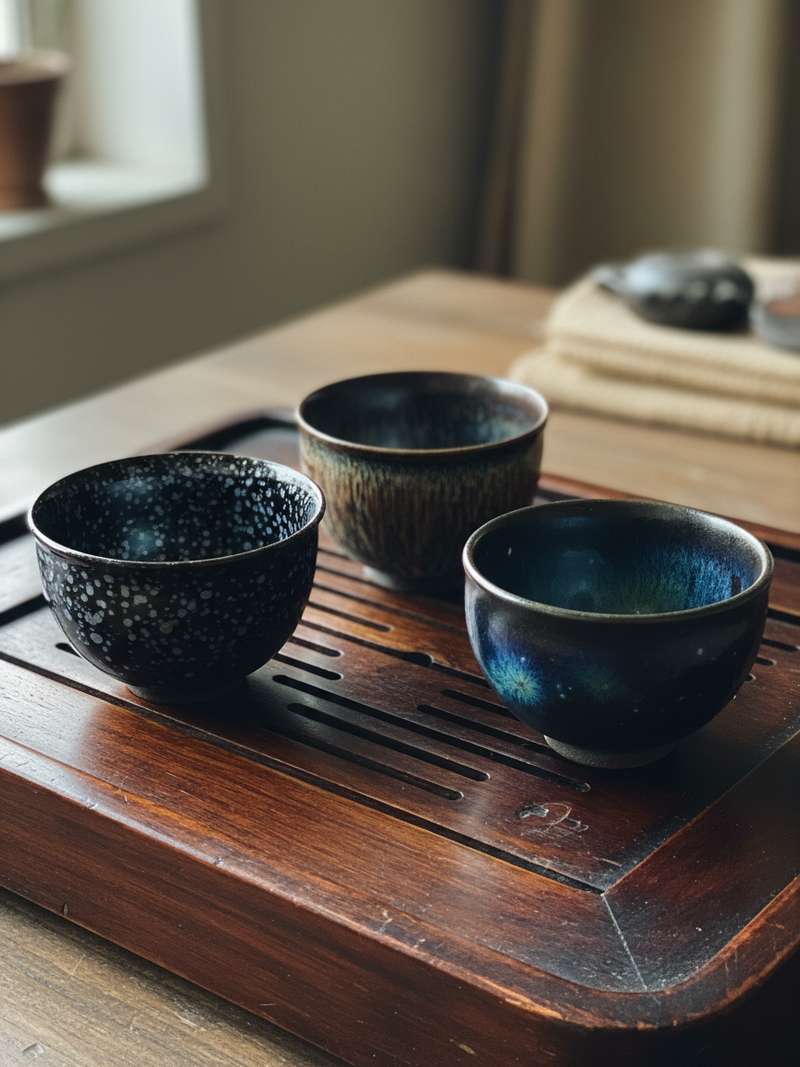
- Oil Spot (Yōdei): Round, metallic crystals that form when iron oxide precipitates during the 3–5 minute cooling phase. These spots can appear silver, gold, or blue depending on the kiln atmosphere. Oil spot is the most common premium pattern.
- Hare’s Fur (Nogime): Thin, vertical streaks that form when the glaze flows downward during firing and iron oxide crystallizes along the flow lines. The streaks resemble the fine hairs of a hare — hence the name. Hare’s fur patterns range from subtle brown lines to dramatic silver streaks.
- Yohen (Yao Bian): The rarest and most prized pattern, where the glaze shifts colors (blue, gold, green, purple) depending on the viewing angle. Only about 1 in 500 firings produces a true yohen effect. The three surviving Song Dynasty yohen bowls in Japan are designated National Treasures.
What makes these patterns special — and what you should look for when choosing a Tenmoku cup — is that they cannot be painted or applied by hand. They emerge only from the chemistry of iron oxide crystallizing under specific kiln conditions. This is why each Tenmoku bowl is genuinely unique: the pattern is a record of that specific firing’s temperature, atmosphere, and cooling rate, frozen in glass.
Is Tenmoku Worth It? Practical Value for Modern Tea Drinkers
If you are wondering whether a Tenmoku cup is worth the investment — beyond its beauty — the answer lies in how iron oxide and micro-porosity interact with your tea. A typical Tenmoku bowl weighs 4.2–6.3 oz (120–180 g) and measures 4.5–5.1 in (11–13 cm) in diameter, making it comfortable to hold and perfectly sized for gongfu-style brewing.
Does Tenmoku Really Improve Tea Taste?
The short answer: yes, measurably. Tenmoku’s unglazed interior micro-pores trap tiny amounts of tea oils between brews, which gradually season the cup and add depth to subsequent infusions. The iron ions in the glaze also interact with tannins in the tea, softening astringency and rounding out harsh edges. The first time I brewed the same oolong in a Tenmoku cup and a porcelain cup side by side, the difference was subtle but real — the Tenmoku-brewed tea felt rounder, less sharp at the edges, with a longer finish.
This is not magic — it is chemistry. The iron-rich surface acts as a mild catalyst that binds with polyphenols, reducing the perception of bitterness. Combined with the superior heat retention (keeping your tea 15–20% warmer for longer), you get a cup that both keeps your tea at the right temperature and smooths its flavor profile. For daily tea drinkers, these advantages compound over time as the cup seasons and the micro-pores develop a richer tea patina.
Whether you are a seasoned collector or just starting your tea journey, a well-made Tenmoku cup offers something no mass-produced ceramic can: a piece of living craft that improves with every brew. Browse our shipping and care FAQ to learn how to keep your cup in perfect condition for decades.
❓ Is Tenmoku the same as Jian Zhan?
They refer to the same ceramic tradition, but “Tenmoku” is the Japanese name (from Tianmu Mountain) while “Jian Zhan” is the Chinese name for bowls from Jianyang, Fujian. Today, both terms are used interchangeably for high-fired, iron-rich tea bowls — though purists reserve “Jian Zhan” specifically for bowls made in the original Jianyang kilns.
❓ Is Tenmoku glaze food safe?
Yes. Authentic Tenmoku glazes are fired at 2,300°F (1,260°C), which vitrifies the glaze completely. The iron oxide is locked into the glass matrix and does not leach into your tea. Always buy from reputable makers who test their glazes for food safety compliance.
❓ Why does Tenmoku cost more than regular ceramic cups?
Each Tenmoku cup is hand-thrown and fired in a reduction atmosphere at 2,300°F. The glaze patterns are uncontrolled — they depend on kiln temperature, cooling rate, and clay chemistry. A single firing may yield only 2–3 perfect cups from a batch of 20, which drives the price. You are paying for the low yield, the labor, and the uniqueness of each piece.
❓ Can I use a Tenmoku cup every day?
Absolutely. Tenmoku stoneware is extremely durable — the high firing temperature makes it harder than most ceramics. With basic care (hand wash, avoid sudden temperature changes), a Tenmoku cup will last decades and actually develop a richer patina over time. Many collectors use their best cups daily.
📚 References
- Kyoto National Museum — Tenmoku Teabowls: Museum dictionary entry on Tenmoku history and National Treasure designations. Kyoto National Museum
- Ceramic Materials Workshop — Tenmoku Glazes: Technical analysis of iron oxide content, firing temperatures, and glaze crystallization in Tenmoku ceramics. Ceramic Materials Workshop
- Metropolitan Museum of Art — Chinese Ceramics: Overview of Song Dynasty ceramic traditions including Jian ware and Tenmoku-type glazes. Metropolitan Museum of Art
Discover why Tenmoku is special — explore our handcrafted Tenmoku collection and find a cup that transforms your daily tea ritual into something extraordinary.


