

Jian Zhan cups are valuable to collectors because each piece is one-of-a-kind — the iridescent glaze patterns are created by uncontrollable kiln reactions at 1300°C (2372°F), with a success rate of just 5-15% (yes, that means 85-95% of pieces never make it to a collector’s shelf). If you are looking for a gift that is truly meaningful — not just another mass-produced item — Jian Zhan delivers something no factory can replicate.
This guide explains why collectors prize these Song Dynasty tea cups, how to evaluate their value, and how to choose the right one as a gift. Whether you are shopping for a seasoned collector or someone who simply appreciates beautiful craftsmanship, Zen Tea Cup has curated the knowledge you need.
| Key Stat | Value |
|---|---|
| Firing Temperature | 1300°C (2372°F) |
| Yield Rate | 5-15% per kiln |
| History | Song Dynasty (960-1279) |
| Glaze Types | 3 main patterns |
| Auction Record | $50,000+ (Yohen) |
| Price Range | $25-200+ (retail) |
| Uniqueness | Every piece is one-of-a-kind |
Contents
- What Makes Jian Zhan Valuable to Collectors?
- The Three-Part Collector’s Framework
- Why Yield Rate Matters for Value
- Understanding the Three Glaze Patterns
- Hare’s Fur (兔毫): The Entry Point
- Oil Spot (油滴): The Collector’s Sweet Spot
- Yohen (曜变): The Holy Grail
- A Brief History: From Imperial Courts to Modern Collections
- How to Choose the Right Jian Zhan as a Gift
- Budget-Friendly Gifts ($25-80)
- Serious Collector Gifts ($150+)
- Caring for a Jian Zhan: What Every Gift Recipient Should Know
- ❓ Is Jian Zhan a Good Investment for Collectors?
- ❓ How Can You Tell If a Jian Zhan Cup Is Authentic?
- ❓ What Is the Most Valuable Jian Zhan Pattern?
- ❓ Can You Use a Jian Zhan Cup Every Day?
- 📚 References
What Makes Jian Zhan Valuable to Collectors?
Three things drive collector interest in Jian Zhan: aesthetic rarity, historical significance, and the simple fact that no two cups are ever identical. When you hold a Jian Zhan cup, you are holding the result of a 1300°C kiln reaction that cannot be fully controlled — even by the most skilled artisan. The iron-rich glaze melts, flows, and crystallizes in ways that depend on temperature gradients, oxygen levels, and cooling speed inside the kiln.
This unpredictability is precisely what makes each piece collectible. A master potter can influence the process, but the final pattern? That belongs to the kiln alone — and that is what collectors find irresistible.
The Three-Part Collector’s Framework
When evaluating a Jian Zhan cup for yourself or as a gift, consider three dimensions:
Aesthetic appeal: Does the glaze pattern draw you in? The best pieces have depth — layers of color that shift as you rotate the cup under light. A flat, uniform surface is less desirable than one with movement and variation.
Scarcity: How rare is this specific pattern? With a 5-15% yield rate per firing, even “common” Jian Zhan is scarce by mass-production standards. But within that 5-15%, the rarest patterns — like Yohen — represent less than 1% of successful firings.
Historical weight: Jian Zhan was used in Song Dynasty imperial tea ceremonies (960-1279). Emperor Huizong himself wrote about it. That 1,000-year lineage gives every piece a story that no modern ceramic can match.
Why Yield Rate Matters for Value
Here is the math that collectors understand intuitively: if a kiln fires 100 cups and only 5-15 emerge with acceptable glaze patterns, each successful piece already carries the cost of 85-95 failed attempts. Add in the fact that Yohen patterns appear in fewer than 1% of successful firings, and you begin to see why the rarest Jian Zhan cups have sold at auction for over $50,000.
For gift-givers, this means even an entry-level Jian Zhan carries more inherent value than a factory-made ceramic at the same price point — because it survived a process that rejects the vast majority of pieces.
Understanding the Three Glaze Patterns
Not all Jian Zhan cups are created equal — the glaze pattern determines both the beauty and the rarity. Knowing the three main types helps you choose a gift that matches the recipient’s taste and your budget.
| Pattern | Appearance | Rarity | Price Range |
|---|---|---|---|
| Hare’s Fur (兔毫) | Fine vertical lines resembling fur | Most common | $25-80 |
| Oil Spot (油滴) | Round metallic spots across the surface | Moderate | $50-150 |
| Yohen (曜变) | Iridescent halos that shift with light | Extremely rare (<1%) | $200+ / Auction: $50K+ |
Hare’s Fur (兔毫): The Entry Point
Hare’s Fur is the most recognizable Jian Zhan pattern — fine, parallel lines running down the interior of the cup, resembling the soft fur of a hare. These lines form when iron oxide in the glaze flows downward during firing at 1300°C and crystallizes into thin streaks. It is the most affordable entry point for new collectors and makes an excellent gift for someone just discovering Jian Zhan.
Oil Spot (油滴): The Collector’s Sweet Spot
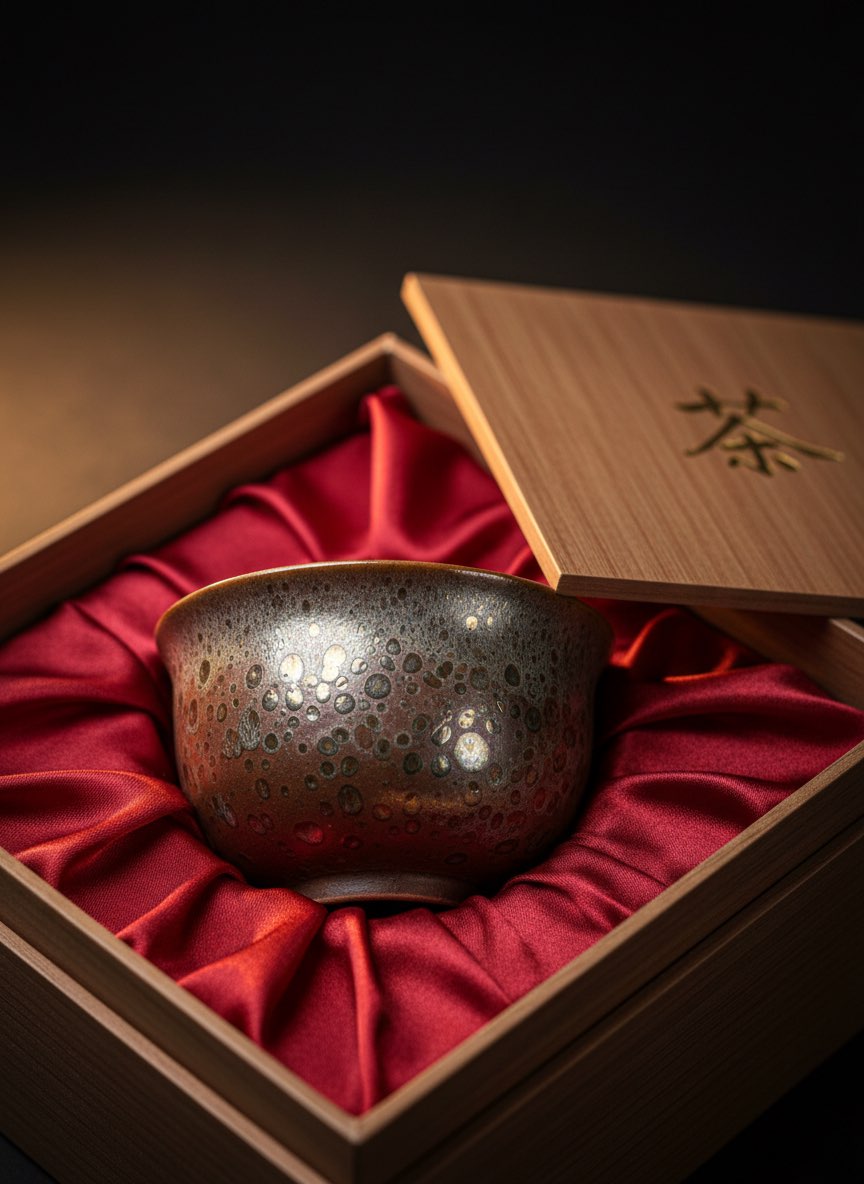
Oil Spot features round, metallic-looking dots scattered across the glaze surface. These spots form when iron oxide pools into circular droplets during the cooling phase. Oil Spot sits in the middle of the rarity spectrum — uncommon enough to feel special, but available enough to find within a reasonable budget. For most gift-givers, this is the sweet spot between impressiveness and affordability.
Yohen (曜变): The Holy Grail
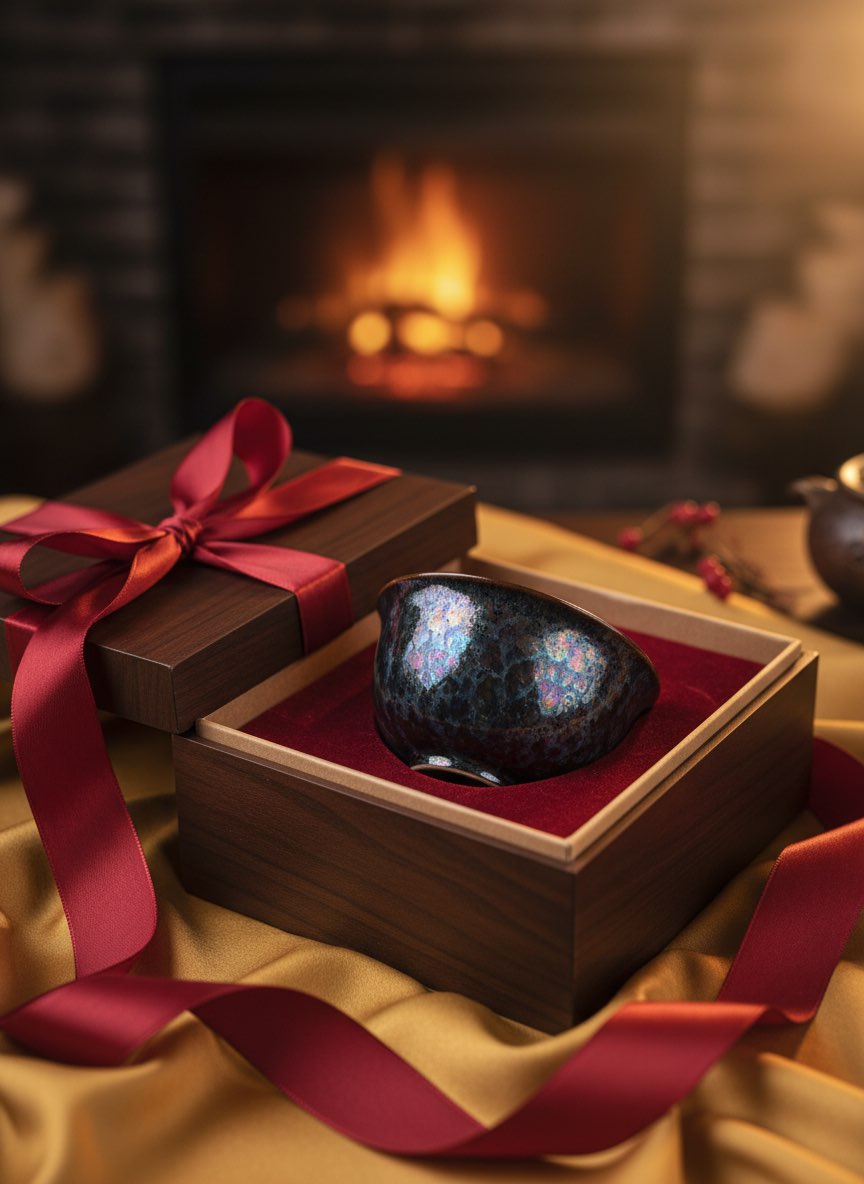
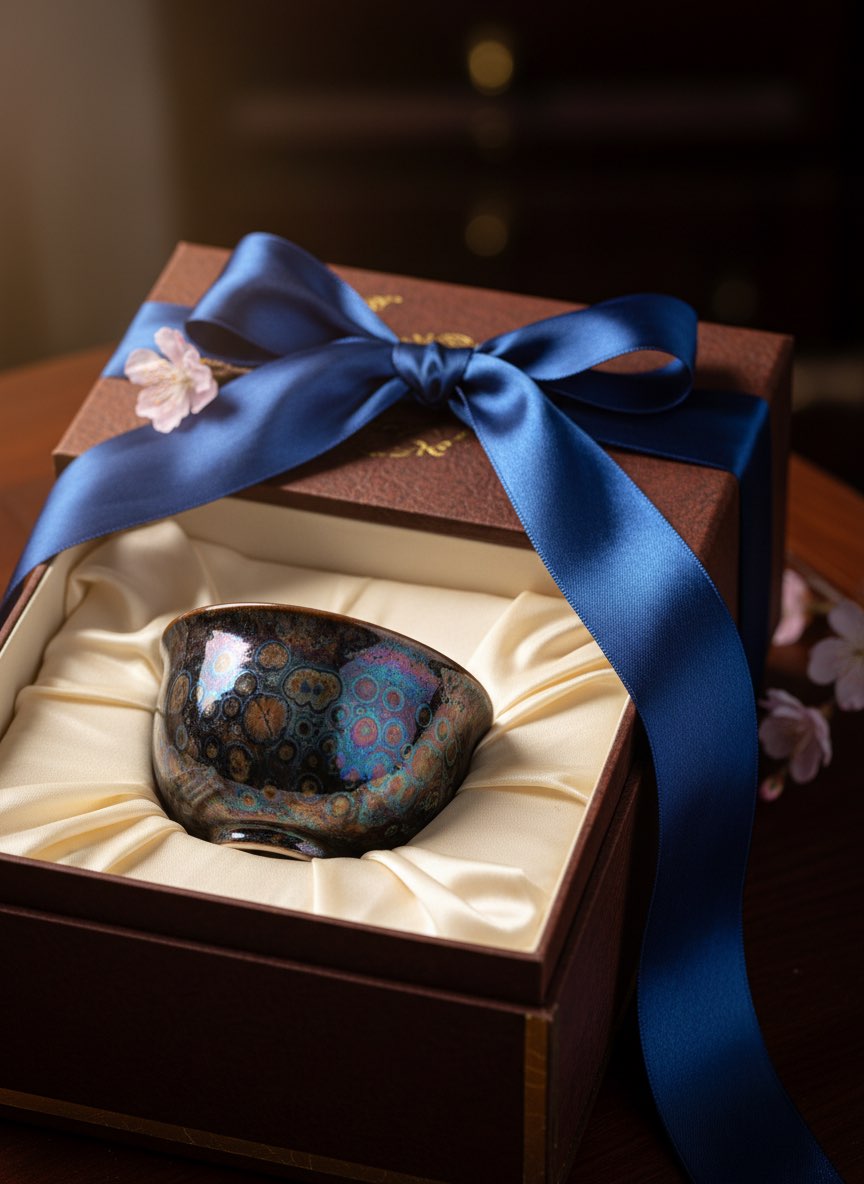
Yohen is the rarest and most coveted Jian Zhan pattern — iridescent halos that shift color as you move the cup under light, creating an almost otherworldly effect. Only three complete Yohen Tenmoku cups are recognized as Japanese National Treasures, and they are housed in Tokyo, Kyoto, and Osaka. When a Yohen piece appears at auction, it commands prices above $50,000. For most collectors, owning even a small Yohen-accented piece is a lifelong goal.
A Brief History: From Imperial Courts to Modern Collections
Jian Zhan has been prized for nearly a thousand years — Emperor Huizong of the Song Dynasty personally praised it in his Daguan Cha Lun (大观茶论), his treatise on tea written around 1107. The emperor favored the dark, lustrous bowls for whisked tea competitions at court, where the glaze patterns provided a dramatic backdrop for the bright green foam of powdered tea.
When Japanese monks traveled to China during the Song Dynasty, they brought Jian Zhan cups home — and three of the rarest Yohen pieces are now Japanese National Treasures, housed in the Tokyo National Museum, the Seikado Bunko Art Museum, and the Ryukoin sub-temple of Daitoku-ji in Kyoto. These cups have been protected for over 700 years — a testament to how seriously collectors have always taken this ware.
Today, modern artisans in Jianyang, Fujian Province continue the tradition, firing in wood-burning and gas kilns that replicate the conditions responsible for those legendary Song Dynasty glazes. The craft never died — it just waited for a new generation of collectors to rediscover it.
How to Choose the Right Jian Zhan as a Gift
Choosing a Jian Zhan gift is less about the price tag and more about matching the piece to the person (we have seen a $35 Hare’s Fur cup bring more joy than a $200 Oil Spot — it is all about the story). Here is a simple framework to help you decide.
Budget-Friendly Gifts ($25-80)
A Hare’s Fur cup in the $25-80 range makes a thoughtful gift for a tea drinker who is new to Jian Zhan. Look for pieces with clear, well-defined lines and a smooth interior glaze. Our guide to the best tenmoku bowls for matcha includes several options in this range that pair beautifully with both tea ceremony use and everyday sipping.
Serious Collector Gifts ($150+)
For someone who already collects, an Oil Spot or Yohen-accented piece in the $150+ range shows you understand their passion. Look for strong contrast in the spots, depth in the glaze layers, and a well-proportioned shape. Our size guide helps you pick the right diameter (7-9 cm is standard for tea tasting; 10-12 cm works for display).
Not sure where to start? Our authentication guide walks you through the key markers of genuine Jian Zhan — so you can gift with confidence.
Caring for a Jian Zhan: What Every Gift Recipient Should Know
A Jian Zhan cup actually gets more beautiful with use — the tea oils build a subtle patina that deepens the glaze over time. This process, called yang zhan (养盏, “raising the cup”), takes 3-6 months of regular use and gentle care.
Here are the basics every recipient should know:
Hand wash only — never put Jian Zhan in the dishwasher. The high-pressure water and detergent will strip the developing patina and can damage the glaze surface.
Avoid soap — rinse with warm water after each use. A soft cloth is all you need. The goal is to let tea oils accumulate naturally.
Use it regularly — a cup that sits on a shelf does not develop the same depth of color as one that is used daily. Oolong and puerh teas are especially good for building patina because of their higher oil content.
❓ Is Jian Zhan a Good Investment for Collectors?
Jian Zhan has strong collectible value due to its low yield rate (5-15%), historical significance (Song Dynasty), and the fact that each piece is unique. While we cannot promise financial returns, the rarest Yohen pieces have sold at auction for over $50,000 — and even mid-range Oil Spot cups tend to hold their value well because supply is inherently limited.
❓ How Can You Tell If a Jian Zhan Cup Is Authentic?
Look for three key markers: (1) the glaze should have depth and variation, not look flat or painted on; (2) the foot ring (base) should show the raw clay body, typically dark brown or gray; (3) under strong light, the glaze should show crystalline structures — not just surface color. For a detailed walkthrough, see our authentication guide.
❓ What Is the Most Valuable Jian Zhan Pattern?
Yohen (曜变) is the most valuable — its iridescent halos that shift with light are the rarest kiln mutation, appearing in fewer than 1% of successful firings. Three Yohen Tenmoku cups are designated as Japanese National Treasures. Oil Spot is the second most valuable, followed by Hare’s Fur.
❓ Can You Use a Jian Zhan Cup Every Day?
Absolutely — in fact, regular use is encouraged. The tea oils build a natural patina (called yang zhan) that enhances the glaze over 3-6 months. Just hand wash with warm water and avoid soap or the dishwasher. Daily use with oolong or puerh tea produces the richest patina.
📚 References
- Jian Ware Collection: The Freer Gallery of Art and Arthur M. Sackler Gallery at the Smithsonian Institution houses one of the finest Jian ware collections outside Asia. Smithsonian Institution
- Yohen Tenmoku National Treasures: The Tokyo National Museum preserves one of three surviving Yohen Tenmoku cups designated as Japanese National Treasures. Tokyo National Museum
- Jian Zhan Auction Records: Sotheby’s and Christie’s have documented Jian Zhan sales exceeding $50,000 for rare Yohen pieces, confirming the strong collector market. Sotheby’s
Ready to find the perfect Jian Zhan gift? Explore our handcrafted collection at Zen Tea Cup — each piece is individually fired at 2,300°F to create patterns that will never be repeated. Whether you are shopping for a first-time collector or a seasoned connoisseur, the right cup is waiting.
Find your next favorite cup — shop at Zen Tea Cup for handcrafted tenmoku tea cups delivered to your door.


