

Contents
- Worried About Buying a Fake Jian Zhan? Here’s How to Protect Yourself
- Why Fake Jian Zhan Are So Common Right Now
- The 5-Second Authenticity Test: What to Check First
- Glaze Pattern Red Flags: When “Too Perfect” Is a Warning
- Body and Clay: The Most Reliable Authentication Method
- Price and Seller Red Flags: Don’t Get Scammed Online
- TikTok and Social Media Scams: What We’ve Learned
- A Step-by-Step Authentication Checklist
- What to Do If You Already Bought a Fake
- ❓ Frequently Asked Questions
- ❓ Can a magnet test definitively prove a Jian Zhan is authentic?
- ❓ Are all cheap Jian Zhan tea cups fake?
- ❓ How can I tell wood-fired from electric-fired Jian Zhan?
- ❓ Is it safe to drink from a fake Jian Zhan cup?
- 📚 References
Worried About Buying a Fake Jian Zhan? Here’s How to Protect Yourself
If you’ve spent any time shopping for Jian Zhan tea cups online, you’ve probably seen the same stunning patterns at wildly different prices — from $10 on social media to $200+ from specialty sellers. The truth is, the market is flooded with counterfeits, and telling them apart from authentic pieces takes more than a quick glance.
At ZenTeaCup, we’ve worked directly with kiln masters in Jianyang, Fujian — the birthplace of Jian Zhan — and we’ve seen firsthand how convincing some fakes can be. After examining dozens of cups across price ranges, we’ve identified the most reliable red flags that anyone can check, no special tools required.
An authentic Jian Zhan tea cup is made from iron-rich stoneware clay, fired at around 1300°C in a reduction atmosphere, and develops its glaze patterns naturally through kiln transformation — not from paint, decals, or chemical coatings. If a cup’s patterns look too perfect, its body feels too light, or its price seems too good to be true, those are your first warnings.
Why Fake Jian Zhan Are So Common Right Now
The surge in fake Jian Zhan isn’t random — it’s driven by demand. TikTok videos showcasing dramatic glaze patterns have gone viral, and sellers are cashing in by mass-producing cups that look like the real thing but are made with completely different materials and methods.
Here’s what’s happening in the market right now:
- TikTok scams are widespread — multiple Reddit threads on r/Scams and r/tea document buyers paying $50–$70 for cups worth $10 or less, often with misleading “kiln opening” livestreams
- Decal and paint techniques have improved significantly — printed patterns can mimic oil spot and hare’s fur from a distance
- Price manipulation — sellers mark up cheap electric-fired cups as “handmade” or “wood-fired” originals
- Fake provenance — certificates, artisan signatures, and “kiln master” claims are frequently fabricated
One TikTok creator who exposed these scams noted: “They are selling cheaply made electric-fired cups made by craftsmen and NOT master tea cup makers. Do NOT pay $59 for a $10 cup!” This sentiment echoes across ceramic forums and tea communities online.
The 5-Second Authenticity Test: What to Check First
Before diving into detailed analysis, here’s a quick test you can do the moment you hold a cup:
- Weight check: An authentic Jian Zhan cup (80–120 ml capacity) typically weighs 80–150 grams. If it feels unusually light — like a regular porcelain teacup — that’s an immediate red flag.
- Flick test: Gently flick the rim with your fingernail. Authentic iron-rich clay produces a deep, resonant “ding” that lingers. Fake cups made from ordinary porcelain or low-iron clay give a dull, short “thud.”
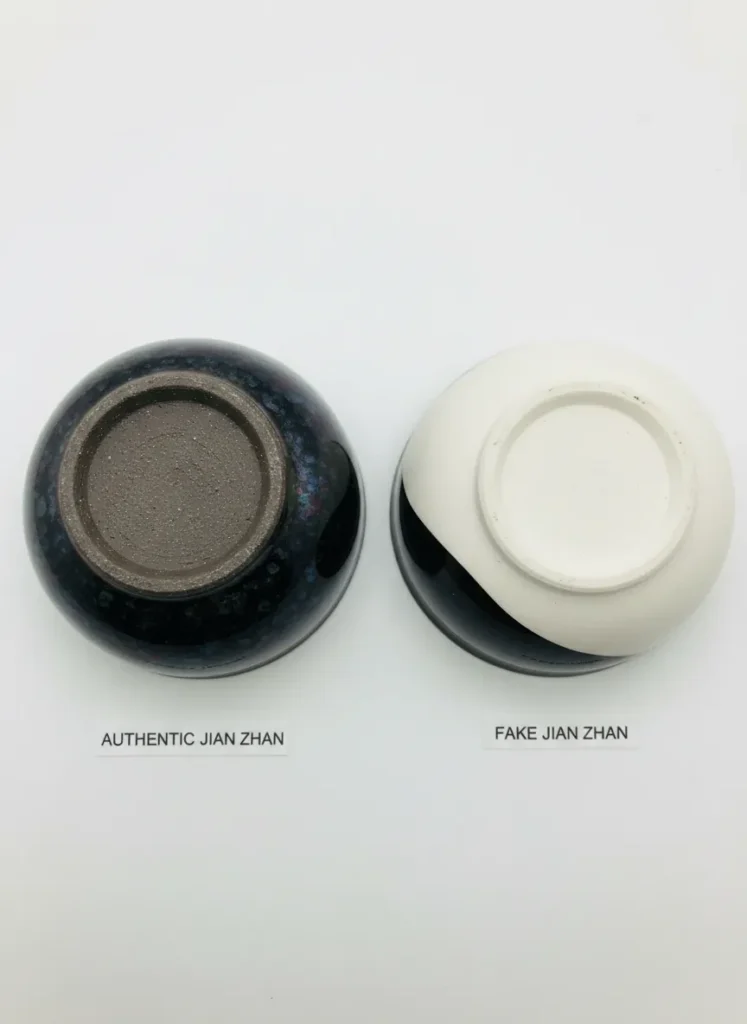
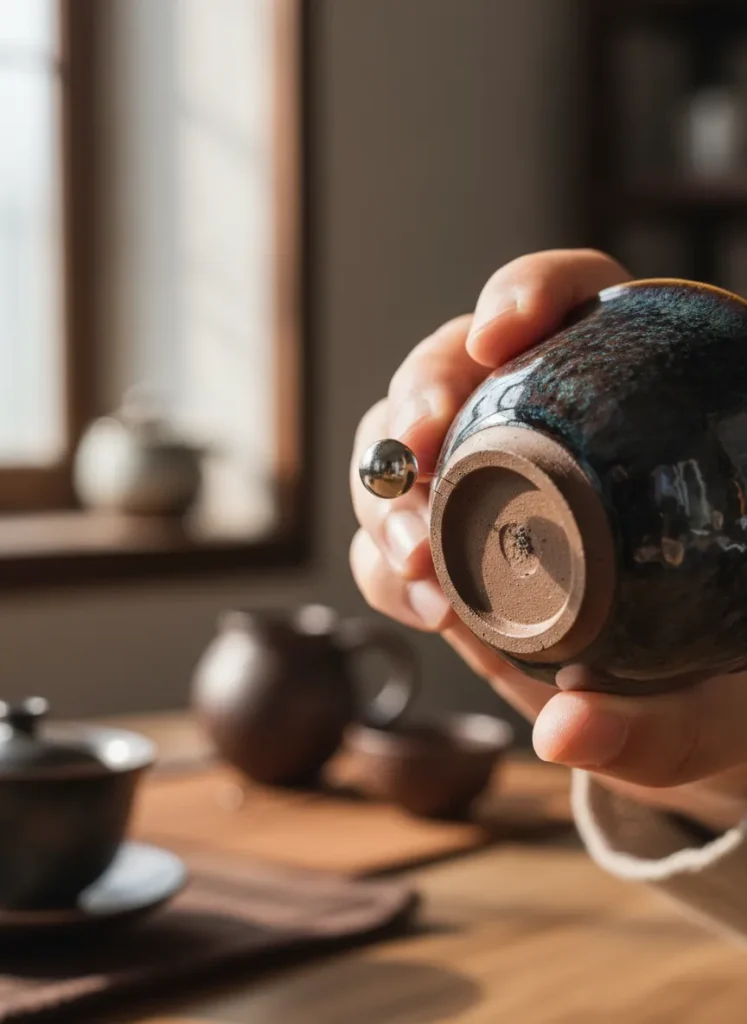
- Foot ring inspection: Turn the cup over. The unglazed foot ring (bottom) of an authentic piece shows dark gray-brown, slightly rough clay — it should look like natural, iron-rich stoneware. If it’s white, pale, or bright red, the clay isn’t authentic Jianyang material.
These three checks take less than five seconds and will catch the majority of obvious fakes. For more subtle counterfeits, read on.
Glaze Pattern Red Flags: When “Too Perfect” Is a Warning
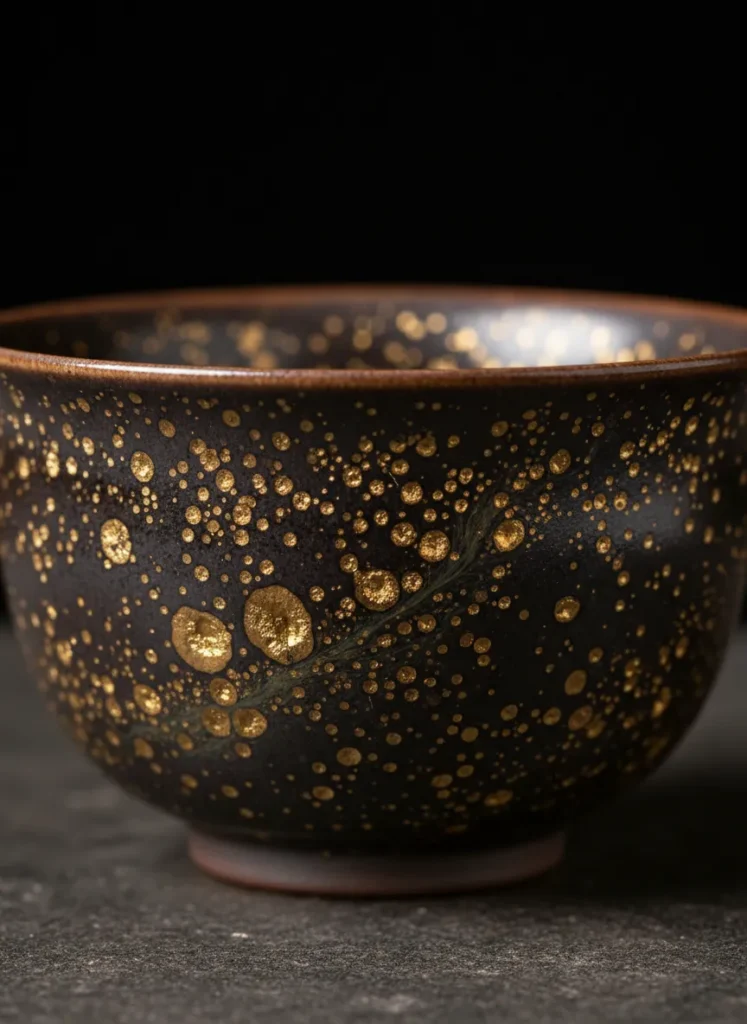
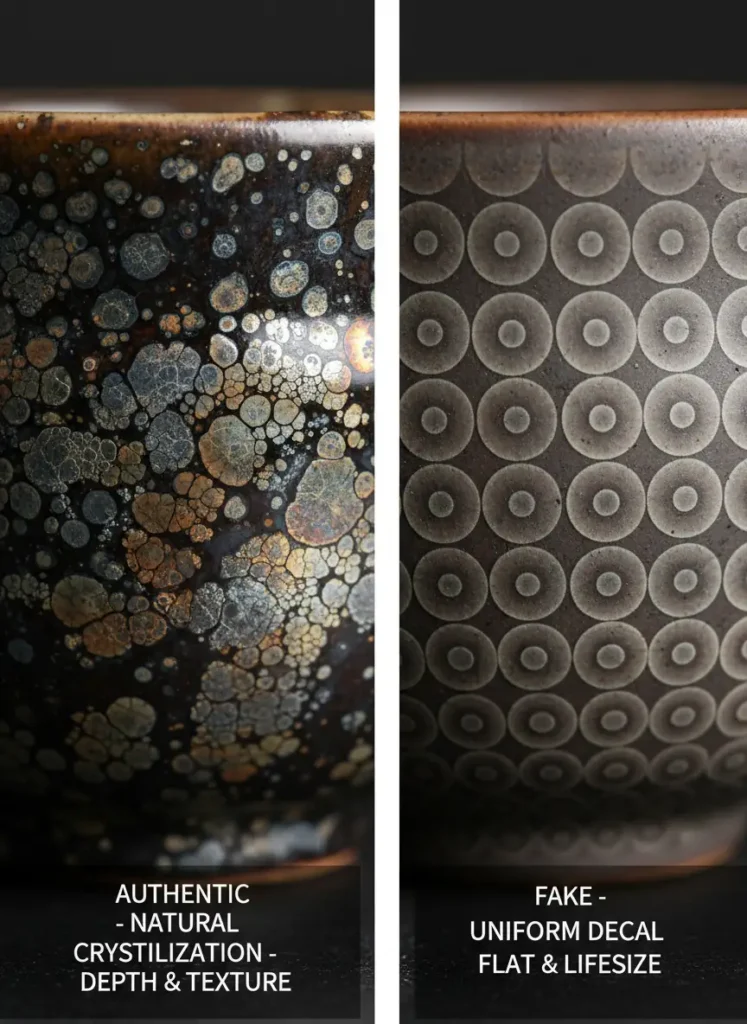
The glaze pattern is where most fakes reveal themselves — if you know what to look for. Authentic Jian Zhan glaze patterns form naturally during high-temperature reduction firing, which means they always have a degree of beautiful imperfection.
Here are the key glaze red flags:
| Red Flag | What You See on a Fake | What Authentic Looks Like |
|---|---|---|
| Perfect symmetry | Patterns repeat identically or look machine-uniform | Naturally irregular — no two spots or streaks are exactly alike |
| Flat, printed appearance | Pattern sits on the surface like a sticker; no depth or texture | Pattern has visible depth — crystals catch light at different angles |
| Metallic paint sheen | Shiny, uniform gold or silver coating that looks painted on | Subtle metallic crystallization that shifts with viewing angle; not uniformly shiny |
| Color inconsistency | Unnatural neon colors (bright blue, vivid purple, hot pink) | Earth tones — silver, gold, brown, amber, deep blue-black from iron oxidation |
| No tactile texture | Surface feels completely smooth, like printed ceramic | Oil spots and hare’s fur streaks have subtle raised or textured feel under fingertip |
A real oil spot pattern (Yuteki in Japanese) consists of iron-rich crystalline droplets that formed as metallic iron precipitated out of the glaze during cooling. Each spot is a tiny three-dimensional crystal — you can feel slight texture, and the spots catch light differently depending on the angle. Decal or painted patterns lack this depth entirely.
Body and Clay: The Most Reliable Authentication Method
While glaze patterns can be faked convincingly from a distance, the clay body is much harder to replicate. Authentic Jian Zhan uses local clay from Jianyang, Fujian, which has a distinctive iron content of 8–12% Fe₂O₃ — significantly higher than ordinary ceramics.
Here’s how to inspect the body and clay:
- Base color: The unglazed foot ring should be dark gray-brown to nearly black. This indicates the high iron content in the clay. White, pale, or bright red bases are clear signs of non-Jianyang clay.
- Wall thickness variation: Hand-thrown authentic cups have subtle variations in wall thickness (typically 3–5 mm). If every wall feels perfectly uniform, the cup was likely machine-pressed.
- Weight-to-size ratio: A standard 80–120 ml Jian Zhan weighs approximately 80–150 grams. If a cup of the same size weighs significantly less, the clay density is wrong — a sign of low-iron substitutes.
- Magnet test: Because authentic Jian Zhan clay contains high iron, a small magnet will slightly cling to the unglazed foot ring. This isn’t a strong pull — don’t expect the cup to hang from a magnet — but you’ll feel a faint drag. Non-iron clay won’t produce any magnetic response at all.
We tested this ourselves: using a small neodymium fridge magnet on the unglazed base of an authentic Jian Zhan from our collection, there was a noticeable but gentle magnetic attraction. On a suspected fake with a pale base, the magnet simply slid off with zero resistance.
Price and Seller Red Flags: Don’t Get Scammed Online
Price alone isn’t a perfect indicator — you can find authentic entry-level Jian Zhan starting around $40–$60, and some overpriced fakes cost $100+. But certain price patterns should make you cautious.
Price red flags:
- Under $20 for “handmade” or “wood-fired”: Authentic hand-thrown Jian Zhan cannot be produced at this price point. The clay, firing, and labor alone cost more.
- Same patterns sold in bulk: If a seller offers 50+ identical cups with the “same” glaze pattern, they’re almost certainly mass-produced — authentic kiln firing produces unique results every time.
- “Kiln opening” livestream deals: Some sellers stage fake kiln opening events on TikTok, showing dramatic reveals of pre-sorted cups at “special” prices. Multiple scam reports exist on Reddit.
- No return policy or vague origin claims: Legitimate sellers will specify the kiln, firing method, and artisan. Vague descriptions like “traditional Chinese tea cup” without specifics are a warning sign.
What a fair price range looks like:
| Type | Typical Price (USD) | What to Expect |
|---|---|---|
| Electric-fired, entry-level | $40–$80 | Authentic clay, simpler glaze patterns, good for daily use |
| Electric-fired, premium patterns | $80–$150 | Better oil spot or hare’s fur development, named patterns |
| Wood-fired, artisan | $120–$300+ | Natural kiln effects, unique patterns, master-crafted |
| Collector / museum-grade | $300–$2,000+ | Rare patterns (Yao Bian), named artisans, certificates of authenticity |
If you’re looking for a reliable starting point, browse our handcrafted Jian Zhan tea cup collection — every piece is sourced directly from verified kilns in Jianyang.
TikTok and Social Media Scams: What We’ve Learned
The intersection of Jian Zhan and social media has created a particularly dangerous scam ecosystem. Here’s what’s actually happening, based on community reports and our own investigations:
The “Kiln Opening” livestream scam: Sellers broadcast what appears to be a live kiln opening in Jianyang, showing dramatic cups being “discovered” for the first time. In reality, these events are often staged with pre-sorted, mass-produced cups. One Reddit user on r/Scams reported: “I think I fell for a Jianzhan tea cup TikTok scam” — and the thread had dozens of similar stories.
The “Master Craftsman” claim: Many sellers attach impressive-sounding artisan names to cheap cups. Without verifiable credentials or a traceable kiln affiliation, these claims are meaningless. Genuine master artisans in Jianyang are registered, and their work commands premium prices — not $25 TikTok deals.
The “same cup, different angle” trick: Some sellers use carefully shot photos and lighting to make a basic electric-fired cup look like a premium wood-fired piece. The metallic paint or decal catches light in a way that mimics natural crystallization on camera, but looks flat and lifeless in person.
To avoid these traps, always buy from sellers who provide clear origin information, multiple angles of the actual cup (not stock photos), and a verifiable return policy. Our buyer’s guide for authentic Tenmoku tea cups goes deeper into vetting sellers.
A Step-by-Step Authentication Checklist
Use this checklist when evaluating any Jian Zhan tea cup — whether online or in person:
- Check the weight: 80–150 grams for a standard cup? Too light = red flag.
- Inspect the foot ring: Dark gray-brown clay visible? White or pale = red flag.
- Run the flick test: Deep, resonant ring = good sign. Dull thud = suspicious.
- Examine glaze texture: Feel for subtle raised texture in oil spots or hare’s fur streaks. Completely smooth surface = possible decal or paint.
- Look for pattern irregularity: Every spot or streak should be slightly different. Identical repetition = mass-produced.
- Check under strong light: Tilt the cup under a bright light. Authentic iron crystallization reflects at different angles — it shimmers. Painted or printed patterns look flat under direct light.
- Magnet test on unglazed base: Faint magnetic drag = high iron content. No response = likely non-authentic clay.
- Verify the seller: Can they name the kiln, firing method, and artisan? Vague answers = proceed with caution.
If a cup passes all eight checks, you’re very likely looking at an authentic piece. If it fails two or more, walk away.
What to Do If You Already Bought a Fake
First, don’t panic. A fake Jian Zhan isn’t dangerous — it’s just not what you paid for. Here’s what to do:
- Request a refund: If you bought through a platform with buyer protection (eBay, Amazon, Etsy), file a “not as described” claim. Many sellers of fake Jian Zhan will issue refunds to avoid negative reviews.
- Document the evidence: Take clear photos of the foot ring (showing pale clay), any suspicious glaze uniformity, and weight measurements. This supports your refund claim.
- Can you still use it? If the cup is food-safe ceramic, you can still drink from it — it just won’t have the heat retention or patina-building properties of authentic Jian Zhan. Check our guide on Tenmoku glaze food safety for more details.
- Report the seller: Leave an honest review or report the listing. This helps other buyers avoid the same trap.
The most important lesson: next time, buy from a verified source. Authentic Jian Zhan from a reputable seller may cost more upfront, but it holds its value, improves with use, and gives you a genuine piece of living ceramic tradition.
❓ Frequently Asked Questions
❓ Can a magnet test definitively prove a Jian Zhan is authentic?
No — the magnet test is a helpful indicator, not definitive proof. Authentic Jian Zhan clay contains 8–12% iron oxide, which creates a faint magnetic attraction on the unglazed base. However, some counterfeit producers add iron powder to the clay mix, which can also respond to magnets. Use the magnet test alongside other checks like weight, sound, and glaze texture for a more reliable assessment.
❓ Are all cheap Jian Zhan tea cups fake?
Not necessarily. Authentic electric-fired Jian Zhan from Jianyang can be found in the $40–$80 range. These are genuine pieces made with the correct iron-rich clay — they just use modern electric kilns instead of traditional wood-fired dragon kilns. What’s definitely fake is anything under $20 claiming to be “handmade” or “wood-fired.” That price point simply can’t cover authentic materials and labor.
❓ How can I tell wood-fired from electric-fired Jian Zhan?
Wood-fired Jian Zhan typically shows more natural variation in glaze color and pattern, with subtle ash deposits and less uniform results. Electric-fired cups tend to have more consistent, controlled patterns. Neither is inherently “fake” — both can use authentic Jianyang clay. For a detailed comparison, see our guide on wood-fired vs electric-fired Jian Zhan.
❓ Is it safe to drink from a fake Jian Zhan cup?
Most counterfeit Jian Zhan are made from standard ceramic materials, which are generally food-safe. The main concern is if the cup uses metallic paint or chemical coatings that aren’t food-grade — these can potentially leach into hot liquids. If your cup has an unusually strong chemical smell, a paint-like coating that chips easily, or unnaturally bright colors, avoid drinking from it. When in doubt, stick to cups from verified sellers.
📚 References
-
Jian Ware History and Authentication:
Overview of Jian kiln ceramics, glaze formation science, and methods for distinguishing authentic pieces from modern reproductions.
The Metropolitan Museum of Art -
Ceramic Tableware Safety Standards:
FDA guidance on lead and cadmium safety for ceramic foodware, relevant for evaluating whether a suspect cup is safe to use.
U.S. FDA -
Jian Zhan Community Reports on Counterfeits:
Multiple threads documenting Jian Zhan scams, fake kiln openings, and buyer experiences with counterfeit cups.
Source: Reddit r/Ceramics, r/tea, r/Scams
(Readers may search these subreddits for current discussions)
Find the tenmoku cup that speaks to you — browse these cups for authentic, artisan-crafted teaware.


