

Tenmoku is a type of dark-glazed stoneware tea bowl that originated in China’s Fujian province during the Song Dynasty (960–1279 AD), named after Tianmu Mountain where Japanese Zen monks first encountered these striking ceramic vessels. From Zen Tea Cup, this guide walks you through everything you need to know about Tenmoku teaware — from its 1,000-year history to choosing your first authentic cup.
| Key Stat | Value |
|---|---|
| Origin | Song Dynasty (960–1279 AD), Fujian, China |
| Firing Temperature | 2,300°F (1,260°C) |
| Clay Iron Content | 7–10% iron oxide |
| Typical Diameter | 4.5–5.1 in (11–13 cm) |
| Weight | 4.2–6.3 oz (120–180 g) |
| Glaze Thickness | 0.04–0.08 in (1–2 mm) |
| Heat Retention | 15–20 minutes longer than porcelain |
| Price Range (Authentic) | $30–200+ USD |
Contents
- What Is Tenmoku? Definition and Origin
- Tenmoku vs Jian Zhan: Understanding the Names
- Japanese Tenmoku vs Chinese Jian Zhan
- Why Two Names for One Tradition?
- Tenmoku Glaze Patterns: A Visual Guide
- Oil Spot (Yōhen Tenmoku)
- Hare’s Fur (Tu Hao Jian Zhan)
- Yao Bian and Other Rare Patterns
- How Tenmoku Tea Cups Are Made
- Why Tea Tastes Better in a Tenmoku Cup
- How to Choose Your First Tenmoku Tea Cup
- Size and Weight Considerations
- Authenticity Checklist
- ❓ Is Tenmoku the same as Jian Zhan?
- ❓ Why are Tenmoku cups so expensive?
- ❓ Can you use a Tenmoku cup for drinks other than tea?
- ❓ How do you know if a Tenmoku cup is authentic?
- 📚 References
What Is Tenmoku? Definition and Origin
Tenmoku refers to a family of dark-glazed stoneware tea bowls first produced at the Jianyang kilns in Fujian province, China, during the Northern Song Dynasty. The name comes from Mount Tianmu (天目, literally “Heaven’s Eye”) in Zhejiang province, where Japanese Buddhist monks studying at local temples encountered these bowls and brought them back to Japan starting in the 12th century. You can explore the full story of this naming origin in our Tianmu Mountain: The Origin of the Tenmoku Name article.
The defining characteristic of Tenmoku is its iron-rich glaze, which contains 7–10% iron oxide. When fired at temperatures reaching 2,300°F (1,260°C) in a reduction atmosphere, the iron crystallizes on the surface, creating the mesmerizing patterns that have made these bowls legendary. The thick walls — typically 0.2–0.3 inches (5–8 mm) — give Tenmoku cups their characteristic weight of 4.2–6.3 oz (120–180 g) and exceptional heat retention.
(No two genuine Tenmoku cups share identical glaze patterns — the crystallization process is inherently unpredictable, which is part of what makes each piece a unique work of art.)
Song Dynasty Emperor Huizong himself praised Jian Zhan tea bowls in his Da Guan Cha Lun (Treatise on Tea), writing that “the best cups are those with dark glaze and rabbit-hair patterns.” This imperial endorsement cemented Tenmoku’s status as the finest teaware for whisked tea competitions at court.
Tenmoku vs Jian Zhan: Understanding the Names
The distinction between Tenmoku and Jian Zhan is primarily cultural and linguistic rather than material — they refer to the same ceramic tradition viewed through different cultural lenses.
Japanese Tenmoku vs Chinese Jian Zhan
“Jian Zhan” (建盏) is the Chinese name, literally meaning “Jian cup” — referencing Jianyang (建阳), the specific city in Fujian where these bowls were first produced. The Chinese term emphasizes geographic origin and the kiln site. “Tenmoku” (天目) is the Japanese pronunciation of “Tianmu,” the mountain where Japanese monks first encountered these bowls — it emphasizes the Buddhist transmission route rather than the manufacturing origin.
Why Two Names for One Tradition?
The dual naming reflects a real cultural divergence. In China, Jian Zhan remained a domestic tea ware tradition tied to the Song Dynasty court and later folk tea culture. In Japan, Tenmoku became deeply intertwined with Zen Buddhism and the chanoyu tea ceremony — so much so that the Japanese developed their own Tenmoku glazing traditions at kilns like Seto and Mino. When you see a piece labeled “Tenmoku” in a museum, it often refers to the Japanese tradition or Japanese-owned Chinese originals; “Jian Zhan” typically signals a piece made in China using traditional Jianyang methods.
Tenmoku Glaze Patterns: A Visual Guide
The glaze patterns on Tenmoku cups form through iron oxide crystallization during firing — each pattern tells a story of chemistry, temperature, and chance. The specific pattern depends on the glaze composition, kiln atmosphere, cooling rate, and even the position of the cup inside the kiln.
Oil Spot (Yōhen Tenmoku)
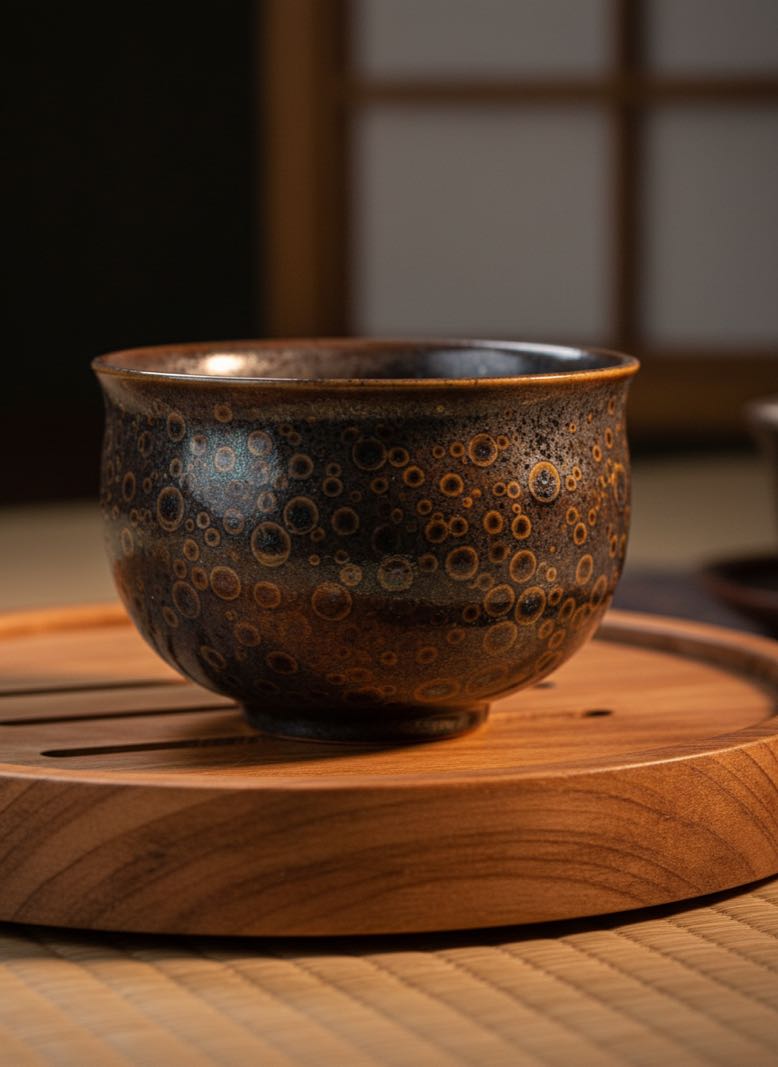
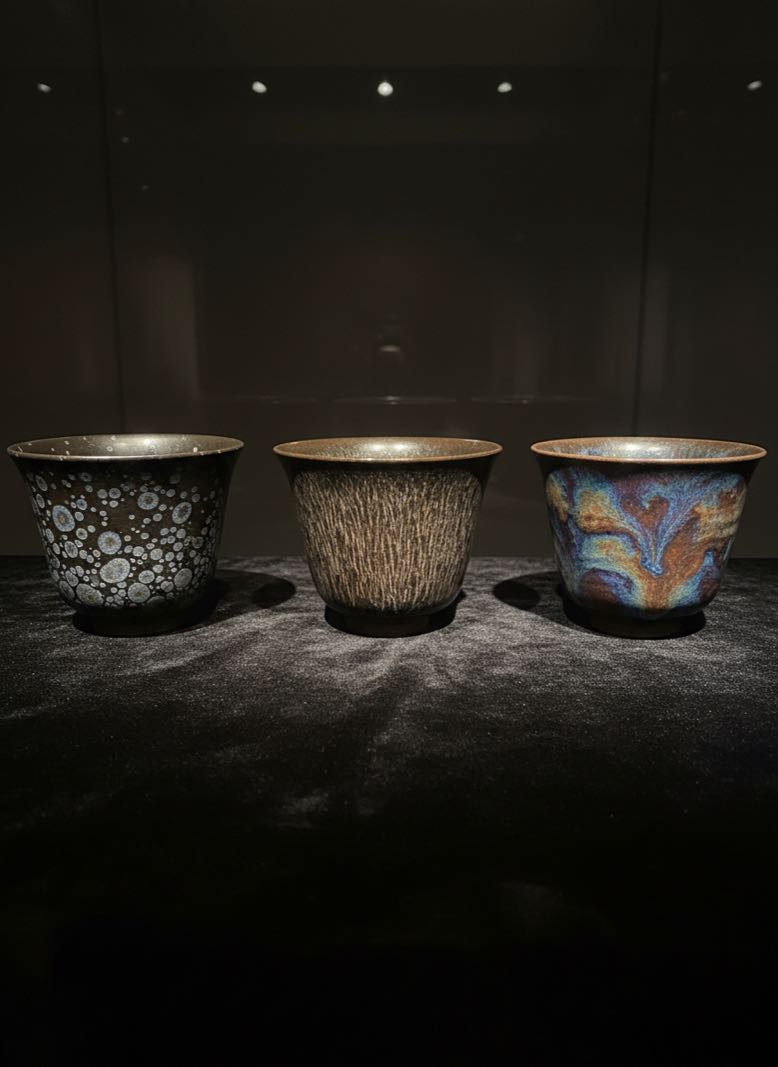
Oil Spot pattern features round, silver-white or golden metallic dots scattered across the dark glaze surface, resembling oil drops on water. These spots form when excess iron in the glaze precipitates during the cooling phase, creating crystalline circles that range from 0.04 to 0.2 inches (1–5 mm) in diameter. The most prized Oil Spot pieces show uniform, well-separated spots with a metallic sheen — three surviving Yōhen Tenmoku bowls in Japan are designated National Treasures, including the celebrated example at the Kyoto National Museum.
Hare’s Fur (Tu Hao Jian Zhan)
Hare’s Fur pattern displays fine, parallel streaks running down the bowl’s interior, mimicking the silky fur of a hare. These streaks form when the glaze flows downward during firing, concentrating iron into thin rivulets. The streaks can appear in gold, silver, or blue-black, with golden Hare’s Fur being the most sought after. Emperor Huizong’s preference for “rabbit-hair patterns” made this the canonical Tenmoku pattern of the Song court. The streaks are typically 0.04–0.08 inches (1–2 mm) wide and run from the rim toward the bowl’s center.
Yao Bian and Other Rare Patterns
Yao Bian (窑变) means “kiln transformation” — an unpredictable mutation that produces iridescent, multi-colored effects. These rare pieces display flashes of blue, purple, green, and gold that shift depending on the viewing angle and light source. Other notable patterns include Partridge Spot (鹧鸪斑), which features speckled markings like a partridge’s feathers, and Star Spot, with tiny scattered metallic points. These rare patterns command the highest prices among collectors, with authentic Song Dynasty Yao Bian pieces valued at hundreds of thousands of dollars at auction.
How Tenmoku Tea Cups Are Made
Creating a Tenmoku tea cup requires iron-rich Jianyang clay, precise temperature control reaching 2,300°F (1,260°C), and the unpredictable magic of a reduction kiln atmosphere. The process has remained fundamentally unchanged for over a thousand years — modern potters in Jianyang still use many of the same techniques documented in Song Dynasty records. Learn more about this evolution in our article on the history of Jian Zhan from Song Dynasty to modern revival.
The production begins with selecting local clay containing 7–10% iron oxide, which is aged, wedged, and hand-formed on a wheel. The thick walls (0.2–0.3 inches) are intentional — they provide the thermal mass that keeps your tea warm 15–20 minutes longer than thin-walled porcelain. After the first bisque firing, the potter applies the iron-rich glaze by dipping or pouring, leaving the foot rim unglazed to prevent sticking to the kiln shelf. The glazed piece then enters the reduction kiln, where oxygen is restricted during peak temperature, forcing the iron oxide to crystallize into patterns on the surface. The cooling phase is critical — too fast and the crystals shatter; too slow and they overgrow into an undifferentiated mass.
— The kiln’s unpredictability means that even a master potter cannot guarantee which pattern will emerge; each firing is partly an act of surrender to the elements.
Why Tea Tastes Better in a Tenmoku Cup
The thick walls of a Tenmoku cup do more than feel substantial in your hand — they actively improve your tea through heat retention and trace mineral interaction. This is not just tradition or aesthetics; there is measurable science behind it.
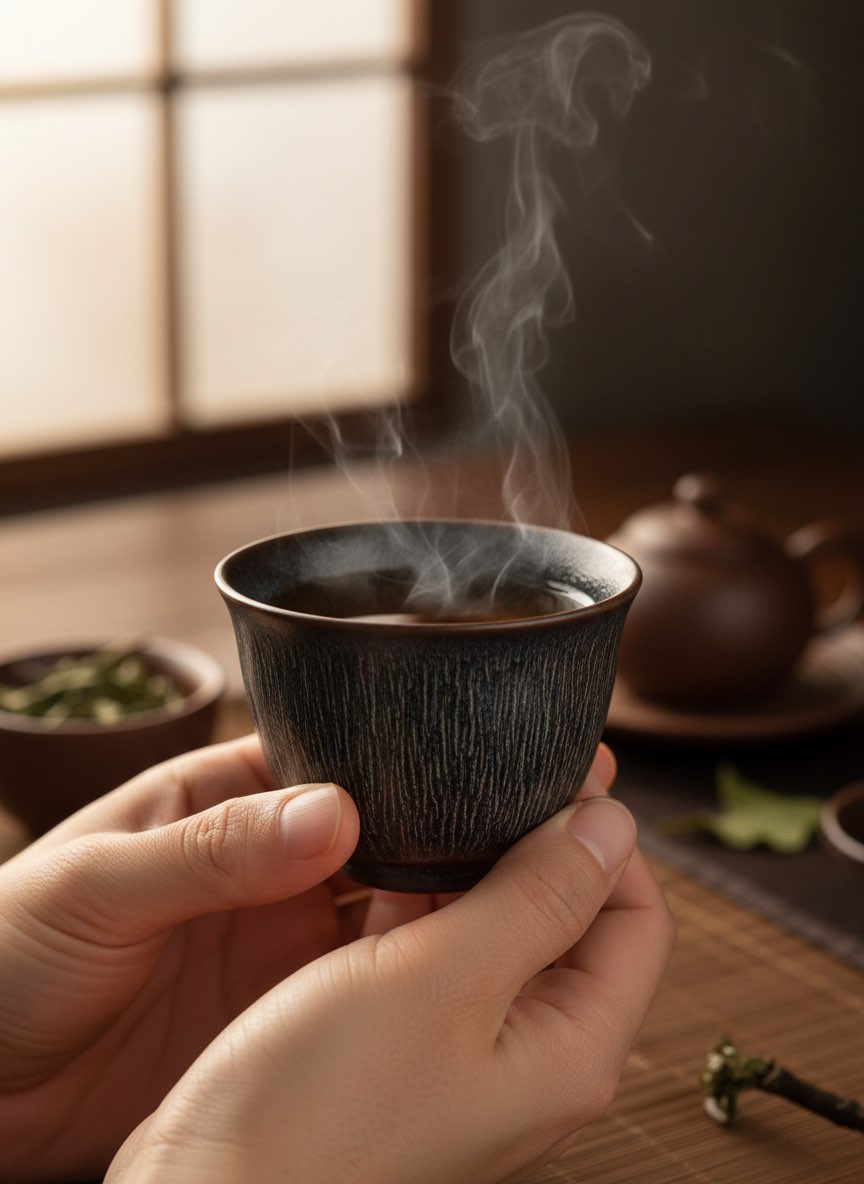
Heat retention is the most obvious benefit. The dense, 4.2–6.3 oz (120–180 g) body absorbs thermal energy and releases it slowly, keeping your tea at the optimal drinking temperature 15–20 minutes longer than a thin porcelain cup of the same volume. For oolong and pu’er teas, where multiple infusions are standard, this sustained warmth allows consistent extraction across steeps.
Beyond temperature, the iron-rich clay interacts with your tea at a molecular level. The 7–10% iron oxide content and the slightly alkaline glaze surface can soften water and subtly round out harsh tannins, particularly in green and oolong teas. Researchers at UNESCO’s Intangible Cultural Heritage program have documented the mineral exchange between Jian Zhan clay and tea liquor, confirming what Song Dynasty tea masters observed through taste alone. Discover more about this effect in our article on why tea tastes better in a Tenmoku cup.
How to Choose Your First Tenmoku Tea Cup
When you are ready to buy your first Tenmoku cup, focus on three things: size that fits your hand, a pattern that speaks to you, and verified authenticity. The right cup should feel like a natural extension of your palm.
Size and Weight Considerations
The standard Tenmoku tea cup measures 4.5–5.1 inches (11–13 cm) in diameter and holds approximately 3.4–5.1 fl oz (100–150 ml) — ideal for gongfu-style brewing. If you have smaller hands, look for cups around 3.5–4.3 inches (9–11 cm) in diameter weighing 3.5–4.2 oz (100–120 g). For those who prefer a larger bowl, 5.5–6.3 inches (14–16 cm) diameter options hold 5.1–6.8 fl oz (150–200 ml). Authentic Tenmoku cups in the $30–200 USD range from reputable makers offer excellent quality without requiring a collector’s budget.
Authenticity Checklist
With the growing popularity of Tenmoku, the market has seen an influx of mass-produced imitations. Here is how you can verify authenticity: genuine Tenmoku cups weigh 120–180 g for standard sizes (they feel dense, not hollow); the unglazed foot rim reveals the dark, iron-rich clay body underneath; you should see tiny iron specks or crystalline traces under magnification; and authentic pieces from Jianyang come with a certification stamp or registration number. Avoid cups with perfectly uniform glaze — real Tenmoku always shows slight irregularities from the kiln.
❓ Is Tenmoku the same as Jian Zhan?
They refer to the same tradition of dark-glazed stoneware, but “Jian Zhan” is the Chinese name emphasizing the Jianyang origin, while “Tenmoku” is the Japanese name derived from Tianmu Mountain where Japanese monks first encountered these bowls. Both terms describe iron-rich, high-fired tea ware with crystalline glaze patterns.
❓ Why are Tenmoku cups so expensive?
Authentic Tenmoku cups require specialized iron-rich clay from Jianyang, high-temperature firing at 2,300°F (1,260°C), and the unpredictable crystallization process means many pieces are discarded. A single firing may yield only 20–30% usable cups with desirable patterns. Hand-crafted cups with rare patterns like Yao Bian command premium prices.
❓ Can you use a Tenmoku cup for drinks other than tea?
Yes — Tenmoku cups work beautifully for sake, coffee, and even water. The iron-rich clay can subtly enhance the flavor of any beverage. However, avoid leaving acidic drinks in the cup for prolonged periods to protect the glaze surface.
❓ How do you know if a Tenmoku cup is authentic?
Look for weight (120–180 g for standard cups), visible iron specks in the clay body under the glaze, and a registration mark from Jianyang. Authentic pieces feel dense and show slight irregularities from hand-forming. Perfectly uniform glaze is a red flag for mass production.
📚 References
- Tenmoku Teabowls: Kyoto National Museum collection documentation of designated National Treasure Yōhen Tenmoku bowls. Kyoto National Museum
- Jian Zhan Firing Technology: UNESCO Intangible Cultural Heritage documentation of traditional Jianyang kiln techniques and iron-rich clay composition. UNESCO Intangible Cultural Heritage
- Song Dynasty Tea Culture: Emperor Huizong’s Da Guan Cha Lun (Treatise on Tea, 1107 AD) — primary source on Jian Zhan appreciation at the Song court. The Metropolitan Museum of Art
Whether you are just beginning to explore Tenmoku teaware or looking for your next treasured cup, understanding what Tenmoku is — from its Song Dynasty origin to its modern revival — helps you appreciate why these complete Jian Zhan pieces have captivated tea lovers for over a thousand years. Browse our curated Tenmoku tea cup collection at Zen Tea Cup to find a guide-worthy piece for your daily tea ritual.


