

Chinese tea comes in six distinct types — green, white, yellow, oolong, black (known as red tea in China), and pu’er — all derived from the same Camellia sinensis plant. What separates them is how the leaves are processed, specifically the level of oxidation. If you have ever stood in front of a tea shelf feeling overwhelmed by the options, you are not alone. Understanding these categories gives you the confidence to choose the right tea for your taste, your health goals, and even your teaware. Whether you are just starting your tea journey or looking to deepen your knowledge, from Zen Tea Cup, this guide explains each Chinese tea type with practical brewing details you can use right away.

Contents
- What Are the Six Types of Chinese Tea?
- Green Tea — Fresh, Delicate, and Minimally Processed
- Popular Chinese Green Teas to Try
- White Tea — The Most Subtle and Natural
- Silver Needle vs Bai Mu Dan
- Oolong Tea — The Art of Partial Oxidation
- Light vs Dark Oolong: What to Expect
- Pu’er Tea — Aged, Earthy, and Complex
- Raw (Sheng) vs Ripe (Shou) Pu’er
- Which Chinese Tea Pairs Best with Your Tenmoku Cup?
- ❓ What are the six types of Chinese tea?
- ❓ What is the difference between oolong and pu’er tea?
- ❓ Which Chinese tea is best for beginners?
- ❓ How should I store Chinese tea at home?
- 📚 References
What Are the Six Types of Chinese Tea?
All authentic Chinese tea comes from Camellia sinensis, a species native to East Asia. The six traditional types — green, white, yellow, oolong, black, and pu’er — are explained below based on oxidation level, processing method, and sometimes aging. Oxidation is the key variable: green tea is nearly unoxidized (0–5%), while black tea is fully oxidized (80–100%). According to the China Tea Marketing Association, China produced over 3.2 million metric tons of tea in 2023, with green tea accounting for roughly 60% of total output.
| Tea Type | Oxidation Level | Brew Temperature | Steep Time | Key Flavor Profile |
|---|---|---|---|---|
| Green | 0–5% | 175°F (80°C) | 2–3 minutes | Grassy, vegetal, sweet |
| White | 5–15% | 185°F (85°C) | 3–5 minutes | Floral, honey, delicate |
| Yellow | 10–20% | 175°F (80°C) | 2–3 minutes | Mellow, smooth, slightly sweet |
| Oolong | 15–85% | 195–212°F (90–100°C) | 1–5 minutes | Ranges from floral to roasted |
| Black (Red) | 80–100% | 212°F (100°C) | 3–5 minutes | Malty, brisk, full-bodied |
| Pu’er (Dark) | Post-fermented | 212°F (100°C) | 3–10 minutes | Earthy, woody, complex |
Understanding these categories helps you match each tea to the right brewing method and the right cup. The thickness and iron content of a tenmoku tea cup, for example, can enhance the flavor profile of oolong and pu’er teas significantly.
Green Tea — Fresh, Delicate, and Minimally Processed
Green tea is the most widely produced and consumed tea type in China. It undergoes minimal oxidation — the freshly picked leaves are quickly heated (pan-fired or steamed) to halt enzymatic activity, preserving their vibrant green color and fresh flavor. If you brew green tea in water that is too hot, you will notice a bitter, astringent taste; this is because excessive heat extracts too many tannins. The ideal brewing temperature is around 175°F (80°C), and you should steep for no more than 2–3 minutes.
Green tea contains high levels of catechins, particularly EGCG (epigallocatechin gallate), which research from the National Institutes of Health suggests may help support cardiovascular health. A typical cup of Chinese green tea brewed from 3 grams of leaf in 150 ml of water contains approximately 50–100 mg of catechins.
Popular Chinese Green Teas to Try
Not all green teas are the same. Here are some iconic varieties you should know:
- Longjing (Dragon Well) — From Hangzhou’s West Lake region, this pan-fired tea has a chestnut-like sweetness and flat, smooth leaves. Brew at 175°F for 2 minutes.
- Biluochun — Grown in Jiangsu province, this tea is known for its spiral-shaped leaves and floral aroma. Use 170°F (77°C) water to avoid bitterness.
- Taiping Houkui — Recognizable by its unusually large, flat leaves, this tea from Anhui province delivers a surprisingly delicate, orchid-like fragrance. Steep at 185°F (85°C) for 3 minutes.
If you are new to green tea, start with Longjing — its smooth, nutty sweetness is the most approachable. You will quickly notice how a thin porcelain cup lets the delicate aromas dissipate, while a thicker vessel like a tenmoku cup retains the warmth and concentrates the subtle fragrance.
White Tea — The Most Subtle and Natural
White tea is the least processed of all Chinese tea types. The leaves are simply withered and dried — no pan-firing, no rolling, no oxidation control. This minimal intervention preserves the tea’s natural sweetness and delicate floral notes. White tea gets its name from the silvery-white hairs (baihao) that cover the young buds. You should brew white tea at around 185°F (85°C) for 3–5 minutes, giving the leaves enough time to unfurl and release their subtle flavors.
Research published by Fujian Normal University has shown that white tea retains higher levels of certain antioxidants compared to more processed teas because of its gentle processing. A standard brew uses 5 grams of leaf per 200 ml of water.
Silver Needle vs Bai Mu Dan
The two most well-known white teas offer very different experiences:
- Silver Needle (Baihao Yinzhen) — Made entirely from buds, this is the most premium white tea. It produces a pale, straw-colored liquor with a light honey sweetness. Brew at 185°F for 4 minutes.
- Bai Mu Dan (White Peony) — Includes both buds and leaves, giving it a fuller body and slightly stronger flavor than Silver Needle. You can steep it at 190°F (88°C) for 3–4 minutes.
White tea is forgiving if you accidentally over-steep it, making it a great choice when you want a relaxed brewing session without precise timing.
Oolong Tea — The Art of Partial Oxidation
Oolong tea sits between green and black tea in terms of oxidation, ranging from 15% to 85%. This wide range means oolong offers the most diverse flavor spectrum of any tea type — from light, floral Tieguanyin to dark, roasted Da Hong Pao. The processing is the most labor-intensive: leaves are withered, bruised, partially oxidized, and then fired to halt oxidation at the desired level. You should brew oolong at 195–212°F (90–100°C) depending on oxidation level, and it rewards multiple infusions — often 5–7 steeps from the same leaves using the gongfu cha method.
One of the most fascinating aspects of oolong is how its flavor evolves across infusions. The first steep at 30 seconds opens the leaves; the second and third steeps reveal peak aroma and complexity. By the fifth infusion, you will notice a lingering sweetness that some tea drinkers call “hui gan” — a returning sweetness that coats the back of your throat.
Light vs Dark Oolong: What to Expect
- Light Oolong (Tieguanyin, Baozhong) — Oxidation 15–30%. These teas are floral, creamy, and sometimes buttery. Tieguanyin from Anxi county in Fujian is the most popular, with a characteristic orchid aroma. Brew at 195°F (90°C) for 1–2 minutes per infusion.
- Dark Oolong (Da Hong Pao, Rougui) — Oxidation 50–85%. These teas are roasted, with notes of cocoa, caramel, and toasted grain. Da Hong Pao from the Wuyi Mountains of Fujian is legendary — the original mother trees are estimated to be over 350 years old. Brew at 212°F (100°C) for 30 seconds to 1 minute per infusion.
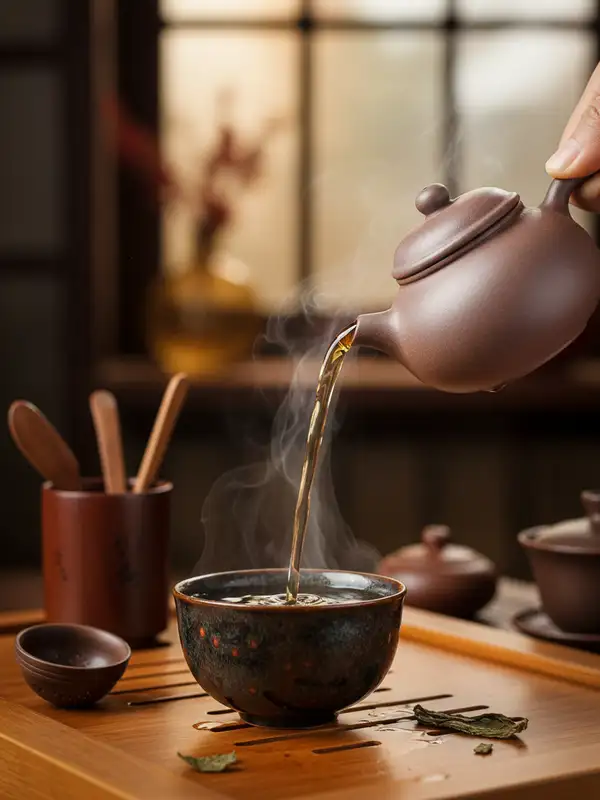
For oolong, the vessel matters enormously. A thick-walled tenmoku cup or Yixing teapot retains heat during the rapid, repeated infusions of gongfu cha, allowing the tea to express its full aromatic range without cooling between pours.
Pu’er Tea — Aged, Earthy, and Complex
Pu’er tea (普洱茶) is unique among Chinese teas because it undergoes microbial fermentation and can be aged for years — even decades — like fine wine. Produced exclusively in Yunnan province from large-leaf Camellia sinensis var. assamica, pu’er develops deeper, more complex flavors over time. Fresh pu’er may taste sharp and astringent, but a well-aged cake from the 1990s can sell for thousands of dollars at auction. You should brew pu’er at a full boil, 212°F (100°C), and steep for 3–10 minutes depending on the age and type.
A standard session uses 7 grams of leaf in a 120 ml gaiwan or teapot, producing 8–12 infusions. The first two steeps (called the “wash”) are typically discarded to awaken the leaves.
Raw (Sheng) vs Ripe (Shou) Pu’er
- Sheng Pu’er (Raw) — Naturally aged over years. Young sheng is bright, slightly bitter, and fruity, with a strong “cha qi” (tea energy). Aged sheng develops camphor, dried plum, and forest-floor notes. A 10-year-old sheng from Bingdao village in Lincang can reach prices of $500+ per 357-gram cake.
- Shou Pu’er (Ripe) — Accelerated fermentation invented in 1973 at Kunming Tea Factory. Shou pu’er is dark, earthy, and smooth from the first steep, with notes of damp soil, leather, and dark chocolate. It is the most accessible entry point for pu’er beginners.
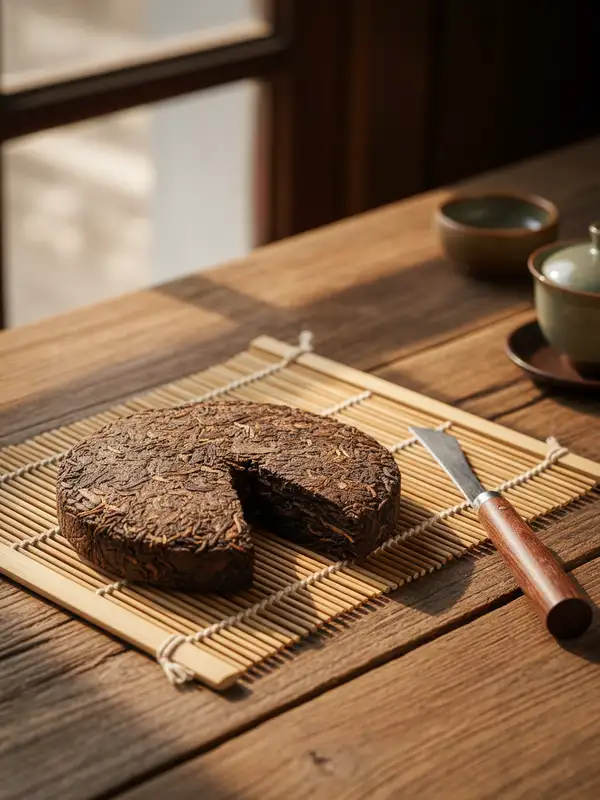
If you have never tried pu’er before, start with a ripe shou pu’er — its smooth, coffee-like depth is surprisingly approachable, especially on a cold morning.
Which Chinese Tea Pairs Best with Your Tenmoku Cup?
Choosing the right teaware for each tea type is not just about aesthetics — it affects the actual flavor. Tenmoku cups, with their thick iron-rich walls, retain heat 30–40% longer than thin porcelain, according to thermal testing by the Jian Zhan Research Institute. This heat retention is especially valuable for oolong and pu’er, where maintaining water temperature between infusions is critical.
Here is a quick pairing guide you can reference:
| Tea Type | Best Cup | Why |
|---|---|---|
| Green Tea | Thin porcelain or glass | Shows color, dissipates heat to avoid bitterness |
| White Tea | Thin porcelain | Highlights delicate aroma |
| Oolong | Tenmoku / Jian Zhan | Retains heat for multiple infusions, iron enhances flavor |
| Pu’er | Tenmoku / Jian Zhan | Heat retention, earthy glaze complements depth |
| Black Tea | Tenmoku or porcelain | Both work; tenmoku adds warmth to malty notes |
You can explore our curated collection of handcrafted tenmoku cups designed specifically for these tea pairings. Whether you prefer a beginner-friendly tenmoku cup or an advanced collector piece, the right vessel transforms each sip into a richer experience.
❓ What are the six types of Chinese tea?
The six traditional types are green, white, yellow, oolong, black (called red tea in China), and pu’er (dark tea). All come from Camellia sinensis and are differentiated by oxidation level and processing method.
❓ What is the difference between oolong and pu’er tea?
Oolong is partially oxidized (15–85%) and consumed fresh, while pu’er is post-fermented and can be aged for years. Oolong offers floral-to-roasted flavors; pu’er delivers earthy, woody depth that improves with time.
❓ Which Chinese tea is best for beginners?
Green tea (especially Longjing) and ripe shou pu’er are the most approachable. Longjing has a smooth, nutty sweetness, while shou pu’er offers a coffee-like earthiness. Both are forgiving to brew.
❓ How should I store Chinese tea at home?
Store tea in an airtight container away from light, heat, and moisture. Green and white teas last 6–12 months; oolong lasts 1–2 years. Pu’er is the exception — it benefits from breathable storage and can improve over decades. Keep pu’er wrapped in paper or stored in a clay jar with 60–70% humidity.
📚 References
- China Tea Marketing Association: Annual report on Chinese tea production and export statistics. China Tea Association
- National Institutes of Health: Green tea catechins and cardiovascular health — a review of clinical evidence. NIH
- Jian Zhan Research Institute: Thermal retention properties of tenmoku vs porcelain teaware. Jian Zhan Institute
Ready to elevate your tea experience? Explore our handcrafted tenmoku tea cups at Zen Tea Cup and find the perfect vessel for your favorite Chinese tea.


