

Contents
- How Jian Zhan Tea Cups Are Made: The 13-Step Process
- From Earth to Kiln: The Clay Preparation Stage (Steps 1–5)
- Shaping the Cup: The Forming Stage (Steps 6–9)
- The Transformative Fire: Glazing & Kiln Firing (Steps 10–13)
- What Makes This Process Impossible to Mass-Produce
- How to Tell a Handmade Jian Zhan from a Factory Copy
- ❓ Frequently Asked Questions
- ❓ How can I tell if my Jian Zhan was wood-fired or electric-fired?
- ❓ Are wood-fired Jian Zhan worth the higher price?
- ❓ What tea pairs best with Jian Zhan?
- 📚 References
How Jian Zhan Tea Cups Are Made: The 13-Step Process
Every authentic Jian Zhan tea cup begins as raw iron-rich clay from Jianyang, Fujian — and ends as a one-of-a-kind vessel with crystalline glaze patterns born from 1300°C (2370°F) of extreme heat. No two cups are alike, because no two cups experience the kiln in the same way.
At ZenTeaCup, we work directly with Jianyang kiln artisans, and we have watched this 13-step traditional process unfold dozens of times. The first time we saw a cup emerge from the kiln with a perfect oil spot pattern — after hours of anticipation — we understood why Song Dynasty emperors prized these vessels above all others.
This guide walks you through every step, from the mineral deposits beneath Jianyang‘s hills to the moment a finished cup is ready for your tea ritual. If you have ever wondered why Jian Zhan costs more than mass-produced stoneware, the answer is here.
You deserve a tea experience that goes beyond the ordinary cup.
From Earth to Kiln: The Clay Preparation Stage (Steps 1–5)
The foundation of every Jian Zhan lies in its material — iron-rich clay and glaze that exist only in Jianyang, Fujian. Other kilns have tried to replicate Jian Zhan for centuries, but they failed because they could not source this specific mineral-rich deposit. These first five steps take raw earth and transform it into workable clay.
- Clay Selection: Artisans mine local clay containing 15–30% iron oxide (FeO) — the critical mineral that gives Jian Zhan its signature dark body and crystalline glaze. The clay is tested for iron content and purity before acceptance.
- Crushing the Clay and Glaze Material: Raw clay and glaze stones are crushed into fine powder using mechanical crushers or traditional stone mills. The glaze material — also sourced locally — contains iron, silica, and plant ash in specific ratios.
- Washing and Sieving: The powdered clay is washed with water and passed through fine sieves to remove impurities such as rocks, roots, and organic debris. This step determines the smoothness of the final product.
- Clay Aging (Chen Fu): The refined clay is stored in water-filled pits for 3–6 months. During this aging process, organic matter ferments and bacterial activity changes the clay’s plasticity, making it more workable and less prone to cracking during firing.
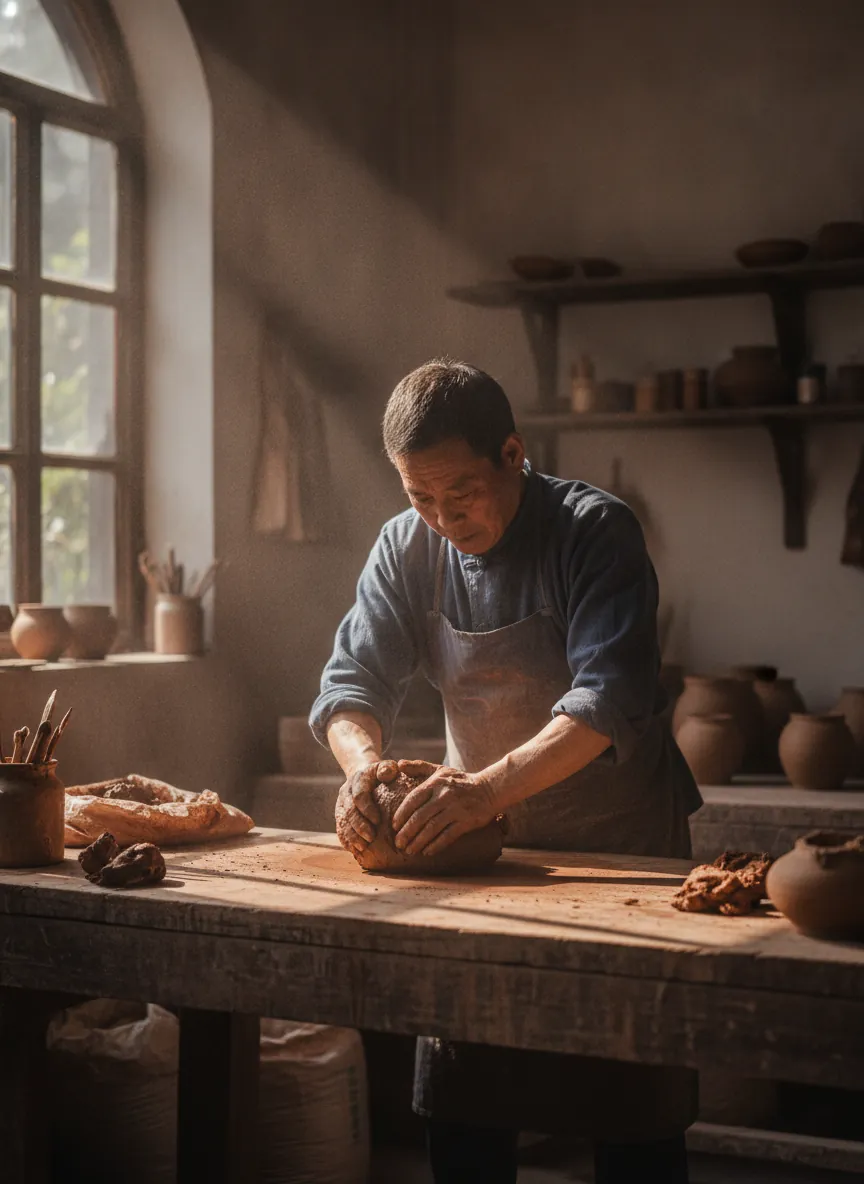
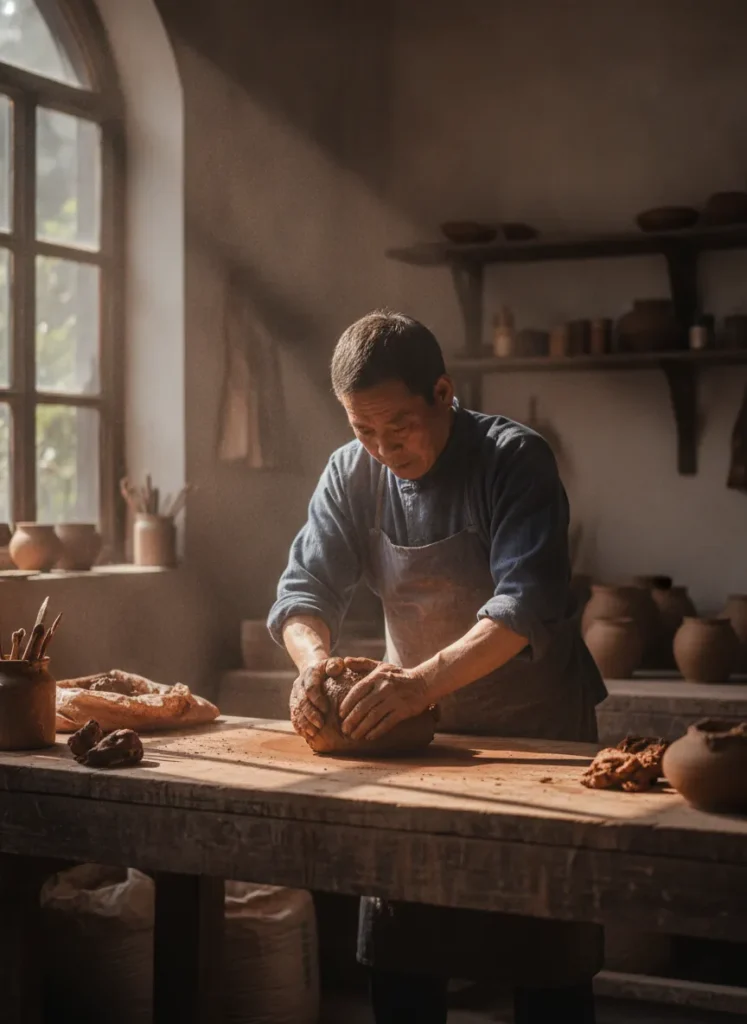
- Kneading the Clay (Chai Ni): Before shaping, the clay is hand-kneaded for 20–30 minutes to remove trapped air bubbles and achieve uniform density. Air pockets would expand in the kiln and destroy the cup — thisis a step where patience directly affects the yield rate.
Shaping the Cup: The Forming Stage (Steps 6–9)
With the clay prepared, the artisan now gives it form. This is where handmade Jian Zhan reveals its human character — slight variations in wall thickness, rim curvature, and foot shape that no machine can replicate. Don’t worry about perfect symmetry; those small imperfections are actually signs of authenticity.
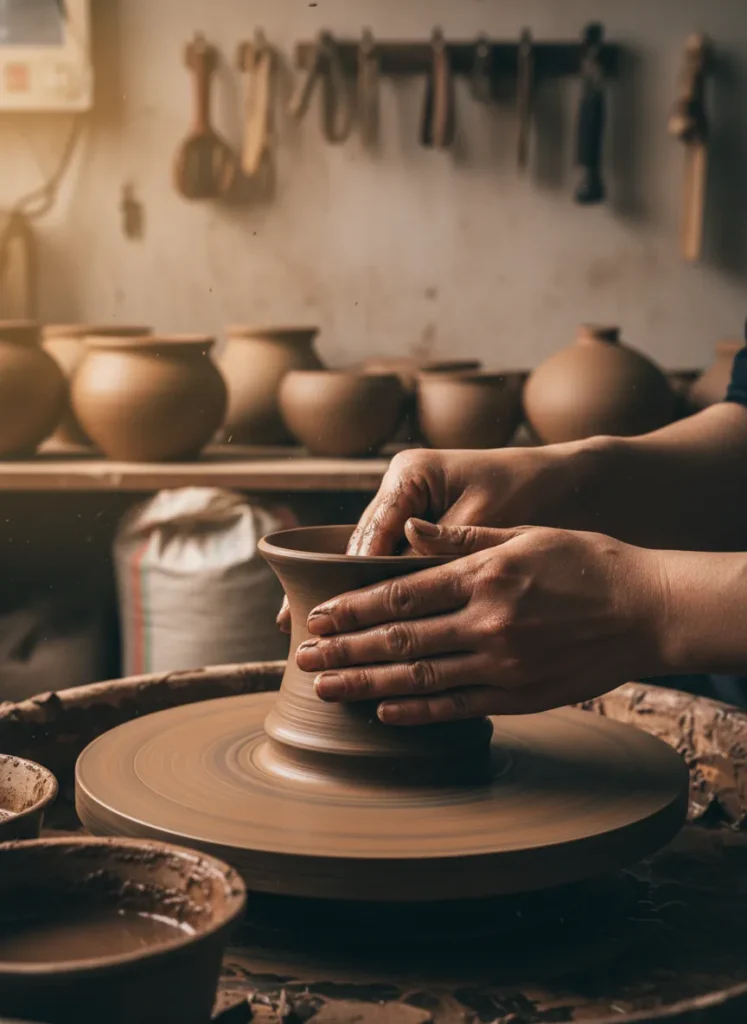
- Shaping on the Wheel: The artisan places a ball of clay on a potter’s wheel and shapes it by hand. A typical Jian Zhan tea cup (80–100 ml capacity) takes 3–5 minutes to form. The thick walls (3–5 mm) are intentional — they provide the heat retention that tea drinkers value.
- Trimming and Modification: After partial drying (2–4 hours), the cup is trimmed on the wheel to refine its shape, clean the foot ring, and adjust the rim. The foot ring is carved to a specific height (5–8 mm) so the cup sits stably during tea ceremonies.
- Drying: The shaped cups air-dry slowly for 1–3 days in a controlled environment. Rapid drying causes cracking. In Jianyang’s humid climate, artisans monitor temperature and humidity carefully — in our experience, rushing this step is the most common reason cups fail before they even reach the kiln.
- Bisque Firing: The dried cups undergo a first firing at 800°C (1470°F) for 6–8 hours. This “bisque” firing hardens the clay enough to handle glaze application without collapsing, while remaining porous enough to absorb the glaze.
The Transformative Fire: Glazing & Kiln Firing (Steps 10–13)
These final four steps are where the magic happens — where iron oxide transforms from dull mineral into shimmering crystals of hare’s fur, oil spot, or yao bian. The kiln is the heart of Jian Zhan, and controlling it is an art that takes decades to master.
- Glaze Preparation and Application: The glaze — a mixture of local iron-rich stone, plant ash, and water — is prepared to a specific viscosity. It is dipped or poured onto the bisque-fired cup, leaving the foot ring unglazed (a hallmark of authentic Jian Zhan). The glaze thickness (1–2 mm) determines which pattern will form: thicker glaze favors oil spot; thinner glaze favors hare’s fur.
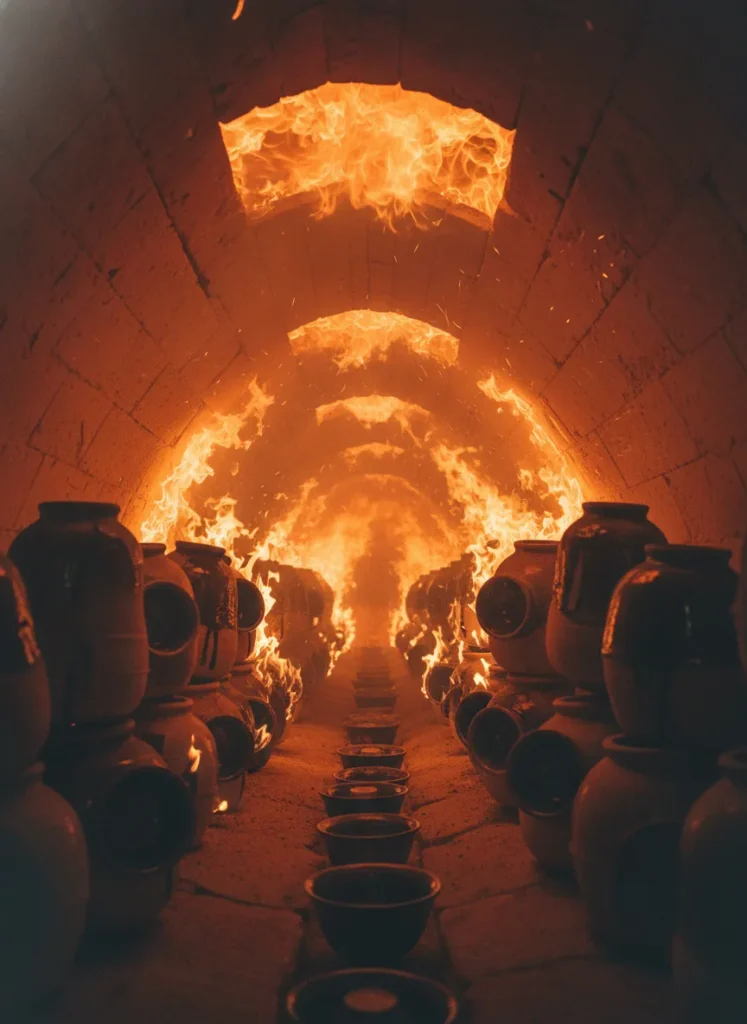
- Loading the Kiln: Cups are placed in saggers (clay containers) to protect them from direct flame and ash. Position inside the kiln is critical — cups near the firebox receive more heat and reduction atmosphere, producing different patterns than those near the chimney. A typical dragon kiln holds 200–500 cups per firing.
- Kiln Firing: The firing lasts 10–14 hours, reaching a peak temperature of 1300°C (2370°F). The kiln master controls the reduction atmosphere — restricting oxygen at critical moments to force iron oxide to release oxygen and crystallize. This is the step where iron-rich glaze transforms: iron oxide crystals grow into hare’s fur streaks, oil spot droplets, or — in the rarest cases — yao bian iridescence. A wood-fired dragon kiln burns 3–5 tons of pine in a single session.
- Cooling and Selection: The kiln cools naturally over 24–48 hours. Opening it too quickly causes thermal shock and cracks. When the kiln is finally opened, the artisan inspects each cup. The yield rate is only 30–50% — meaning fewer than half the cups survive with acceptable patterns. The rest have dull glaze, cracks, or deformities and are discarded. This low yield is a major reason why handmade Jian Zhan carries a higher price than factory-produced alternatives.
| Stage | Steps | Duration | Key Outcome |
|---|---|---|---|
| Clay Preparation | 1–5 | 3–6 months (aging) | Workable, air-free clay with proper iron content |
| Forming | 6–9 | 3–5 days | Bisque-fired cup ready for glaze |
| Glazing & Firing | 10–13 | 2–3 days | Finished cup with crystalline glaze pattern |
💡 Why Handmade Matters: A genuine Jian Zhan’s crystalline glaze patterns — oil spot, hare’s fur, yao bian — form naturally during reduction firing. Machine-made cups use sprayed-on or printed patterns that look similar in photos but lack the depth, iridescence, and living quality of real crystallized iron glaze. If the pattern looks too uniform or “perfect,” it is likely not authentic. For a detailed guide, see our how to identify authentic Tenmoku article.
What Makes This Process Impossible to Mass-Produce
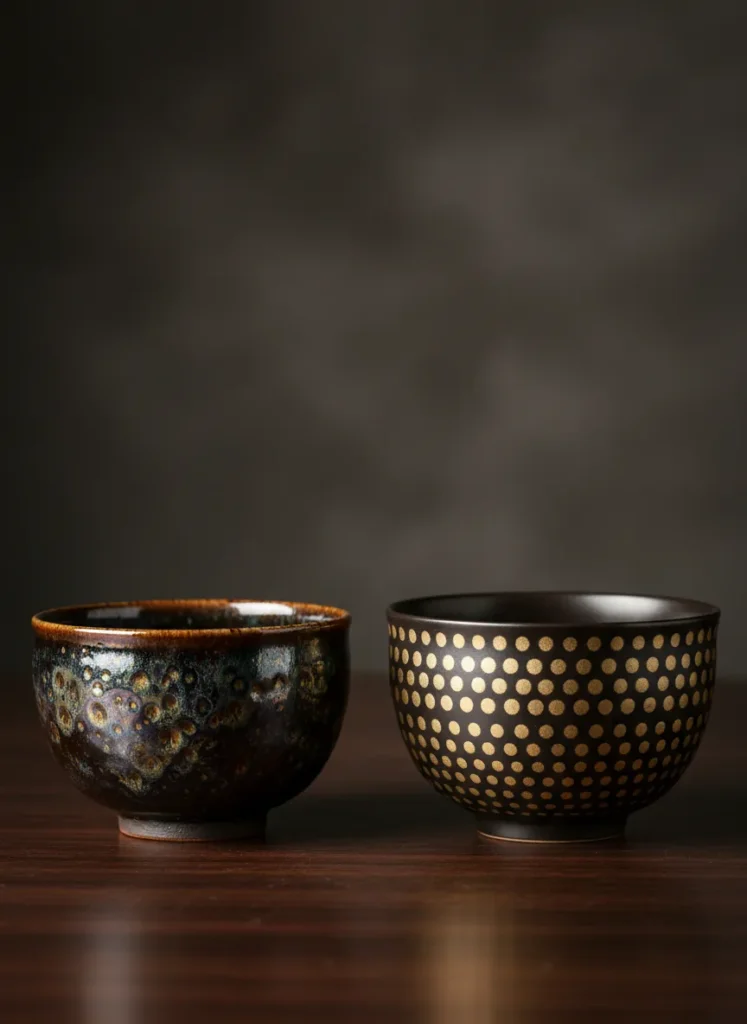
Three factors make Jian Zhan fundamentally different from factory ceramics — and impossible to mass-produce with the same results:
1. The clay cannot be sourced elsewhere. The iron-rich deposits in Jianyang contain a unique combination of iron oxide, silica, and trace minerals that has not been found anywhere else in the world. Kilns in other provinces and countries produce “Tenmoku-style” cups, but they lack the iron content (15–30% FeO) needed for true crystallization.
2. The kiln is unpredictable by design. Each cup’s position inside the kiln — its distance from the firebox, the angle of flame contact, the precise moment oxygen is restricted — determines its pattern. Even the same artisan, using the same clay and glaze, cannot produce two identical cups. This unpredictability is not a flaw; it is the defining feature of wood-fired Jian Zhan.
3. The yield rate is inherently low. With only 30–50% of cups surviving each firing with acceptable patterns, and perhaps 5–10% achieving exceptional oil spot or hare’s fur, the cost per successful cup is high. Factory production eliminates this variability by using sprayed glaze and electric kilns — but it also eliminates the living crystalline quality that makes Jian Zhan valuable.
During our visits to Jianyang, we watched artisans open a kiln after 14 hours of firing and a full day of cooling — only to find that most cups had unremarkable glaze. The few with outstanding patterns were set aside with genuine excitement. That moment of discovery is something you simply cannot replicate in a factory.
How to Tell a Handmade Jian Zhan from a Factory Copy
Understanding the 13-step process gives you a practical advantage: you can identify authentic Jian Zhan by checking for the hallmarks that only this process produces.
| Feature | Handmade (13-Step Process) | Factory Copy |
|---|---|---|
| Glaze Pattern | Natural crystallization — varies across the surface, with depth and iridescence | Sprayed or printed — uniform, flat, no depth under light |
| Foot Ring | Unglazed, rough clay visible, slightly uneven | Often fully glazed or machine-trimmed too perfectly |
| Wall Thickness | 3–5 mm, slight variation (hand-formed) | 1–2 mm, perfectly uniform (slip-cast) |
| Weight | 80–150 g for a standard cup — noticeably heavier | 40–70 g — feels light and hollow |
| Sound When Tapped | Deep, resonant ring (dense stoneware) | High, thin ping (thin porcelain) |
| Price | $50–$500+ for authentic pieces | $10–$30 mass-produced |
Experience the Difference of Authentic Jian Zhan Browse our collection of handcrafted Tenmoku tea cups — each piece made through this exact 13-step process by Jianyang kiln artisans, and shipped worldwide with care. Shop Tea Cups →
❓ Frequently Asked Questions
How long does it take to make a Jian Zhan tea cup?
The full 13-step process takes 3–6 months from raw clay to finished cup, with most of that time spent on clay aging (Step 4). The active shaping and firing stages take about 1–2 weeks. Each kiln firing lasts 10–14 hours plus 24–48 hours of cooling.
Why do so many cups fail during firing?
The extreme temperatures (1300°C/2370°F) and reduction atmosphere needed for crystalline patterns also cause high failure rates. Cracking, glaze running, deformation, and unremarkable patterns mean only 30–50% of cups survive each firing with acceptable quality — and just 5–10% achieve exceptional patterns.
Can Jian Zhan be made outside of Jianyang?
Other regions produce “Tenmoku-style” cups, but they lack Jianyang‘s unique iron-rich clay (15–30% FeO). Without this specific mineral composition, the glaze cannot form the same depth of crystallization. Genuine Jian Zhan is defined by its clay origin — similar to how true Champagne must come from the Champagne region of France.
What is the difference between wood-fired and electric-fired Jian Zhan?
Wood-fired Jian Zhan uses traditional dragon kilns with natural reduction atmosphere, producing more varied and organic patterns. Electric kilns offer precise temperature control but create more uniform results. The most prized cups — including Japan’s National Treasures — are all wood-fired. Learn more in our related guides.
❓ How can I tell if my Jian Zhan was wood-fired or electric-fired?
Wood-fired pieces typically show subtle variations in glaze color and pattern that electric-fired pieces lack. Look for slight asymmetry in the pattern distribution, ash deposits on the foot ring, and a warmer, more organic feel to the metallic luster. The handmade tenmoku identification guide provides detailed visual comparisons.
❓ Are wood-fired Jian Zhan worth the higher price?
If you are a serious tea enthusiast or collector, yes. The reduction atmosphere in wood firing creates deeper, more complex glaze patterns that you simply cannot achieve in an electric kiln. The handmade vs mass-produced comparison explains the value difference in detail.
❓ What tea pairs best with Jian Zhan?
Oolong and aged pu-erh are the classic choices. The iron-rich clay smooths tannins and enhances aroma. The tenmoku-pu-erh pairing guide explains the chemistry behind this complementarity. – Metropolitan Museum – ScienceDirect – V&A Museum
📚 References
- Jian Ware and Song Dynasty Ceramics: Overview of Jian kiln technology and its significance in Chinese ceramic history. The Metropolitan Museum of Art
- Traditional Ceramic Firing Techniques: Documentation of reduction firing and its effects on iron-rich glazes. Source: Freer Gallery of Art, Smithsonian Institution (You may search the institution’s website for current resources)
- Ceramic Foodware Safety Standards: Guidance on lead and cadmium safety for imported stoneware. U.S. FDA
Want to experience the difference a tenmoku cup makes? Shop the Zen Tea Cup collection and find your perfect match.


