

Contents
- What Does “Rabbit Hair” Mean in Jianzhan Tianmu?
- How Rabbit Hair Patterns Form Inside the Kiln
- Types of Rabbit Hair: Gold, Silver, and Blue
- Rabbit Hair vs. Other Jian Zhan Patterns
- The Cultural Significance of Rabbit Hair in Song Dynasty Tea Culture
- Rabbit Hair Tenmoku in Japanese Tea Tradition
- How to Identify Authentic Rabbit Hair Jian Zhan
- ❓ Frequently Asked Questions About Rabbit Hair Jian Zhan
- ❓ Is rabbit hair the same as hare’s fur in Tenmoku?
- ❓ Why is blue rabbit hair the most valuable variant?
- ❓ Can electric kilns produce rabbit hair patterns?
- ❓ How should I care for a rabbit hair Jian Zhan bowl?
- 📚 References
What Does “Rabbit Hair” Mean in Jianzhan Tianmu?
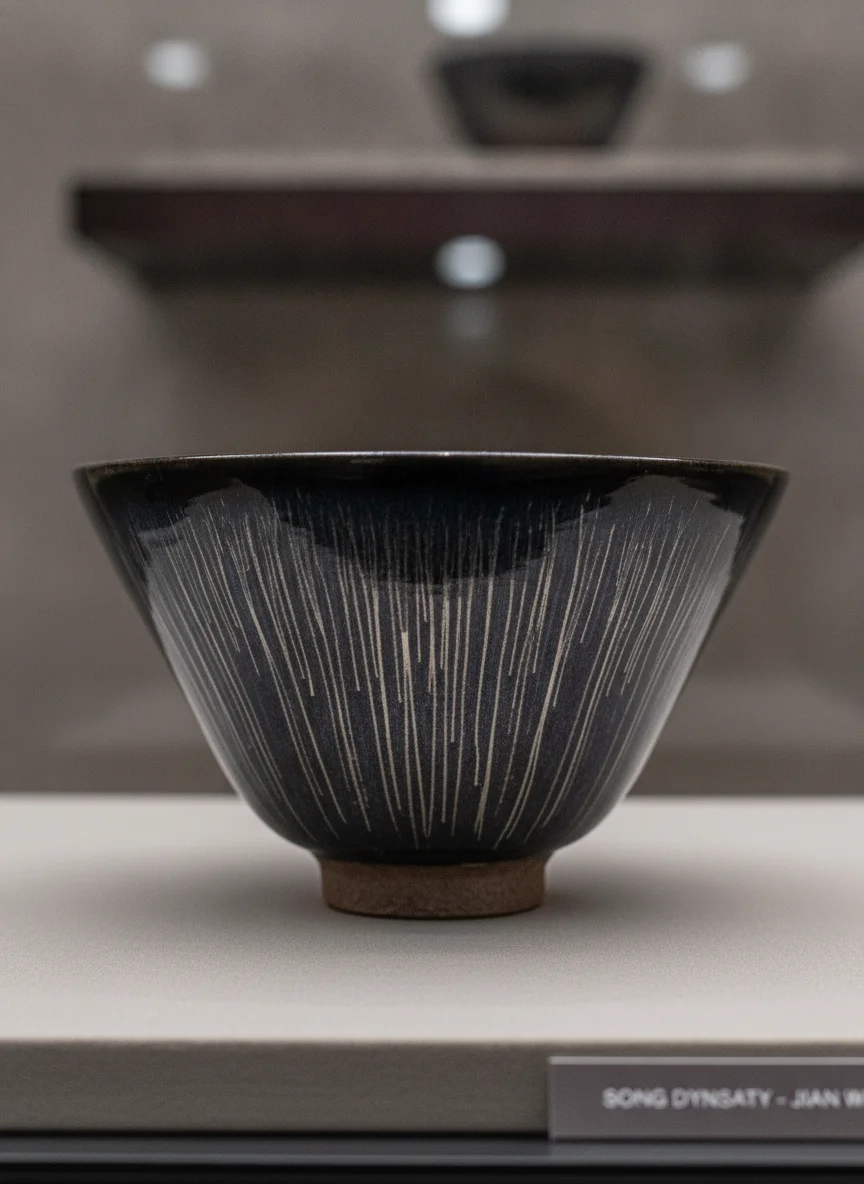
“Rabbit hair” (兔毫, tu hao in Chinese, togu in Japanese) is the most iconic and widely recognized glaze pattern on Jian Zhan — the iron-rich stoneware fired in the dragon kilns of Jianyang, Fujian, during the Song Dynasty (960–1279 CE). The pattern consists of fine, parallel streaks running vertically down the interior of the bowl, resembling the soft, silky fur of a rabbit. At potalastore, we consider rabbit hair the foundational pattern of Jian Zhan art — understanding its meaning is essential for every tea lover. at Zen Tea Cup
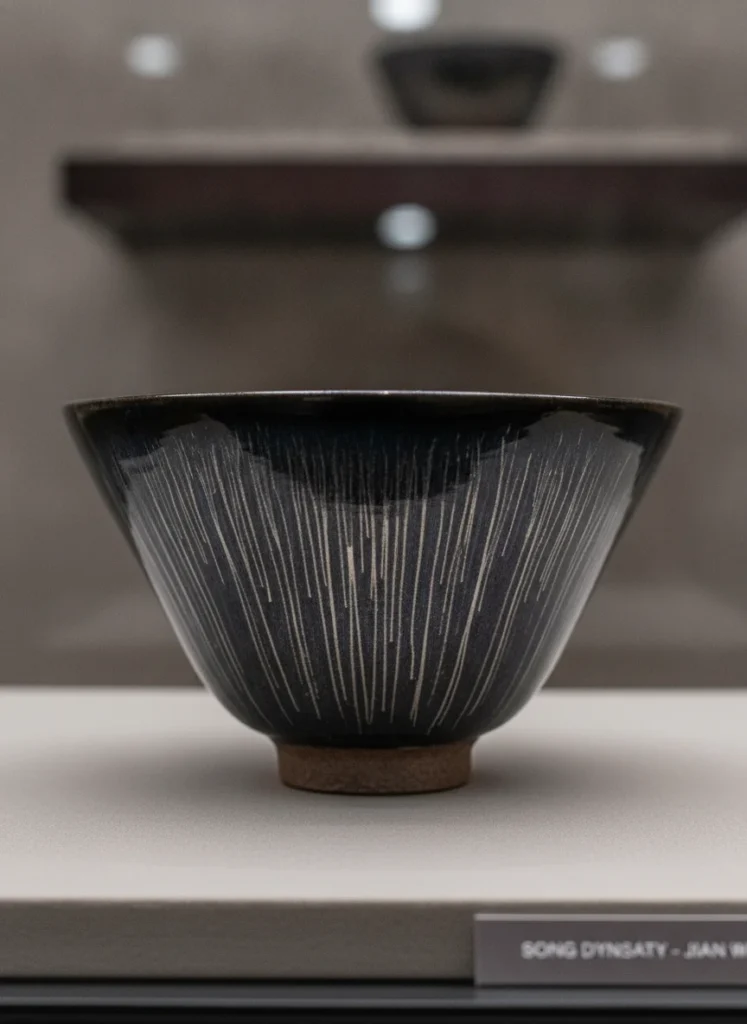
The meaning of the name is both descriptive and poetic: when you hold a rabbit hair Jian Zhan under light, the fine metallic lines catch the light and shimmer like the individual hairs of a rabbit’s coat. In Japanese tea culture, the pattern is called togu (兔毫), using the same Chinese characters, and hare’s fur Tenmoku bowls have been treasured in Japan since the Kamakura period (1185–1333 CE).
Historical records from the Song Dynasty rank rabbit hair as the most common of the three major Jian Zhan patterns, but “common” is relative — even rabbit hair bowls required extraordinary skill to produce. The Song Dynasty text Cha Lu (茶录) by Cai Xiang specifically praised Jian Zhan with rabbit hair patterns for tea competition, noting that the dark glaze and fine streaks provided the perfect visual contrast for the white froth of whisked tea.
You can display your tenmoku collection as stunning decor when not in use.
How Rabbit Hair Patterns Form Inside the Kiln
The formation of rabbit hair patterns is a remarkable process that depends on the interaction between gravity, iron-rich glaze, and precise kiln conditions:
- Iron-rich glaze application — Jian Zhan glaze contains 15–30% iron oxide (FeO), far higher than most ceramic glazes. This iron is the raw material for all Jian Zhan patterns.
- High-temperature firing — The bowl is fired to approximately 1300°C (2372°F) in a reduction atmosphere inside a dragon kiln. At this temperature, the iron melts into the glaze and becomes mobile.
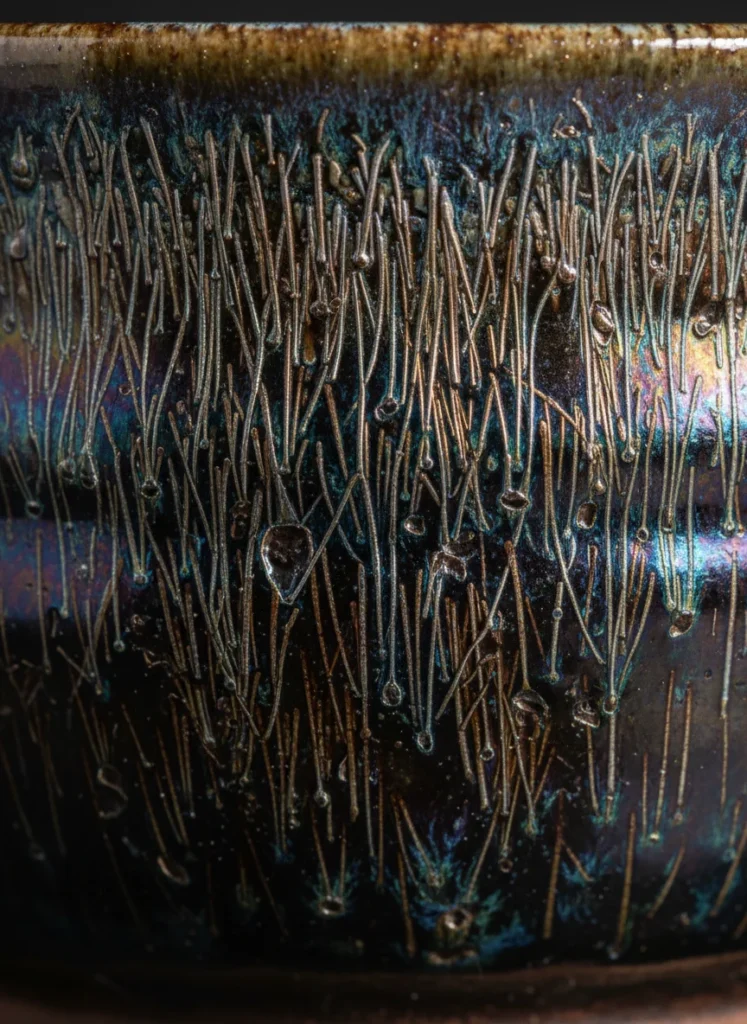
- Gravity-driven flow — As the glaze melts, the iron-rich component flows downward under gravity along the interior walls of the bowl. This downward flow creates the characteristic vertical streaks.
- Crystallization during cooling — As the kiln cools, the iron oxide in these flowing streaks crystallizes, forming the fine metallic lines that define the rabbit hair pattern. The spacing, clarity, and color of the lines depend on the cooling rate, the glaze thickness, and the local atmosphere around each bowl.
The key difference between rabbit hair and oil spot patterns is the formation mechanism: rabbit hair forms through gravity-driven flow (creating linear streaks), while oil spots form through phase separation and pooling (creating round droplets). This is why rabbit hair streaks always run vertically — they follow the direction of gravity during the firing.
Types of Rabbit Hair: Gold, Silver, and Blue
Within the rabbit hair category, collectors distinguish several subtypes based on the color and quality of the streaks:
| Type | Chinese Name | Appearance | Rarity |
|---|---|---|---|
| Gold rabbit hair | 金兔毫 (jin tu hao) | Warm golden-amber streaks with metallic luster | Rare |
| Silver rabbit hair | 银兔毫 (yin tu hao) | Cool silvery-white streaks, bright metallic reflection | Uncommon |
| Blue rabbit hair | 蓝兔毫 (lan tu hao) | Streaks with blue-purple iridescent halos | Very rare |
| Yellow rabbit hair | 黄兔毫 (huang tu hao) | Yellowish-brown streaks, less metallic | Common |
The color difference comes from the thickness and crystal structure of the iron oxide streaks. Gold rabbit hair forms when the crystallized layer is thin enough to allow warm-toned light interference. Silver rabbit hair results from a thicker crystallized layer that reflects cool white light. Blue rabbit hair — the rarest and most prized — shows thin-film interference effects similar to those seen in Yohen Tenmoku, where the streaks display blue-purple halos that shift with the viewing angle.
You should know that the color is not determined by adding different pigments — all rabbit hair patterns come from the same iron-rich glaze. The variation is entirely due to differences in kiln temperature, atmosphere, and cooling rate, which is why a single firing can produce multiple colors of rabbit hair on different bowls.
Rabbit Hair vs. Other Jian Zhan Patterns
Understanding how rabbit hair differs from other patterns helps you identify and appreciate each type: A gongfu tea session typically uses 5–8 g of tea leaves per 100 ml.
- Rabbit hair vs. oil spot — Rabbit hair shows fine vertical streaks (gravity-driven flow), while oil spots show round metallic droplets (phase separation pooling). Rabbit hair is more common; oil spots are rarer and generally more valuable.
- Rabbit hair vs. partridge spots — Rabbit hair streaks are linear and continuous, while partridge spots are small, discrete round dots (1–3 mm). Partridge spots are far rarer than rabbit hair.
- Rabbit hair vs. Yohen (曜变) — Yohen Tenmoku is the rarest of all Jian Zhan patterns, showing circular halos of iridescent color around dark spots. While rabbit hair may show some iridescence in the blue variant, Yohen displays a completely different structural pattern that is orders of magnitude rarer.
Historical Song Dynasty records ranked the three major Tenmoku patterns by value: rabbit hair at 3,000 pieces, oil drop at 5,000, and Yohen at 10,000 — reflecting the relative rarity and difficulty of producing each pattern.
The Cultural Significance of Rabbit Hair in Song Dynasty Tea Culture
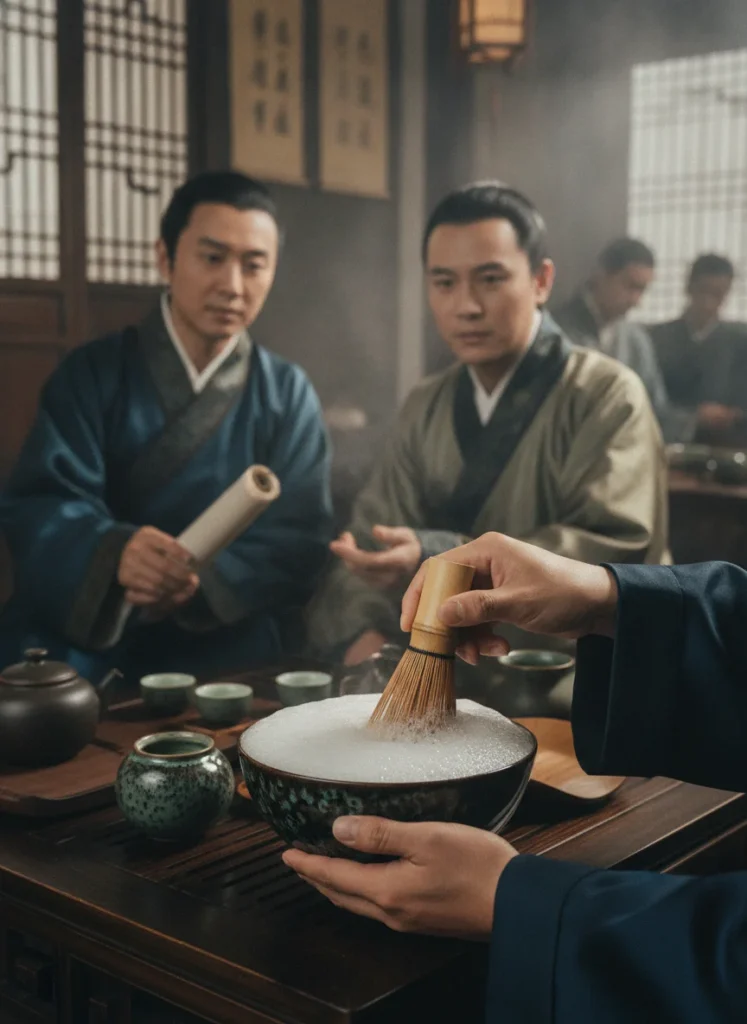
During the Song Dynasty, tea was prepared by whisking powdered tea into a frothy brew — a method that later evolved into Japanese matcha preparation. The Song Dynasty tea competition (斗茶, dou cha) was a popular social activity where participants judged the quality of tea by the color and persistence of the white froth.
Jian Zhan bowls with rabbit hair patterns were the preferred vessels for these competitions for a specific reason: the dark glaze provided maximum visual contrast against the white tea froth, and the fine metallic streaks added a shimmering backdrop that made the froth appear even more brilliant. The Song Dynasty emperor Huizong himself wrote in Daguan Cha Lun (大观茶论) that “Jian Zhan with rabbit hair streaks is the most desirable for tea” — an imperial endorsement that cemented the pattern’s prestige.
The history of Jian Zhan is inseparable from the history of Chinese tea culture, and rabbit hair patterns represent the most direct link between ceramic artistry and tea practice.
Rabbit Hair Tenmoku in Japanese Tea Tradition
When Japanese monks and merchants brought Jian Zhan bowls back from China, rabbit hair pieces were among the most commonly imported — but “common” Song Dynasty Jian Zhan was still extraordinary by any standard. In Japan, these bowls became known as togu tenmoku (兔毫天目), and they played a central role in the development of the Japanese tea ceremony.
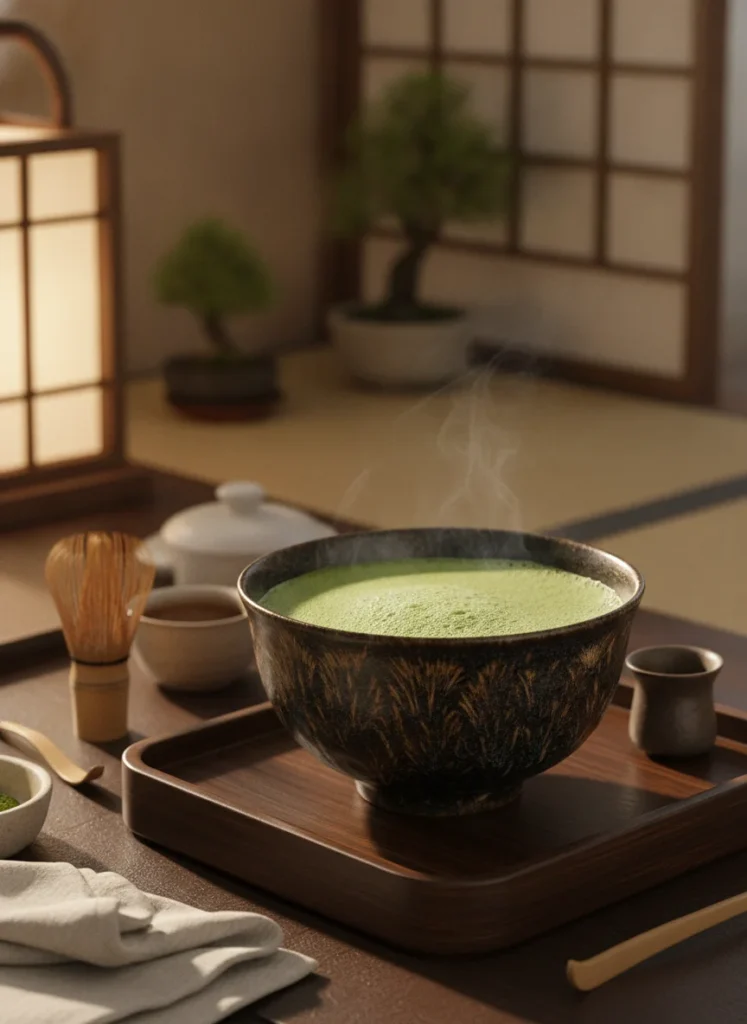
The Yale University Art Gallery houses a celebrated hare’s fur tea bowl from the Southern Song Dynasty, described as having “an iridescent surface with a silvery pattern” that resulted from crystallization during the cooling phase. This bowl exemplifies the finest quality of Song Dynasty rabbit hair — streaks that are not merely decorative but seem to glow from within the glaze.
The connection between Tenmoku and Japanese tea culture continues today. Modern Japanese tea practitioners value rabbit hair bowls for their wabi-sabi aesthetic, where the natural, uncontrollable variation in the streaks embodies the Zen principle of finding beauty in imperfection.
How to Identify Authentic Rabbit Hair Jian Zhan
With the popularity of Jian Zhan has come a market full of imitations. Here are the key markers you should check:
- Directional flow — Authentic rabbit hair streaks always flow downward (following gravity during firing). Streaks that go sideways, upward, or appear random are likely painted on.
- Metallic luster — Real rabbit hair streaks have a metallic sheen that catches light. Under direct light, the streaks should shimmer with silver, gold, or blue reflections. Painted streaks appear flat and matte.
- Natural variation — The streaks should vary in thickness, spacing, and intensity across the bowl. Perfectly uniform, evenly spaced lines are a sign of mechanical application.
- Iron-rich body — The bowl’s clay body should be dark, heavy, and slightly magnetic due to high iron content. Lightweight, pale-bodied bowls are not authentic Jian Zhan.
- Depth within glaze — Authentic streaks emerge from within the glaze, not on top of it. When you tilt the bowl, the streaks should show depth and interaction with the surrounding glaze layer.
If you are considering purchasing a rabbit hair Jian Zhan, buy from reputable kiln masters or established dealers. The handcrafted tea cups in our collection at potalastore are sourced directly from Jianyang kiln masters who continue the Song Dynasty tradition.
❓ Frequently Asked Questions About Rabbit Hair Jian Zhan
❓ Is rabbit hair the same as hare’s fur in Tenmoku?
Yes. “Rabbit hair” and “hare’s fur” refer to the same glaze pattern — fine vertical streaks on a dark glaze. The Chinese term is 兔毫 (tu hao), and the Japanese term is togu (兔毫). English speakers use both “rabbit hair” and “hare’s fur” interchangeably.
❓ Why is blue rabbit hair the most valuable variant?
Blue rabbit hair displays thin-film interference effects that create blue-purple iridescent halos around the streaks. This optical phenomenon requires an extremely precise combination of glaze thickness, cooling rate, and atmospheric conditions — making it far rarer than gold or silver variants. The blue iridescence is structurally similar to what you see in Yohen Tenmoku, the rarest of all Jian Zhan patterns.
❓ Can electric kilns produce rabbit hair patterns?
Yes, modern electric kilns can produce rabbit hair patterns, but the results differ from wood-fired pieces. Electric kiln rabbit hair tends to be more regular and uniform, while wood-fired pieces show the organic variation and occasional iridescence that collectors prize. The reducing atmosphere in wood-fired kilns also produces richer, more varied colors.
❓ How should I care for a rabbit hair Jian Zhan bowl?
Avoid sudden temperature changes, never use in a microwave or dishwasher, and clean with warm water and a soft cloth. The rabbit hair pattern is crystallized within the glaze and will not fade. Regular tea brewing enhances the bowl’s luster through a process called yang hu (养壶), where tea oils gradually build a warm patina on the surface.
📚 References
Cai Xiang, Cha Lu (茶录, Record of Tea), Song Dynasty, c. 1049–1053 CE.
Emperor Huizong, Daguan Cha Lun (大观茶论, Treatise on Tea), Song Dynasty, 1107 CE.
Robert D. Mowry, Hare’s Fur, Tortoiseshell, and Partridge Feathers: Chinese Brown- and Black-Glazed Ceramics, 400–1400, Harvard Art Museums, 1996.
Yale University Art Gallery, “Tea Bowl with Hare’s Fur Design,” Southern Song Dynasty, accession record.
Updated June 2026. Research on Jian Zhan glaze crystallization continues, with new analytical techniques providing deeper understanding of the iron oxide flow and phase separation mechanisms.
Ready to experience the beauty of rabbit hair Jian Zhan for yourself? Explore our curated collection at potalastore — where Song Dynasty tradition meets your daily tea practice. Most tenmoku cups measure 8–12 cm (3.1–4.7 inches) in diameter.


