

Contents
- What Does “Oil Drop” Mean in Jianzhan Tenmoku?
- How Oil Drop Patterns Form Inside the Kiln
- Oil Drop vs. Other Jian Zhan Glaze Patterns
- Golden Oil Spot vs. Silver Oil Spot — What Makes the Difference?
- The Record-Breaking Value of Oil Spot Jian Zhan
- Oil Spot Tenmoku in Japanese Tea Culture
- How to Identify Authentic Oil Spot Jian Zhan
- ❓ Frequently Asked Questions About Oil Drop Jian Zhan
- ❓ Is “oil drop” the same as “oil spot” in Jian Zhan?
- ❓ Why did an oil spot Jian Zhan sell for $11.7 million?
- ❓ Can modern kilns produce oil spot patterns?
- ❓ How should I care for an oil spot Jian Zhan bowl?
- 📚 References
What Does “Oil Drop” Mean in Jianzhan Tenmoku?
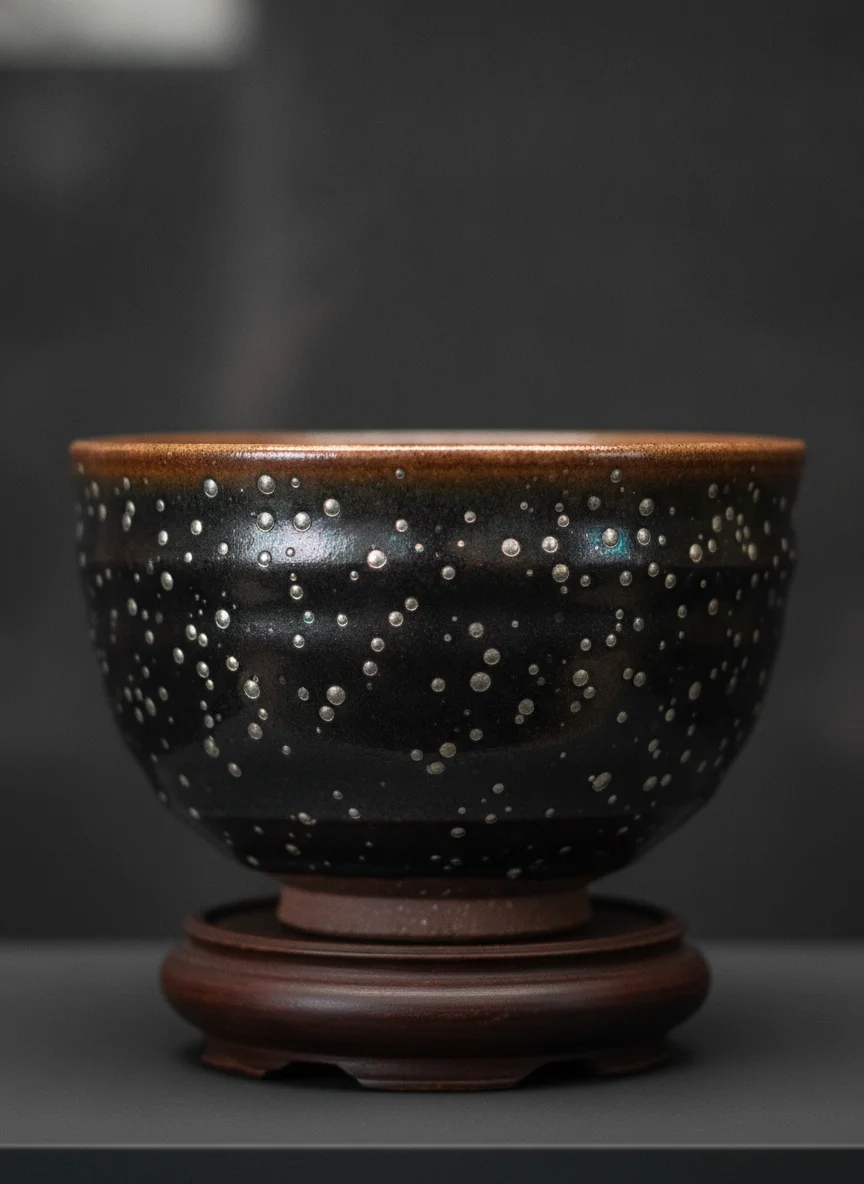
In the world of Jian Zhan — the iron-rich stoneware fired in the dragon kilns of Jianyang, Fujian, during the Song Dynasty (960–1279 CE) — “oil drop” (油滴, yuteki in Japanese) refers to one of the most prized and visually striking glaze patterns: round, metallic spots scattered across a dark glaze surface, shimmering with silver, gold, or iridescent halos. At potalastore, we consider the oil drop pattern one of the defining achievements of Chinese ceramic art, and understanding it is essential for anyone who appreciates Tenmoku teaware. at Zen Tea Cup
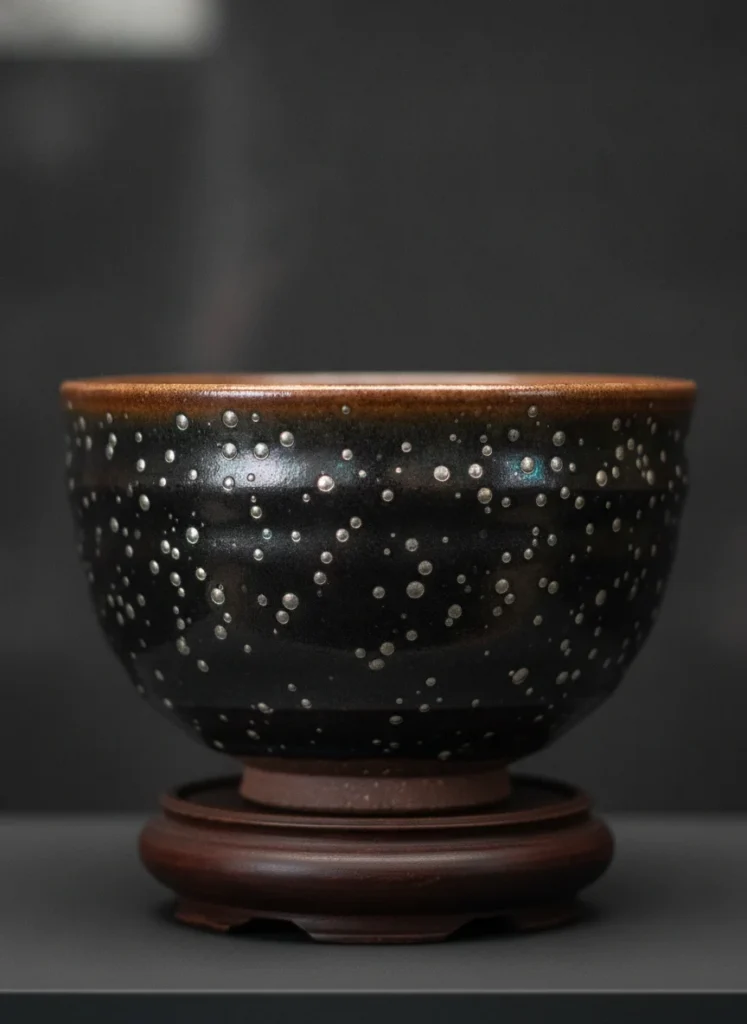
The name comes from the pattern’s resemblance to droplets of oil floating on water. In Japanese tea culture, the term yuteki (油滴) carries the same meaning, and oil spot Tenmoku bowls have been treasured in Japan since the Kamakura period (1185–1333 CE). Historical records from 1511 state that oil spot bowls were valued at 5,000 bolts of silk — an extraordinary sum that reflects their rarity and cultural significance even then.
What makes oil drop patterns so special is not just their beauty but their origin: each spot is a natural crystallization of iron oxide that forms during the kiln’s cooling phase, a process that cannot be fully controlled. No two oil spot bowls are alike, and the finest examples display a mesmerizing interplay of light and color that changes with every angle.
You deserve a tea experience that goes beyond the ordinary cup.
How Oil Drop Patterns Form Inside the Kiln
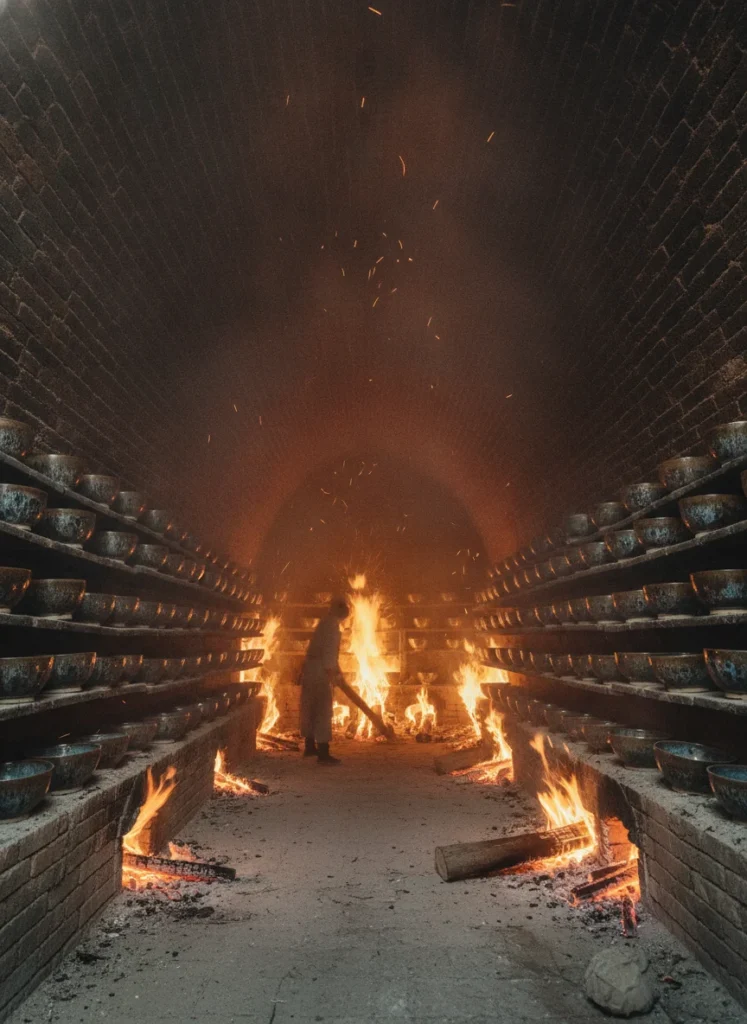
The formation of oil drop patterns is a remarkable demonstration of materials science at work inside a traditional wood-fired kiln. Here is the step-by-step process:
- Iron-rich glaze application — Jian Zhan glaze contains 15–30% iron oxide (FeO), far higher than most ceramic glazes. This iron is the raw material for all Jian Zhan patterns, including oil spot, hare’s fur, and the rarer partridge spots.
- High-temperature firing — The bowl is fired to approximately 1300°C (2372°F) in a reduction atmosphere inside a dragon kiln. At this temperature, the iron melts into the glaze and becomes evenly distributed.
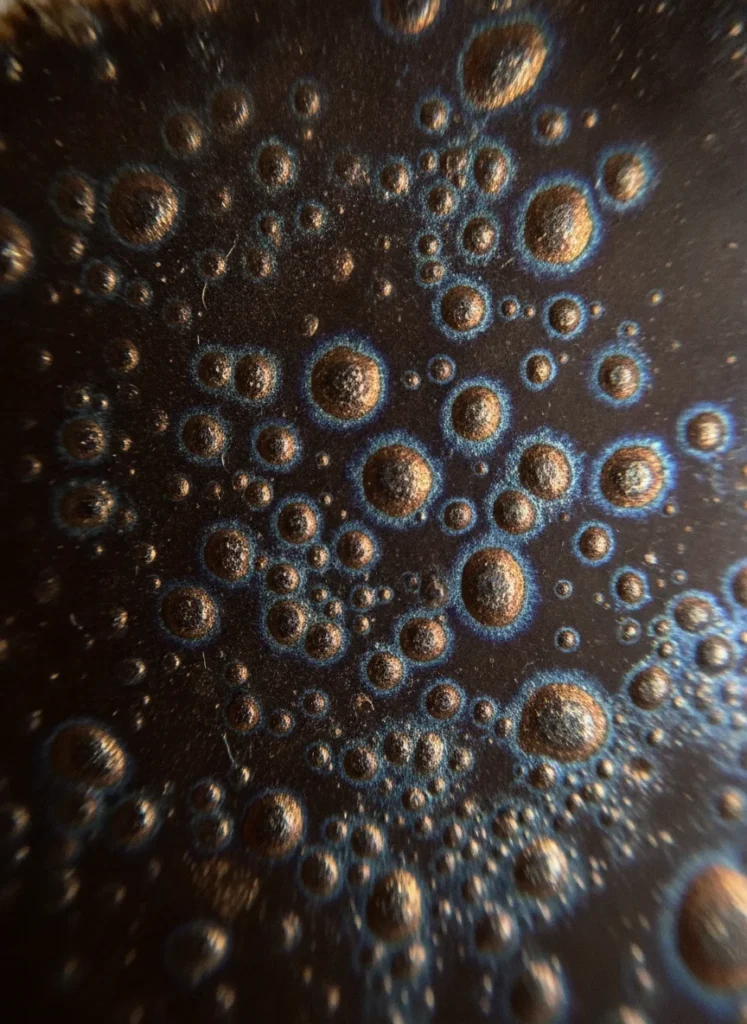
- Phase separation during cooling — As the kiln cools, the iron-rich glaze undergoes a process called liquid-liquid phase separation. The iron oxide separates from the base glaze and pools into distinct droplets on the surface.
- Crystallization of the droplets — These iron-rich pools crystallize as the temperature continues to drop, forming the round, metallic spots that characterize the oil drop pattern. The size and distribution of the spots depend on the cooling rate, the local atmosphere around each bowl, and the glaze composition.
The critical factor is the cooling phase. If the kiln cools too quickly, the iron does not have time to pool and crystallize — you get a plain black glaze. If it cools too slowly, the droplets merge into larger, less defined patches. The sweet spot that produces perfect oil drop patterns is narrow, which is why even in the Song Dynasty, oil spot bowls were rare compared to the more common hare’s fur and other Tenmoku patterns.
Oil Drop vs. Other Jian Zhan Glaze Patterns
Understanding how oil drop differs from other Jian Zhan patterns helps you identify and appreciate each type:
| Feature | Oil Spot (Yuteki) | Hare’s Fur (Togu) | Partridge Spots (Zhegu Ban) |
|---|---|---|---|
| Appearance | Round metallic droplets, 3–8 mm | Thin linear streaks running down | Small discrete dots, 1–3 mm |
| Formation | Iron pooling and phase separation | Iron flowing under gravity | Surface crystallization during slow cooling |
| Light response | Metallic iridescence, blue-purple halos | Subtle metallic sheen along streaks | Silvery-white shimmer |
| Rarity | Rare | Relatively common | Extremely rare |
| Most valued variant | Golden oil spot | Silver hare’s fur | Song Dynasty pieces only |
The key distinction you will notice is shape: oil spots are round droplets, hare’s fur is linear streaks, and partridge spots are smaller, more uniformdots. The difference in formation mechanism — pooling versus flowing versus crystallizing — is what creates these distinct visual signatures.
Golden Oil Spot vs. Silver Oil Spot — What Makes the Difference?
Within the oil drop category, collectors distinguish between two major subtypes based on the color of the metallic spots:
- Silver oil spot (银油滴) — The most common variant, where the spots reflect silvery-white light. The crystallized iron oxide forms hematite (Fe₂O₃) with a silvery metallic luster. Silver oil spots are more frequently seen in both antique and modern Jian Zhan.
- Golden oil spot (金油滴) — Considerably rarer, these spots reflect warm golden or amber light. The golden color results from a thinner layer of crystallized iron oxide that allows the underlying dark glaze to show through, creating a warm-toned reflection. Some golden oil spots also show traces of epsilon-Fe₂O₃, a rare iron oxide polymorph that produces a distinctive reddish-gold shimmer.
The difference between silver and golden oil spots is not due to different ingredients — both come from the same iron-rich glaze. Instead, the color depends on the thickness of the crystallized layer, which is determined by the cooling rate and the local atmosphere in the kiln. This is why a single firing can produce both silver and golden spots on different bowls, or even on different areas of the same bowl.
The Record-Breaking Value of Oil Spot Jian Zhan
Oil spot Jian Zhan bowls are among the most valuable ceramics in the world. The most famous example is the “Oil Spot Tenmoku” bowl from the Southern Song Dynasty that sold at Sotheby’s in New York on September 15, 2016, for $11.7 million USD — setting the world auction record for any Chinese ceramic from the Song Dynasty.
This extraordinary value reflects several factors:
- Extreme rarity — Only a handful of Song Dynasty oil spot Jian Zhan bowls survive in museum and private collections worldwide.
- Unrepeatable beauty — The wood-firing process that created the finest oil spot patterns cannot be precisely replicated, even by modern masters.
- Cultural significance — Oil spot bowls were prized by Song Dynasty emperors and later by Japanese shoguns and tea masters, giving them a documented provenance spanning centuries.
- Museum designation — Several oil spot Tenmoku bowls in Japanese collections are designated as National Treasures or Important Cultural Properties, which further elevates the prestige of the pattern.
The 2016 Sotheby’s sale was not an anomaly — earlier auctions had already established oil spot Jian Zhan as the most valuable category of Song Dynasty ceramics. The history of Jian Zhan from imperial kiln to modern auction house is a testament to the enduring power of this ceramic tradition.
Oil Spot Tenmoku in Japanese Tea Culture
When Japanese monks traveled to China during the Song Dynasty, they encountered Jian Zhan bowls in Chan Buddhist monasteries and brought them back as treasured objects. The Japanese tea master Murata Jukō (c. 1423–1502) specifically valued spotted Tenmoku bowls for the wabi-cha style of tea ceremony, where the bowl’s imperfect, natural beauty embodied the Zen aesthetic of finding richness in simplicity.
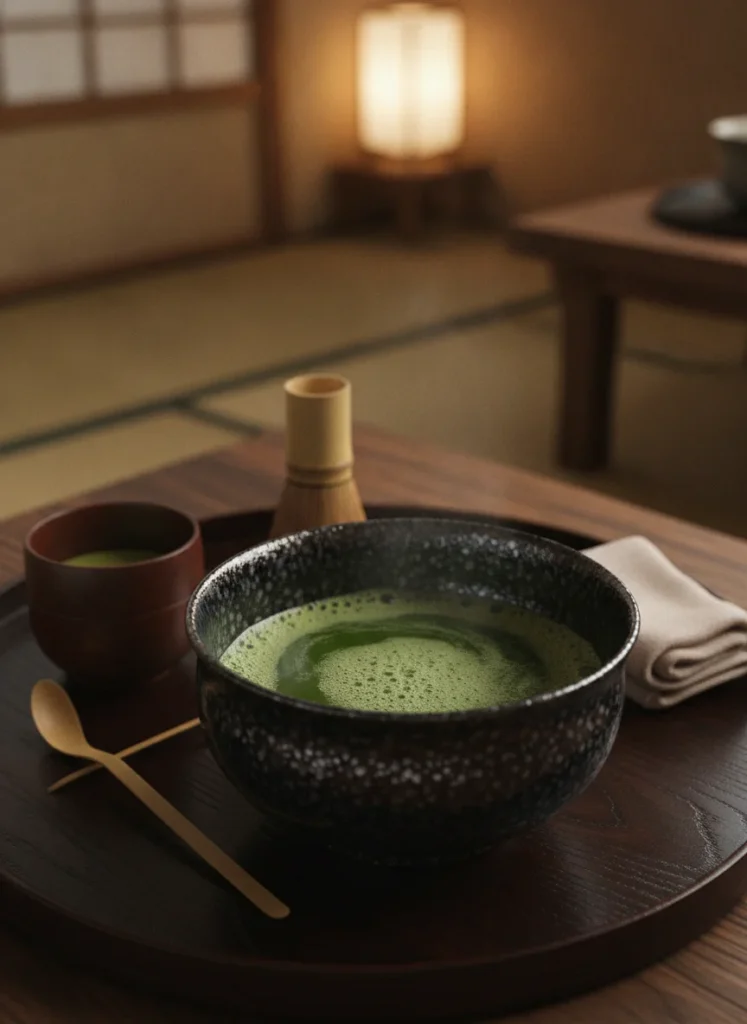
In Japan, oil spot Tenmoku bowls became known as yuteki tenmoku (油滴天目), and the most celebrated example — the Kuroda Family Yuteki Tenmoku — is classified as an Important Cultural Property. This bowl, with its dense field of silvery spots across a lustrous black glaze, represents the pinnacle of what the Song Dynasty kilns could achieve. The foot ring diameter is usually around 3.5 cm (1.4 inches).
The connection between Tenmoku and Japanese tea culture remains strong today. Modern Japanese tea practitioners continue to use oil spot bowls for formal tea gatherings, and the pattern is considered the most prestigious for matcha preparation in the traditional ceremony.
How to Identify Authentic Oil Spot Jian Zhan
With the high value of oil spot Jian Zhan comes a market full of imitations. Here are the key markers you should check:
- Crystal depth — Authentic oil spots are not painted on; they emerge from within the glaze. When you tilt the bowl under light, the spots show depth and interact with the surrounding glaze.
- Natural variation — Real oil spots vary in size, spacing, and intensity across the bowl. Perfectly uniform spots are a sign of mechanical application.
- Iron-rich body — The bowl’s clay body should be dark, heavy, and magnetic due to high iron content. Lightweight, pale-bodied bowls are not authentic Jian Zhan.
- Metallic luster — Under direct light, authentic oil spots display a metallic luster that shifts between silver, gold, and sometimes blue-purple iridescence. This iridescence is caused by thin-film interference within the crystallized iron oxide layer — it cannot be replicated by glaze painting.
- Foot rim texture — The unglazed foot rim shows the dark, iron-rich stoneware body with a slightly rough texture from the kiln floor.
If you are considering purchasing an oil spot Jian Zhan, it is best to buy from reputable kiln masters or established dealers. Prices for authentic modern oil spot pieces typically start at several hundred dollars, while antique Song Dynasty examples — when they appear at auction — command millions.
❓ Frequently Asked Questions About Oil Drop Jian Zhan
❓ Is “oil drop” the same as “oil spot” in Jian Zhan?
Yes. Both terms refer to the same glaze pattern — round metallic spots on a dark glaze. “Oil drop” is the direct English translation of the Chinese term 油滴 (yóudī), while “oil spot” is a common English variation. In Japanese, the pattern is called yuteki (油滴), which also means “oil drop.”
❓ Why did an oil spot Jian Zhan sell for $11.7 million?
The 2016 Sotheby’s sale reflected extreme rarity (only a handful of Song Dynasty oil spot bowls survive), unrepeatable kiln-transformed beauty, and centuries of documented cultural significance in both Chinese and Japanese tea traditions. No two oil spot bowls are alike, and the finest examples display iridescent halos that no modern kiln has been able to fully replicate.
❓ Can modern kilns produce oil spot patterns?
Yes, modern Jianyang kiln masters have successfully revived oil spot firing techniques. However, modern pieces — whether wood-fired or electric-kiln-fired — generally show different characteristics than Song Dynasty originals. Modern oil spots tend to be more regular and less varied in size, while Song Dynasty spots show the organic unpredictability that only centuries of accumulated kiln knowledge could produce.
❓ How should I care for an oil spot Jian Zhan bowl?
Avoid sudden temperature changes, never use in a microwave or dishwasher, and clean with warm water and a soft cloth. The oil spot pattern is embedded in the glaze and will not fade. Regular tea brewing actually enhances the bowl’s luster through a process called yang hu (养壶), where tea oils gradually build a warm patina on the surface.
📚 References
Robert D. Mowry, Hare’s Fur, Tortoiseshell, and Partridge Feathers: Chinese Brown- and Black-Glazed Ceramics, 400–1400, Harvard Art Museums, 1996.
Sotheby’s, “Important Chinese Art” sale, Lot 517, September 15, 2016. Oil Spot Tenmoku Tea Bowl, Southern Song Dynasty.
Chen Xianqiu, “Crystallization Mechanisms in Jian Ware Glazes,” Journal of Chinese Ceramics, Vol. 42, 2014.
Takeshi Nagata, “Optical Properties of Yuteki Tenmoku Glazes,” Journal of the Japanese Society for Scientific Studies on Cultural Properties, 2022.
Updated June 2026. Research on Jian Zhan glaze formation continues, with new analytical techniques revealing further details about the iron oxide crystallization process.
Drawn to the mesmerizing beauty of oil spot patterns? Explore our curated Jian Zhan collection at potalastore — where Song Dynasty tradition meets your daily tea practice.


