

Contents
- Why Tenmoku Glaze Patterns Have Meaning Beyond Beauty
- 1. Hare’s Fur (Tu Hao 兔毫) — The Emperor’s Choice
- 2. Oil Spot (You Di 油滴 / Yuteki) — Fortune Falling from Heaven
- 3. Yao Bian (窯変 Kiln Transformation) — The Beauty of Unpredictability
- 4. Partridge Spot (Zhe Gu Ban 鹧鸪斑) — The Pattern of Distinction
- 5. Mirror Black (Wu Jin 乌金) — The Foundation of Depth
- Which Pattern Speaks to You?
- ❓ Frequently Asked Questions
- ❓ How do I know if my tenmoku cup is authentic?
- ❓ Can I put my tenmoku cup in the dishwasher?
- ❓ What tea tastes best in a tenmoku cup?
- 📚 References
Why Tenmoku Glaze Patterns Have Meaning Beyond Beauty
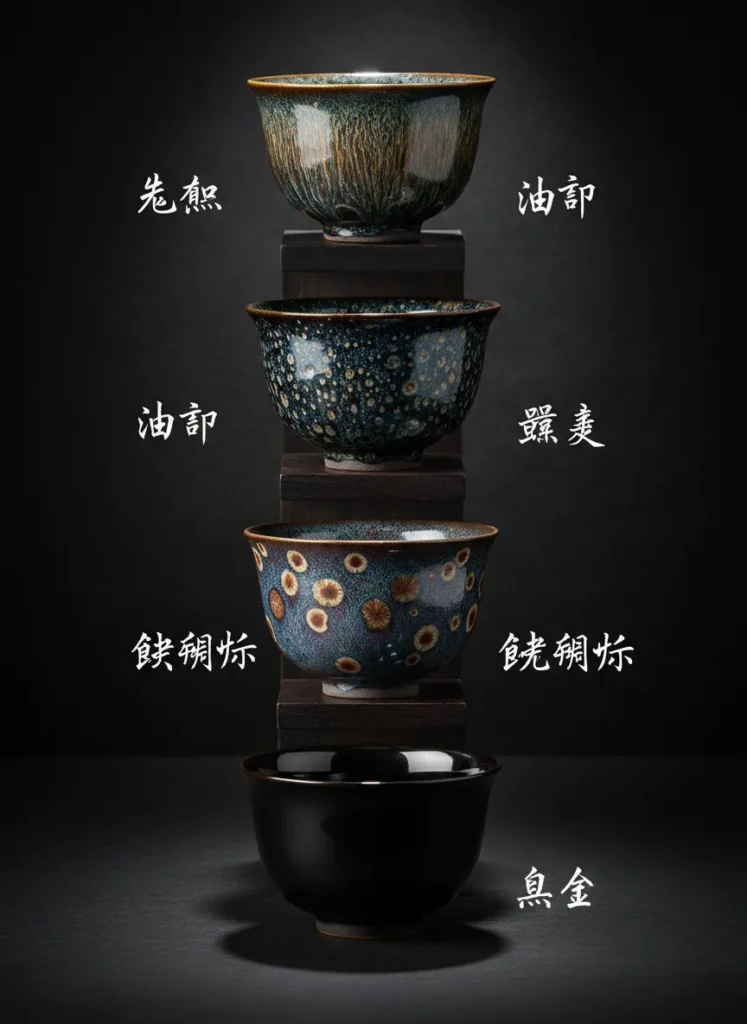
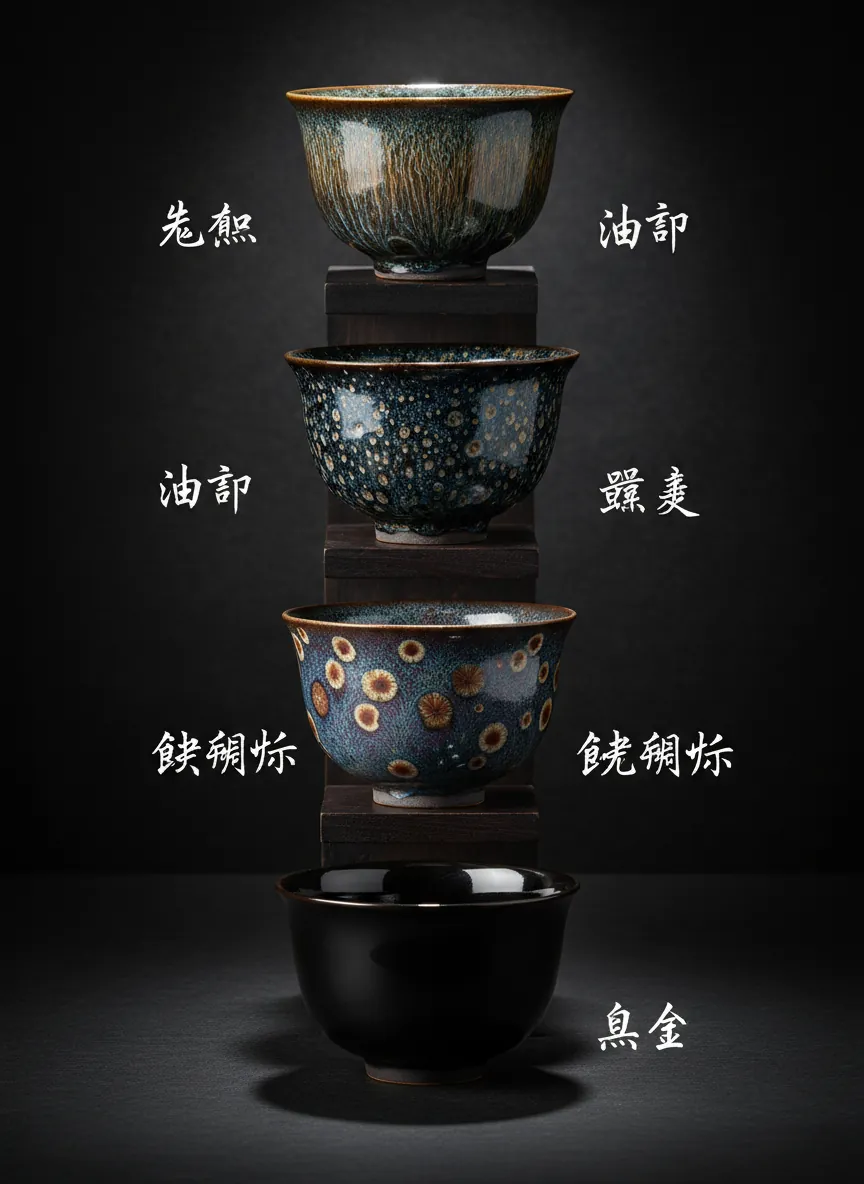
Every Tenmoku glaze pattern carries cultural meaning rooted in centuries of Chinese and Japanese tea tradition — from the hare’s fur pattern that Song Dynasty emperors prized as a sign of refinement, to the yao bian (窯変) “kiln transformation” that represents the unpredictable beauty of nature itself. Understanding these meanings transforms your cup from a beautiful object into a cultural artifact with a story to tell.
At Zen Tea Cup, we believe that knowing what your pattern means makes every sip more meaningful. This guide covers the five most significant Tenmoku glaze patterns — their visual characteristics, how they form, and what they have symbolized across nearly a thousand years of tea culture.
As you use your cup daily, you will notice the glaze becoming richer.
1. Hare’s Fur (Tu Hao 兔毫) — The Emperor’s Choice
Meaning: Refined elegance, scholarly virtue, imperial approval.
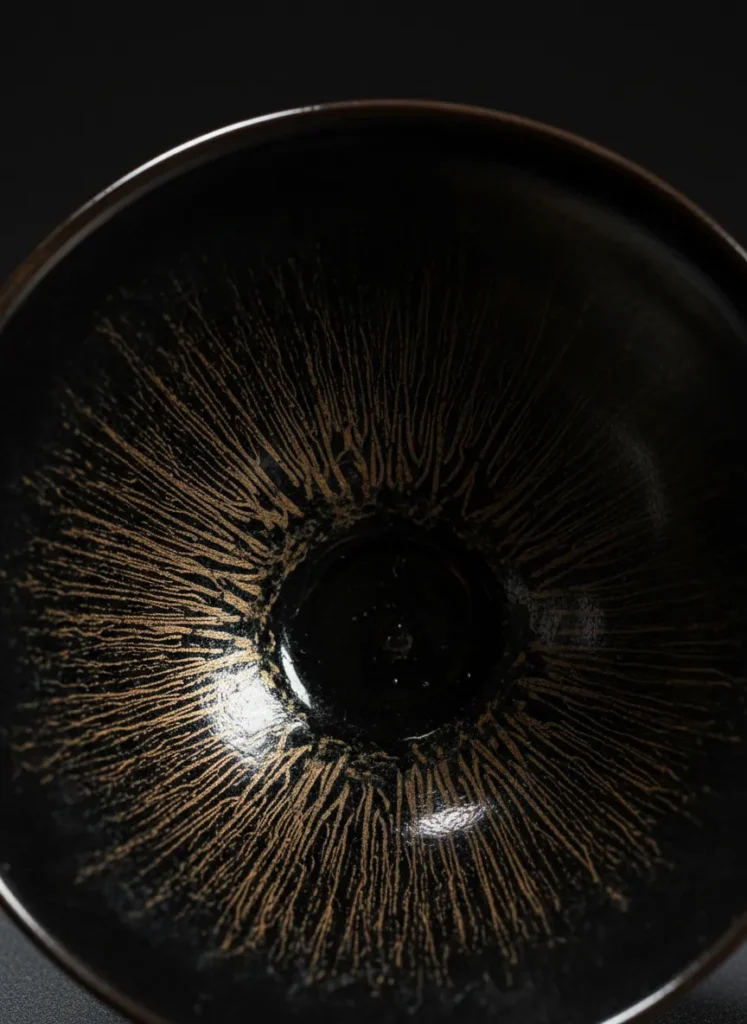
Hare’s fur is the most historically celebrated Tenmoku pattern — fine, hair-like streaks that radiate from the rim of the cup toward the center, ranging in color from golden-bronze to silver-blue. The pattern earned its name because the streaks resemble the fine fur of a hare when viewed up close.
The cultural significance of hare’s fur is unmatched. Emperor Huizong of the Song Dynasty (1082–1135) — himself an accomplished artist and tea master — wrote in his Daguan Chalun (Treatise on Tea): “The best cups are those with hare’s fur patterns, blue-black in color.” This imperial endorsement made hare’s fur the standard against which all Tenmoku cups were judged for centuries.
In Chinese tea culture, the fine, orderly streaks of hare’s fur symbolize scholarly refinement — the disciplined yet graceful character of a learned person. The parallel lines also evoke bamboo, a traditional symbol of integrity and resilience.
Formation: Hare’s fur forms when iron-rich glaze flows downward during firing at 1300°C+. Gravity pulls the molten glaze down the cup’s interior wall, creating parallel trails of iron oxide crystals that solidify into the characteristic streaks. Learn more about this process in our 13-step Jian Zhan making guide.
2. Oil Spot (You Di 油滴 / Yuteki) — Fortune Falling from Heaven
Meaning: Prosperity, good fortune, abundance.
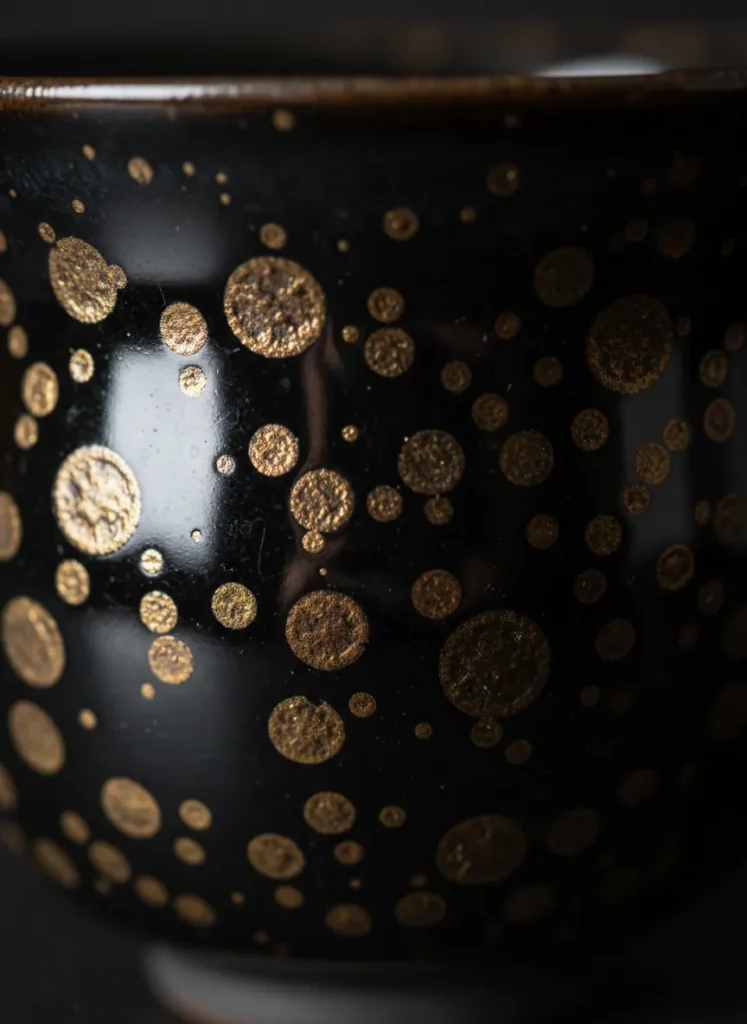
Oil spot is perhaps the most visually dramatic of all Tenmoku patterns — circular or elliptical metallic spots scattered across the black glaze surface, ranging from 1mm to 10mm in diameter. The spots can appear golden, silver, or iridescent depending on the iron crystal structure and viewing angle.
In Chinese culture, the scattered circular spots evoke coins falling from heaven (天降横财), making oil spot cups symbols of prosperity and good fortune. The Japanese name yuteki (油滴) literally means “oil droplets” — referring to how rain falls on a still pond, creating expanding circles that overlap and interact. This metaphor of abundance and natural bounty resonates deeply in both cultures.
The Christie’s auction house has described oil spot as one of the rarest Jian Zhan patterns, noting that “the current bowl is one of only a small group of vessels from these kilns which bear the rare speckled glaze known as ‘oil spot’ in English, yuteki.” Authentic oil spot cups from the Song Dynasty have sold for over $1 million at auction.
Formation: Oil spot forms when iron oxide clusters nucleate at the glaze surface during cooling, growing into discrete circular crystals rather than flowing into streaks. The key variable is glaze viscosity — thicker, more viscous glaze tends to produce oil spots rather than hare’s fur. For a detailed comparison of both patterns, see our Tenmoku glaze patterns guide.
3. Yao Bian (窯変 Kiln Transformation) — The Beauty of Unpredictability
Meaning: Transformation, impermanence, the beauty of nature’s unpredictability.
Yao bian is the rarest and most philosophically significant of all Tenmoku patterns. The name literally translates to “kiln transformation” — the pattern is not intentionally created but emerges through the unpredictable interaction of heat, atmosphere, and materials during firing. Green tea should be brewed at 160–180°F (71–82°C) for 2–3 minutes.
Yao bian cups display iridescent color shifts that change depending on the viewing angle and lighting conditions. The surface may show blues, purples, greens, and golds that seem to shimmer and move as you turn the cup. No two yao bian cups are ever alike — and no potter can guarantee the result.
In both Chinese and Japanese aesthetic philosophy, yao bian embodies the concept of wabi-sabi — finding beauty in imperfection and transience. The pattern’s unpredictability mirrors the Buddhist concept of impermanence (无常): just as the kiln transforms the glaze in ways no you can predict, life itself transforms in ways beyond our control. The Teavivre tea resource describes yao bian as “an accidental colouring change in the kiln which will result unpredictable beautiful color and patterns.”
Formation: Yao bian occurs when multiple glaze reactions happen simultaneously in different areas of the same cup — some areas in reduction, some in oxidation, with varying iron crystal sizes and orientations. This is most likely in wood-fired kilns where the atmosphere fluctuates naturally. Our wood-fired vs electric-fired guide explains why wood firing produces more yao bian effects.
4. Partridge Spot (Zhe Gu Ban 鹧鸪斑) — The Pattern of Distinction
Meaning: Distinction, rarity, scholarly achievement.
Partridge spot features mottled, speckled patterns in silver-gray or brownish tones that resemble the plumage of a partridge bird. The spots are typically smaller and more densely distributed than oil spot, creating a textured, organic surface that feels both rustic and refined.
The pattern takes its name from the Chinese poetic tradition. Cai Xiang (1012–1067), a Song Dynasty scholar and tea master, wrote that the finest tea cups displayed “partridge spots” (鹧鸪斑). In Chinese literary culture, the partridge bird appears in poetry as a symbol of distinction and noble character — a bird that stands apart from the ordinary flock.
Partridge spot cups were historically considered second only to hare’s fur in the Song Dynasty tea hierarchy. Today, they are among the hardest patterns to reproduce consistently, making authentic examples particularly valued by collectors.
Formation: Partridge spot forms through a different crystallization mechanism than oil spot — the iron oxide crystals grow in a dendritic (branch-like) pattern rather than as discrete circles, creating the characteristic mottled, feathery appearance. The Tenmokus blog notes that the term “partridge spot” may have historically overlapped with what we now call oil spot, as “oil spot remained chance occurrences within the wider group of hare’s fur and other iron-rich glaze effects.”
5. Mirror Black (Wu Jin 乌金) — The Foundation of Depth
Meaning: Depth, mystery, the void from which all patterns emerge.
Mirror black is the foundational Tenmoku glaze — a deep, lustrous black surface with a mirror-like sheen that may appear solid at first glance but reveals subtle depth and warmth when held to the light. It is the “blank canvas” from which all other patterns emerge, and some of the finest examples stand on their own as masterful works.
In Chinese philosophy, black represents the Wuji (无极) — the primordial void before creation, the state of infinite potential from which all things emerge. A mirror black Tenmoku cup embodies this concept: beneath its apparently uniform surface lies the potential for any pattern — hare’s fur, oil spot, yao bian — depending on how the kiln conditions shift during firing.
The China Tea Spirit resource classifies mirror black as one of the six classic Jian Zhan glaze patterns, alongside hare’s fur, oil spot, partridge spot, yao bian, and various colored glazes. Mirror black cups are often the starting point for collectors who appreciate understated elegance over dramatic visual effects.
Formation: Mirror black occurs when the iron-rich glaze melts smoothly without significant crystallization at the surface. The deep black color comes from iron oxide in a reduced state (FeO), and the mirror sheen results from a perfectly smooth glaze surface formed during peak temperature.
Which Pattern Speaks to You?
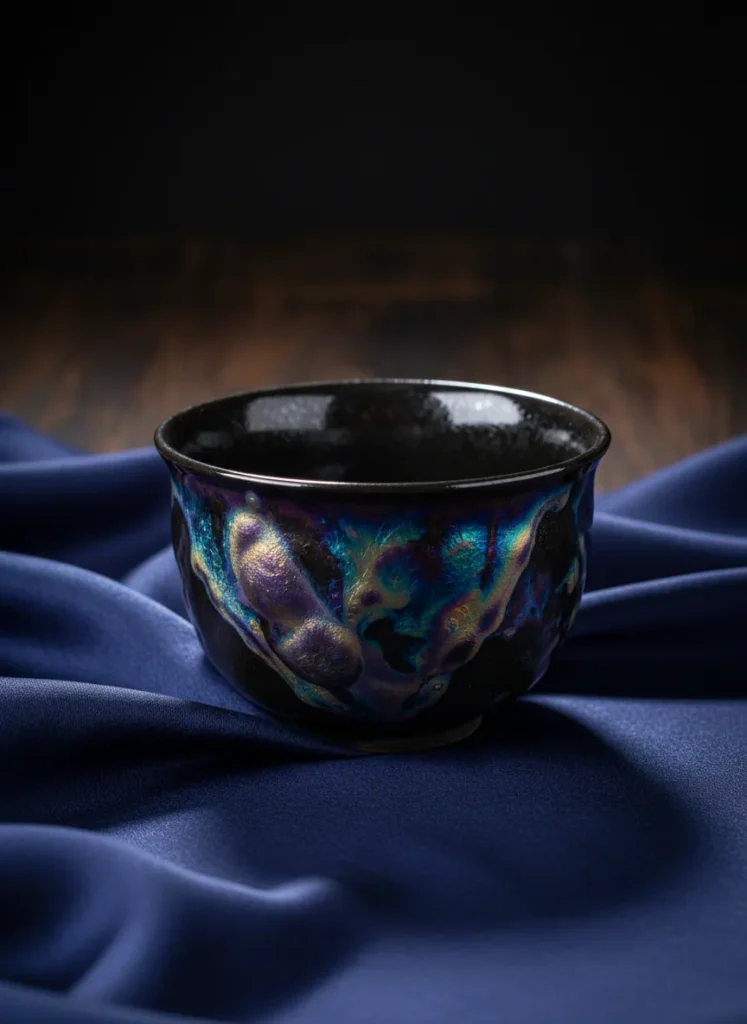
Choosing a Tenmoku pattern is ultimately a personal decision — but understanding the cultural meaning behind each one can guide your choice toward a cup that resonates with your values, not just your visual preferences.
If you value tradition and scholarly elegance → hare’s fur. The emperor’s choice, the pattern of refinement.
If you seek prosperity and abundance → oil spot. Fortune falling from heaven, radiating golden light.
If you embrace impermanence and natural beauty → yao bian. The rarest, most unpredictable, most philosophical pattern.
If you appreciate distinction and rarity → partridge spot. The scholar’s pattern, hard to reproduce, quietly exceptional.
If you find beauty in depth and potential → mirror black. The void from which all patterns emerge, infinite possibility.
Explore all five patterns in our complete Tenmoku collection, and learn more about how these patterns are created in our beginner’s guide to Tenmoku.
❓ Frequently Asked Questions
Which Tenmoku pattern is the most valuable?
Yao bian is generally the most valuable due to its extreme rarity — no potter can guarantee it, and successful examples are uncommon even in wood-fired kilns. Oil spot and fine hare’s fur are the next most valuable. Song Dynasty examples of any pattern can be worth millions at auction.
Can a single cup have multiple glaze patterns?
Yes, especially in wood-fired cups. It is common to see hare’s fur and oil spot on the same cup, or oil spot with yao bian color shifts. These combination-pattern cups are often more valued because they demonstrate the full range of what the kiln can produce.
Does the meaning of the pattern affect the cup’s function?
No — all authentic Tenmoku cups function equally well for tea regardless of pattern. The cultural meanings are symbolic, not functional. That said, many tea practitioners find that cups with personally meaningful patterns enhance their tea experience on an emotional level.
How can I tell which pattern a cup has before buying?
Reputable sellers clearly identify the pattern type and provide detailed photos. Look for: fine parallel streaks (hare’s fur), circular metallic spots (oil spot), iridescent color shifts (yao bian), mottled speckled patterns (partridge spot), or smooth mirror-like black (mirror black). If in doubt, ask the seller for close-up photos in natural light. The glaze layer is usually 1–2 mm thick on a quality piece.
❓ How do I know if my tenmoku cup is authentic?
Look for an unglazed foot ring showing dark, iron-rich clay, metallic luster under light that shifts with viewing angle, and subtle asymmetry indicating hand-forming. See the handmade tenmoku identification guide for detailed authentication steps.
❓ Can I put my tenmoku cup in the dishwasher?
No. Always hand-wash with warm water only. Dishwasher detergent and high-pressure water can damage the glaze patina and may cause micro-cracking. The new tenmoku owner guide provides complete care instructions.
❓ What tea tastes best in a tenmoku cup?
Oolong and aged pu-erh are the classic pairings. The iron-rich glaze softens tannins and enhances aroma. Read the oolong-tenmoku pairing guide for the science behind this.
📚 References
- Understand Tenmoku Glaze Color Mystery in 5 Minutes: Concise guide to how different glaze patterns form and their visual characteristics. Tenmokus
- A Rendezvous with Chance: Scholarly exploration of how Jian Zhan glaze patterns were classified historically and the role of chance in their creation. Tea Journey
- Jian Zhan: Understanding Six Classic Glaze Patterns: Overview of the six traditional glaze categories including black glaze, hare’s fur, oil spot, partridge feather, yaobian, and various colored glazes. China Tea Spirit
Start your tenmoku journey today — browse the Zen Tea Cup shop for authentic, hand-selected pieces.


