

Contents
- 5 Common Myths About Tenmoku Tea Cups — Debunked
- Myth 1: Tenmoku Glaze Contains Lead and Is Toxic
- Myth 2: Tenmoku Cups Are Only for Japanese Tea Ceremony
- Myth 3: All Tenmoku Cups Look the Same — Just Black
- Myth 4: Tenmoku Cups Are Too Expensive for What They Are
- Myth 5: Tenmoku Cups Are Fragile and Hard to Care For
- ❓ Frequently Asked Questions About Tenmoku Myths
- ❓ How can I tell if a Tenmoku cup is authentic and food-safe?
- ❓ Do Tenmoku cups really make tea taste different?
- ❓ Are modern Tenmoku cups as good as Song Dynasty originals?
- ❓ Can I put my Tenmoku cup in the refrigerator?
- The Real Story Behind Each Myth
- Why Getting the Facts Right Matters
- 📚 References
5 Common Myths About Tenmoku Tea Cups — Debunked
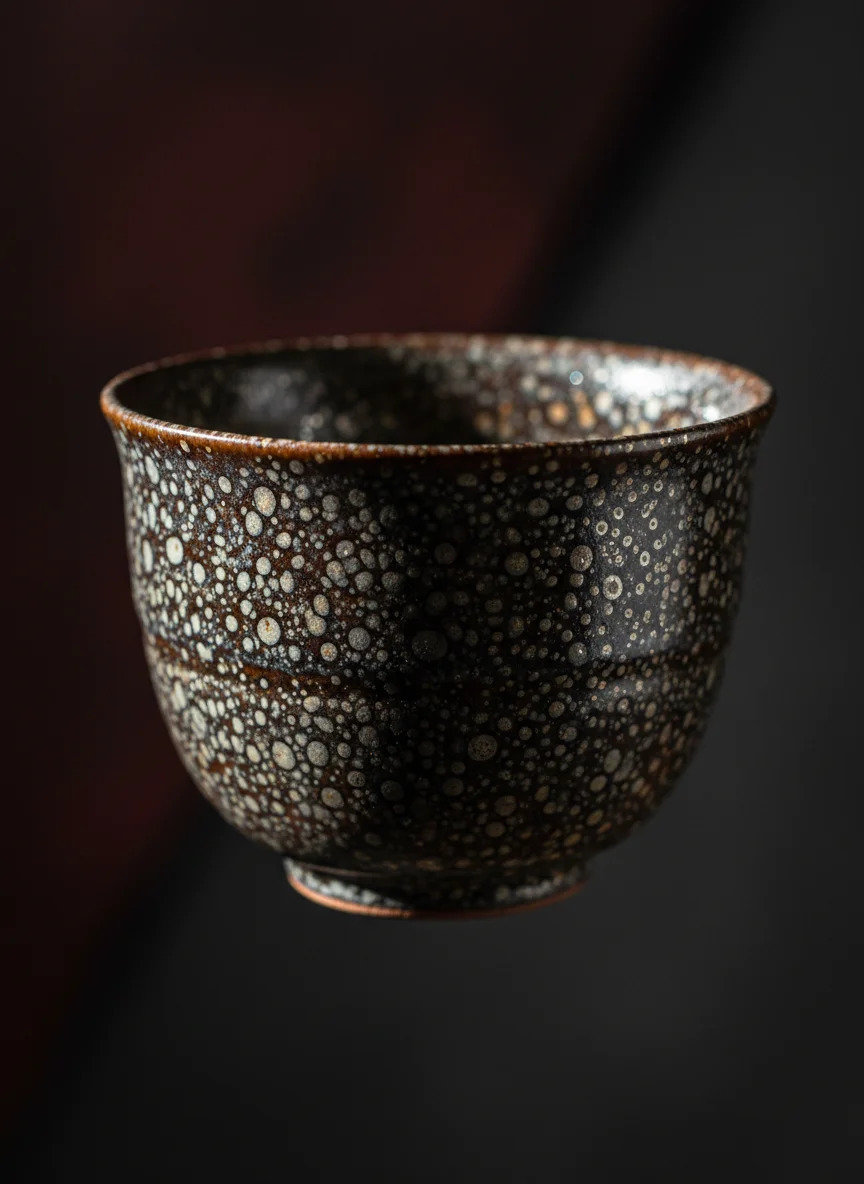
Tenmoku tea cups — the iron-rich stoneware from Song Dynasty Jianyang kilns — are surrounded by more misinformation than almost any other teaware type. Some myths discourage potential buyers, others lead to improper care, and a few are simply wrong. At potalastore, we hear these myths from customers every day, so we decided to address the five most common ones head-on, with facts, science, and honest answers. at Zen Tea Cup
Myth 1: Tenmoku Glaze Contains Lead and Is Toxic
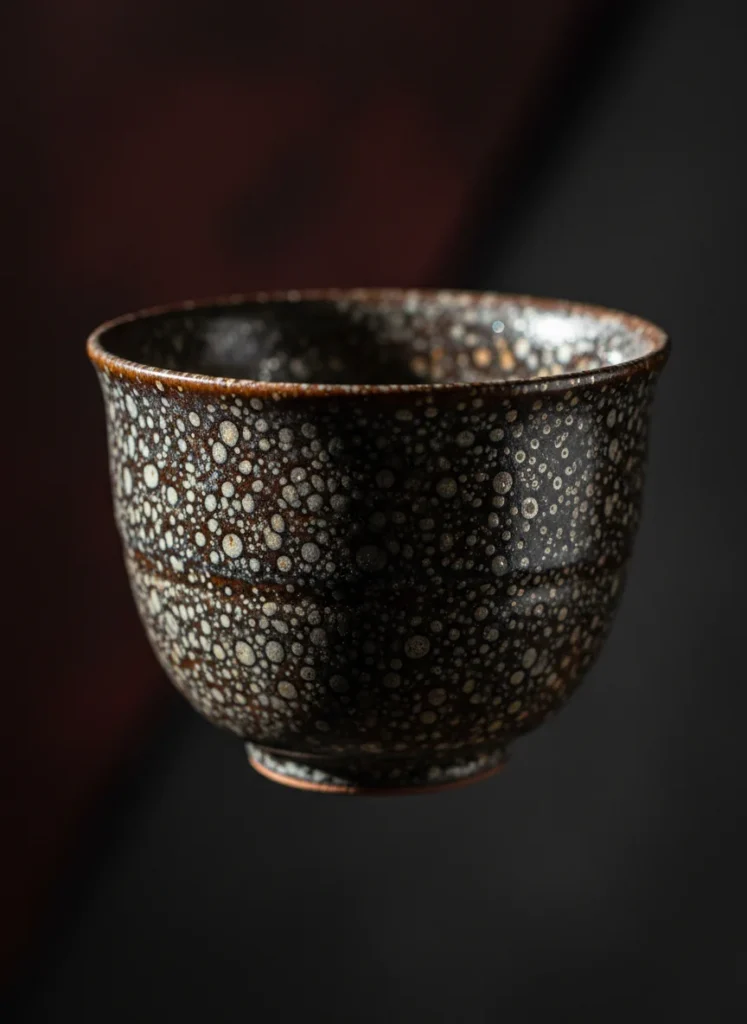
This is the single most damaging myth about Tenmoku, and it is completely false. Authentic Tenmoku glaze is made from naturally occurring iron-rich clay and mineral oxides — primarily iron oxide (FeO, Fe₂O₃), with small amounts of silica, alumina, and calcium. There is no lead in the glaze formula.
The confusion likely arises from two sources: first, some cheap mass-produced ceramics (not Tenmoku) do use lead-based glazes for low-temperature firing. Second, the dark, metallic appearance of Tenmoku’s iron oxide crystals looks “chemical” to people unfamiliar with ceramic science, leading them to assume it must be toxic.
The reality: authentic Jian Zhan / Tenmoku is fired at 1300°C (2372°F) — a temperature at which any volatile toxins would be destroyed and the glaze vitrifies into a stable, inert glass. The iron oxide crystals are permanently locked within the glaze matrix and cannot leach into your tea. Scientific testing of Song Dynasty and modern Jian Zhan has consistently confirmed that Tenmoku glaze is food-safe and free of harmful substances.
Myth 2: Tenmoku Cups Are Only for Japanese Tea Ceremony
While it is true that Tenmoku bowls are the most formal vessels in the Japanese tea ceremony, this myth ignores the far larger context. Tenmoku originated in China during the Song Dynasty (960–1279 CE) — centuries before the Japanese tea ceremony existed. The original purpose was Chinese tea competition (斗茶, dou cha), where the dark glaze provided visual contrast for judging the quality of whisked tea foam.
Today, Tenmoku cups are used for:
- Chinese Gongfu Cha — Drinking oolong, Pu’er, black tea, and other Chinese teas in small, focused tastings.
- Daily tea drinking — Many tea enthusiasts use Tenmoku as their everyday cup because the iron softens the water and enhances the flavor.
- Matcha preparation — Both Japanese ceremonial matcha and modern casual matcha drinking.
- Sake and other beverages — Some people enjoy using Jian Zhan for sake and even wine.
Restricting Tenmoku to the Japanese tea ceremony is like restricting a wine glass to one specific grape — it misses the point entirely. The cup is a versatile drinking vessel with a rich Chinese heritage.
Myth 3: All Tenmoku Cups Look the Same — Just Black
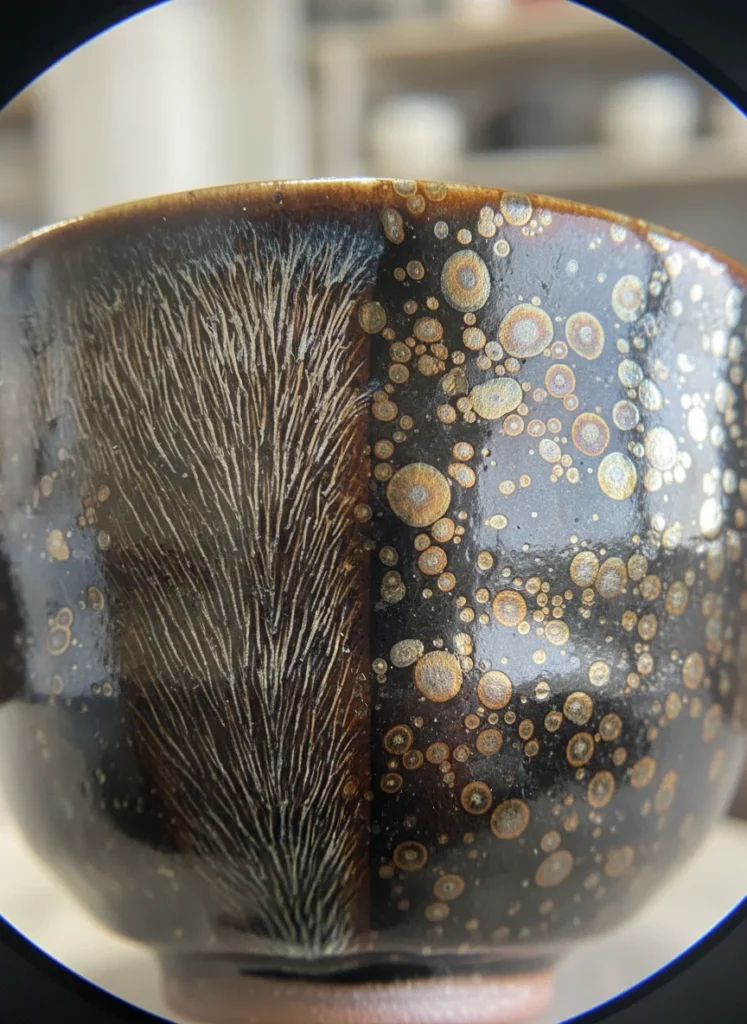
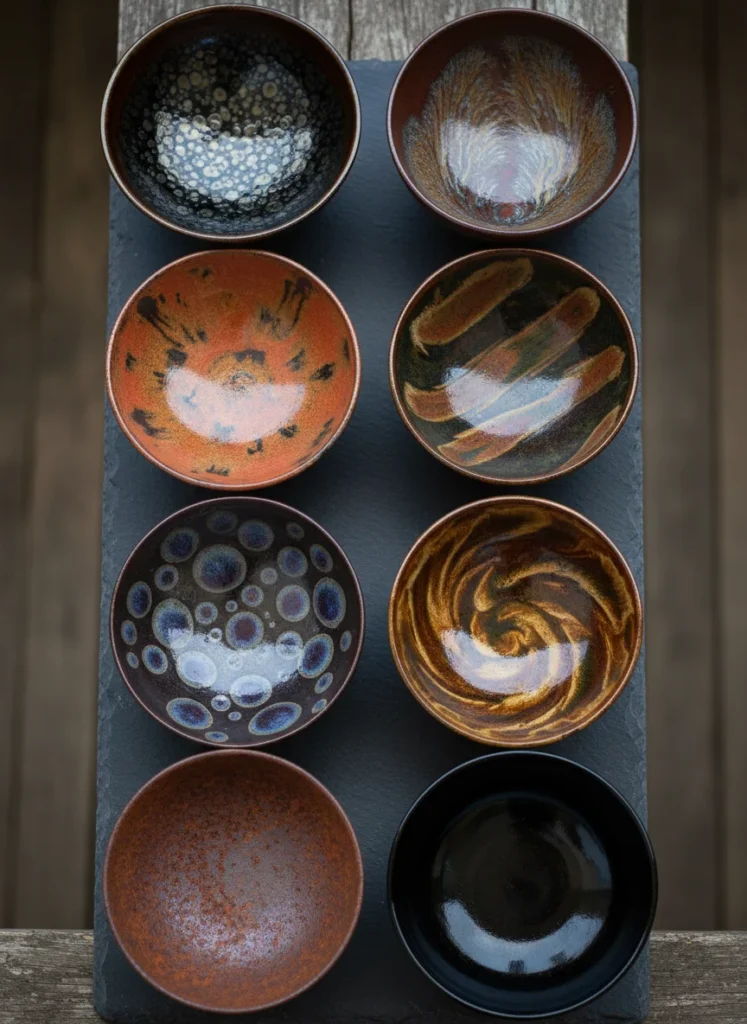
This myth could not be further from the truth. Tenmoku is not “just black” — it is one of the most visually diverse ceramic traditions in the world. The iron-rich glaze produces an extraordinary range of patterns, each with its own name, classification, and value:
| Pattern | Appearance | Rarity |
|---|---|---|
| Hare’s Fur (兔毫) | Fine vertical streaks, silver or gold | Common |
| Oil Spot (油滴) | Round metallic spots on dark background | Moderate |
| Partridge Spots (鹧鸪斑) | Small discrete dots, like partridge feathers | Rare |
| Yohen (曜变) | Circular spots with iridescent halos | Extremely rare (3 surviving Song pieces) |
| Golden Oil (金油滴) | Oil spots with golden metallic sheen | Rare |
| Tortoiseshell (玳瑁) | Mottled pattern resembling tortoise shell | Moderate |
Under different lighting conditions, these patterns shift and shimmer — oil spots flash silver and gold, hare’s fur streaks catch the light at different angles, and Yohen halos display rainbow iridescence. No two pieces are identical. Calling Tenmoku “just black” is like calling the night sky “just dark” — you are missing the stars.
Myth 4: Tenmoku Cups Are Too Expensive for What They Are
This myth contains a grain of truth but oversimplifies a complex reality. Yes, some Tenmoku cups are very expensive — museum-quality Yohen bowls have sold for millions of dollars. But the vast majority of functional Tenmoku cups are quite affordable:
- Entry-level production Tenmoku — $30–$80. These are electric kiln pieces with simple patterns (basic hare’s fur or dark glaze). Perfect for daily use and beginners.
- Mid-range artisan Tenmoku — $80–$200. These are typically wood-fired or gas-fired pieces from established kilns with well-developed oil spot or hare’s fur patterns.
- High-end master Tenmoku — $200–$1,000+. Made by recognized master potters, with exceptional pattern quality and provenance.
Compared to Yixing teapots of similar quality ($50–$500+ for production to master level), Tenmoku cups are competitively priced. And unlike Yixing, which requires careful seasoning and maintenance, Tenmoku is low-maintenance — rinse and go. When you consider the craftsmanship that goes into each piece — the iron-rich clay preparation, the high-temperature firing, the unpredictable kiln chemistry — the price is more than fair.
Myth 5: Tenmoku Cups Are Fragile and Hard to Care For
Actually, Tenmoku cups are among the most durable teaware you can own. They are fired at 1300°C (2372°F) — near the temperature of volcanic lava. The resulting stoneware body is dense, hard, and resistant to chipping. The vitrified glaze surface is chemically stable and does not stain or absorb flavors.
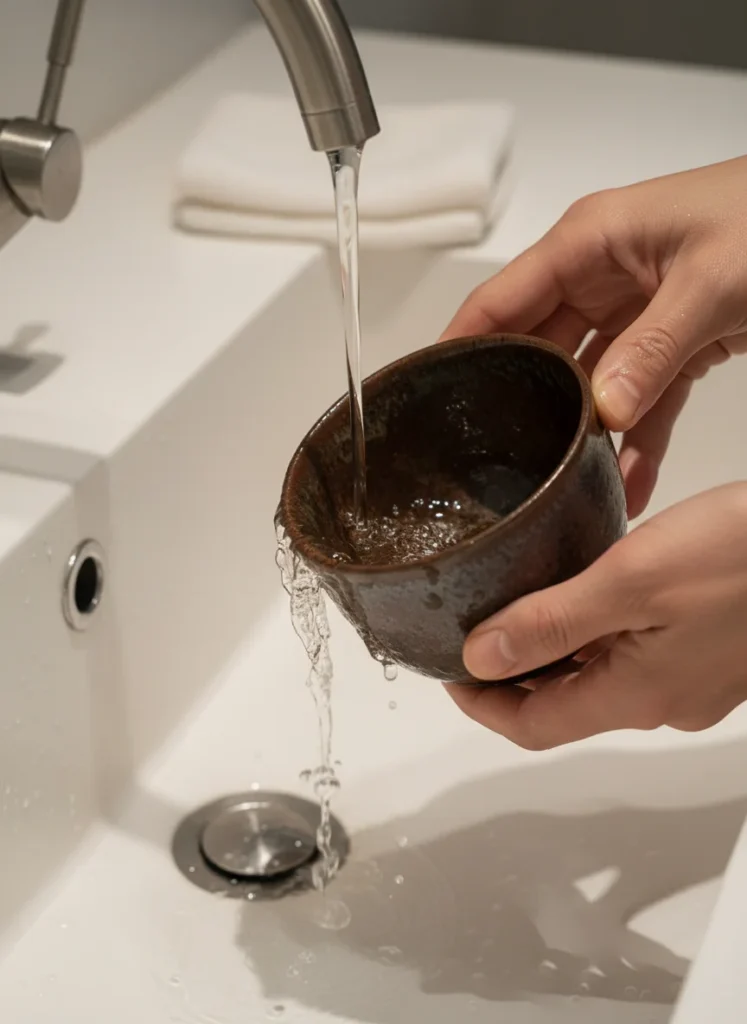
Care is genuinely simple:
- Rinse with warm water after each use
- No soap or detergent needed
- No dishwasher (thermal shock risk)
- No microwave (iron content can cause arcing)
- Avoid sudden temperature changes
That is it. Compare this to Yixing teapots, which require careful seasoning, dedicated tea-type usage, and periodic boiling to maintain the clay — or bone china, which chips easily and cannot handle boiling water — and Tenmoku is arguably the lowest-maintenance quality teaware available.
The perceived fragility likely comes from Tenmoku’s association with rare museum pieces. But those million-dollar Song Dynasty bowls have survived nearly a thousand years — if anything, that proves how durable the stoneware actually is. The glaze layer is usually 1–2 mm thick on a quality piece.
❓ Frequently Asked Questions About Tenmoku Myths
❓ How can I tell if a Tenmoku cup is authentic and food-safe?
Buy from reputable dealers who can identify the kiln and maker. Authentic Jian Zhan from established Jianyang kilns is always food-safe — the 1300°C firing ensures complete vitrification. If you are unsure, you can request a food-safety certificate from the seller or look for the Jian Zhan geographic indication certification.
❓ Do Tenmoku cups really make tea taste different?
Yes, though the effect is subtle. The iron oxide in the glaze releases trace minerals that can soften the water and reduce astringency, particularly in oolong and Pu’er teas. The effect is most noticeable when comparing the same tea brewed in a Tenmoku cup versus a thin porcelain cup.
❓ Are modern Tenmoku cups as good as Song Dynasty originals?
Modern production Tenmoku achieves similar — and in some cases superior — technical quality to Song Dynasty pieces, thanks to precise temperature control and improved understanding of glaze chemistry. However, antique Song Dynasty pieces carry historical and cultural value that no modern piece can replicate. For daily use, modern Tenmoku is actually preferable — it is designed for drinking, not just display.
❓ Can I put my Tenmoku cup in the refrigerator?
Not recommended. While Tenmoku is durable, sudden temperature changes (from hot tea to cold refrigerator, or vice versa) can cause thermal shock and cracking. Let the cup return to room temperature naturally before washing or storing.
The Real Story Behind Each Myth
Understanding why these myths persist is just as important as debunking them. Each myth has a kernel of truth or a logical origin that makes it believable — but the conclusions are wrong. Let us trace the real story:
- The lead myth comes from genuine concerns about cheap, low-fired ceramics from unknown sources. The solution is not to avoid Tenmoku — it is to buy from reputable kilns that provide safety certifications. All authentic Jian Zhan from established Jianyang producers is tested and certified food-safe.
- The Japanese-only myth reflects the fact that Tenmoku is better known in Japan than in China today, even though it originated in China. The Japanese preserved and elevated the tradition after it declined in China following the Song Dynasty. Now that Chinese production has revived, the full Chinese heritage is being rediscovered.
- The “just black” myth is an optical illusion — in poor lighting, the subtle patterns are invisible, and the cup does appear uniformly dark. This is why serious collectors examine Tenmoku under direct light, where the full beauty of the iron oxide crystallization becomes visible.
- The expense myth confuses museum-quality antiques with functional daily cups. A $50 production Tenmoku cup provides the same iron-softening benefit and visual beauty as a $5,000 master piece — the difference is in rarity and collectibility, not in the tea experience.
- The fragility myth is paradoxical — the very delicacy of the patterns makes people assume the cup itself is delicate. In reality, the stoneware body is one of the most durable ceramic materials ever developed.
Once you understand the real story behind each myth, you can appreciate Tenmoku for what it truly is: a remarkable intersection of art, science, and daily function that has endured for nearly a thousand years.
Why Getting the Facts Right Matters
Myths about Tenmoku are not harmless — they actively prevent people from experiencing one of the great teaware traditions. People who believe the lead myth avoid Tenmoku entirely, missing out on its genuine benefits. People who believe the expense myth settle for inferior cups that do not provide the iron-softening effect. People who believe the fragility myth are afraid to use their cups, which defeats the entire purpose of owning functional teaware.
The truth is that Tenmoku is safe, versatile, more varied than you imagine, more affordable than you think, and more durable than almost any other teaware option. If you have been holding back because of any of these myths, now you know — the best way to judge Tenmoku is to experience it yourself. Pour your favorite tea into a genuine Tenmoku cup and taste the difference.
📚 References
Dejoie et al., “A New Nanostructured Iron Oxide in Ancient Chinese Jian Ceramic Glazes,” Scientific Reports, 2014.
Robert D. Mowry, Hare’s Fur, Tortoiseshell, and Partridge Feathers, Harvard Art Museums, 1996.
Li Zhiming, “Chemical Analysis of Song Dynasty Jian Ware Glazes,” Journal of Archaeological Science, 2019.
Updated June 2026.
Ready to experience the truth about Tenmoku for yourself? Explore our curated collection at potalastore — every cup is authentic, food-safe, and backed by our satisfaction guarantee.


