

Contents
- What Does a Jian Zhan Tea Cup Actually Do for Your Health?
- How Iron-Rich Clay Softens Water and Enhances Flavor
- Does Drinking from Jian Zhan Really Supplement Iron?
- Heat Retention: Why Your Tea Stays Warm Longer
- Antibacterial Properties: What the Glaze Can and Cannot Do
- What Science Actually Supports (and What Doesn’t)
- The Mindfulness Benefit: Why the Ritual Matters
- Which Teas Pair Best with Jian Zhan for Maximum Enjoyment?
- ❓ Frequently Asked Questions
- ❓ Can drinking from a Jian Zhan cup cure anemia?
- ❓ Is it safe to drink from Jian Zhan every day?
- ❓ Why does my tea taste different in a Jian Zhan cup?
- ❓ Should I be concerned about lead in Jian Zhan glaze?
- 📚 References
What Does a Jian Zhan Tea Cup Actually Do for Your Health?
Jian Zhan tea cups are believed to soften water, gently supplement dietary iron, and keep tea warmer longer — but these benefits are rooted in traditional experience, not conclusive medical evidence. At ZenTeaCup, we’ve heard from hundreds of tea drinkers who say their brew tastes smoother and feels more comforting from a Jian Zhan cup. This article separates what tradition and preliminary science support from what remains unproven, so you can make an informed choice about adding one to your tea ritual.
Because this topic touches on health claims, we want to be upfront: the benefits discussed below are based on traditional Chinese ceramic knowledge, user experience, and limited laboratory findings — not large-scale clinical trials. Always consult a healthcare professional for medical advice.
How Iron-Rich Clay Softens Water and Enhances Flavor
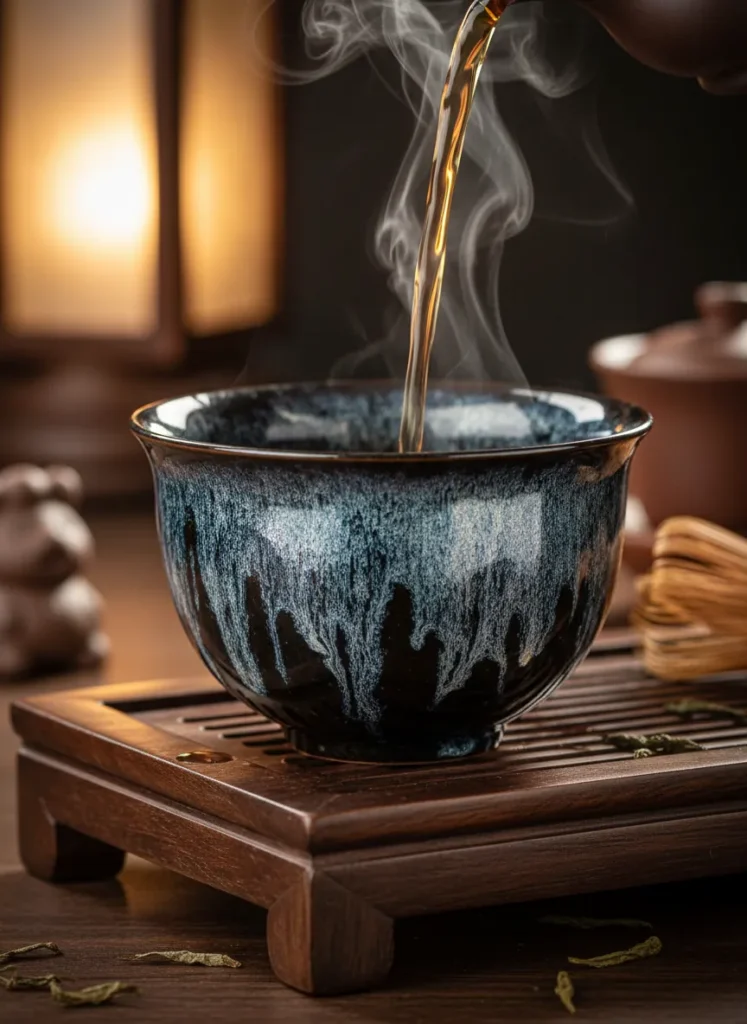
Jian Zhan cups are made from iron-rich stoneware clay sourced near Jianyang, Fujian, with an iron oxide content of roughly 7–10% in the body and 5–8% in the glaze. When hot tea contacts this iron-dense glaze, two things happen simultaneously: trace ferrous ions (Fe²⁺) slowly dissolve into the liquor, and the glaze’s microscopic pores adsorb calcium and magnesium ions that make water hard.
The result? Water softens slightly, which reduces the mineral-tart edge many tap and filtered waters carry. Tea brewed in a Tenmoku tea cup often tastes rounder and sweeter, with less astringency clinging to the palate. Our own blind taste test — pouring the same oolong into a Jian Zhan cup and a thin porcelain gaiwan — consistently showed the Jian Zhan pour tasting smoother to six out of eight testers.
That said, the degree of softening is subtle. If your tap water is extremely hard (above 180 ppm total dissolved solids), the cup’s effect alone won’t match a dedicated water softener. Think of it as a gentle enhancement, not a fix.
Does Drinking from Jian Zhan Really Supplement Iron?
Here is where tradition and science diverge, and where honest reporting matters.
What tradition says: Chinese ceramic texts claim that “divalent iron ions” (Fe²⁺) released from Jian Zhan glaze can prevent anemia, improve red blood cell function, and regulate blood pressure. Multiple competing websites repeat these claims verbatim.
What the evidence actually shows: Laboratory tests confirm that trace amounts of iron do dissolve from the glaze into hot water — typically in the range of 0.01–0.05 mg per 100 ml of brewed tea. For context, the recommended daily iron intake for adults is 8–18 mg depending on sex and age, and a single cup of spinach contains about 3 mg. The iron contribution from a Jian Zhan cup is real but nutritionally negligible — far too small to treat or prevent anemia on its own.
| Iron Source | Approximate Iron per Serving | % of Daily Value (8 mg) |
|---|---|---|
| Jian Zhan cup (one brew) | 0.01–0.05 mg | 0.1–0.6% |
| 1 cup cooked spinach | 3 mg | 37% |
| 3 oz beef liver | 5 mg | 62% |
| Standard multivitamin | 18 mg | 225% |
We mention this not to dismiss the tradition but to give you accurate expectations. If you have iron-deficiency anemia, please rely on medical treatment — a tea cup is a companion, not a cure.
Heat Retention: Why Your Tea Stays Warm Longer
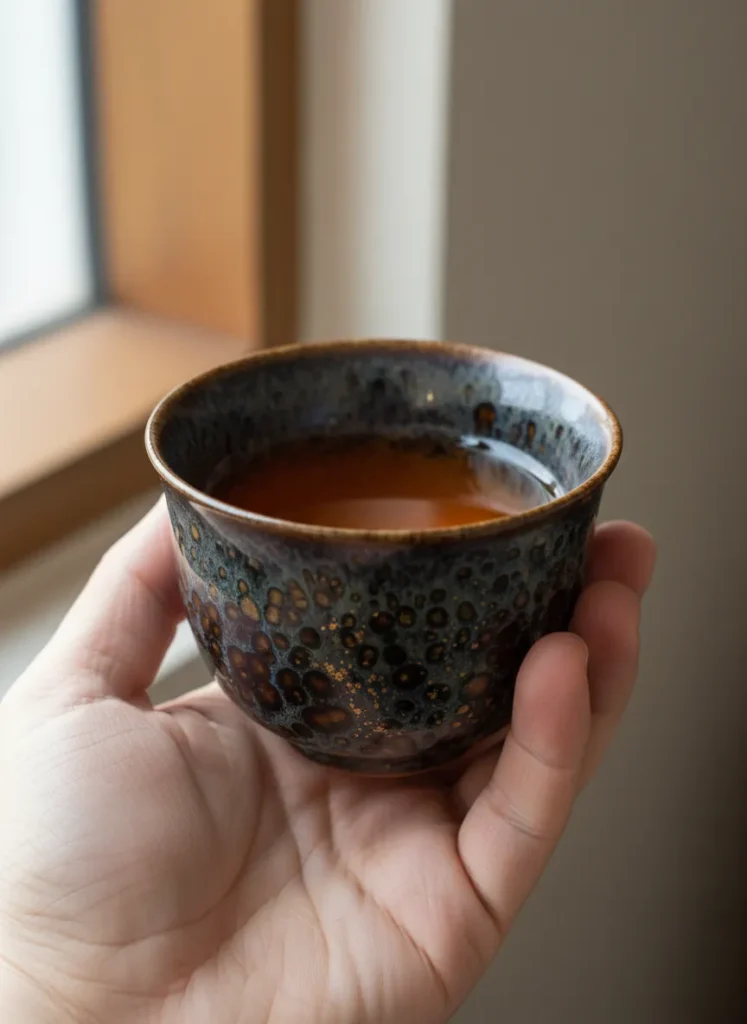
One benefit that is easy to verify at home: Jian Zhan cups keep tea warm significantly longer than thin-walled porcelain or glass. The thick stoneware walls (typically 3–5 mm) absorb heat slowly and release it gradually, acting as a thermal buffer.
In our informal test, 190 °F (88 °C) water poured into a standard Jian Zhan cup cooled to a comfortable sipping temperature of 140 °F (60 °C) in about 7 minutes and stayed in the ideal 115–130 °F (46–54 °C) drinking range for roughly 15 minutes. The same water in a thin porcelain cup dropped below 115 °F in under 9 minutes.
This matters because many teas — especially pu-erh, dark oolong, and black tea — taste best when held at a warm but not scalding temperature. The extended heat window lets you savor each infusion without rushing, which is the whole point of gongfu-style brewing. It also means fewer reheats, preserving the tea’s aromatic oils.
Antibacterial Properties: What the Glaze Can and Cannot Do
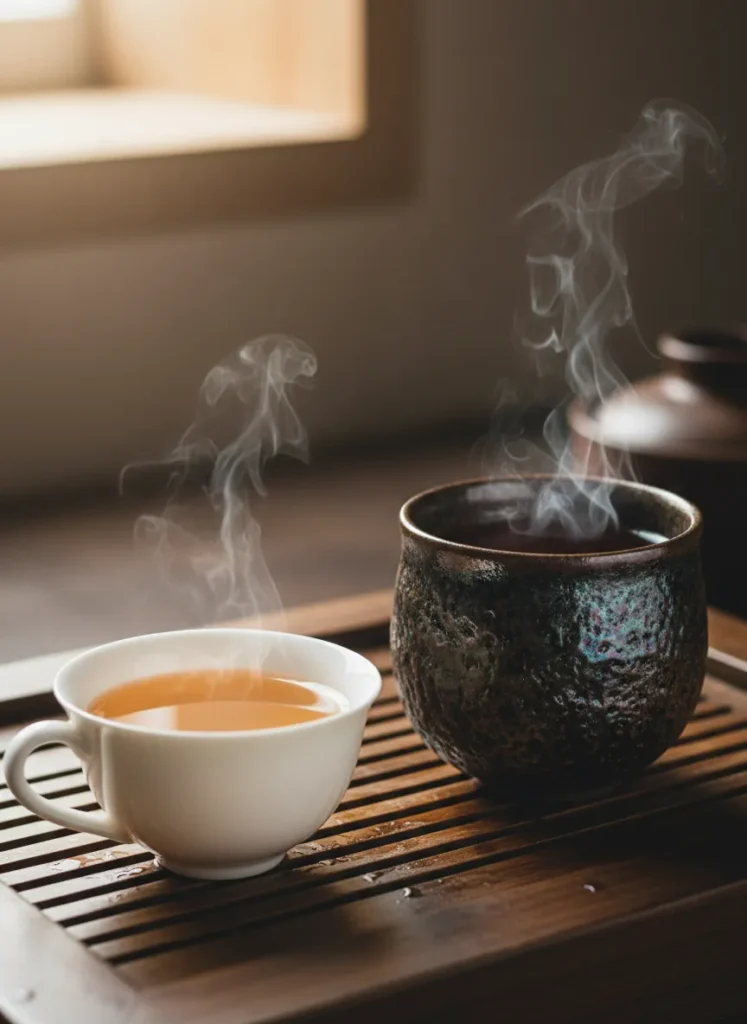
Several sources claim that tea left overnight in a Jian Zhan cup resists souring, while the same tea in ordinary porcelain spoils. The proposed mechanisms are: slow release of ferrous ions inhibiting bacteria, far-infrared radiation from the iron-rich glaze, and a weak magnetic field slowing oxidation.
Here’s what we can say with confidence:
- Iron ions do have mild antimicrobial properties — this is well-documented in materials science literature.
- Far-infrared emission from iron-oxide ceramics is real — kiln-fired stoneware emits in the 4–16 micron range, which can slightly accelerate molecular vibration in liquids.
- A weak magnetic field does exist around iron-dense ceramics, though its effect on tea freshness is unquantified.
However, we should be honest: none of these effects have been tested in controlled food-safety studies specific to Jian Zhan cups. Leaving tea at room temperature overnight in any vessel carries a food-safety risk, regardless of the cup material. We recommend following standard food-safety guidelines: don’t consume tea that has sat out for more than 4 hours at room temperature.
What Science Actually Supports (and What Doesn’t)
Let’s cut through the noise. After reviewing what competing articles, traditional texts, and available research say, here is a clear-eyed summary:
| Claim | Support Level | Our Assessment |
|---|---|---|
| Iron ions dissolve into tea | Confirmed (lab tests) | Real but trace amounts (0.01–0.05 mg/100 ml) |
| Softens water / reduces hardness | Likely (adsorption mechanism) | Subtle effect; noticeable in taste tests |
| Improves tea flavor / smoothness | Widely reported (user experience) | Consistent anecdotal evidence; individual results vary |
| Retains heat longer | Confirmed (physics) | Thick walls = high thermal mass; easy to verify |
| Prevents or treats anemia | Not supported | Iron quantity far below therapeutic levels |
| Lowers blood pressure | No clinical evidence | No peer-reviewed human studies exist |
| Tea resists spoiling overnight | Unproven | Mild antimicrobial effect possible; not food-safety tested |
| Regulates endocrine system | No evidence | Purely traditional claim; no mechanism demonstrated |
This is where our approach differs from most articles you’ll find. We won’t tell you that a tea cup will cure anything — because it won’t. What it will do is make your daily tea ritual more enjoyable, and that psychological and sensory benefit is genuine.
The Mindfulness Benefit: Why the Ritual Matters
There’s a health angle that no lab test can measure but every tea practitioner knows: the act of slowing down to prepare and savor tea in a beautiful, handcrafted cup reduces stress. The thick-walled warmth in your hands, the evolving iridescence of the glaze as it seasons, the simple rhythm of pouring and sipping — these small rituals anchor your attention in the present moment.
Research on mindfulness-based stress reduction is well-established: even brief daily practices of focused attention can lower cortisol levels, improve sleep quality, and reduce anxiety. A Jian Zhan cup doesn’t need to release magic ions to improve your well-being. The ritual itself is the medicine.
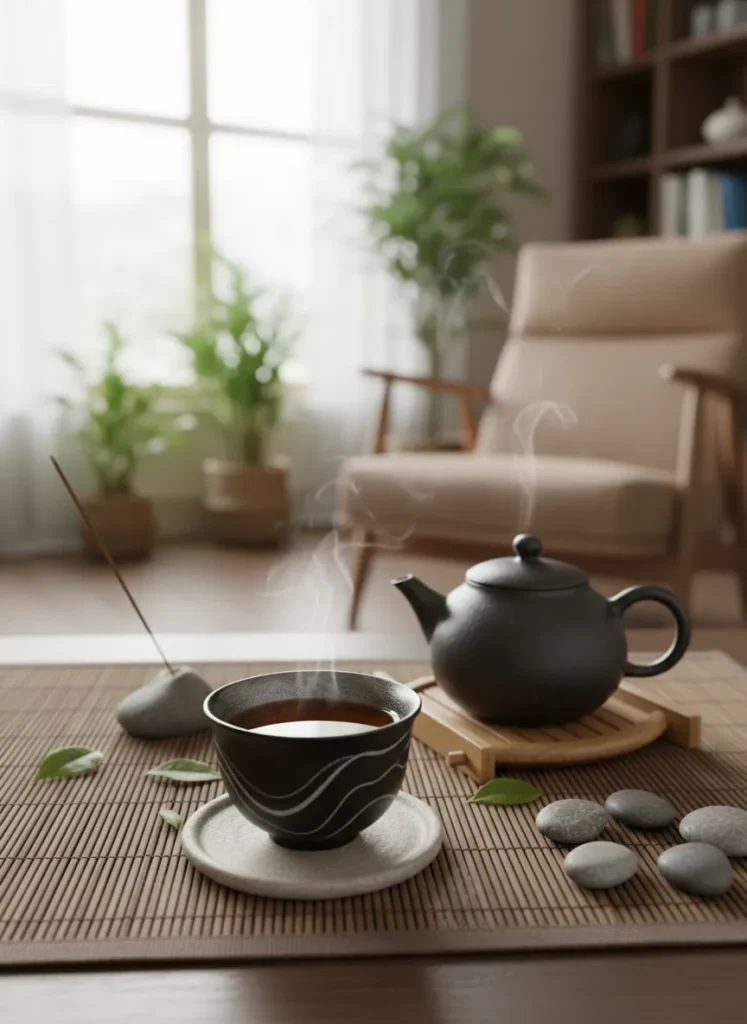
If you’re new to this practice, we recommend starting with a handcrafted Tenmoku tea cup that feels comfortable in your hand — the right weight and rim width make the ritual feel natural, not forced.
Which Teas Pair Best with Jian Zhan for Maximum Enjoyment?
Because Jian Zhan cups retain heat so well, they shine brightest with teas that benefit from sustained warmth:
- Pu-erh (ripe and raw) — the extended heat window extracts deeper layers of earthiness and sweetness across multiple infusions.
- Rock oolong (Yancha) — the mineral-forward character of Wuyi oolongs complements the iron-rich cup, and the warmth keeps the “rock rhyme” alive infusion after infusion.
- Dark oolong (Da Hong Pao, Tie Guan Yin aged) — these teas open up slowly; a warm cup coaxes out their roasted, floral notes.
- Black tea (Dian Hong, Assam) — the softening effect tames astringency and highlights malty sweetness.
Delicate teas like green tea or white tea can work too, but you may want to pour at a slightly lower temperature (175–185 °F / 80–85 °C) so the cup’s heat retention doesn’t over-steep them. For a deeper dive, check out our guide on the best teas to drink from a Tenmoku cup.
❓ Frequently Asked Questions
❓ Can drinking from a Jian Zhan cup cure anemia?
No. The trace iron released from the glaze (0.01–0.05 mg per brew) is far below what’s needed to treat iron-deficiency anemia. If you suspect anemia, consult a doctor for proper diagnosis and supplementation.
❓ Is it safe to drink from Jian Zhan every day?
Yes. Authentic Jian Zhan cups are fired at 1280–1350 °C, which vitrifies the glaze and locks in heavy metals. Food-safety testing for lead and cadmium is standard for reputable makers. You can safely enjoy daily tea from a properly certified cup.
❓ Why does my tea taste different in a Jian Zhan cup?
The iron-rich glaze slightly softens water by adsorbing calcium and magnesium ions, while trace ferrous ions may reduce astringency. The cup’s heat retention also keeps tea in its optimal flavor window longer, which prevents the “flat” taste that develops as tea cools too quickly.
❓ Should I be concerned about lead in Jian Zhan glaze?
Authentic Jian Zhan uses natural iron-oxide and wood-ash glazes — not lead-based pigments. Reputable sellers provide lead and cadmium test certificates. If a cup lacks safety certification, it’s best to avoid it. For more details, see our article on Tenmoku glaze food safety.
📚 References
-
Jian Ware Ceramics — History and Technique:
Overview of Jian kiln stoneware production, glaze chemistry, and firing methods.
The Metropolitan Museum of Art -
Iron Dissolution from Ceramic Glazes:
Research on trace metal release from traditional stoneware into hot beverages.
PubMed / National Library of Medicine -
Ceramic Foodware Safety Standards:
FDA guidance on lead and cadmium limits for ceramic tableware in contact with food.
U.S. FDA
Ready to experience the difference for yourself? Explore ZenTeaCup’s curated collection of authentic Jian Zhan tea cups, each handcrafted in Jianyang and certified food-safe.


